Note: This website was automatically translated, so some terms or nuances may not be completely accurate.
 The Psychology of Modern Consumers Revealed Through the Synergy of Mail-Order Advertising and Psychology [7/7]
Discovery! A super simple method to double the desire to buy.
A unique project team combining mail-order advertising and psychology spent three years analyzing mail-order advertising data. We'll introduce topics from the results compiled in " The 7 Laws of Selling Ads " (Kobunsha Shinsho) in this 7-part series.
This series is finally reaching its conclusion. So this time, I want to share a special secret strategy that anyone can immediately put into practice and that doubles the desire to buy!
I know, that intro sounds a bit fishy. Honestly, if someone suddenly claims to have a "secret strategy to double your desire to buy," most people would think, "There's no way such a convenient method exists," or "Even if it does, it's probably some useless, non-universal trick."
But this isn't a lie. After thoroughly analyzing accumulated mail-order advertising data, I discovered a simple method that definitely works and anyone can implement.
That method is simply repeating your sales pitch three times. That's all.
The data clearly shows the effectiveness of "repeating three times."
Truth be told, long before we started digging through all this data decades ago, the idea that "repeating something three times" is effective for boosting purchasing intent was already an established principle in the direct mail industry. You've probably seen it too – most TV shopping programs are structured around repeating the same story three times.
Technically, this repetition unit is called a "roll," and the three-roll format—where three rolls are repeated—is considered the absolute foundation of TV shopping. Of course, the reason for this is simply that this approach sells the most.
Amidst this, our challenge this time was to verify whether this "conventional wisdom" is truly correct. Specifically, we conducted an experiment where we had monitors view footage of a three-roll format TV shopping program online and measured their reactions.
The experiment involved participants watching the footage while pressing three buttons in real-time: "Like," "Dislike," and "Want to Buy." The results are shown in the following diagram.
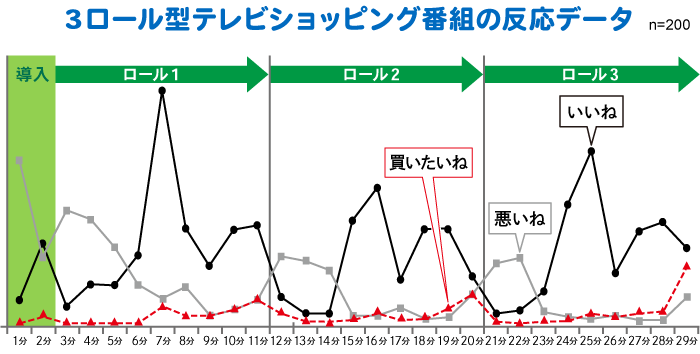
The dividing lines in the chart mark the transitions between segments. Examining each segment reveals a consistent pattern: "Bad" (gray solid line) rises first, followed by "Good" (black solid line), and finally "Want to buy" (red dotted line) peaks. This reflects the psychological flow created by the classic TV shopping story: first gaining negative empathy at the beginning, then introducing the product to build positive feelings, and finally communicating the price to prompt a purchase decision (this point was covered in detail in a previous series, so please take a look).
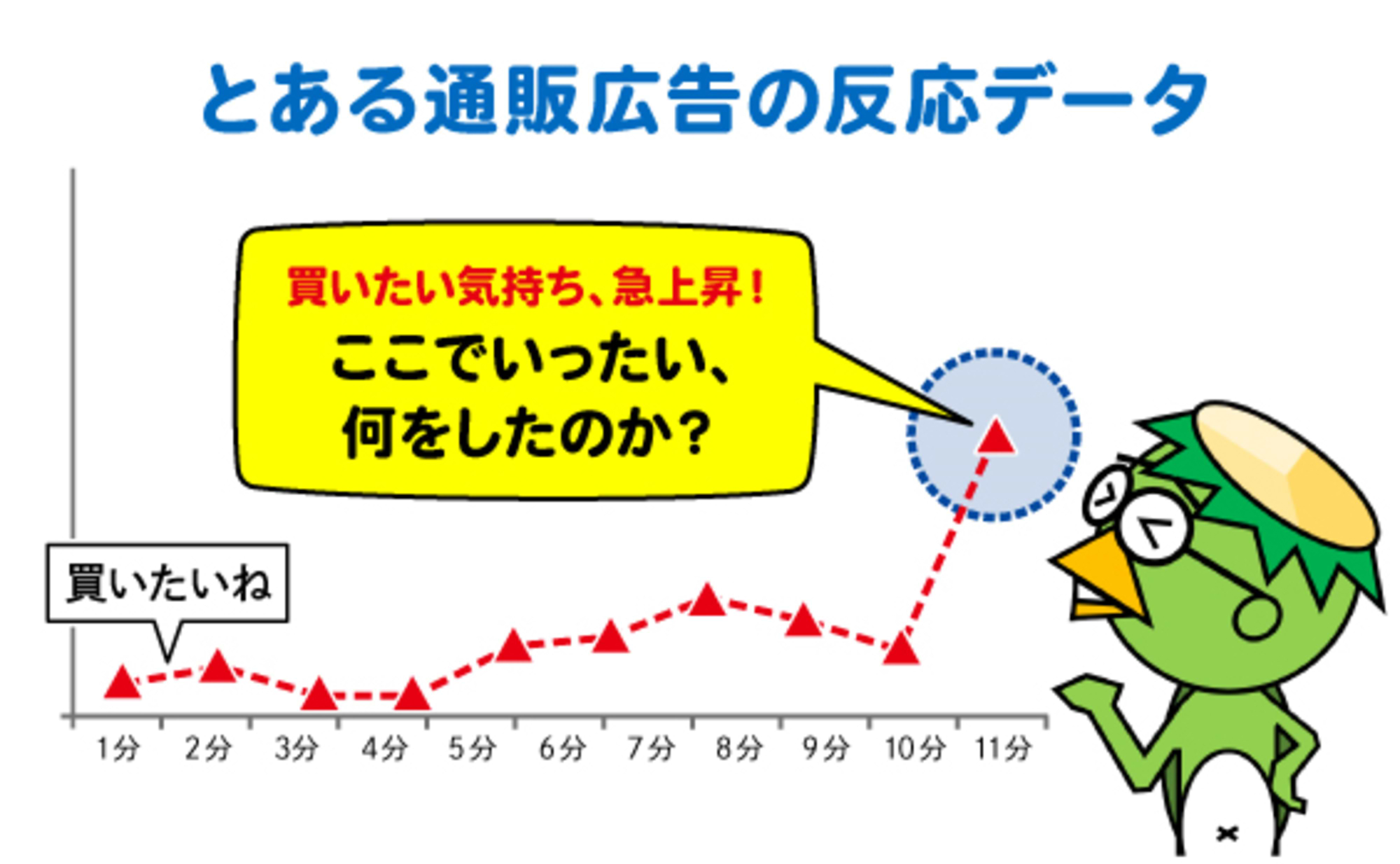
Now, pay close attention to the changes when the same story's roles are repeated three times, especially the shift in "Want to Buy." To make it clearer, take a look at the following chart, which isolates only the "Want to Buy" reactions.
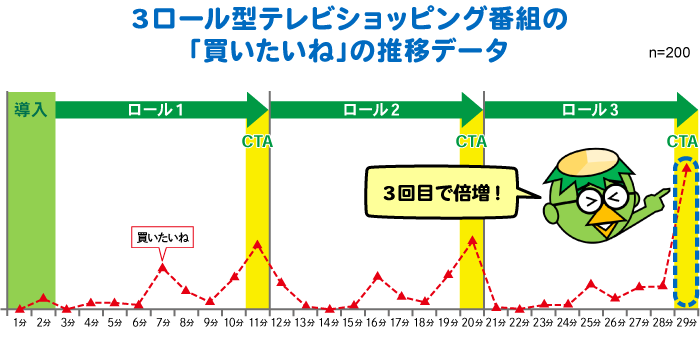
As mentioned earlier, "I want to buy it" increases at the end of each role, specifically during the "Call To Action" (CTA) where the price is revealed. Examining the change in this metric across the roles, we see it rises slightly from Role 1 to Role 2, then doubles in height by the final Role 3. Considering that the "I want to buy" button is pressed when someone feels like buying, this result clearly shows that repeating the process three times doubled the desire to purchase.
This phenomenon isn't limited to TV shopping.
In fact, the effect of boosting purchase intent through three repetitions is frequently observed in mail-order advertisements beyond TV shopping.
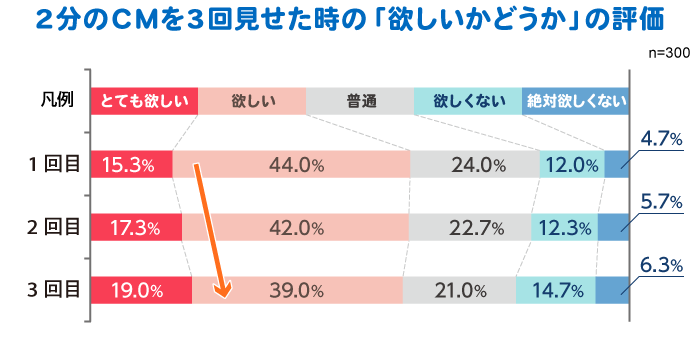
The figure above shows the results of asking monitors whether they wanted the product after viewing a 2-minute mail-order commercial, or infomercial, three times consecutively. While the data didn't show a doubling effect in this experiment, it did confirm that "repeating three times increases the number of people who want the product."
Furthermore, when asking callers placing orders at mail-order call centers "How many times did you see the ad before calling?", most people respond "About three times."
Considering these phenomena, it's safe to say that "repeating something three times increases the desire to buy" is a verifiable fact.
The reason why repeating something three times increases the desire to buy.
But why does simply repeating the same information three times increase the desire to buy?
The reason, in a word, is the "rumination effect." Modern consumers' desire to buy isn't completed after a single exposure to information; rather, it is reinforced and finalized through multiple exposures.
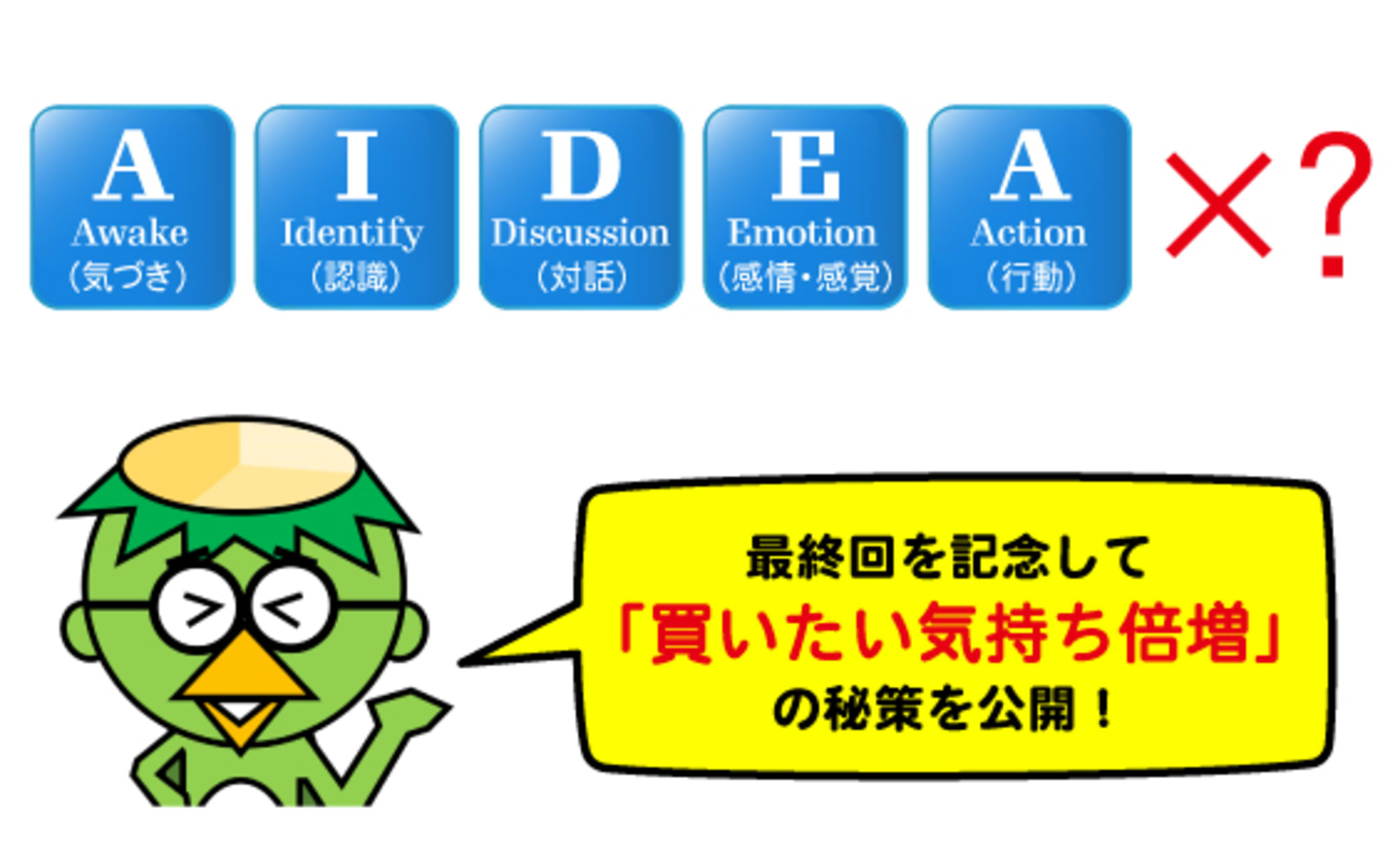
This is modeled in our proposed purchasing psychology model, "A·I·D·E·A (×3)."
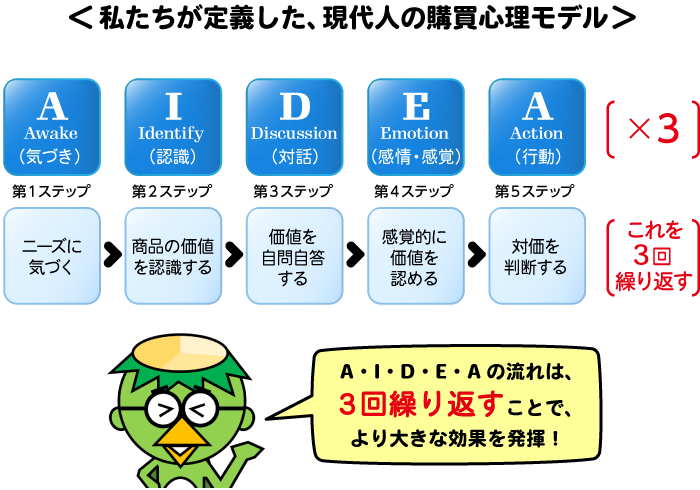
As you can see, the fundamental psychological shift toward purchase follows a flow from Step 1 "A" to Step 5 "A". Crucially, this sequence of psychological shifts must be repeated three times. The "×3" appended at the end signifies precisely this.
Modern shoppers navigating a world overflowing with products and information rarely act immediately upon developing a desire to buy after a single encounter with information. Rather, they place the product on the table for consideration after the initial exposure, then compare it with competing products through several rounds of deliberation. Only after reaching full satisfaction do they finally resolve to buy. In other words, the reason multiple exposures to the same information are effective is that this approach creates opportunities for effective rumination, fostering conviction.
This is precisely the modern consumer psychology behind the saying, "Repeating your sales pitch three times doubles your sales." In an era overflowing with goods and information, getting someone to buy after just one sales pitch is difficult. That's where repeating your sales pitch three times comes in – it effectively creates multiple opportunities for consideration and helps the customer become convinced of the need to buy.
For those who find this convincing, I highly recommend putting it into practice.
Reflections as this series concludes.
Well, this column, which I've had the privilege of writing for about four months, has now reached its final installment, thanks to your support. Looking back to the first installment, I can't help but be astonished at how completely the world has transformed in such a short time.
Amidst these changes, non-face-to-face business models have gained increased attention. Direct marketing, the focus of this series, falls squarely within this category.
Moving forward, to minimize economic stagnation and adapt to new lifestyles, it is essential to make non-face-to-face business even more effective and elevate it into a mutually beneficial model for both businesses and consumers. As someone with long experience in non-face-to-face business, I wrote each article with the hope that sharing my know-how, however modestly, might contribute to society's future.
As we reach the final installment, revisiting the essence of direct marketing distills to two key points. First, "whether non-face-to-face or face-to-face, the psychological transformation driving people to buy goods remains fundamentally unchanged." Second, "that said, there are unique points specific to non-face-to-face interactions when it comes to moving people's hearts." In other words, to put it differently, non-face-to-face business that leverages the essence cultivated in face-to-face interactions is entirely possible, provided the correct application methods are used. I would be truly delighted if this column could offer hints for such application methods.
This concludes the seven-part series. Thank you to everyone who read along. The concepts discussed in this column are explained in greater detail in my book, The Seven Laws of Effective Advertising (Kobunsha Shinsho). I would be honored if you would consider picking up a copy.
Was this article helpful?
Share this article


Newsletter registration is here
We select and publish important news every day
For inquiries about this article
Back Numbers
Author

Katsuyuki Kazuki
Dentsu Kyushu Inc.
Communication Design Bureau Direct Marketing Department