Note: This website was automatically translated, so some terms or nuances may not be completely accurate.
 The Psychology of Modern Consumers Revealed Through the Synergy of Mail-Order Advertising and Psychology [6/7]
Those who don't know this will inevitably fail—it's essential for selling online.
A unique project team combining mail-order advertising and psychology spent three years analyzing mail-order advertising data. We present topics from the results, compiled in 'The 7 Laws of Selling Ads ' (Kobunsha Shinsho), in a 7-part series.
Lately, I often get asked, "I want to start a new e-commerce business. What should I be careful about?" My standard answer is always, "You should definitely communicate ○○ without hesitation." Most people react with surprise, saying things like, "Huh, really?" or "Won't that backfire?"
So what is this XX?
The intriguing answer is "price." In mail-order sales, clearly communicating the price is absolutely crucial.
This time, Hayaya Ijichi from Dentsu Kyushu Inc., who has long researched shopping behavior related to "price," explains the fascinating relationship between price and psychology.
The core principle linking price and psychology is the concept of "value for money."
Nice to meet you. I'm Ichi. This might seem abrupt, but I recently bought a car.
It was a car I'd wanted for a while but couldn't afford. Recently, though, the dealer contacted me saying, "The new model has arrived, making the old one cheaper." So, I went to the dealership and, well... I signed the papers in no time.
There's a reason I started with this personal anecdote. It's because this shopping experience reveals the fundamental truth that connects price and psychology.
The truth is, people don't buy something just because they like it. They see the price of something they like, judge it to be reasonable—that is, they judge the "value" to be appropriate—and only then do they take the action to buy.
This is vividly demonstrated by the "CTA" element that always appears in mail-order advertisements.
CTA stands for "Call To Action," meaning "to prompt action."
True to its name, the block that states the price and invites customers to call a toll-free number is the CTA in mail-order advertising. In TV shopping, it appears near the end of the program; in insert flyers, it's in the lower left corner; on landing pages, it's placed in multiple prominent spots throughout. The CTA is positioned with eye-catching text colors and designs precisely to urge customers to take action.
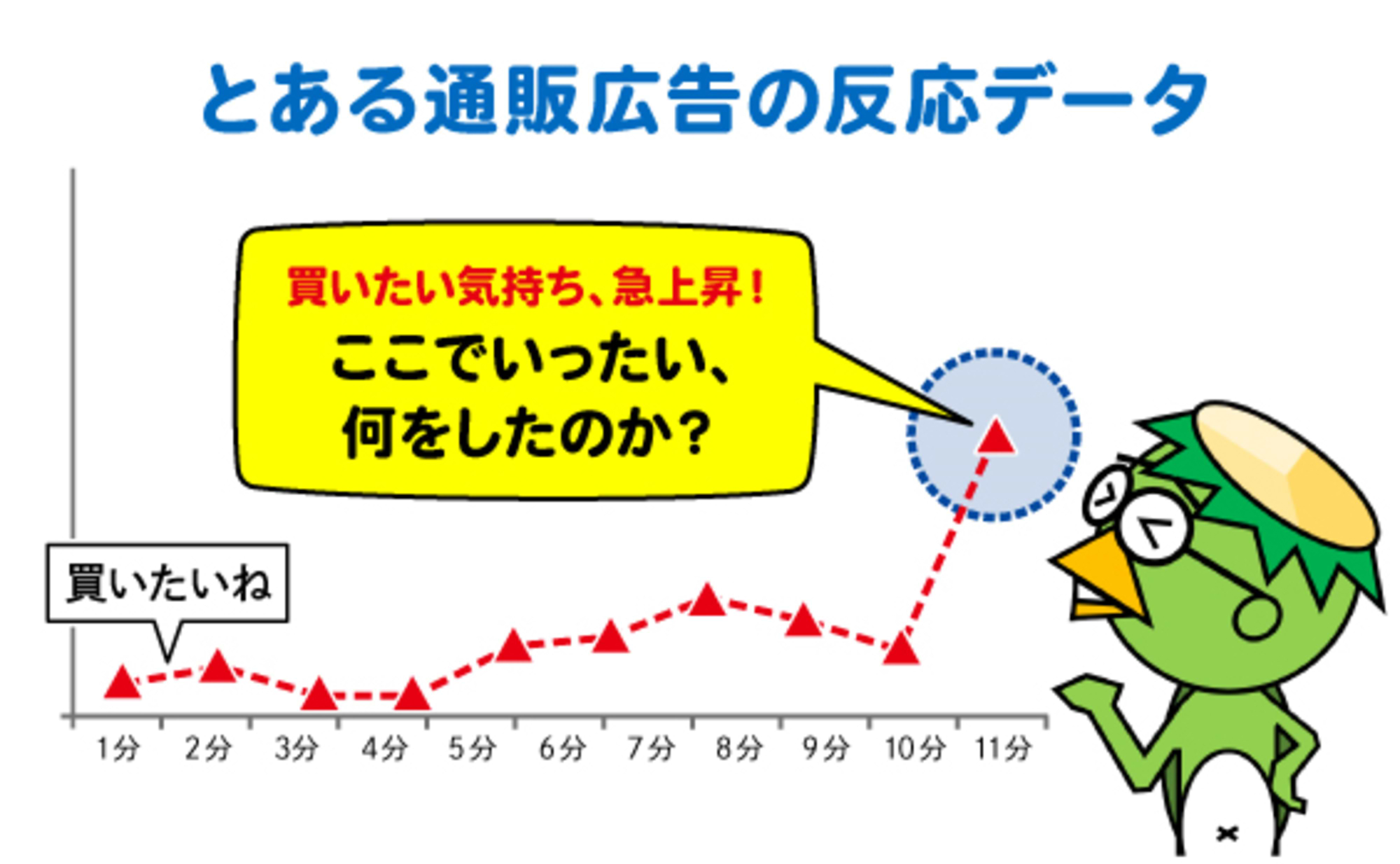
Why is this CTA always present in mail-order ads? The answer is simple: having a CTA significantly boosts sales. How much does actually encountering a CTA increase people's desire to buy? Here's the data.
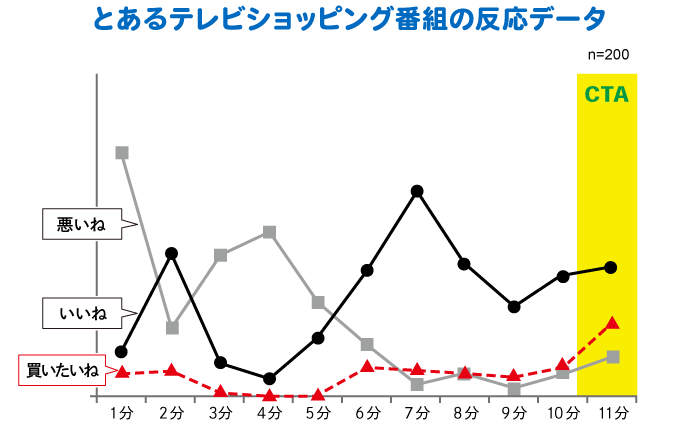
The chart above shows results from having 200 people watch a TV shopping program and press three buttons—"Like," "Dislike," and "Want to Buy"—in real time.
The "I want to buy" button is pressed when someone literally thinks "I want to buy." The chart clearly shows this "I want to buy" button spikes dramatically in the CTA section. This is because the CTA section rapidly emphasizes price, highlights special offers, and introduces the toll-free number, intensely stirring the "I want to buy" emotion.
Buying = Judging that the "value" is worth the "price"
Why does facing a CTA heighten the desire to buy? The key lies in the concept of "value for money," mentioned earlier.
Human purchasing behavior can broadly be divided into two steps: recognizing the "value" of a product, and then judging whether the price paid to obtain it – the "consideration" – is reasonable. To put it in everyday terms, seeing a shirt displayed in a clothing store and thinking "I like this" is recognizing its "value." Seeing the price tag on that shirt and thinking "And it's cheap! I'll buy it" is judging the "consideration."
The car purchase story from the beginning can also be interpreted this way: initially, when the person saw it and thought "This car is cool!", the price was still too high. However, when the new model came out and the price dropped, the price became reasonable, so they bought it without hesitation.
In fact, revisiting the response data from the mail-order ad mentioned earlier, you can see both the communication of value and the presentation of cost functioned effectively.
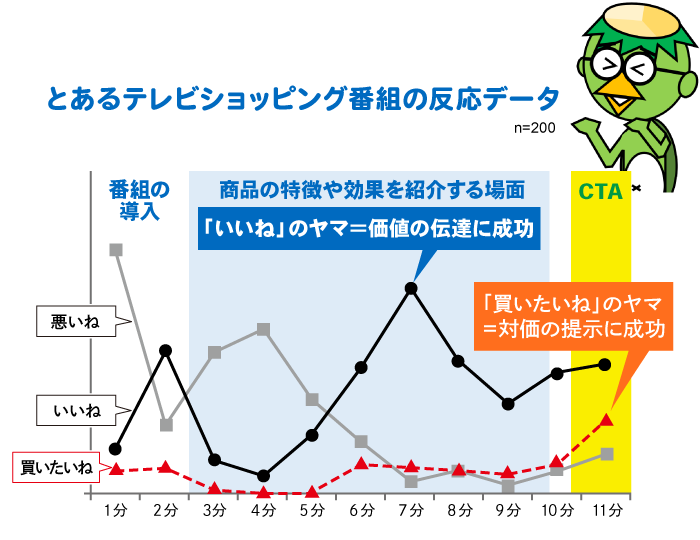
The increase in "likes" during the initial segment introducing the product's features and effects signifies successful value communication. Furthermore, the rise in "want to buy" during the CTA section indicates that the price presentation was effective, successfully generating the desire to purchase. In other words, it was precisely because both value communication and price presentation succeeded that this ad achieved the result of "selling."
Modeling the flow of "value" recognition and "price" judgment
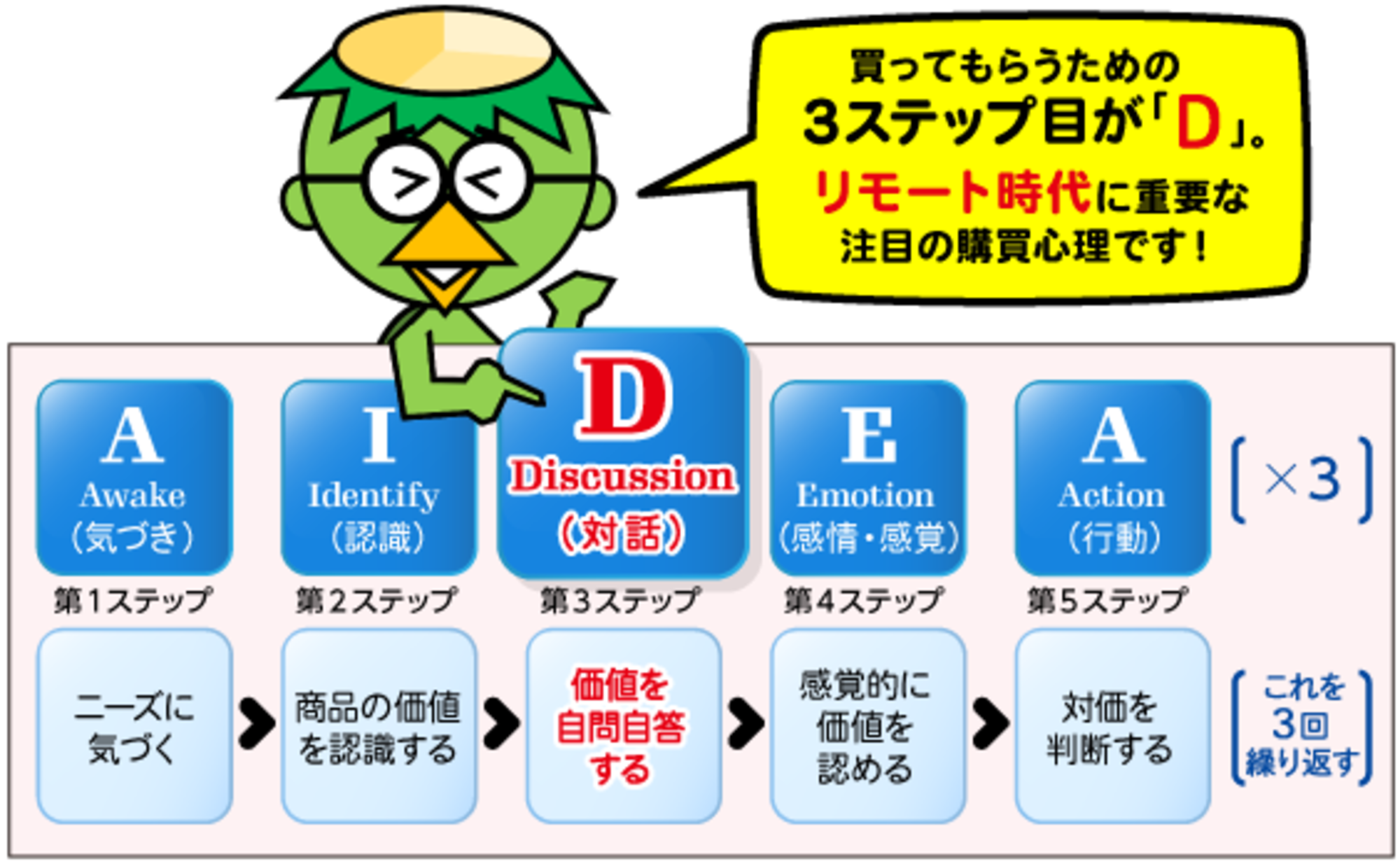
The "A.I.D.E.A. (×3)" model introduced throughout this series models the flow: people recognize a product's value, then judge whether the price is reasonable before deciding to buy.
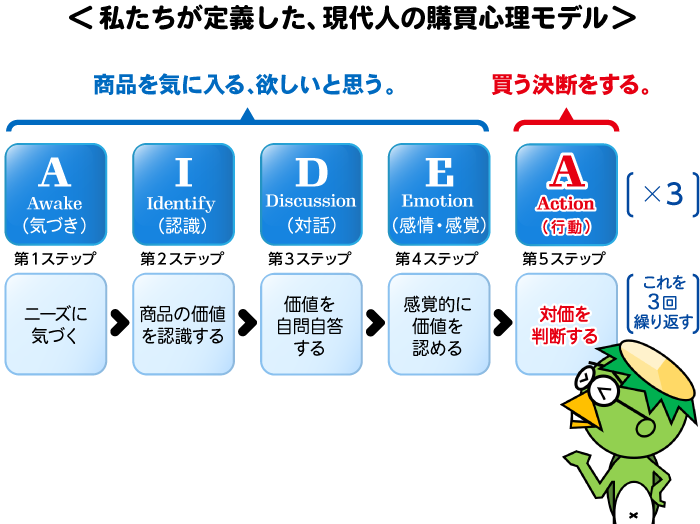
After recognizing the product's value through the "A," "I," "D," and "E" steps introduced previously, people move to the fifth step: judging whether the price is reasonable. Only when they are satisfied with the price in this fifth step does the action of "buying" occur.
The first four steps merely represent states of liking the product, developing an interest, or desiring it. To take the next step and initiate the actual action of purchasing, the crucial step of presenting the price for evaluation is indispensable.
Thinking about it this way, I can't help but feel that using "Price" instead of "Action" as the abbreviation for this fifth step might have been clearer. But since it's the model name my senior came up with, I'll leave it at that...
Why is it only in mail-order sales that "you should clearly state the price without hesitation"?
Now, if presenting the price is so crucial, you'd think CTAs should be common in non-mail-order advertising too. But in reality, you almost never see this kind of direct price presentation in other types of ads. Why is that?
The underlying reason lies in the unique characteristic of mail order: it's non-face-to-face.
It's said that the human brain is wired to avoid stressful activities like judgment, decision-making, and deep deliberation. Our brains fundamentally seek ease.
Conversely, being presented with a price and pressured to decide is inherently a stressful situation. When this happens in an inescapable "face-to-face" setting, the stress is considerable. For a brain seeking ease, facing such a situation might make it impossible to even consider the price, or it might take preventive measures by sensing the impending stress and avoiding such encounters altogether.
In other words, for "face-to-face" sales, presenting the price must be done in a way that minimizes stress on the brain—it's essential to devise methods that allow the brain to assess the price without resistance. The fact that advertisements for high-priced items like cars or bags often don't even list the price is precisely the result of consideration for the customer's brain.
Now, consider mail-order sales. Precisely because it's "non-face-to-face," customers don't feel as much pressure when prices are presented more forcefully or when they're urged to make a purchase decision. In fact, by presenting "reasons to decide now" – like "limited time only" or "limited quantity" – you can get customers to make a decision without avoiding it, even if their brain wants to. This is precisely why CTAs (Call-to-Action) work only in "non-face-to-face" mail-order sales.
What do you think? Even if you hear the advice "Don't hesitate to clearly state prices in mail order," you probably no longer feel that initial discomfort, right?
With the rapid shift to remote living, many of you are likely considering introducing mail-order sales. Mail-order sales involve various other know-how stemming from this unique "non-face-to-face" situation. The book 'The 7 Laws of Selling Ads' covers these details comprehensively. I was deeply involved in the research and hypothesis development for this book, so I sincerely hope those interested will give it a read.
Was this article helpful?
Share this article


Newsletter registration is here
We select and publish important news every day
For inquiries about this article
Back Numbers
Author

Hayaya Ijichi
Dentsu Kyushu Inc.
Strategic Sales Office