Note: This website was automatically translated, so some terms or nuances may not be completely accurate.
 The Psychology of Modern Consumers Revealed Through the Synergy of Mail-Order Advertising and Psychology [4/7]
If you want them to buy, it's better to make them hesitate.
A unique project team combining mail-order advertising and psychology spent three years analyzing mail-order advertising data. We present topics from the results compiled in 'The 7 Laws of Selling Ads ' (Kobunsha Shinsho) in a 7-part series.
Have you ever been so torn about whether to buy something that you kept going back to the store to look at the item you wanted? Especially now, when going out is difficult, you might find yourself repeatedly revisiting product pages on online malls.
You might think that after all that hesitation, the consumer will decide, "Actually, I don't need it after all, so I won't buy it." So, from the seller's perspective, it might seem like it's best to avoid having consumers "hesitate." But in reality, it's the exact opposite. If you want them to buy, "making them hesitate" is actually very effective. This time, we'll talk about "Discussion (Dialogue)," which relates to this concept.
What is the third step of purchasing, "Discussion"?
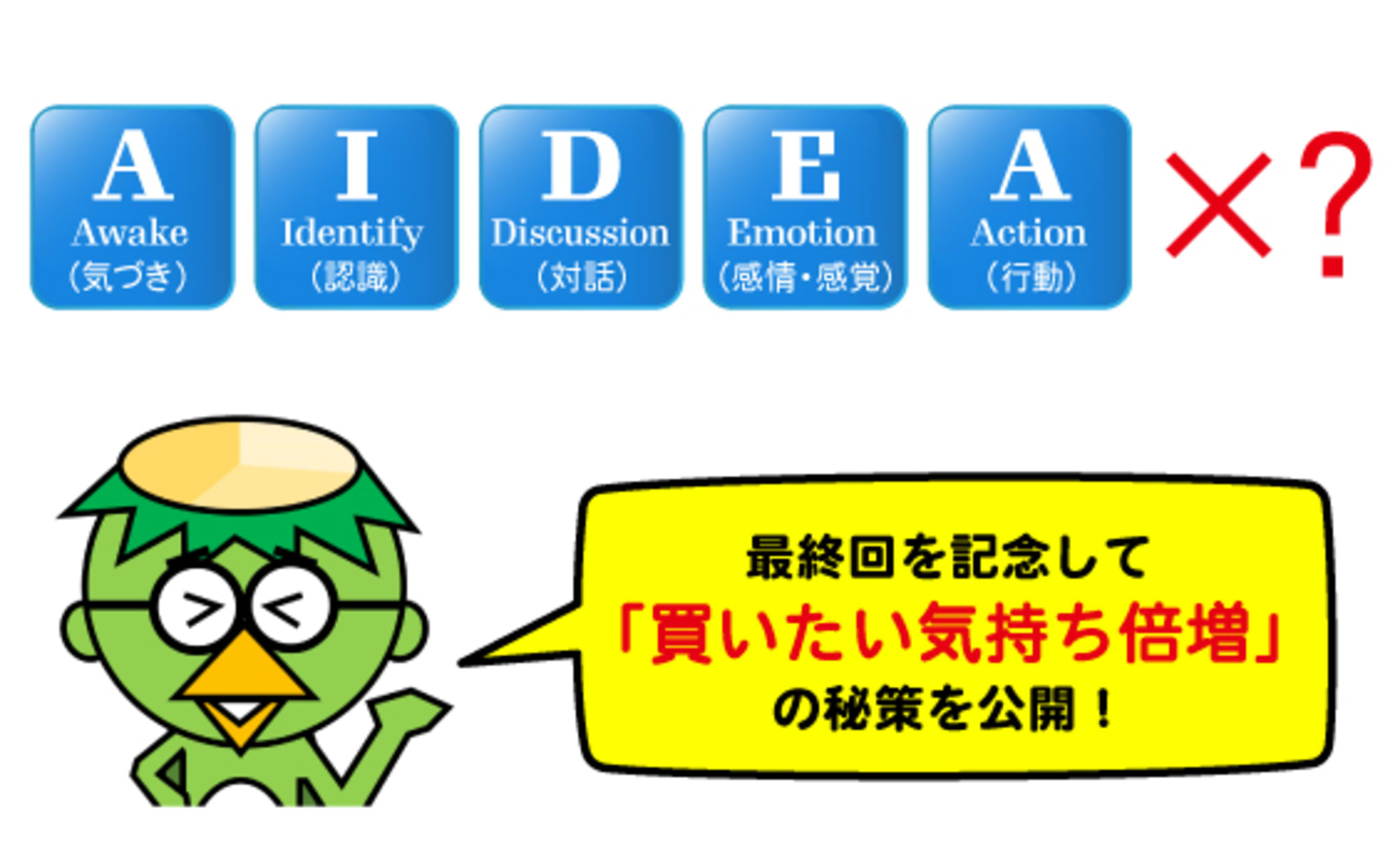
"Discussion" is the third step in the A.I.D.E.A. (×3) purchasing psychology model we derived from e-commerce response data (the full model is summarized in the first article , so please refer to that ).
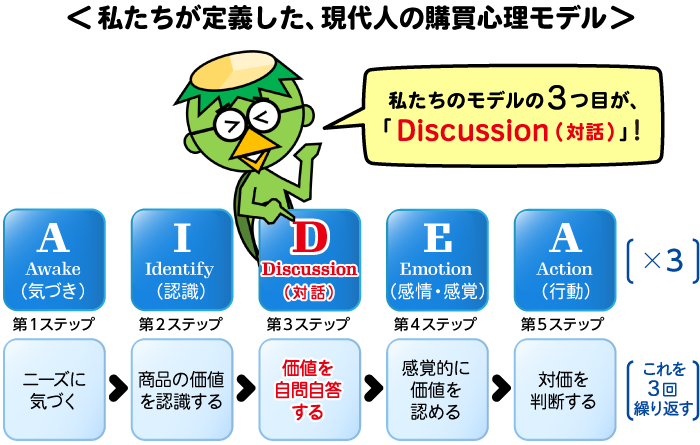
Modern consumers first recognize their own needs, then identify a product as something that could fulfill those needs. After that, they move to the step of concretely verifying the product's value. This is the third step, "Discussion," meaning a "dialogue" with oneself. Unless they question the product's value internally during this step and judge it sufficiently meets their needs, people won't proceed to the next step.
Incidentally, the quintessential model of this purchasing psychology is the "AIDMA" model proposed in the 1920s. Comparing the "D" in this "AIDMA" model with the "D" in our proposed "A·I·D·E·A (×3)" model reveals an interesting fact.
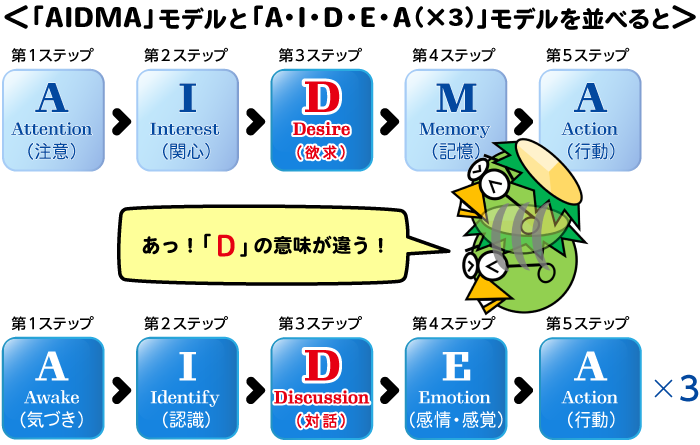
While the D in the "AIDMA" model stands for "Desire," the D in the "A·I·D·E·A (×3)" model stands for "Discussion." Why did this difference arise? Let me explain, though this is a slight digression.
The fact that the D in the "AIDMA" model stands for "Desire" signifies that in the 1920s, what emerged after interest in a product was a strong emotion called "Desire." But what about 100 years later, in 2020? Even if someone becomes interested in a product, the next mental movement is "Discussion" – that is, a calm psychological state of "questioning oneself" about whether to buy it.
The reason is obvious: the sheer volume of goods and information has exploded over this century. In an era of scarcity, simply learning about a product directly sparked desire. But in today's world overflowing with goods and information, interest doesn't automatically translate into wanting. Humankind, having accumulated failures like "buying on impulse and losing big," has evolved its purchasing behavior over 100 years, changing the very nature of the third step, "D."
What mental processes occur during "Discussion"?
Next, let's examine what actual mental processes occur during this "self-questioning." To put it simply, engaging in internal dialogue enhances one's understanding of a product's value. To prove this, let's review an experiment we conducted.
[Experiment 1] How the presence or absence of "street interviews" changes how information is perceived
The first experiment examined how the way information is perceived changes depending on whether or not people engage in "self-questioning," using a mail-order advertisement.

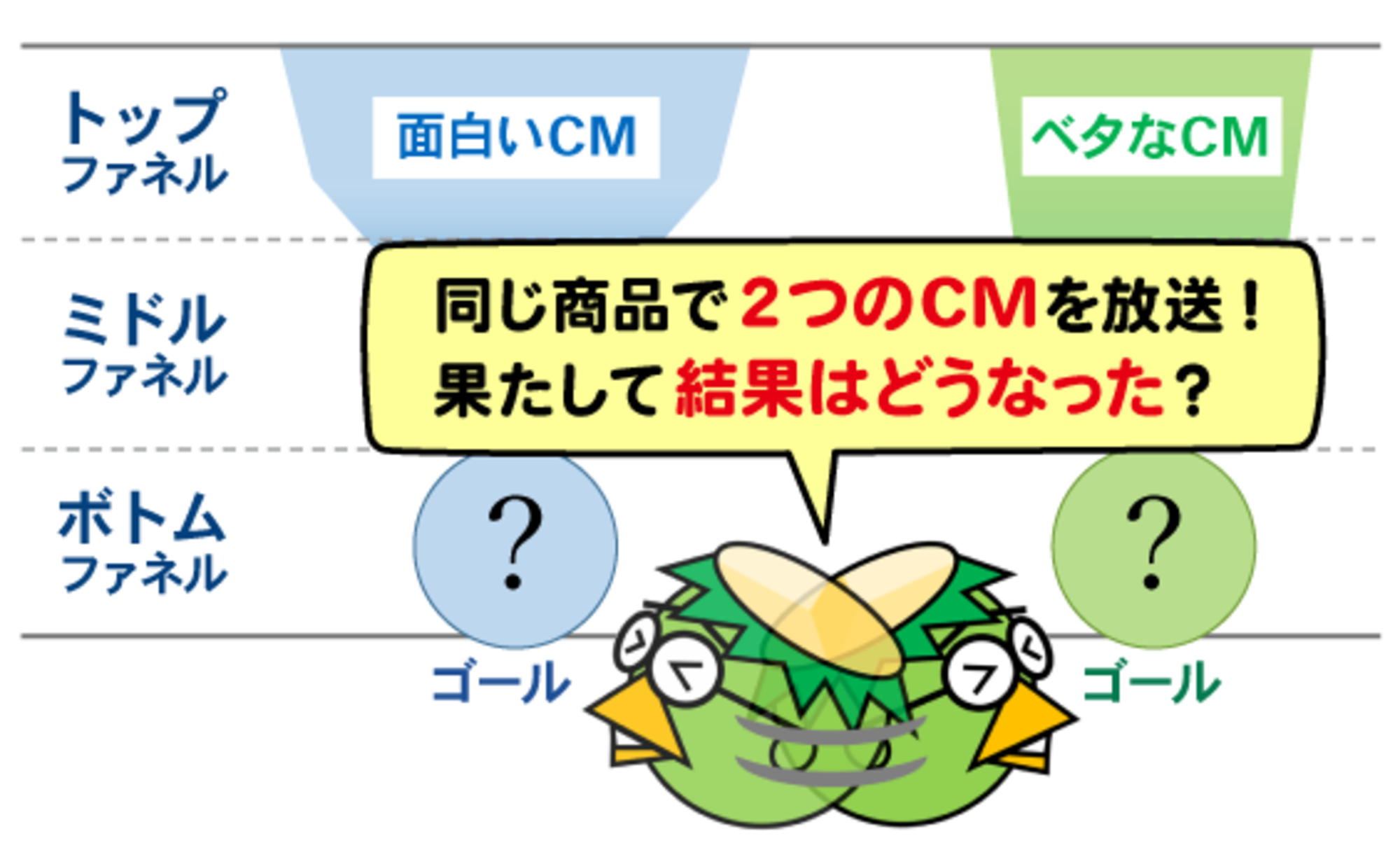
Specifically, we created two ads conveying the information "Most Japanese people don't consume enough vegetables": Pattern A delivered the message directly via narration, while Pattern B included street interviews with people who felt they lacked vegetables. We then asked viewers of each ad whether they perceived the "Japanese vegetable deficiency" information positively or negatively.
The results are as you see. Surprisingly, the exact same information about Japanese people's vegetable deficiency elicited completely opposite reactions.
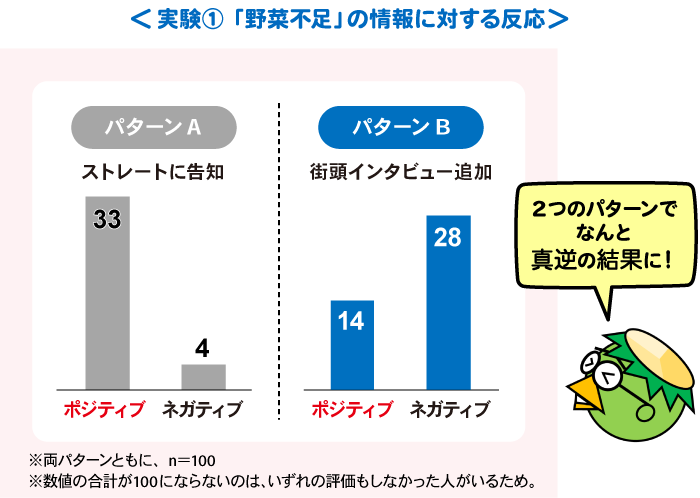
Most viewers of Pattern A evaluated the vegetable deficiency information positively. In contrast, most viewers of Pattern B gave it a negative evaluation. Why did this happen?
The positive evaluation of Pattern A. This means that people who were shown the vegetable deficiency information directly evaluated it as "beneficial" information coming from the TV, just as it was.
On the other hand, Pattern B's negative evaluation can be interpreted as follows. Viewers first saw the street interviews with people lacking vegetables. This likely made them start wondering whether they themselves were getting enough vegetables. In other words, the "vegetable deficiency concern switch" was flipped.
Then, the information "Most Japanese people don't get enough vegetables" was presented. For those with the switch activated, this information inevitably led them to think, "I probably don't get enough vegetables either." In other words, by having them "question themselves" after seeing the street interviews, Pattern B succeeded in making them perceive vegetable deficiency as their own negative issue—that is, making it personal.
This case clearly demonstrates how "Discussion" can heighten modern consumers' awareness of their needs and deepen their recognition of a product's necessity.
[Experiment 2] Changes in Information Comprehension Using "10 Bunches of Spinach"
The second experiment examined how the clarity of explanations affects information comprehension.
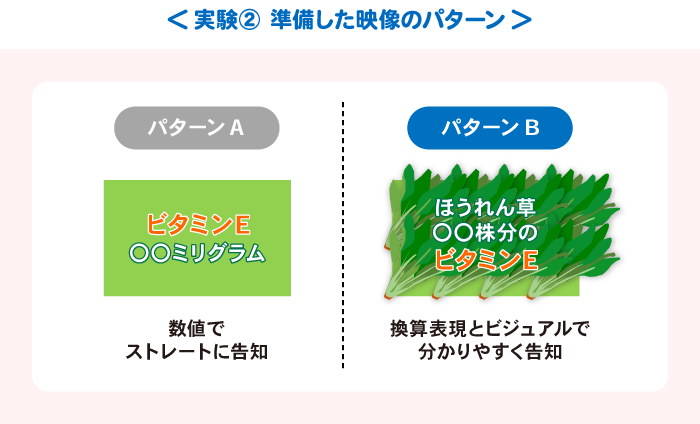
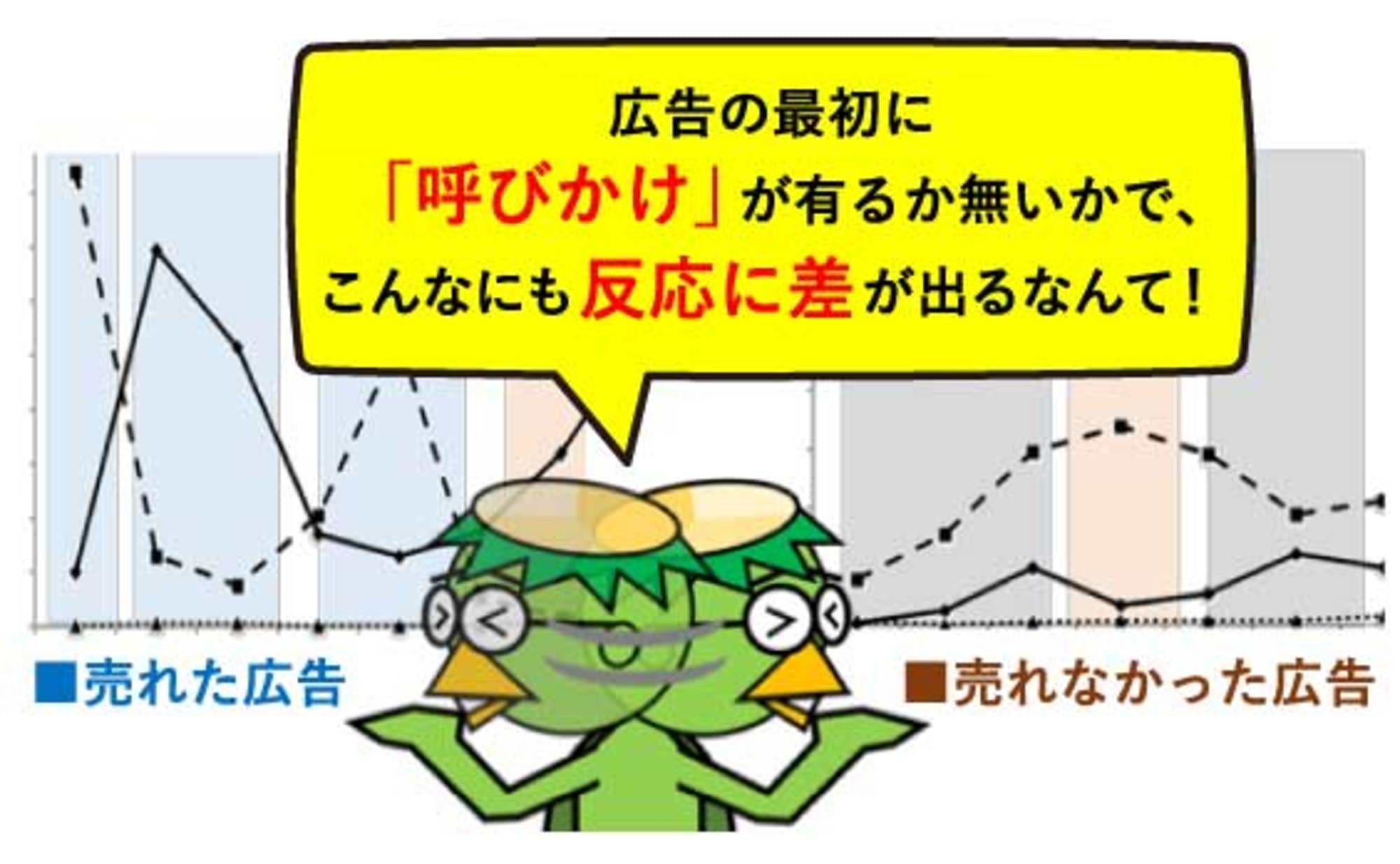
The experiment used an online advertisement for a supplement that provides vitamin E, vitamins B1 and B6, and dietary fiber all at once. We prepared two video patterns: Pattern A, which conveyed the supplement's features directly (e.g., "Vitamin E XX milligrams"), and Pattern B, which used conversion expressions like "Vitamin E equivalent to 10 bunches of spinach" for visually clear presentation. We examined the differences in responses, but the most notable finding came from the survey question: "Which nutrients do you think you can get a lot of from this product?"
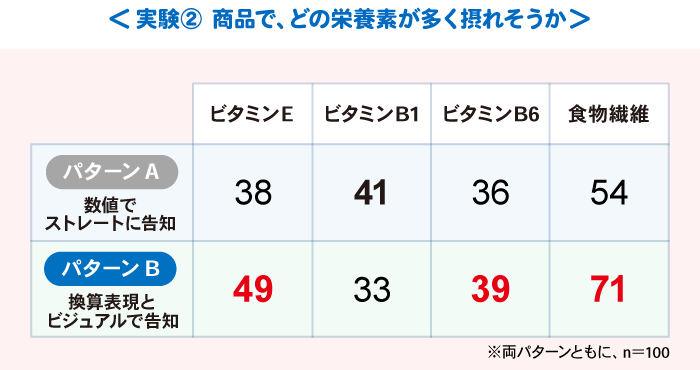
As you can see, those who viewed Pattern B rated the product higher for providing more of each nutrient. Pay close attention to the additional ratings shown on the right side of the table below for "Iron," "β-Carotene," and "Vitamin C."
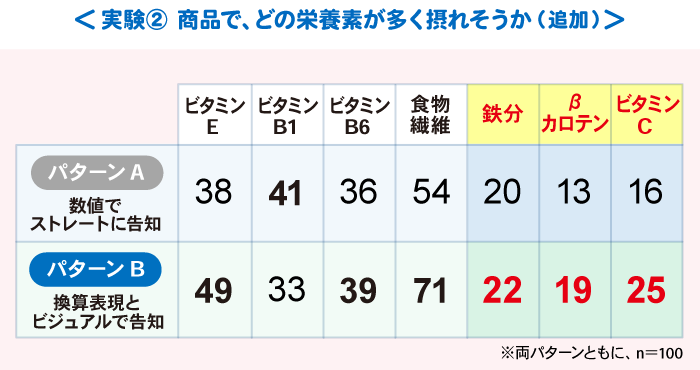
These nutrients are not actually contained in the product and, of course, were not mentioned in the advertisement. In other words, they were dummy options. Yet, those who saw Pattern B gave them high ratings as well.
When explanations are easy to understand, comprehension naturally increases. As understanding deepens, imagination expands on its own, even generating expectations beyond the product's actual value. This result demonstrates such patterns in human thinking. While the form may differ from "self-questioning," this finding shows that deepening understanding—that is, deepening one's own thinking—has the power not only to foster accurate value judgments but also to create what might be called "happy misunderstandings."
Precisely because we live in an era of inevitable uncertainty, "Discussion" is indispensable.
What these two experiments reveal is that the act of "self-questioning" reliably heightens awareness of one's own needs and reliably deepens understanding of a product's features.
Our modern world, overflowing with goods and information, is conversely an era where we cannot decide what to choose in one go. To make the decision to "buy" in this era, it is essential to thoroughly compare and evaluate within oneself whether the product is truly the right choice. That is precisely why, as introduced at the beginning, if you want someone to buy, "making them hesitate" is effective. The step of "Discussion" holds the key to this.
It might be a creepy analogy coming from a middle-aged guy, but this psychology feels similar to that common (does it really exist?) shoujo manga trope where someone plucks petals one by one, wavering between "I like" and "I dislike." Through this "self-questioning," the desire for the object naturally intensifies. And like seeing beauty in flaws, people start valuing features the object doesn't even possess. Isn't modern shopping essentially this shoujo manga-like process of amplifying the urge to buy?
Moving forward, goods and information will only increase, never decrease. Moreover, our lives, forced to adopt remote methods due to sudden circumstances, will become increasingly remote. As a result, shopping in the near future will require even more careful selection than it does now.
In other words, an era of greater "hesitation" is coming, an era where "Discussion" becomes even more crucial. Preparing for such times, I too will strive to deepen "Discussion" and become even better at making people "hesitate."
Was this article helpful?
Share this article


Newsletter registration is here
We select and publish important news every day
For inquiries about this article
Back Numbers
Author

Katsuyuki Kazuki
Dentsu Kyushu Inc.
Communication Design Bureau Direct Marketing Department