Note: This website was automatically translated, so some terms or nuances may not be completely accurate.
 The Psychology of Modern Consumers Revealed Through the Synergy of Mail-Order Advertising and Psychology [3/7]
Funny commercials vs. corny commercials—which sells better?
A unique project team combining mail-order advertising and psychology spent three years analyzing mail-order advertising data. We present topics from the results compiled in 'The 7 Laws of Effective Advertising ' (Kobunsha Shinsho) in a 7-part series.
I'm writing this in early April, but unfortunately, the world has changed dramatically in just the past month. To stop the virus spreading from person to person, how information is communicated between people becomes critically important. As communicators, I want us to constantly consider what we can contribute and act accordingly every day.
Now, due to these turbulent times, it feels like ancient history, but just a month ago in March, news broke that "Internet advertising spending surpassed TV advertising spending!" This news truly suggests a turning point in the era – advertising shifting from a right-brain industry competing on the superiority of expressions that move people's hearts, to a left-brain industry leveraging digital data to derive clear answers. How did you interpret this news?
Working daily with direct-response advertising, I genuinely feel that advertising is undeniably becoming a left-brain industry tied to data. Yet, I also sense the exact opposite. Advertising remains terrifyingly full of mysteries, and no matter how much data we gather, finding the "guaranteed answer to sell products" seems a long way off.
A prime example of this is the incredibly simple question: "Which actually sells more: funny commercials or clichéd ones?" Creatives insist, "If it's not funny, no one will watch it, and it won't be effective!" Analysts counter, "If it hits the target audience, the clichéd one should deliver better results!" In other words, the reality is that even today, we don't have a definitive answer to such a straightforward question.
When we pit "funny commercials" against "corny commercials" in a direct showdown...
So, which is more effective for sales promotion: "funny commercials" or "corny commercials"?
Defying the common opinion that "it depends on the case!", we sought an answer to this "debate" through our very own "Fun Commercial vs. Boring Commercial: Direct Showdown Test". True to its name, we prepared two types: "Funny Commercials," designed to grab attention and achieve overwhelming product imprinting, and "Cliché Commercials," intended to clearly communicate the product's specific function. We aired them under nearly identical conditions and measured the results—how many people took action and how—using metrics like online search volume, website visits, and product sales.
We were excited to see what kind of difference would emerge. The results are shown in the table below. As you can see, both the "Funny Commercial" and the "Boring Commercial" received one ◎, one ○, and one △ each – a result that's quite difficult to judge.
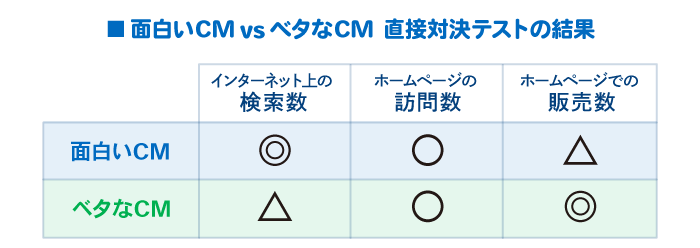
This outcome seems to validate both the creator's claim that "if it's not funny, no one will watch it and it won't be effective" and the analyst's assertion that "the cliché one should yield better results." So, is there really no answer to this question...?
No, that's not the case. What matters is the perspective of "which is more effective for sales promotion." While the "funny commercial" increased search volume, it didn't significantly boost sales. Conversely, the "conventional commercial," though it didn't increase search volume, outperformed the other in final sales figures. In other words, in terms of contribution to sales promotion, the "conventional commercial" came out on top.
In fact, this tendency is even more pronounced in direct mail advertising specifically designed to sell products. Or rather, in direct mail advertising, unless you present the product's specific features using expressions that go beyond cliché—like the before-and-after type, essentially "over-the-top" clichés—it's quite difficult to get customers to buy. When trying to sell products, the undeniable truth in direct-to-consumer advertising is that expressions directly depicting the product's value are overwhelmingly more effective than elegant or witty expressions.
What do "cliché commercials" actually create?
Why do clichéd expressions sell products? We believe the key lies in the psychological process of "Identify," or "recognition."
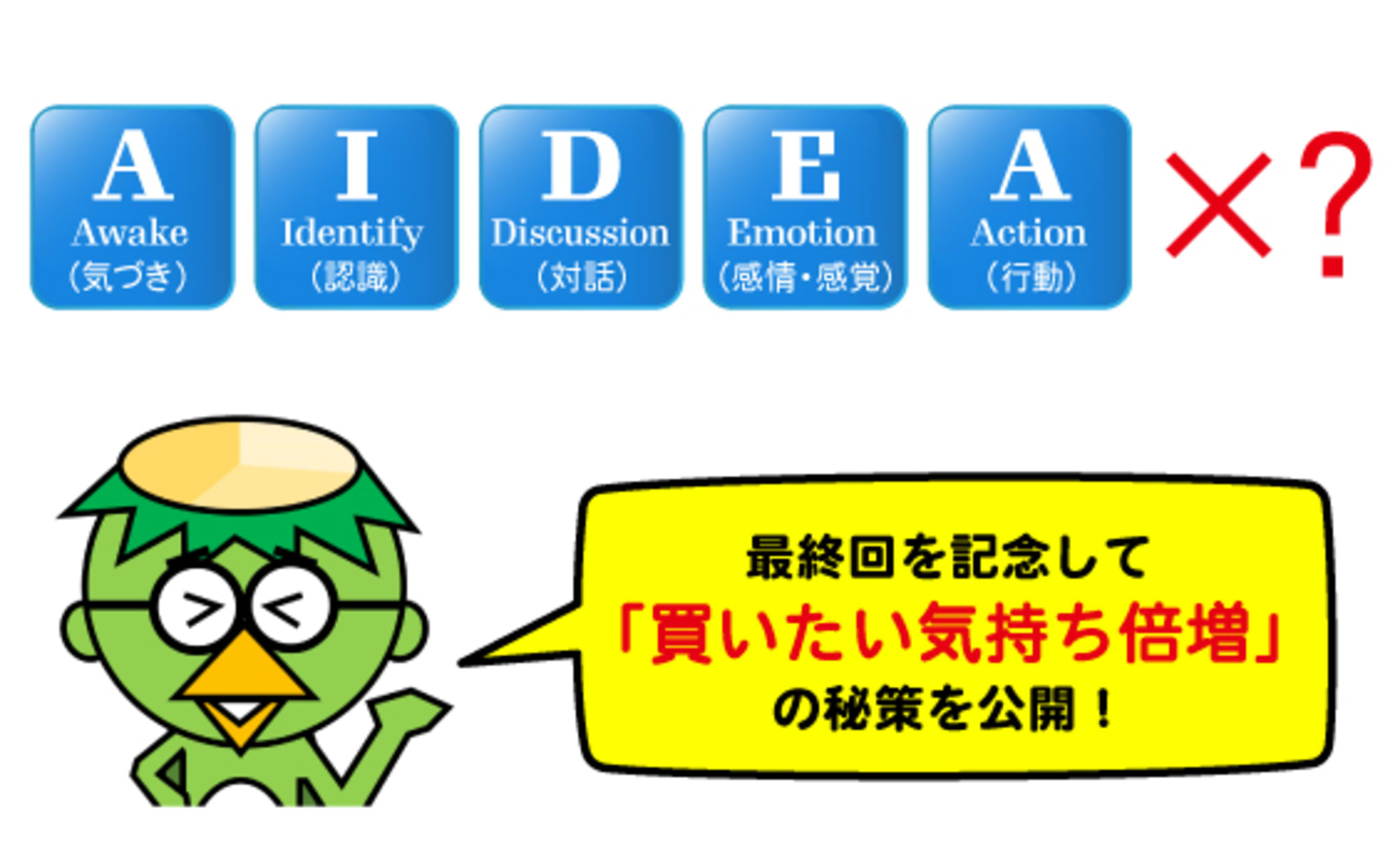
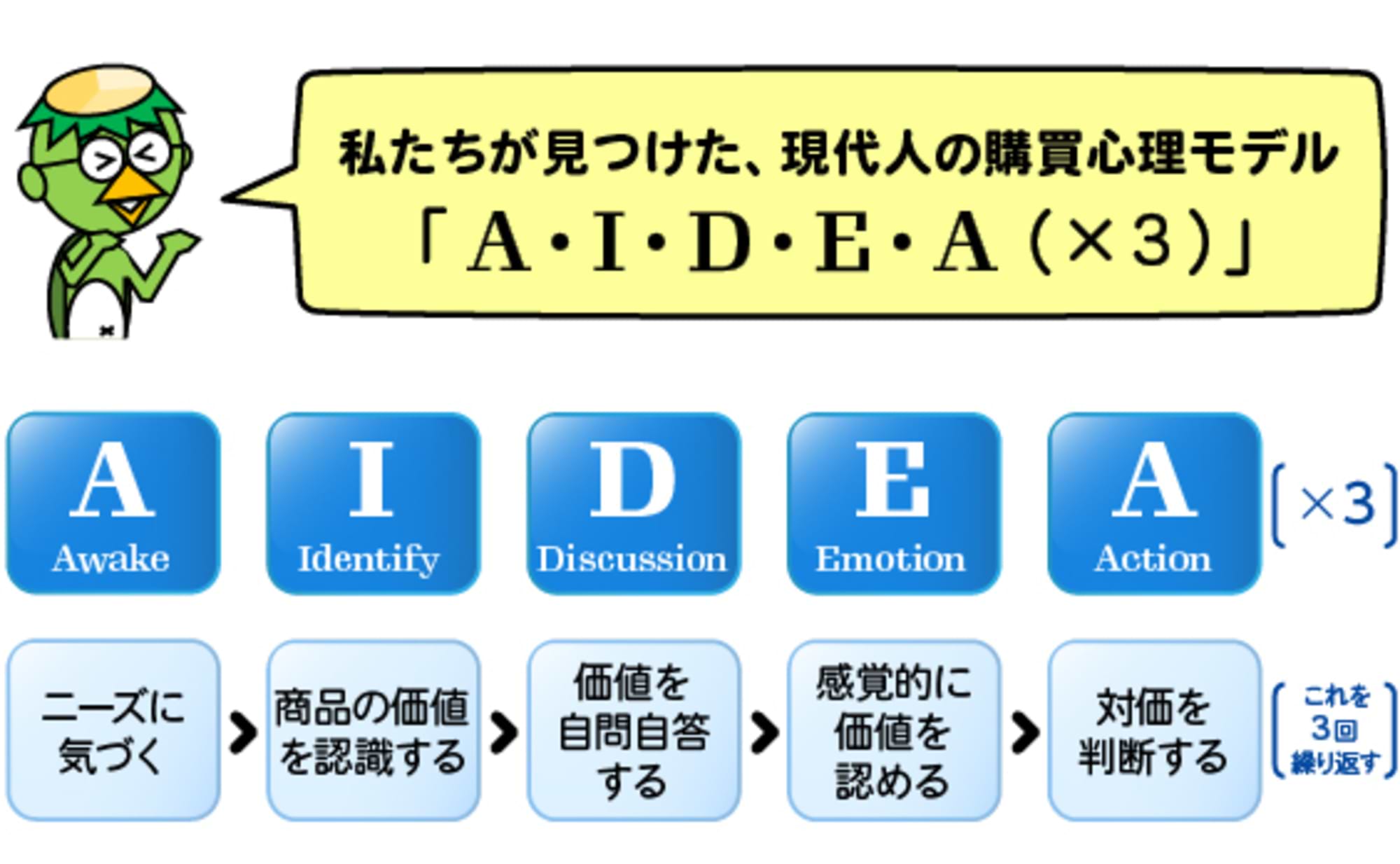
What exactly is "Identify (Recognition)"? How does this psychological state influence purchasing behavior? To understand this, we invite you to examine the purchasing psychology model we derived from mail-order response data: the "A·I·D ·E·A (×3)" model. (The full details are summarized in the first article, so please refer to th at.)
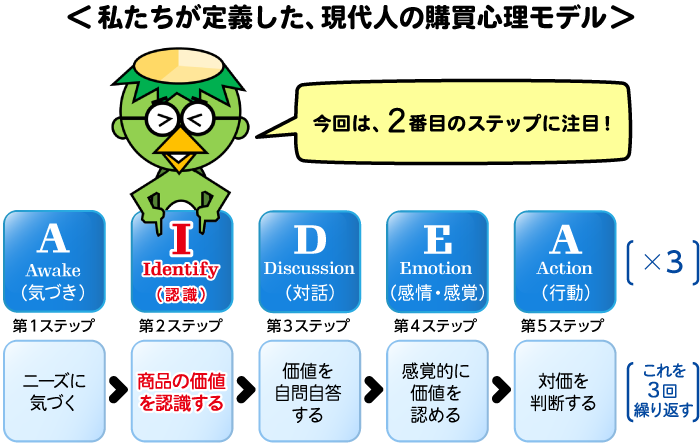
People proceed through five sequential steps to make a purchase, and "Identify" occupies the second position.
Many might wonder, "Wait, isn't the second 'I' for 'Interest'?" However, we believe that in modern purchasing behavior, what matters most is not "Interest" but "Identify."
For example, people won't buy a product unless its necessity is clearly demonstrated—often through heavy-handed "before-and-after" style messaging. This fact means that to get people to buy, it's not enough to rely on the thin emotions of mere "interest" or "curiosity." What's essential is for them to have a clear and strong "recognition" that "this product meets my needs; this is what I'm looking for."
Furthermore, whether or not you can effectively achieve this "Identify" stage determines how many people progress to the "Discussion" stage and beyond. If "Identify" succeeds, more people advance to subsequent stages; if it fails, the purchasing mindset breaks down right there. The difference in sales between "interesting commercials" and "clichéd commercials" was precisely due to this difference in "Identify."
The ideal commercial is one designed by working backward from the goal.
This concept is often discussed today using the term "funnel." The word "funnel," originally meaning a "strainer," became a marketing term because the flow of potential customers narrows progressively, like a funnel, as they approach purchase.
Generally, the funnel is divided into three stages: the "top funnel," representing initial contact with product information; the "middle funnel," where understanding of the product develops; and the "bottom funnel," the stage of final purchase decision. The fundamental idea of the funnel is to take appropriate actions at each stage to keep the funnel as wide as possible and thereby increase sales volume.
Applying the results of our comparison between "interesting commercials" and "cliché commercials" to this funnel concept yields the following diagram.
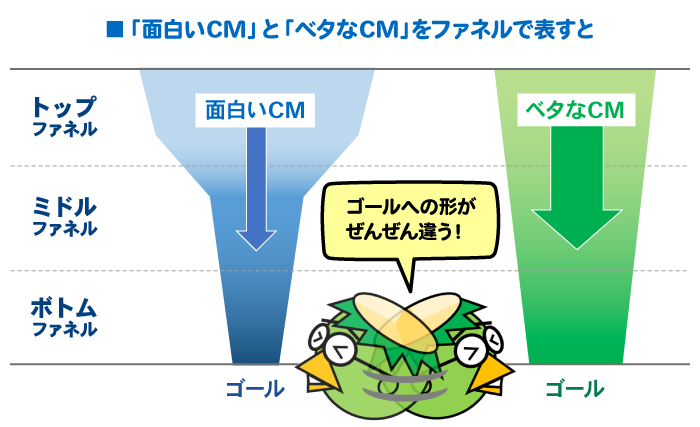
The "interesting" commercial generated many reactions at the top of the funnel due to its entertainment value. However, it failed to strongly implant recognition of the product's value, resulting in few people being pushed through to the middle and subsequent stages of the funnel.
Conversely, "conventional commercials," while generating fewer responses at the top of the funnel, succeeded in pushing more people through to subsequent stages due to their strong ability to establish product value. This ultimately led to increased product sales.
Viewed this way, the "Identify" step serves as the bridge connecting the top and middle funnels.
By firmly establishing that the product meets their needs, this process sparks genuine interest. People then progress to the next step with surprising ease.
This, we believe, is the true reason why the "Identify" step is indispensable for selling products to modern consumers.
In 2019, internet advertising spending surpassed television advertising spending. Behind this news lies the fact that both consumers and marketers changed their behavior as a result of an overflow of goods and information.
Because of this excess, consumers stopped buying unless they recognized a product's value. Marketers, in turn, had to leverage data to track this shift. The emergence of this change above the surface might be the shift from "Interest" to "Identify" – the shift in the "I".
That said, regardless of which "I" we're talking about, what we must move is the human heart—making people recognize a product's value and grow to like it. And the most difficult challenge, in any era, remains coming up with concrete ideas for how to move people's hearts.
Today, the scope for idea generation has expanded beyond simple commercials to include internet advertising using various technologies and real-world events. I, too, will continue striving to keep my antennae up, broaden my thinking, and come up with groundbreaking advertising that has never been seen before.
Was this article helpful?
Share this article


Newsletter registration is here
We select and publish important news every day
For inquiries about this article
Back Numbers
Author

Katsuyuki Kazuki
Dentsu Kyushu Inc.
Communication Design Bureau Direct Marketing Department