Note: This website was automatically translated, so some terms or nuances may not be completely accurate.
 The Psychology of Modern Consumers Revealed Through the Synergy of Mail-Order Advertising and Psychology [2/7]
The key to effective ads lies in using a "call-to-action" style introduction!
A unique project team combining mail-order advertising and psychology spent three years analyzing mail-order advertising data. We present topics from the resulting book, " The 7 Laws of Effective Advertising " (Kobunsha Shinsho), in a 7-part series.
Most purchase psychology models start with "A"—from "AIDMA" to "AISAS"...
Hello everyone! Three enthusiasts researching modern consumer psychology. In this second installment, we'll explore the "starting point" of purchasing.
When it comes to purchasing psychology models, Roland Hall's "AIDMA" is the classic, proposed in the 1920s. It's the well-known model starting with "Attention," moving through "Interest," "Desire," and "Memory," culminating in "Action."
Then, in the 21st century, Dentsu Inc. devised "AISAS." This model also starts with "Attention" and "Interest," but then incorporates "Search" before "Action," and further includes "Share" afterward. It reflects the behaviors of the internet age.
While numerous other purchasing psychology models exist, as exemplified by the two mentioned above, most begin with an "A." And in almost every case, that "A" stands for "Attention." That makes perfect sense—without noticing the information, no purchasing action can occur. Therefore, it seems an indisputable fact that the first step in these models is the "A" for Attention. To be perfectly honest, when we first began our research, we never dreamed there could be any doubt about this. But...
The fact that reactions can change dramatically depending on the content of that Attention.
What prompted us to question this seemingly obvious truth was the result of analyzing the opening segments of successful TV shopping programs versus unsuccessful ones.
We had monitors view both videos online and evaluate them over time based on three factors: "Like" (positive evaluation), "Dislike" (negative evaluation), and "Want to Buy" (purchase intent). This revealed a surprising fact.
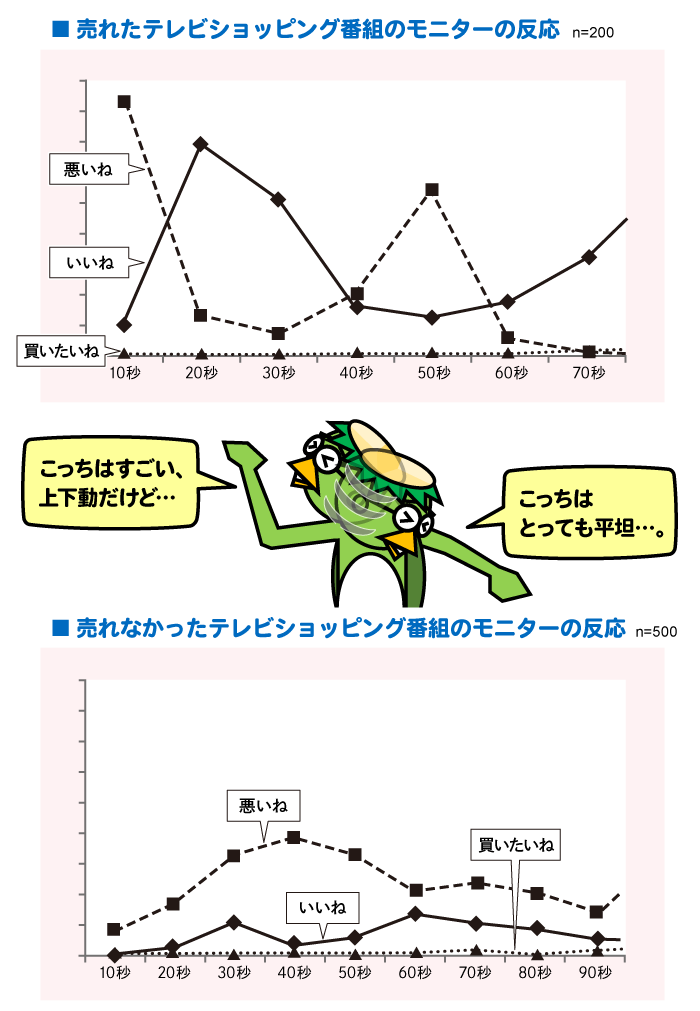
Please look at the two graphs above. They show the reaction data for the opening segments of a "successful" TV shopping program and an "unsuccessful" one. Notice how the line graph for the successful program fluctuates wildly. This indicates viewers' emotions were swung between positive and negative extremes. In contrast, the line for the unsuccessful program is flat. This means viewers weren't particularly moved by this program. This isn't an isolated example. When measuring viewer reactions between successful and unsuccessful programs, a similar clear difference is usually observed in the opening segments.
Naturally, unsuccessful programs weren't without strategy. They incorporated various attention-grabbing techniques to capture viewers' interest. Yet, the fact remains that significant differences in emotional engagement emerged. This suggests that the conventional wisdom—that "simply grabbing attention is enough to flip the 'buy' switch' in people"—might actually be incorrect.
What matters isn't attention itself, but the "substance" of what kind of attention is captured. Discovering another door hidden behind the concept of "attention" – long accepted as gospel worldwide for nearly a century – feels like an exciting development straight out of an Indiana Jones movie.
The key to the answer lay in direct mail ads that "call out" and "ask questions."
In the world of mail-order advertising, the "call-to-action & question" format is considered a tried-and-true method for ad introductions. This technique starts by directly addressing the target audience with questions like, "You who can't find cosmetics that suit your skin!" or "What do you consider when choosing cosmetics?" In fact, the "successful TV shopping program" mentioned earlier also employed precisely this method.
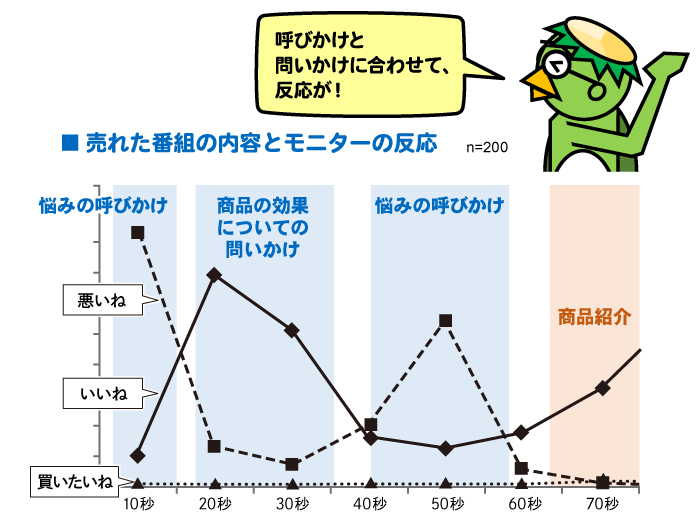
Here is a comparison of the techniques used against the line graph mentioned earlier. While I encourage you to read the book for details, simply put, you can see that the initial appeal triggers a rise in "bad reactions" (i.e., negative responses), followed by a subsequent appeal that elicits positive reactions. Then, another appeal causes negative reactions to rise again. As a result, when the product is introduced, "good reactions" increase, indicating that viewers ultimately developed positive feelings toward the product.
As mentioned earlier, successful programs are characterized by high "bad" reactions as well as "good" ones. Intuitively, one might think that a rise in "bad" reactions—meaning increased negative responses to the ad—is undesirable. However, this is not actually the case.
For example, just as someone who is overweight might feel negative about their weight and decide to diet, experiencing negative emotions can serve as a catalyst for action. And in eliciting such reactions, "appeals" and "questions" play a crucial role.
The reaction to the opening of the "unsuccessful ad" proves this point perfectly. Similarly, the next graph compares the program's production elements.
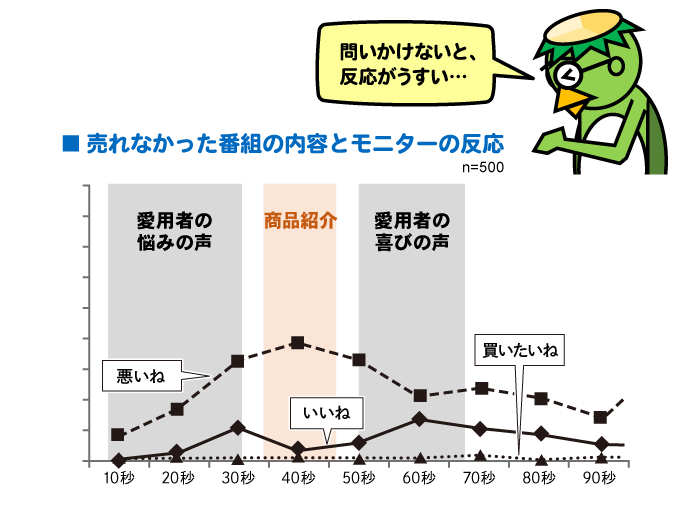
Without using calls to action or questions, we deliberately presented voices of concern and joy directly. However, from the outset, reactions to both "likes" and "dislikes" were sluggish. Consequently, even during the product introduction segment, "likes" failed to increase. This approach clearly failed to generate positive feelings toward the product, evident at a glance.
The starting point of purchasing behavior is "Awake," where one focuses on their own needs.
Why does this difference occur? People respond when you "call out" or "ask questions," but not otherwise.
The answer lies in the "needs" modern people possess. Modern people have too many needs to constantly be aware of each one. That's precisely why, unless you "call out" or "ask questions" to get them to focus on their own needs, the value of the product rarely gets across. Jumping straight into talking about product features without first getting them to focus on their needs is like giving a street speech in a situation where everyone just walks by, without any effort to stop them.
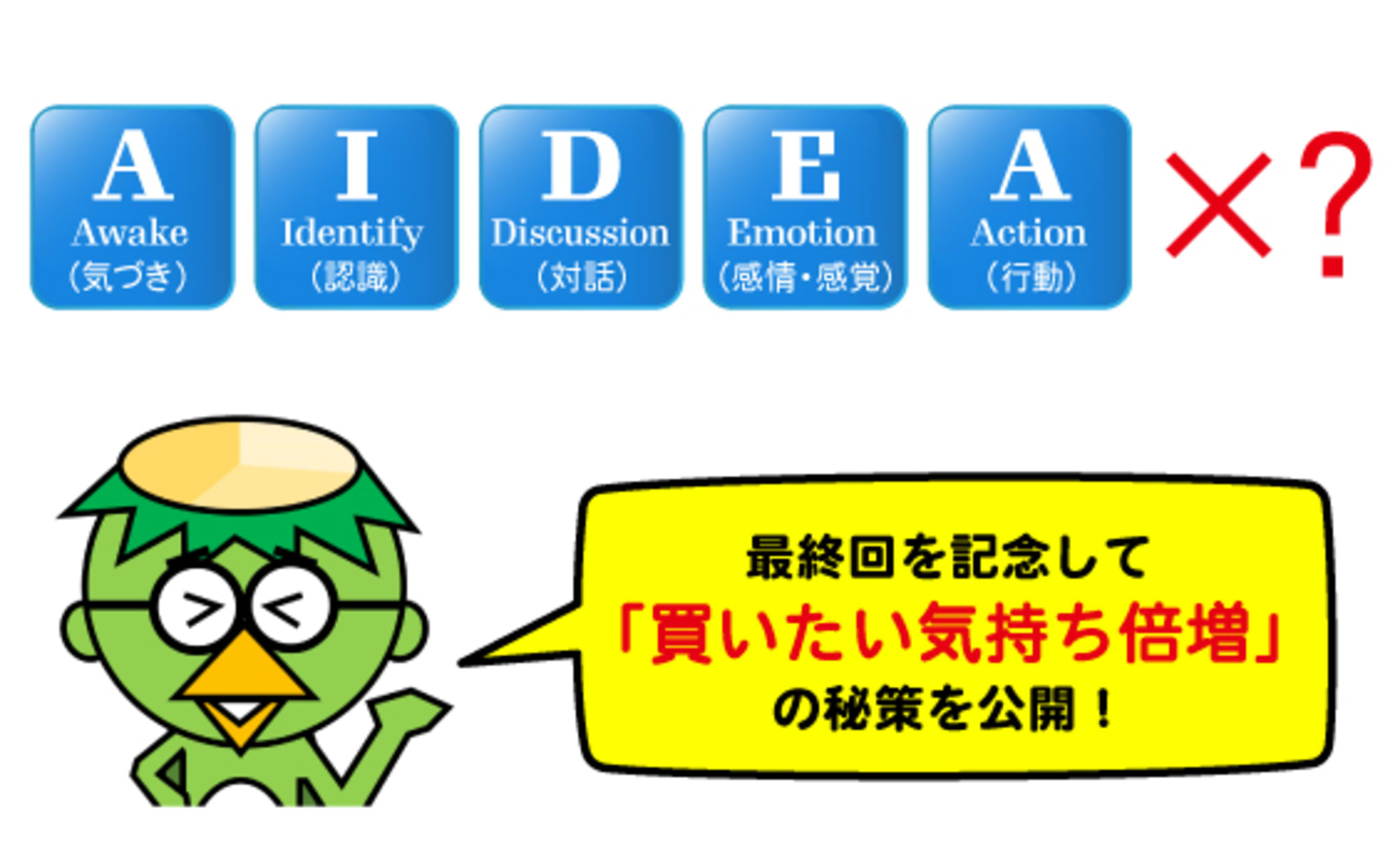
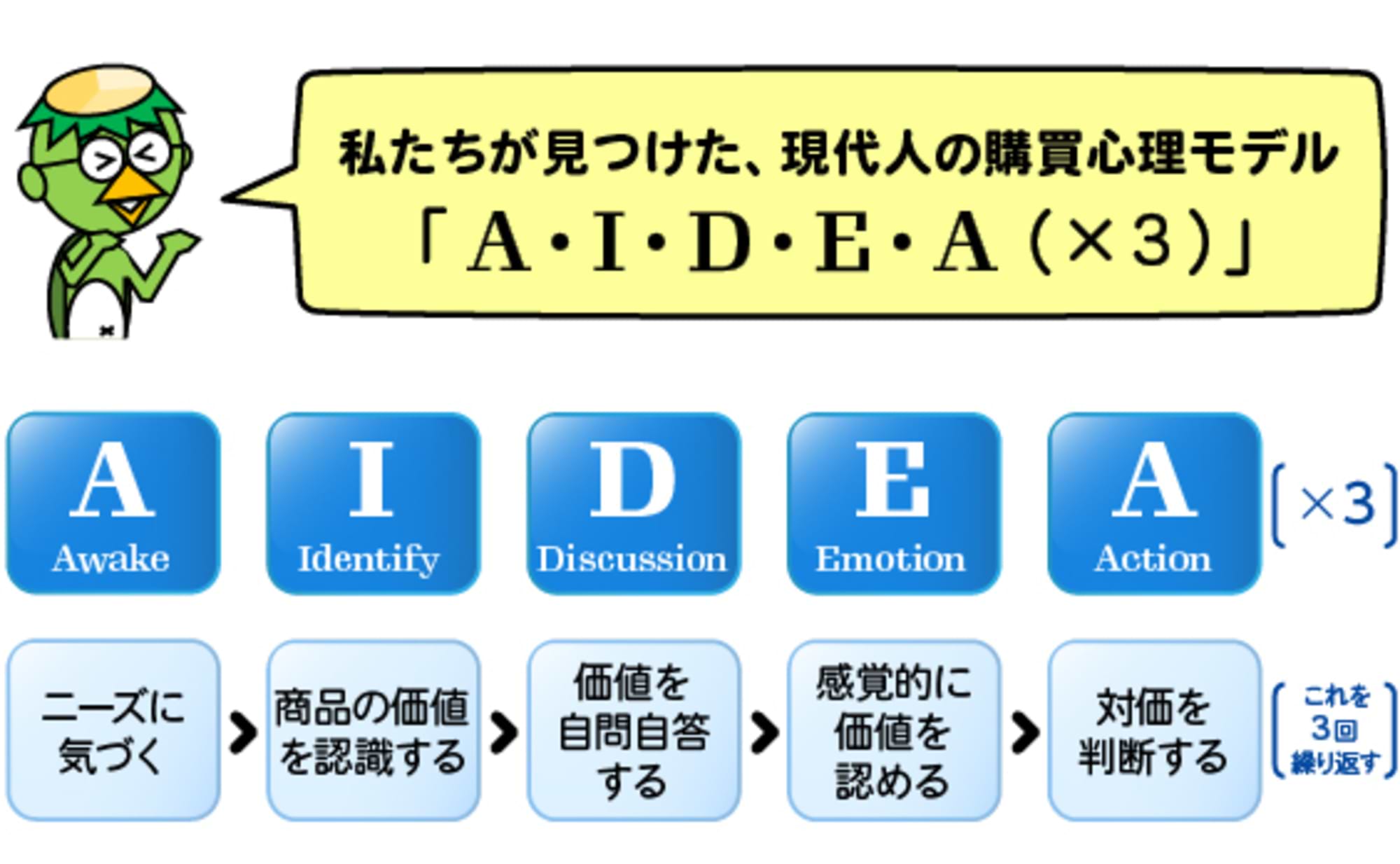
Based on this reality, the purchasing psychology model we defined for modern consumers is "A・I・D・E・A (×3)".
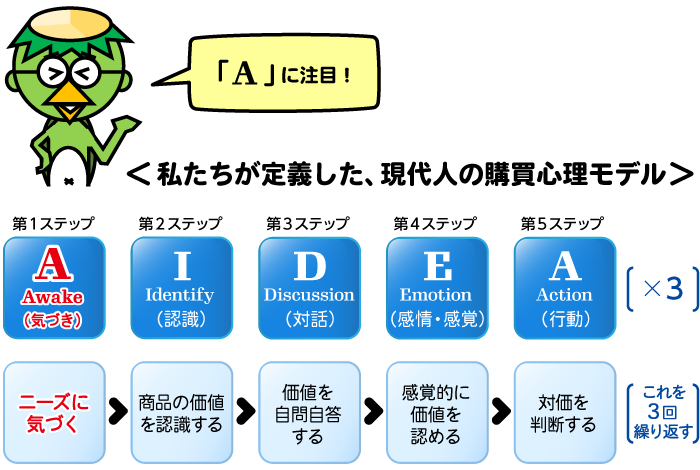
Crucially, the first step isn't merely "Attention" to get noticed, but "Awake" – awakening and making them aware of their own needs. To convey a product's value to modern consumers surrounded by countless needs, it's vital to start the conversation by "calling out" and "asking questions" to make them "Awake" to their own needs. If your product's value isn't resonating as intended, this "Awake" step is likely missing. You might be distributing information to customers who haven't recognized their own needs—essentially, you haven't prepared a receptacle for the information.
This conclusion, derived from analyzing mail-order advertising data, is actually backed by psychology. For instance, consider the brain's decision-making processes—System 1 and System 2—proposed by psychologist Daniel Kahneman, who won the 2002 Nobel Prize in Economics, in his renowned book Thinking, Fast and Slow. Also, the research on "Involvement" published in 1983 by psychologists Petty and Cassioppo. The details are thoroughly explained in the book's columns, so if you're interested, I highly recommend picking up a copy of The 7 Laws of Selling Ads.
...So, how did you find this second installment of the series? By prompting and posing questions, we draw attention to the viewer's own needs, then present the product's value. This approach is better suited to video media, which unfolds a story chronologically, than to flat media with a list-like presentation. The significant growth of video ads in internet advertising in recent years, or the fact that TV ads still hold considerable power despite talk of declining media influence, can be attributed to this underlying human purchasing psychology.
Everything stems from human psychology. Keeping this in mind, I intend to continue engaging with marketing daily, maintaining a broad perspective from creative development to media selection.
Was this article helpful?
Share this article


Newsletter registration is here
We select and publish important news every day
For inquiries about this article
Back Numbers
Author

Katsuyuki Kazuki
Dentsu Kyushu Inc.
Communication Design Bureau Direct Marketing Department