Note: This website was automatically translated, so some terms or nuances may not be completely accurate.
 The Psychology of Modern Consumers Revealed Through the Synergy of Mail-Order Advertising and Psychology [1/7]
What is the "answer to selling products" that three weirdos discovered over three years?!
Mail-order advertising and psychology—this unconventional project team spent three years analyzing mail-order advertising data. This is the first of a seven-part series introducing the key topics we discovered.
Hello everyone! My name is Katsuyuki Kazuki, and I belong to the Direct Marketing Department at Dentsu Kyushu Inc. I've been involved in mail-order advertising for over 15 years here in Kyushu, known as the " Mail-Order Kingdom ." Previously, I also wrote a series for this Web Dentsu News called "New Marketing Discoveries from the Mail-Order Kingdom!" If any of you are thinking, "Oh, I read that!" or "I remember the story about the kappa," I'd be thrilled. I'd like to take this opportunity to thank you all once again.
Now, five years have passed since that last series. What have I been doing in the meantime? Well, I've been working, of course, but alongside that, I've been partnering with psychology experts to analyze mail-order advertising data, aiming to further refine our approach.
You see, the principles I introduced in the previous series—like the "AIDBA Model" and the "Aqua Pazza Theory"—while rooted in practical direct mail advertising experience, were ultimately just empirical rules lacking scientific evidence. I wanted to turn these into proper "laws" backed by scientific proof. That desire led me to seek expert help and challenge myself to establish these as legitimate "laws."
Though on a completely different scale, this project aimed to be a "New Book on 'Wanting to Buy'"—psychologically analyzing shopping behavior, much like the Edo-period masterpiece 'Kaitai Shinsho' (New Book on Dissection), which scientifically reinterpreted empirical rules. The results were published as a new book by Kobunsha: 'The 7 Laws of Selling Ads'.

In this series, we will introduce the key points of "modern consumer psychology" revealed by this project over seven installments. We hope it will offer hints to everyone grappling with that eternal question: how to sell products. We sincerely hope you will read it!
It all began with meeting two eccentric psychologists.
First, let me introduce the two psychologists who volunteered for this project.

The first is Dr. Takeharu Senoo, affectionately known as the "Thinking Fighting Spirit." After completing his graduate studies in the Faculty of Humanities and Sociology at the University of Tokyo, he is currently an Associate Professor at Kyushu University. He is deeply passionate about psychology, neuroscience, and professional wrestling. Incidentally, the library at Kyushu University, where he is affiliated, reportedly houses the first edition of the famous 'Kaitai Shinsho' (Anatomy Textbook).
The second is Dr. Toshihiro Bunbu, known as the "Walking Psychology Database." He also completed his studies at the University of Tokyo Graduate School of Humanities and Sociology and is currently a lecturer at Fukuoka Jogakuin University. He possesses a formidable brain, stocked with every past psychological research data point imaginable.
Originally unrelated to direct mail business, both professors became fascinated with direct mail advertising after seeing the vast response data stockpiled at our company. You see, typical psychology research involves only a few dozen subjects, and due to funding constraints, experiments can't be conducted very frequently.
In contrast, mail-order advertising records the reactions of tens of millions of people exposed to various expressions around the clock as data. This vast data is an incredibly exciting "treasure trove" for researchers. Unraveling this treasure trove should lead to unprecedented truths! This project began from that very spirit of inquiry.
Shocking psychological episodes like "Red uniforms win."
Like a 'new dissection manual,' this project tackled massive data. Initially, we assumed we'd grasp things within a year or so, but it wasn't that simple.
Why? Because most direct mail ads are packed to the brim with sales know-how. This made it impossible to verify the truth behind individual "rules," like "opening with a direct call-to-action boosts response" or "including street interviews draws viewers in."
So what we did was extract each of these various "rules" one by one and experiment to see how responses changed with or without that technique. We deliberately created dummy ads, ran them through tests, and psychologically analyzed the results. We repeated this process countless times.
Take one example: there's an empirical rule that states information like "Limited to the first 1000 customers: XX yen OFF" elicits a stronger response when presented in red text. When we actually created ads with and without this element and tested them, the ads with red text consistently showed a higher response rate.
It turns out that when humans see the color red, it ignites a competitive instinct – a fact that is psychologically indisputable. Presenting conditions in red text triggers the desire to beat others to the punch and secure a bargain. That's precisely why ads using red text generated a stronger response.
As an aside, the power of "red" is formidable. Psychological research reveals astonishing data: in various sports, teams wearing red uniforms have a higher win rate. At the 2004 Athens Olympics, when all matches in sports where athletes wore red and blue uniforms (like wrestling and taekwondo) were tallied, the win rate for red uniforms surpassed that of blue. This was true even in judo, where blue and white faced off, resulting in a 50-50 split.
Hidden within such information lies the formidable power of psychology. This shocking fact could spark a debate about uniform redesigns among sports officials nationwide—not just those organizing red vs. white team competitions at school sports festivals.
And what we discovered about modern consumer psychology: "A·I·D·E·A (×3)".
Over three years, meticulously verifying various empirical rules revealed a consistent pattern in modern shoppers' psychology. This is the purchasing psychology model known as "A·I·D·E·A (×3)" presented below.
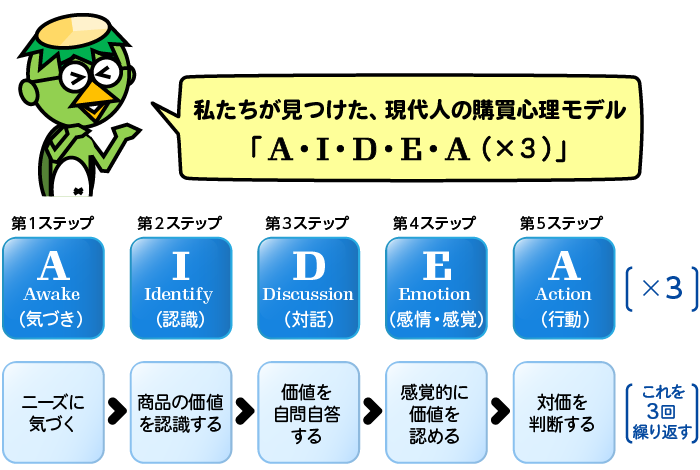
Modern consumers decide to purchase an item by first "recognizing their own needs," then "identifying the product as something that fulfills those needs," next "verifying whether the product truly holds value for them," followed by "positively perceiving the product on a sensory and emotional level," and finally "judging that the product's value exceeds its price." Moreover, they won't ultimately take purchasing action unless this mental process is repeated three times.
Crucially, this model emerged from verifying various "laws." In other words, the "laws" we discovered are the reliable answers for selling products—they guide customers' minds along the "A·I·D·E·A (×3)" path.
...So, for this first installment, we've introduced the full scope of the project. But what you're probably most curious about is the concrete "answer" to how to actually sell products. Therefore, starting next time, over the next six installments, we'll detail the key points and proven "ironclad rules" that move customers' hearts, following each step of "A·I·D·E·A (×3)."
What exactly are these techniques, born from trial and error in direct mail advertising, that tap into people's deep-seated psychology? And what results can you achieve by applying them? We aim to make this series answer those questions, so we'd be delighted if you'd continue reading.
A word from our co-author:
Professor Takeharu Senoo
This collaborative effort was like a mixed martial arts match in psychology. Are the advertising industry's rules truly valid? Or are they just assumptions? Analyzing actual sales data revealed many things. It was an exhilarating collaboration—no, a serious contest. Like pro wrestling, it's about making your opponent shine while securing your own victory. We wrote this with the mindset of making the advertising industry shine while letting psychology win.
Now that the battle is over, I feel refreshed. If reading this series sparks your interest, I'd be honored if you'd also pick up The 7 Laws of Selling Ads and my other works. A new book is scheduled for release by Kobunsha in the fall/winter of 2020. Stay tuned!
Professor Toshihiro Wabuchi
"Why do consumers buy 'that' instead of 'this'? I want to understand the psychology behind it and use that to develop more effective advertising expressions!" This desire sparked a joint research project with Dentsu Kyushu Inc. in December 2015. As we analyzed actual data, we discovered something surprising: the expressions used in mail-order advertising are, in fact, deeply rooted in psychology.
We invite you to read this series, where the advertising industry—aiming to change consumer attitudes—and psychology—exploring the principles of the human mind—come together in perfect harmony.
Was this article helpful?
Share this article


Newsletter registration is here
We select and publish important news every day
For inquiries about this article
Author

Katsuyuki Kazuki
Dentsu Kyushu Inc.
Communication Design Bureau Direct Marketing Department