Note: This website was automatically translated, so some terms or nuances may not be completely accurate.
 Recruitment challenges are management challenges. Bring creativity to recruitment. [5/14]
Exploring the Current State of Science and Engineering Students' Job Hunting and Recruitment Activities
In today's world where innovation is demanded of companies, recruiting science students is essential for creating new businesses and developing existing ones.
However, the job-hunting process for science students is often closed off, and the reality is that even when recruitment activities are conducted similarly to those for liberal arts students, students and companies often fail to match effectively.
How can we achieve job-hunting and recruitment activities that are valuable for both science students and companies?
This series introduces the efforts of Dentsu Inc. Youth Research Department (Dentsu Wakamon), which is redesigning the student job-hunting experience. In this first installment, we explore insights into science and engineering students' job-hunting based on Dentsu Wakamon's research findings.
Science Students' Job Hunting: Different from Liberal Arts Students
In February 2020, Dentsu Inc. Wakamon surveyed 119 students graduating in March 2020 who had completed their job hunting.
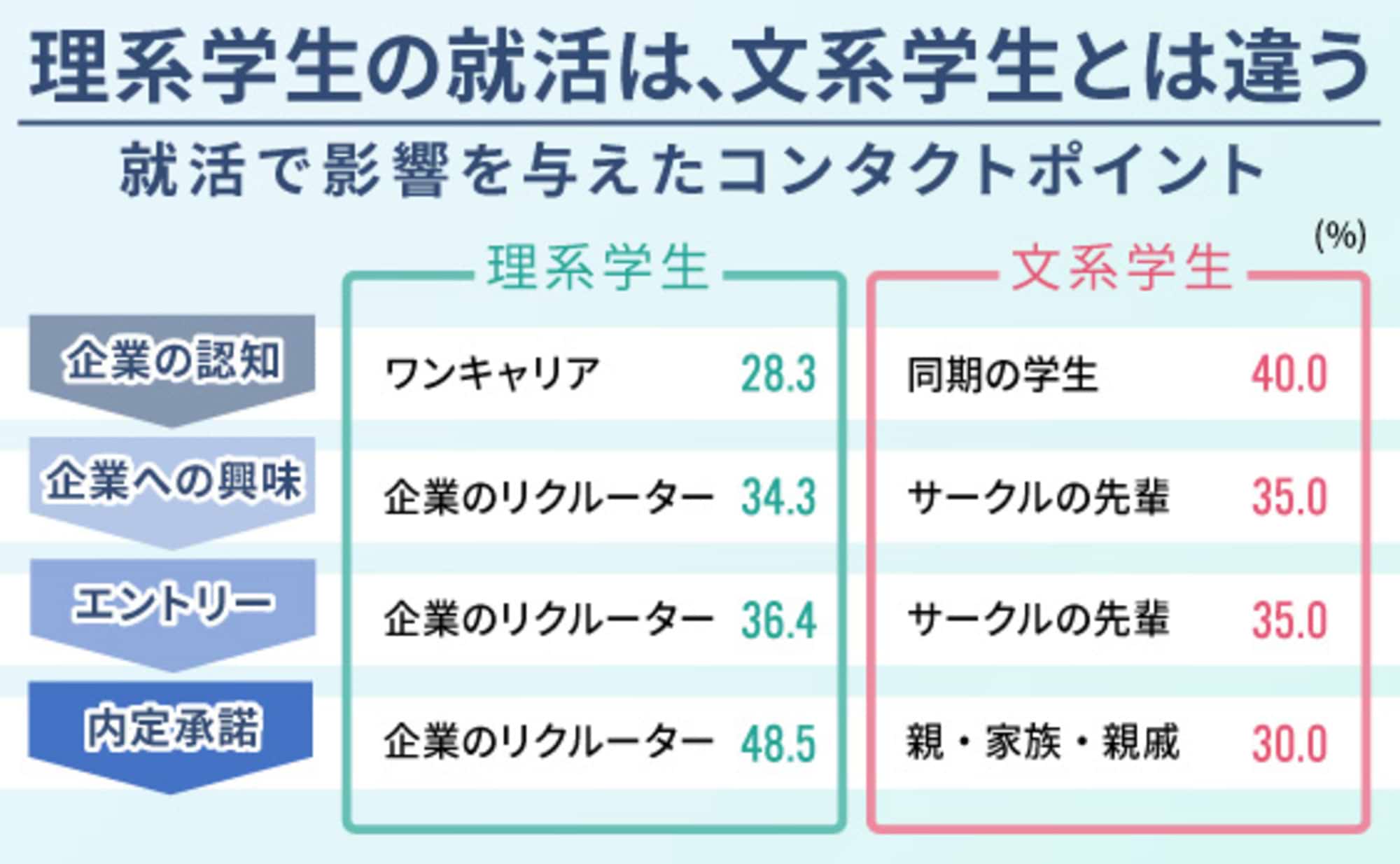
The process from recognizing a prospective employer to accepting a job offer was simplified into four stages. We asked about the contact points that influenced each phase. First, let's look at the results.

For liberal arts students, real-life acquaintances or family members—such as peers, club seniors, parents, family, and relatives—ranked highly from awareness to job offer acceptance. In contrast, for science students, job-hunting services and corporate recruiters ranked highly, indicating these were services and people encountered after starting their job search.
While students are often lumped together as "job seekers," as shown here, the contact points during job hunting differ significantly between liberal arts and science students.
At Dentsu Inc. Wakamon, we conduct daily interviews with both liberal arts and science students. These interviews have revealed the unique, real struggles science students face in their job hunting.
Research for the Lab
This digresses slightly from job hunting, but it's crucial for understanding the situation for science students, so let's explain the structure of research labs.
Students typically pay tuition to attend university for education. Therefore, the fundamental purpose of a research lab (professor) is "to educate students through research."
However, the laboratory (professor) can only secure funding sources—such as research activity funds from the university and joint research funds from companies—by producing results. In this sense, "producing research results" becomes the primary objective for the laboratory (professor).
As a result of this structure, the laboratory's focus often shifts from "educating students" to "producing results." Professors must also handle non-research tasks like regular classes, so students end up doing the hands-on work to generate results for the lab (though many labs successfully balance education and research output).
To achieve results for the lab, students are assigned individual research topics and work on them as researchers. The more results a lab produces, the more it is expected by universities and companies, leading to an increasingly results-oriented environment. Consequently, research hours lengthen, and students find themselves constantly busy with research activities and progress reports. This can result in some labs where students are confined to the lab from morning to night, Monday through Saturday.
Against this backdrop, and due to the inherently high level of specialization in the research itself, students sometimes lose sight of why they are conducting research. Of course, the majority of students are passionate about research and are deeply immersed in it. However, this immersion often leads to research becoming "research for the lab's sake."
"Reputation and relevance to major" become the criteria for choosing companies
This structure leaves many science students with no time for anything outside research, making proper job hunting difficult.
Science students typically choose their research labs around the start of their third or fourth year. The more dedicated students tend to actively seek out labs with proven results or those where peers spend long hours researching, believing these offer better growth environments. At the lab selection stage, they often don't fully grasp the implications for job hunting. Consequently, when the actual job-hunting period arrives, they realize they have no time left for it.
As a result, they not only struggle to participate in the now-standard 3-5 day internships but also have almost no time left for career reflection, self-analysis, or company research.
This lack of time to confront their own future often leads them to choose employers based on vague criteria like "a company with a somewhat familiar name" or "one that seems somewhat related to my research." Even if they start job hunting during research breaks, such as through summer internships, they struggle to balance both and often end up settling for "a company recommended by the school (*) or introduced by alumni."
※ School recommendations are called various things like university recommendations, department recommendations, or professor recommendations. Simply put, it's a system where universities or professors can recommend students to companies. The merits of this school recommendation system are often debated. While I won't go into detail here, opinions include concerns about potential collusion between schools and companies, or that it restricts student freedom. Incidentally, Toyota Motor Corporation recently announced the complete abolition of this system, sparking discussion.
The Misconception of "It's Just Student-Level Busyness"
During job hunting, students are often asked about their "Gakuchika" (activities they focused on during university). Many science students, however, find it difficult to discuss anything beyond their research.
Research topics are highly specialized and often difficult for the general public to grasp. Furthermore, since the research is often conducted solely for the lab, many students only begin to consider the background and purpose of their research once job hunting starts, making it hard to articulate effectively. While some argue that thorough preparation is the solution, few science students pursue liberal arts careers, and time is limited, leading to insufficient preparation for job hunting.
Some science students considering liberal arts careers squeeze in long-term internships at startups between research commitments, but these often only allow for one or two days of work per week.
One student mentioned that when they talked about a long-term internship in their extracurricular activities, they were told, "Why only one or two days a week? You're a student, so you should be doing more." For corporate representatives without a science background, the busyness of science students is often incomprehensible; some even think, "It's just student-level busyness, not like a working adult's."
From "Research for the Lab" to "Research for Society"
Against this backdrop, POL, provider of the science student job-hunting service "LabBase," and Dentsu Inc. Wakamon launched "LabMeets" to create new encounters between research and society.
LabMeets provides new possibilities for students' research by creating a space where they can leverage their research content and tackle real business challenges alongside corporate mentors. In the internship program, professionals in specialized fields, along with Dentsu Inc. planners, support the refinement of project plans. The program is also designed to be accessible to busy science students.
Next time, representatives from POL and Dentsu Inc. Wakamon will share an overview of LabMeets and their motivations for launching the project.
<Survey Overview>
【Source】"Circle Up Survey"
【Survey Period】February 2020
【Survey Subjects】University seniors and second-year graduate students (as of February 2020) registered on the university club-specific app "Circle Up"
[Total Sample Size] 119 respondents
【Survey Area】Nationwide
Was this article helpful?
Share this article


Newsletter registration is here
We select and publish important news every day
For inquiries about this article
Back Numbers

Author
Toshiki Mori
Dentsu Inc.
Second Integrated Solutions Bureau
Solution Planner