Note: This website was automatically translated, so some terms or nuances may not be completely accurate.
 How Have Moms Changed During the Pandemic? ~Emerging New Mom Insights~ [1/3]
How Moms' Attitudes and Spending Habits Changed During the Pandemic!
The pandemic has changed lifestyles worldwide.
Repeated lockdowns, prolonged remote work, and increased time spent at home have significantly altered people's mindsets and behaviors.
Among them, mothers with young children seem to be flexibly adjusting their values regarding childcare and daily life compared to before the pandemic.
Dentsu Inc. Mama Lab collaborated with CONNECT to analyze data from the "Family Notebook," which compiles voices from the popular nationwide mom app "Mamari" (*). Additionally, Mama Lab conducted its own survey to explore the new values emerging among moms.
※Mamari
An information site operated by CONNECT Inc. themed around "supporting moms' next steps," solving questions and worries about fertility, pregnancy, childbirth, and childcare. It shares information daily to address moms' anxieties and concerns.
This series will cover changes in moms' attitudes and behaviors during the pandemic over three installments. Part 1 focuses on shifts in moms' attitudes toward money and consumption trends.
【Mama Lab】
A work tank that sincerely engages with the true feelings of mothers and children to propose solutions. Established in 2008 with the vision: "We want to revitalize the next-generation family market by focusing on the mother's perspective." It predicts the future direction of mothers, children, and families, providing real insights and solutions to help numerous companies and organizations solve business and social challenges.
Make household management a little richer and more fun with "Poi-katsu"!
Amidst the pandemic's impact on work styles and significant household finances, new trends in moms' attitudes toward money are emerging.
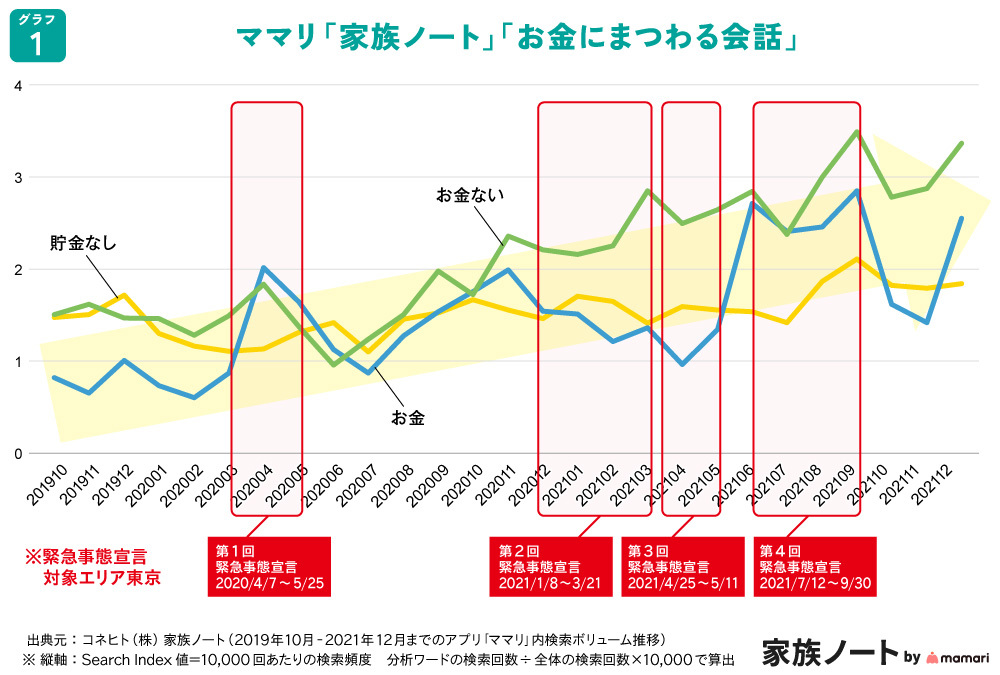
Graph 1 shows search terms within the Mamari app. It clearly reveals that searches like "no money" increased significantly within the moms' community after the first state of emergency declaration.
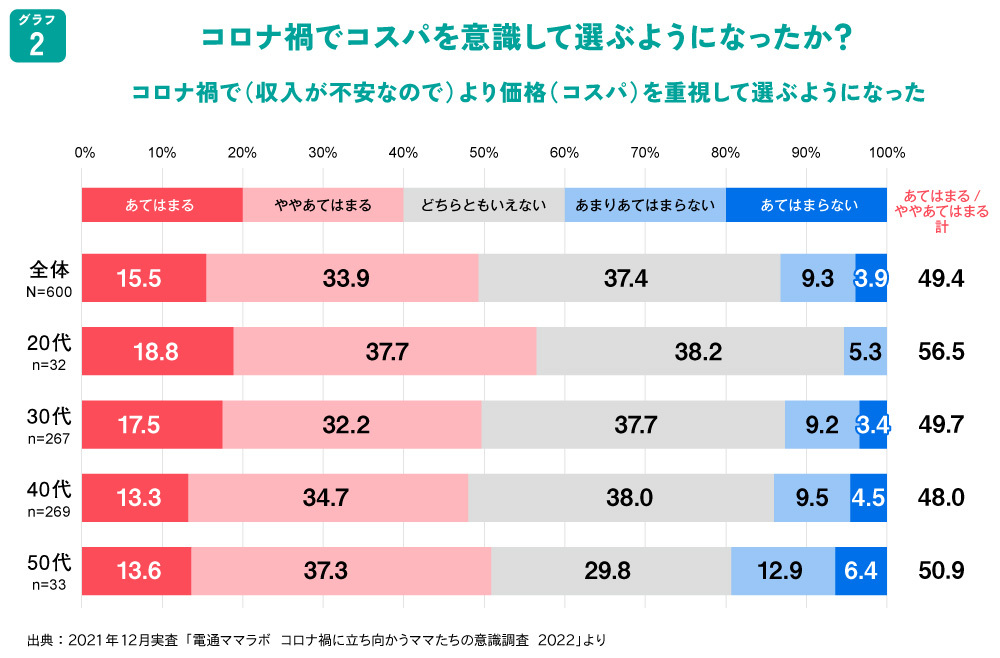
In the "Survey on Moms' Attitudes Toward the Pandemic" conducted by Mama Lab in December 2021, nearly half of all respondents answered "applies" or "somewhat applies" to the statement "Due to the pandemic (income uncertainty), I now place greater emphasis on price (value for money) when making choices." (Graph 2)
The proportion answering "applies" was particularly high among younger moms: 18.8% for moms in their 20s and 17.5% for moms in their 30s.
Moms in the Reiwa era are a generation comfortable with "palm-sized consumption" – efficiently using spare moments in daily life to handle all family and personal shopping and information gathering via smartphone.
Furthermore, influenced by the recent decluttering boom and trends toward simple, minimalist living, there is a growing awareness among moms to avoid owning more than necessary.
They judge that even secondhand items hold value if they meet their family's needs. They skillfully utilize new purchasing channels beyond major retailers, such as apps for buying and selling unwanted household items, to keep costs down and shop smart. Reviewing their lifestyles during stay-at-home periods may have heightened their awareness of the "balance of value obtained for the price paid."
Furthermore, a survey by Dentsu Inc. Mama Lab titled "Survey on Moms' Attitudes in Confronting the Pandemic" revealed an increase in "point-earning activities" (poi-katsu), where moms efficiently accumulate and use points when shopping.
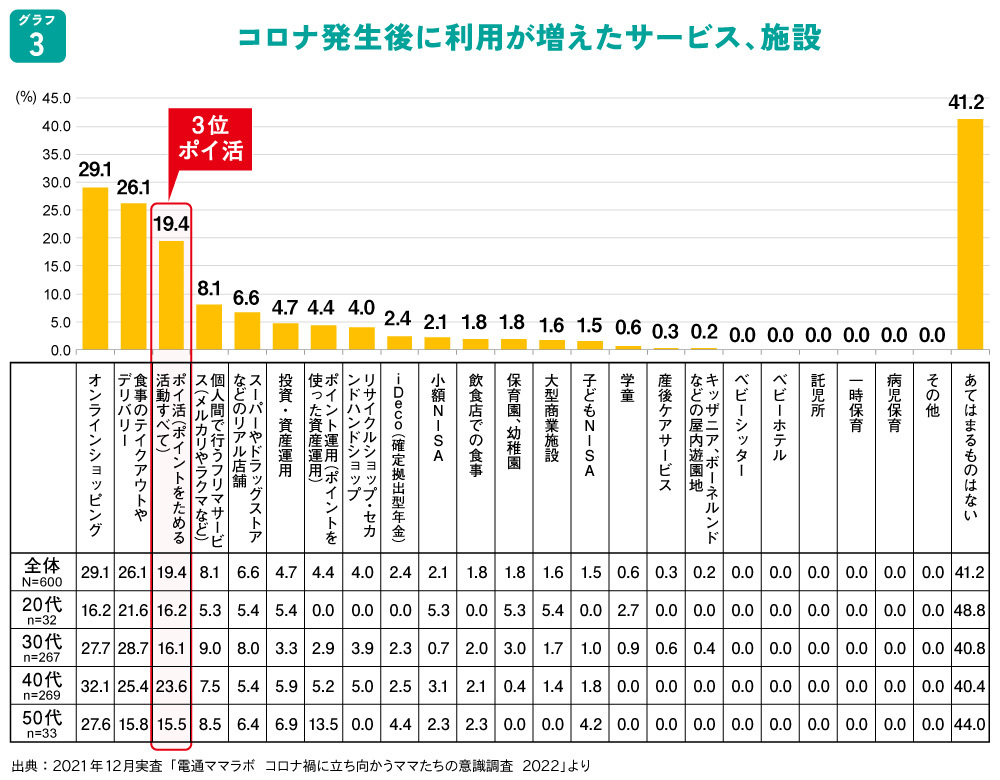
When asked about services used more frequently after the pandemic began, "online shopping" ranked first at 29.1%, followed by "takeout or delivery meals" at 26.1%. "Point activities" came in third at 19.4%. (Graph 3)
Additionally, point management ranked seventh at 4.4%, indicating the growing adoption of new consumption activities and household management approaches, such as using points for shopping or investment. This reflects how mothers are skillfully managing their household finances despite reduced income.
In recent years, it has become possible to earn points not only in physical settings like supermarkets and convenience stores but also through online shopping and app usage. Moms are increasingly focused on how to earn points by using apps during purchases aligned with campaigns and how to use those points wisely.
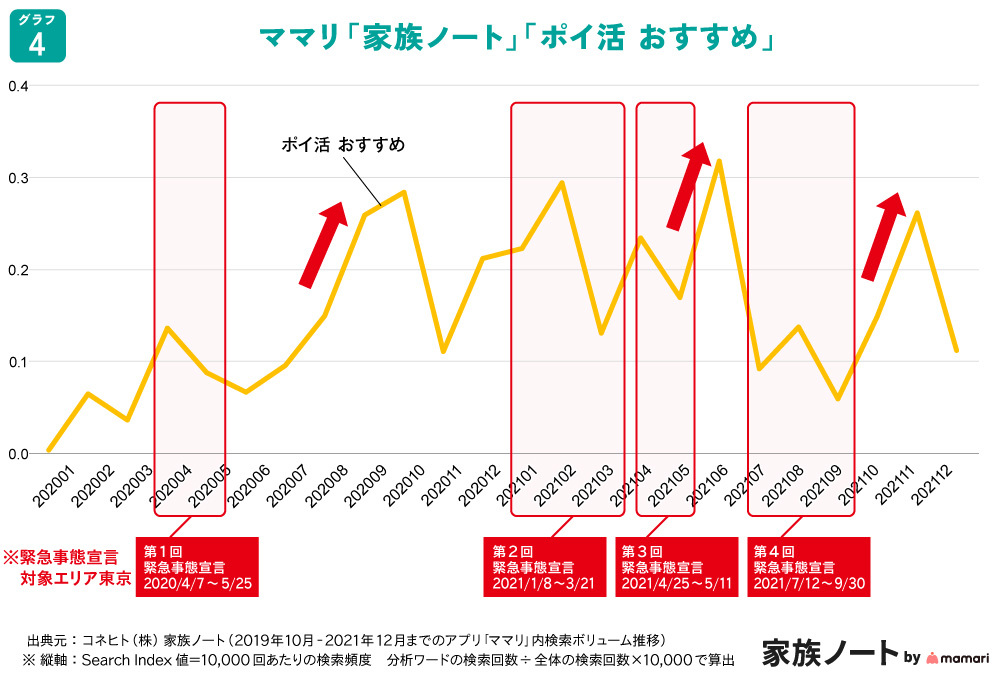
On Mamari, searches for the term "point activities recommendations" have increased since the 2020 state of emergency declaration, indicating growing interest in point activities. (Graph 4)
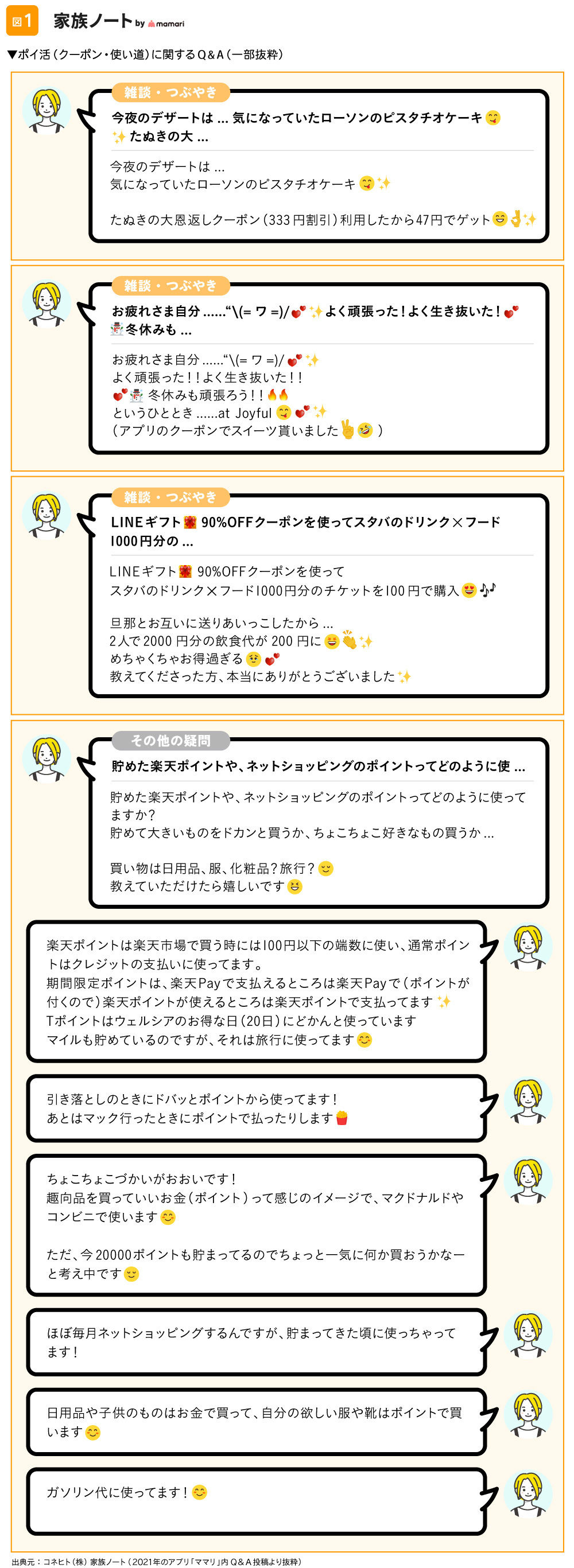
Furthermore, looking at comment examples submitted to Mamari (Figure 1) clearly shows what kinds of point activities moms are doing.
Their point-earning methods seem to involve using multiple systems simultaneously, such as Rakuten Market, LINE, d Payment, credit card payments, and smartphone-based accumulation systems.
While some use points for living expenses like "gasoline costs" or "pharmacy sales," others use them guilt-free for small personal treats, such as "buying daily necessities and using points for my own clothes or shoes" or "using app coupons to buy sweets." This shows they are finding ways to enrich their lives even while saving. Moms in the Reiwa era seem to cherish the mindset that "If moms keep sacrificing, isn't that bad for the family too?" and "Let's find a better way to keep going without pushing ourselves too hard!" They appear to be enjoying their lives.
"Preparing for the future," "getting through COVID," and "enriching family time" are key selection criteria.
Next, let's look at the purchasing characteristics of moms in their 20s and 30s.
Regarding "items/services newly purchased since the pandemic began" (Graph 5), a higher proportion of moms in their 20s and 30s chose "savings/insurance/investments for children." They appear to be diligently saving for their children's future.
Another characteristic is that "children's clothing and accessories (with anti-COVID features like antibacterial properties)", "leisure/travel", and "automatic cooking appliances" are more prominent compared to moms in their 40s and 50s.
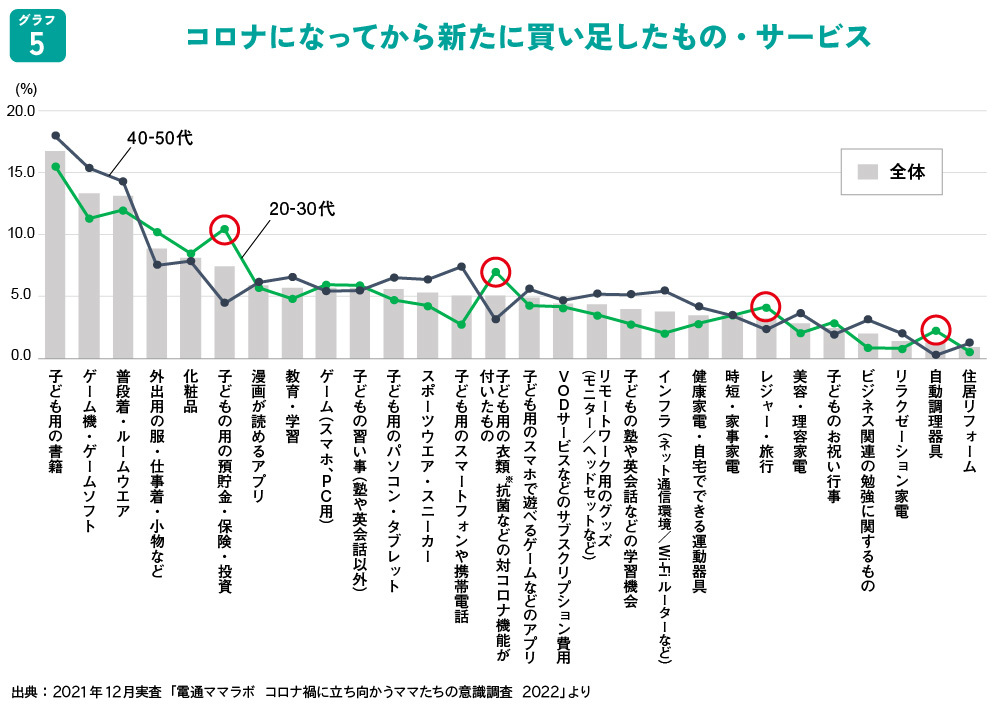
While not numerous, automatic cooking appliances also seem to interest moms in their 20s and 30s. Products like these, which cook meals simply by adding chopped ingredients, may be seen as necessary for keeping the family smiling amidst a stifling lifestyle, even if the price is high.
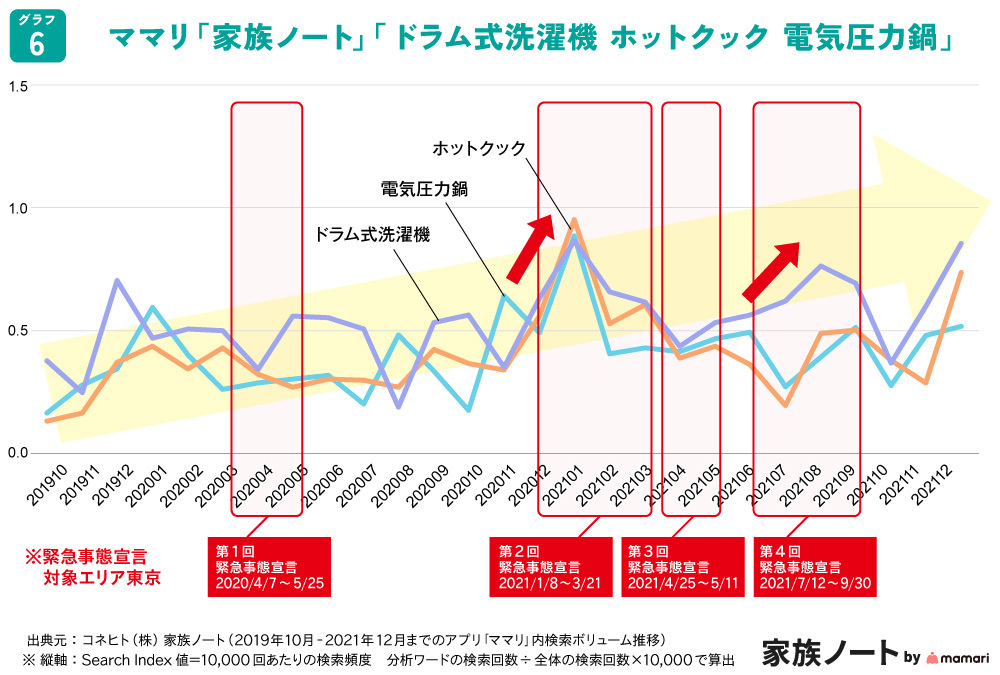
Data from Mamari's "Family Notebook" (Graph 6) also shows searches for high-end appliances like "drum-type washing machines" and "Hot Cook" surged during the stay-at-home period under the second state of emergency in 2021. After a lull, searches increased again during the stay-at-home period under the fourth state of emergency starting in July 2021.
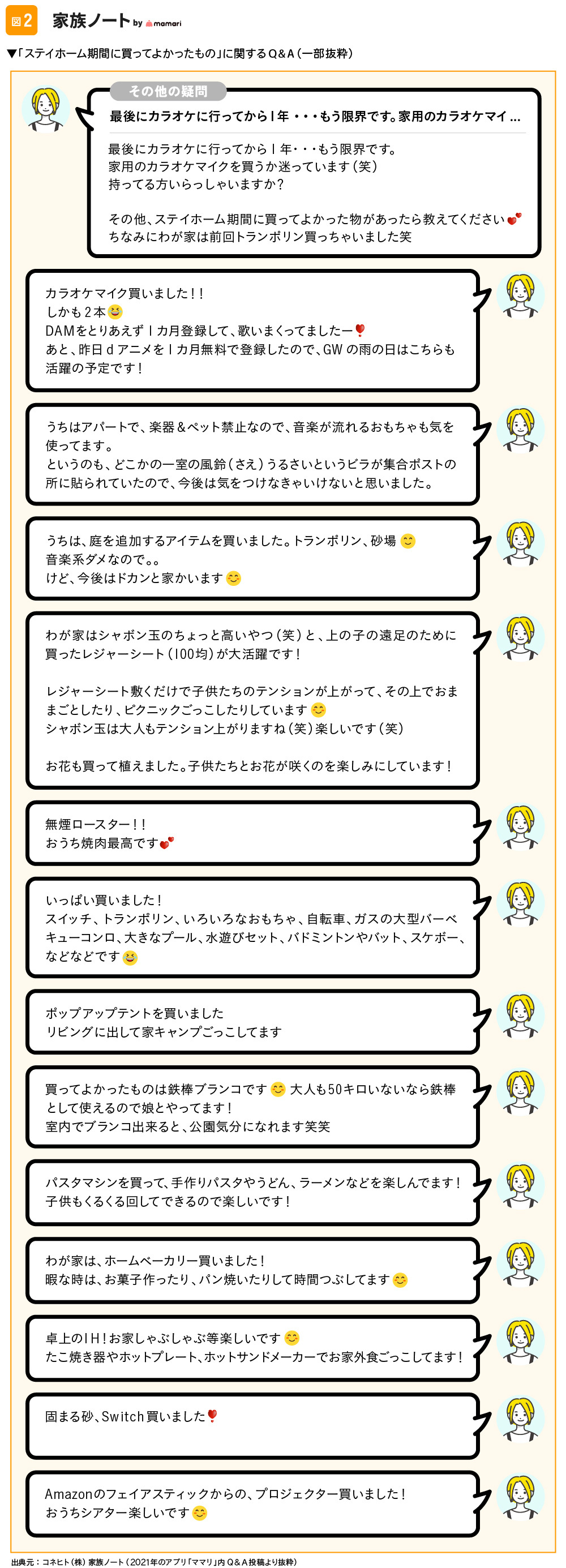
Additionally, according to Mamari's "Family Notebook" section on "Items Worth Buying During Stay-at-Home Periods" (Figure 2), items like karaoke microphones and garden play equipment were popular, alongside home bakery machines, pasta machines, smokeless roasters, and takoyaki makers – items that let families enjoy restaurant-like experiences at home.
It's clear that because stay-at-home orders and remote work increased family time together, items that "enrich family time" have become an important purchasing criterion during the pandemic.
This time, we examined the changes in money awareness and consumption trends among moms. It became clear that even amidst the hardships of the pandemic, moms are striving to find ways to stay positive and discover things they can enjoy themselves.
They tighten their belts where necessary, yet invest in enriching family time even if it costs a bit more. This flexibility in moms' approach is becoming apparent.
Next time, we'll explore changes in attitudes toward children's extracurricular activities during the pandemic.
[Survey Overview]
Survey Method: Online survey
Survey Participants:
◆Screening※Samples collected to match the demographic composition of women aged 20-59 with children
・Women aged 20-59 with children (DB-registered as "with children")
◆Main Survey
・Women with children
・Living with spouse + children (youngest child aged 0–junior high school)
Survey Area: Nationwide
Survey Period:
◆Screening: Tuesday, December 14, 2021 - Sunday, December 19, 2021
◆Main Survey: December 17 (Fri) to 19 (Sun), 2021
Sample Size: 600 samples
Survey Implementation: Dentsu Macromill Insight, Inc.

Was this article helpful?
Share this article


Newsletter registration is here
We select and publish important news every day
For inquiries about this article
Author

Akiko Nakayakuma
Dentsu Inc.
Mama Lab Chief Researcher
For many years in the marketing field, I have managed clients across diverse industries including food, beverages, daily necessities, cosmetics, pharmaceuticals, precision instruments, telecommunications, insurance, education, distribution, and finance, focusing on brand strategy and business expansion. My experience with products for mothers includes diapers, baby food, shampoo, cosmetics, educational programs, beverages, insurance, and food.



Rin Tai
Dentsu Inc.
Mama Lab Principal Researcher/Solution Planner
Engaged in strategic planning across diverse fields including cosmetics, quasi-drugs, home appliances, and automotive manufacturers. Also handles upstream projects related to management strategy, such as global initiatives and new business development. Currently active as a member of "Dentsu FemTech and BEYOND.", an internal cross-functional organization established in 2021 that proposes various femtech solutions.