Note: This website was automatically translated, so some terms or nuances may not be completely accurate.
 How Have Moms Changed During the Pandemic? ~Emerging New Mom Insights~ [2/3]
Voices of moms navigating their children's education in unprecedented times
This series explores changes in moms' attitudes and behaviors during the pandemic.
Dentsu Inc. Mama Lab collaborated with CONNECT to analyze data from the "Family Notebook," which compiles voices from the popular nationwide mom app "Mamari" (*). Additionally, Mama Lab conducted its own survey to explore the new values emerging among moms.
※Mamari
An information site operated by CONNECT Inc. themed around "Supporting Moms' First Steps," solving questions and worries about fertility, pregnancy, childbirth, and childcare. It shares information daily to address moms' anxieties and concerns.
This time, we report on how the COVID-19 pandemic has influenced moms' attitudes toward extracurricular activities and online learning.
【Mama Lab】
A work tank that sincerely engages with the true feelings of mothers and children to propose solutions. Established in 2008 with the vision: "We want to revitalize the next-generation family market by focusing on the mother's perspective." It predicts the future direction of mothers, children, and families, providing real insights and solutions to help numerous companies and organizations solve business and social challenges.
Moms' attitudes toward extracurricular activities are shifting to compensate for "children's reduced opportunities for physical activity"
Children's physical fitness has declined due to the COVID-19 pandemic. Graph 1 shows the results of physical fitness tests conducted by the Japan Sports Agency from April to July 2021 (Reiwa 3) on fifth-grade elementary school students and second-grade junior high school students nationwide. These results clearly show a decrease in the total physical fitness scores for both boys and girls compared to the pre-pandemic survey conducted in 2019 (Reiwa 1).
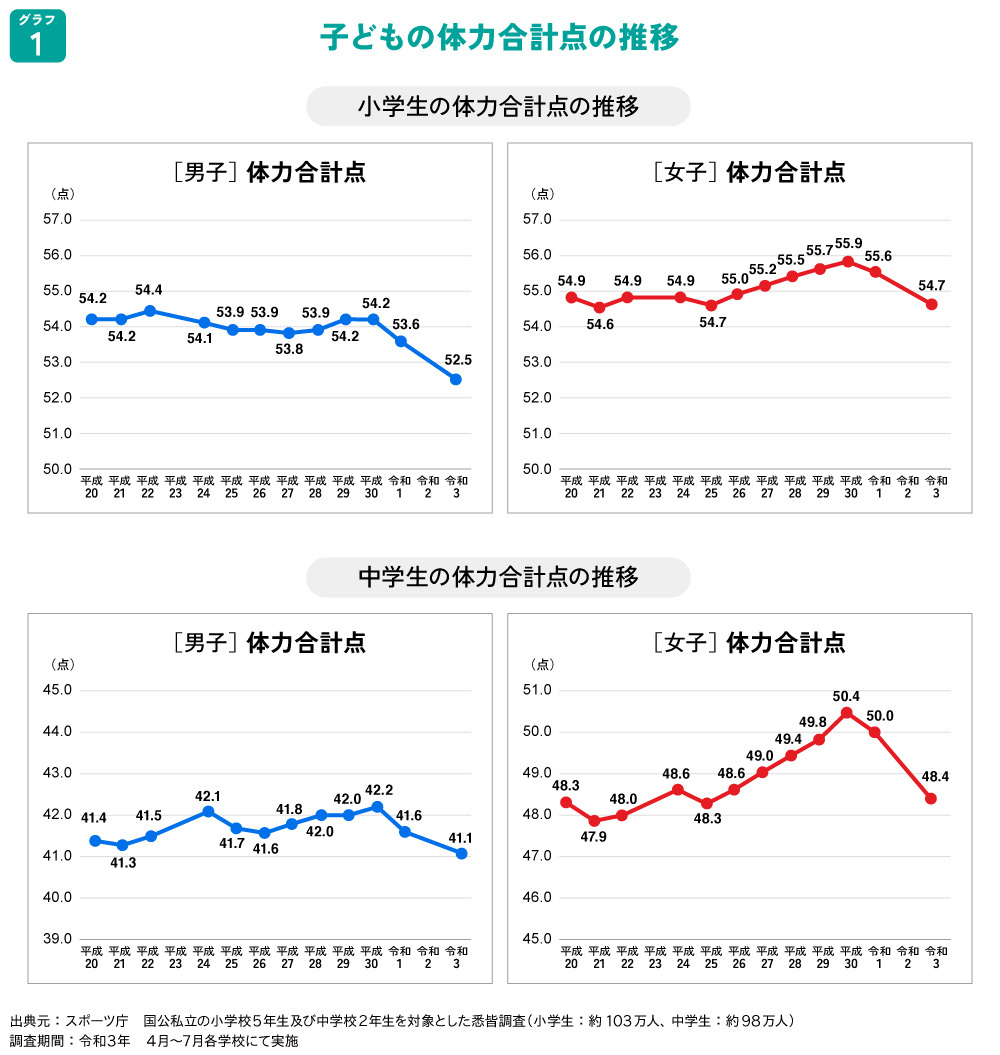
The Sports Agency announced that the pandemic has accelerated this decline in physical fitness. It attributes this primarily to reduced opportunities for physical fitness development, as physical education classes, club activities, and sports festivals at schools were restricted to prevent the spread of COVID-19.
Mothers seem to share a strong sense of crisis about this decline in children's physical fitness, stemming from reduced opportunities for physical development in daycare centers and schools.
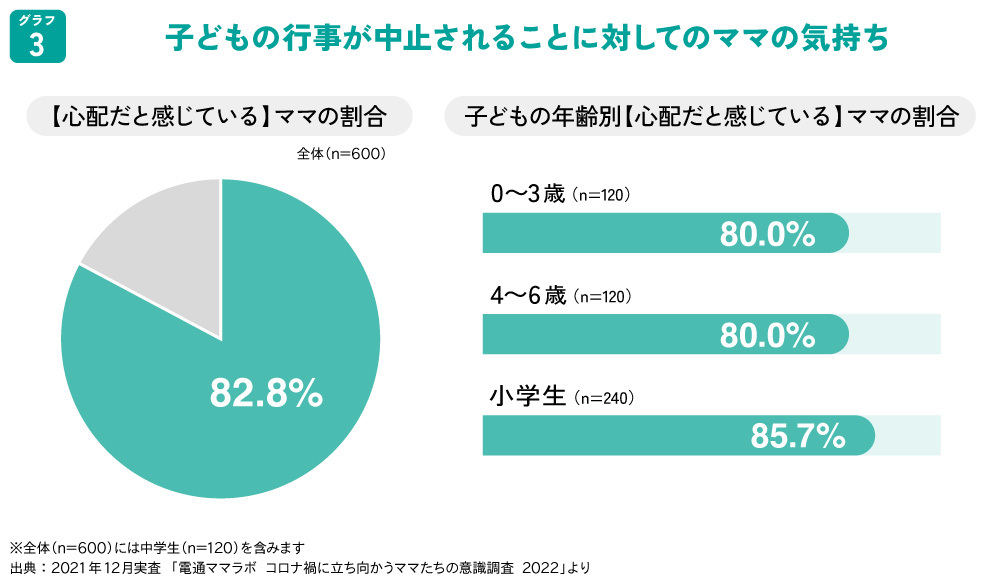
Indeed, in Mama Lab's original survey "Survey of Mothers Facing the COVID-19 Pandemic," when asked about "Changes in Children's Physical and Mental Health After the Pandemic Started" (Graph 2), 72% of respondents answered that they "think their child is not getting enough exercise." Additionally, over 60% reported that their child "has become more easily fatigued recently."
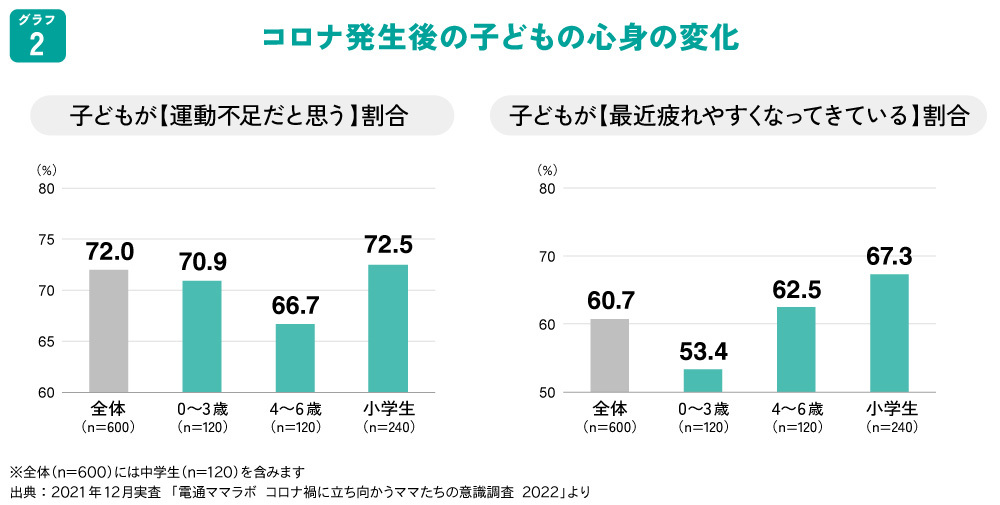
Furthermore, looking at Graph 3, over 80% of mothers expressed concern that the cancellation of events like cultural festivals and sports days means "losing opportunities for children to have diverse experiences."
Data within the Mamari app also reflects these concerns. Since 2021, searches related to extracurricular activities have surged despite the pandemic.
Furthermore, Graph 4 shows an analysis of questions containing the term "extracurricular activities" within the Mamari community, presenting the monthly frequency of posts containing "extracurricular activities."
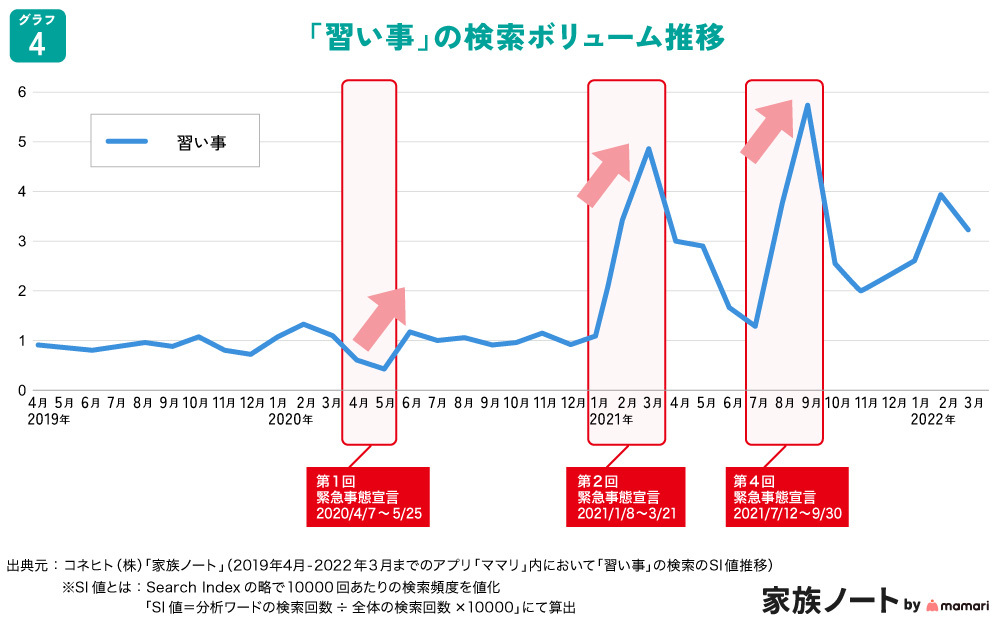
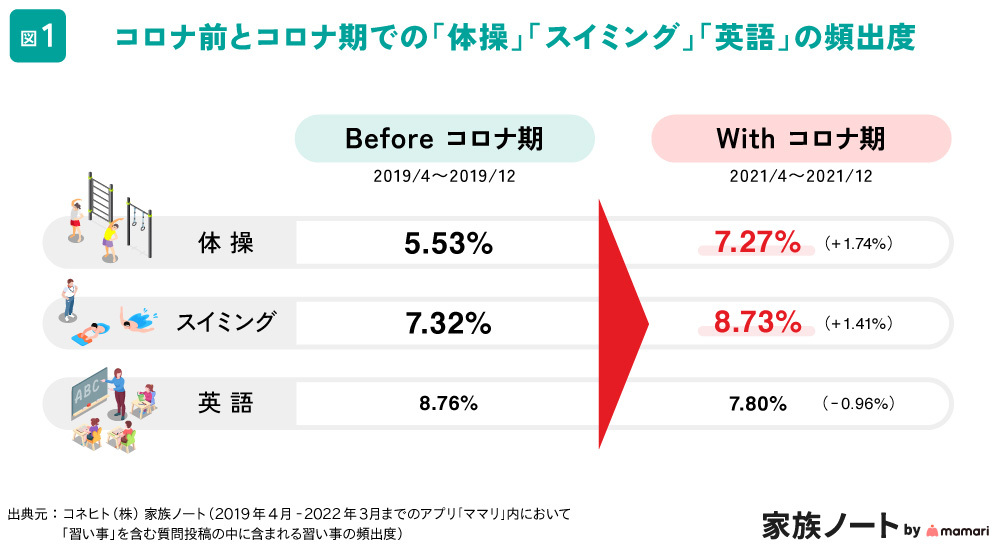
Figure 1 compares the frequency of "gymnastics," "swimming," and "English" in posts related to extracurricular activities before the pandemic and during its peak. It shows that while "English" was more frequent before the pandemic, the appearance rate of physical activities like "swimming" and "gymnastics" increased in 2021. This further indicates a growing desire to enroll children in physical activities to increase opportunities for physical exercise.
Mama Lab's original survey, "Survey of Moms Facing the Pandemic," also asked about "activities they want their children to experience (even just once)". Over 24% of all moms responded that they wanted their children to experience sports or physical activities, with moms of children aged 4-6 showing the highest rate at 35%.
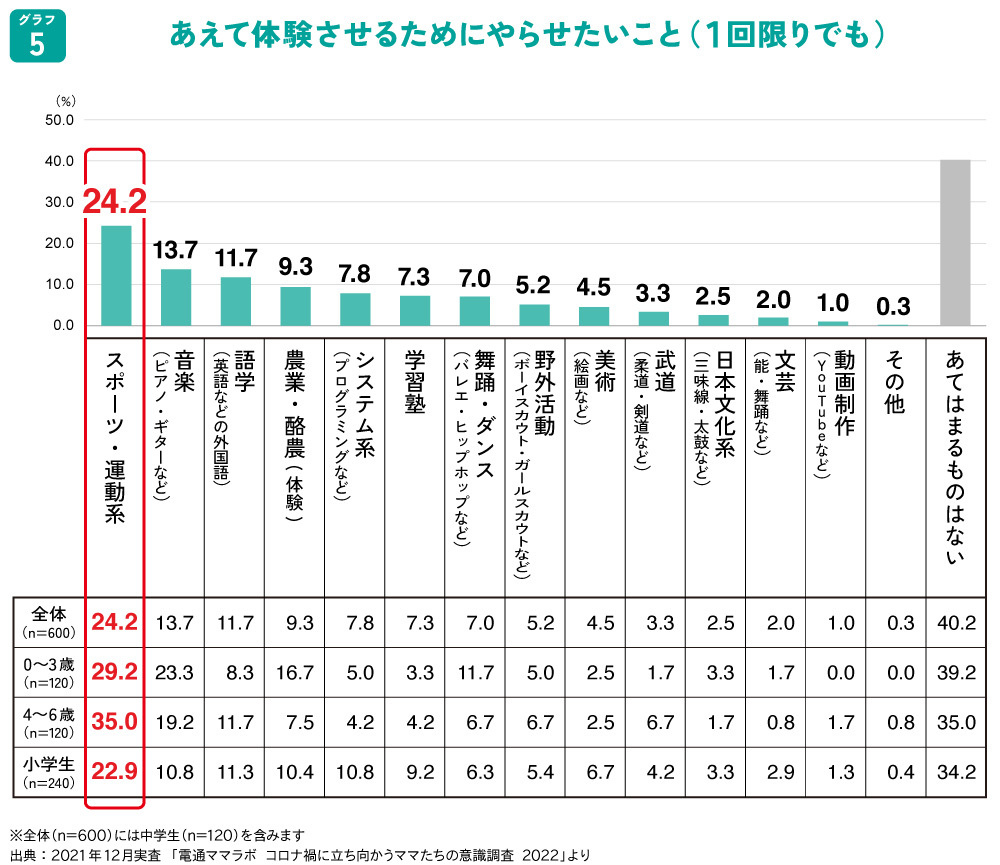
As shown above, during the pandemic, mothers' attitudes shifted toward prioritizing physical activities when considering extracurriculars for children whose physical fitness had declined.
Even amidst the pandemic, creating environments where children can maintain their physical strength, and flexibly arranging age-appropriate exercise opportunities and new experiences tailored to the COVID situation may be what our "with COVID" society demands.
New forms of extracurricular activities born during the pandemic and mothers' struggles
The pandemic accelerated the adoption of digital environments, leading to an increase in extracurricular activities utilizing computers and tablets.
In recent years, the introduction of "EdTech" – a portmanteau of Education and Technology – has gained significant momentum in Japan, becoming a key driver set to profoundly transform future educational environments. However, opinions on the digitization of children's education remain divided. While moms actively exchange views among themselves, a MOM LAB survey suggests they are not yet unreservedly welcoming one-sided online learning.
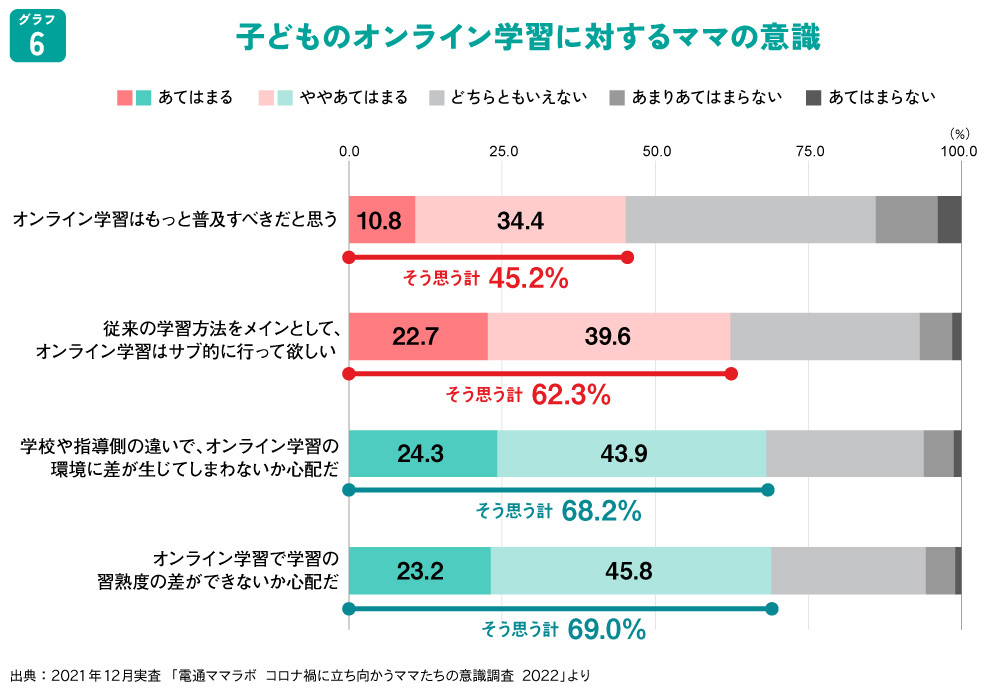
In the "Survey of Moms Facing the Pandemic," when asked, 45.2% responded that "online learning should become more widespread" (combining "agree" and "somewhat agree," same below). Approximately half are positive about its spread. However, 62.3% responded, "I want traditional learning methods (using paper and textbooks) to remain the main approach, with online learning as a supplement." This shows many moms still have reservations about all learning processes becoming online.
Why do they feel this way? Concerns about learning proficiency and environment are significant: "I worry online learning might create disparities in learning proficiency" (69%), and "I worry differences in schools or teaching staff might create disparities in online learning environments" (68.2%). Nearly 70% of moms express anxiety about these issues. Tailored follow-up support for individual proficiency levels and ensuring equitable learning environments appear to be crucial elements for the future development of online learning.
On the other hand, it's also true that some moms are beginning to see the benefits of learning and extracurricular activities that can be done online.
Interviews with mothers who have their children participate in online learning or lessons revealed the following opinions.
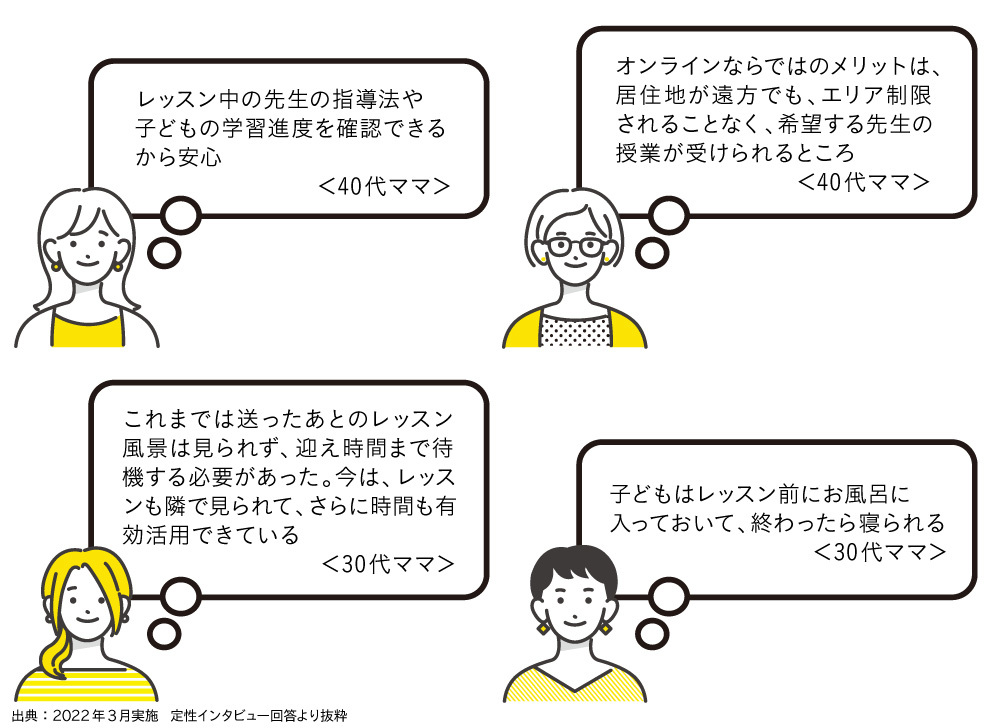
Beyond the opinions above, online lessons offer benefits such as flexibility without geographical restrictions, and the ability for both children and parents to use their time effectively. It also seems that having children take online lessons improves the quality of time spent at home, rather than having them watch more TV during stay-at-home periods.
Online lessons are still in their early stages of adoption, but they are drawing attention for challenging traditional extracurricular norms with their flexible scheduling, adaptable lesson content, and the option for parent-child participation.
As described above, moms seem to be exploring online learning and extracurricular activities, which are still developing. The insight from moms who want their children to attend activities with real-life interaction is that they hope their children will learn interpersonal skills by being in an environment where they can strive together with peers toward a goal.
Moving forward, it seems necessary to consider how to refine online lesson programs, services, and systems to meet these mothers' needs.
At Mama Lab, while paying close attention to moms' insights, we will continue to explore how to create truly beneficial learning experiences for children.
[Survey Overview]
Survey Method: Online survey
Survey Participants:
◆Screening※Sampled to match the demographic composition of women aged 20-59 with children
・Women aged 20-59 with children (DB-registered as "with children")
◆Main Survey
・Women with children
・Living with spouse and children (youngest child aged 0–junior high school)
Survey Area: Nationwide
Survey Period:
◆Screening: Tuesday, December 14, 2021 - Sunday, December 19, 2021
◆Main Survey: December 17 (Fri) to 19 (Sun), 2021
Sample Size: 600 samples
Survey Implementation: Dentsu Macromill Insight, Inc.

Was this article helpful?
Share this article


Newsletter registration is here
We select and publish important news every day
For inquiries about this article
Author

Akiko Nakayakuma
Dentsu Inc.
Mama Lab Chief Researcher
For many years in the marketing field, I have managed clients across diverse industries including food, beverages, daily necessities, cosmetics, pharmaceuticals, precision instruments, telecommunications, insurance, education, distribution, and finance, focusing on brand strategy and business expansion. My experience with products for mothers includes diapers, baby food, shampoo, cosmetics, educational programs, beverages, insurance, and food.



Rin Tai
Dentsu Inc.
Mama Lab Principal Researcher/Solution Planner
Engaged in strategic planning across diverse fields including cosmetics, quasi-drugs, home appliances, and automotive manufacturers. Also handles upstream projects related to management strategy, such as global initiatives and new business development. Currently active as a member of "Dentsu FemTech and BEYOND.", an internal cross-functional organization established in 2021 that proposes various femtech solutions.