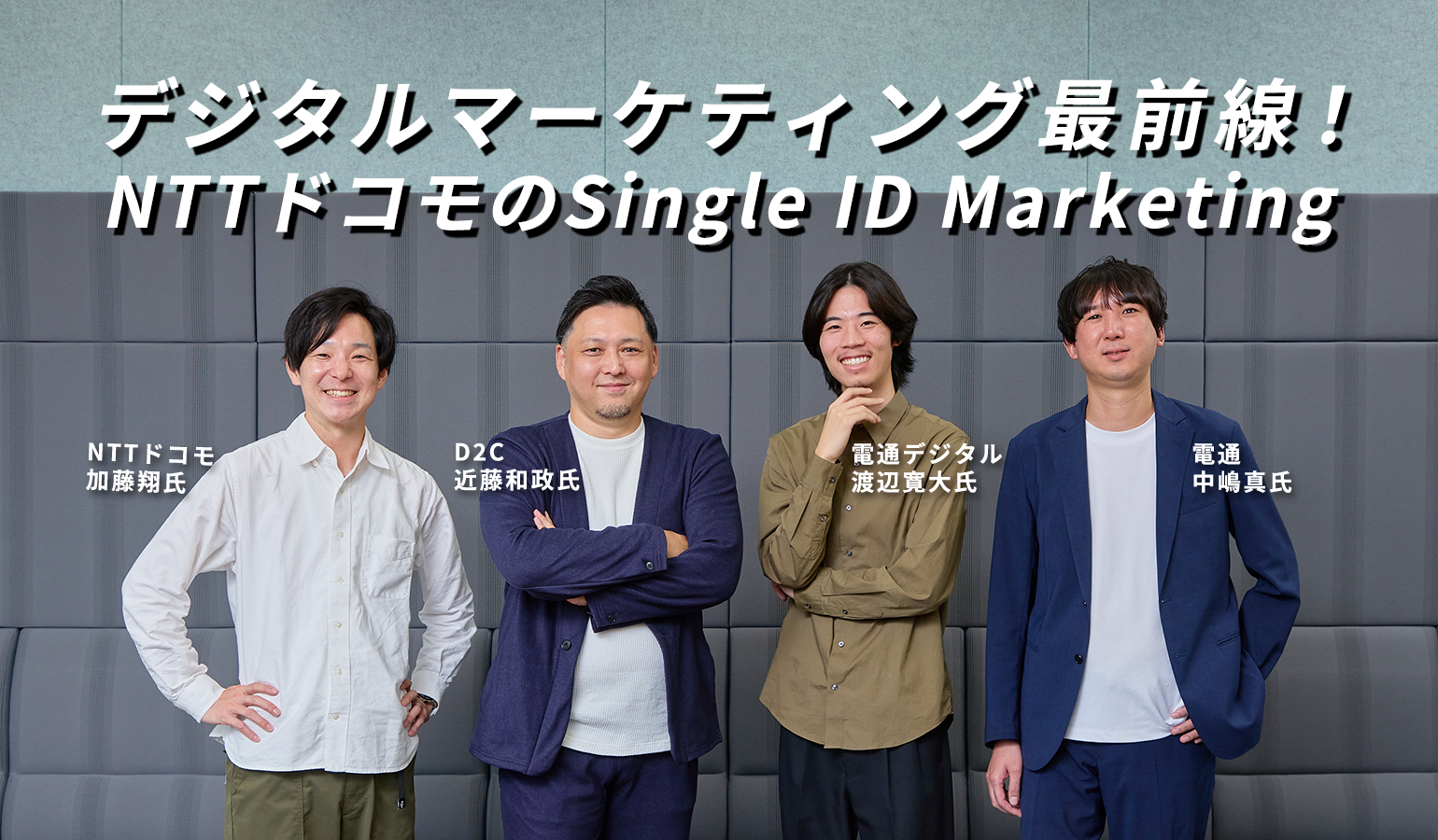
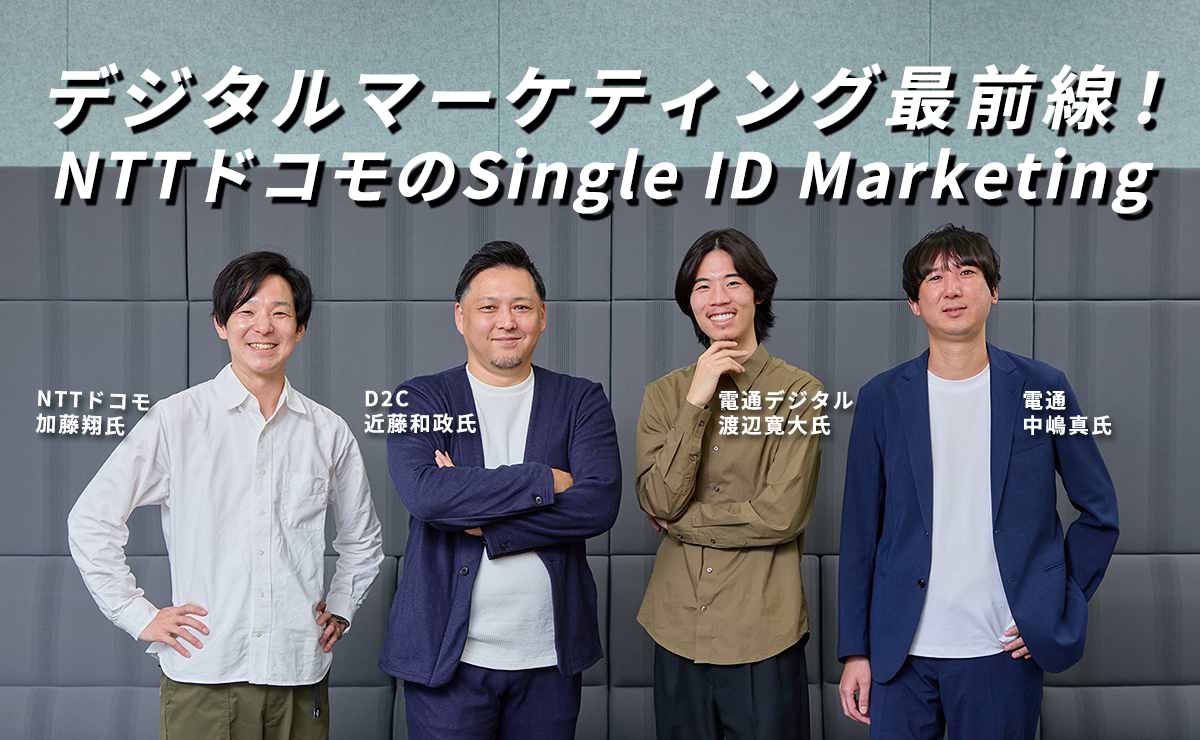
From left: NTT Docomo's Sho Kato, D2C Inc.'s Kazumasa Kondo, Dentsu Digital Inc.'s Hirohiro Watanabe, Dentsu Inc.'s Makoto Nakajima
Delivering a "personalized experience" to each and every customer. Many people likely consider this one of the ideals in digital marketing.
This is becoming a reality through "docomo data square" (hereafter dds), a data clean room built on Docomo's data.
dds enables the utilization of "docomo data"—user data covering approximately 100 million people—by linking it to a single common ID per person and combining various data points for marketing purposes.
While AI-driven operations and optimization on advertising platforms continue to evolve, "Since competitors use the same algorithms, results end up indistinguishable, and CPA (Cost Per Acquisition) improvements plateau." This could be one solution to that dilemma.
What is the capability of dds that can protect user privacy while also providing rich customer experiences?
This article presents a roundtable discussion featuring: Sho Kato, responsible for data marketing promotion at NTT DOCOMO; Kazumasa Kondo, Product Lead for "D2C Data Connect" (DDC) at D2C Inc.; Hirohiro Watanabe, responsible for promoting the utilization of DOCOMO assets at Dentsu Digital Inc.; and Makoto Nakajima, involved in data solution development at Dentsu Inc.
They discussed current specific initiatives, approximately five years after the release, and the evolved delivery menu, sharing examples.
The Accelerating Fragmentation of Data and Services: Is Delivering Personalized Customer Experiences Becoming More Difficult?
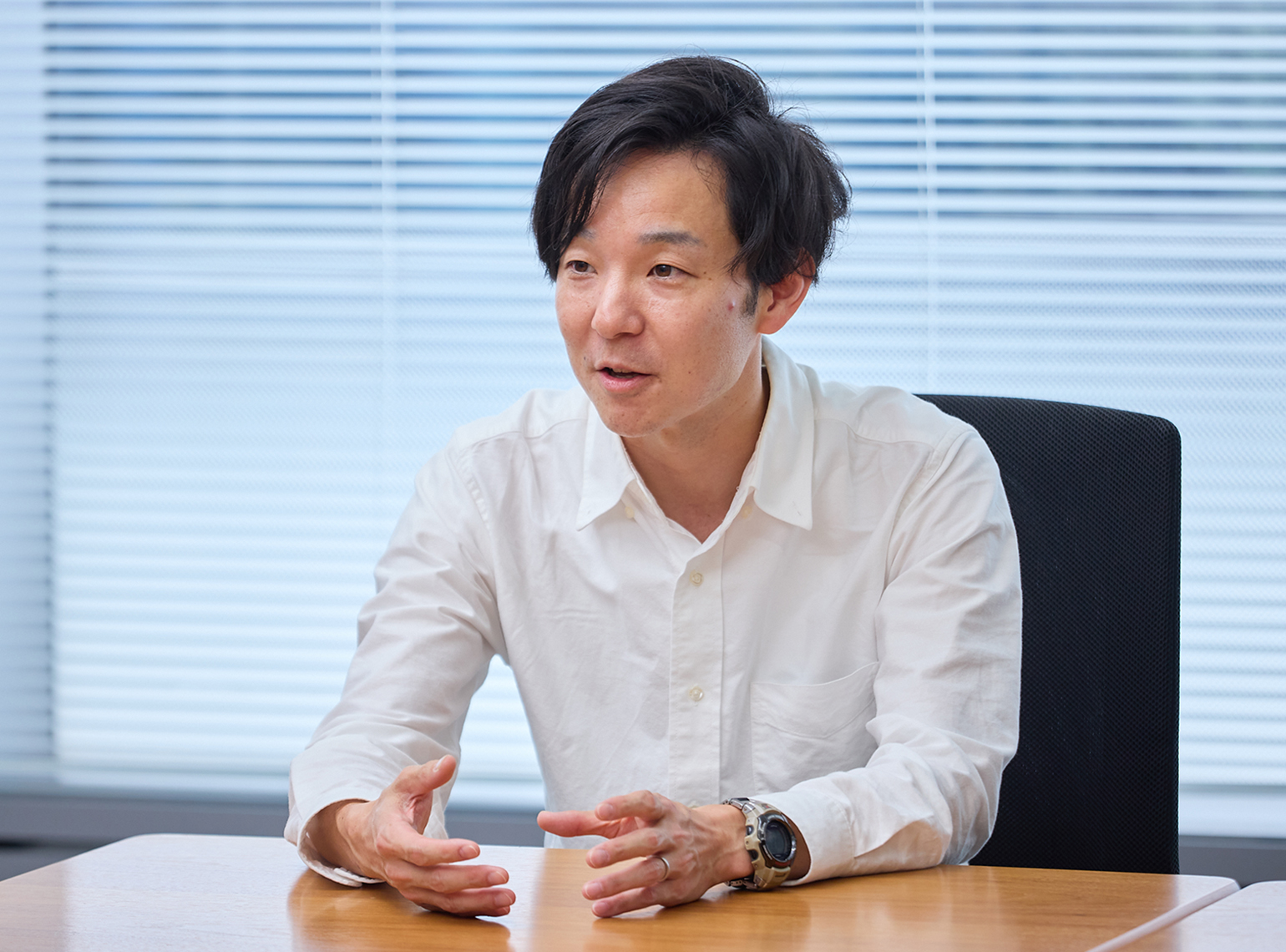
Shou Kato, NTT DOCOMO
Nakajima: Currently, within dentsu Japan (the domestic Dentsu Group), a significant number of clients are utilizing Docomo data. Today, under the theme "Single ID Marketing Realized with Docomo Data," we'd like to hear from dds and "D2C Data Connect" (hereafter DDC) about their current usage.
First, let me introduce myself. I belong to Dentsu Inc.'s Data & Technology Center. I primarily develop solutions utilizing data, and within that, I am responsible for dds, one of our data clean rooms.
Kato: I'm Kato from NTT DOCOMO (hereafter DOCOMO). I'm a manager in the Data Marketing Promotion team. I plan services utilizing DOCOMO data and participate in joint ventures launched with various companies, contributing a data-driven perspective.
Kondo: I'm Kondo from D2C Inc. I serve as the Product Lead for DDC, a product that uses Docomo data and delivers it to external platforms like Google and Meta.
Watanabe: I'm Watanabe from Dentsu Digital Inc., part of the Docomo Group (*). Within Dentsu Digital Inc., I promote the utilization of Docomo's assets.
※Dentsu Group = A team within Dentsu Digital Inc. responsible for advertising delivery and operations using Docomo platforms like dds. Other teams exist for each platform.
Nakajima: First, could Mr. Kato from Docomo speak about the challenges corporate marketing currently faces?
Kato: As marketing methods have become increasingly digital and diverse, we frequently receive requests from various NTT DOCOMO clients expressing a desire to "deliver personalized experiences to each and every customer."
However, a major global trend is the increasing importance of personal information protection. The shift towards cookie-less environments and walled gardens, coupled with the accelerating fragmentation of data and services, has made delivering "personalized experiences for each user" increasingly difficult.
Additionally, machine learning, including generative AI, has been increasingly adopted in the marketing industry in recent years.While this has automated and streamlined advertising and marketing initiatives, increasing convenience, it also makes it difficult to fully explain the reasons behind the results. Understanding "why" a particular initiative was effective and using that insight to properly execute the PDCA cycle becomes challenging. AI can deliver good numbers, but if humans don't understand the underlying reasons, it's hard to translate that into the next initiative. I believe these are challenges not just for us, but for the entire marketing industry.
Nakajima: So, one solution to these challenges is leveraging "Docomo Data," right?
Kato: Docomo Data is a system where various data—from Docomo services and both online and offline sources—is linked to the "d account" assigned to Docomo users within the "Docomo economic sphere." As we'll discuss later, it also connects and integrates with external platforms like Google and Meta.
Nakajima: Could you also explain the relationship between the term "docomo users" used here and docomo data?
Kato: Within the "Docomo economic sphere," users possessing a d account are referred to as Docomo users. This account is treated as a single ID, to which all relevant data is linked. The entirety of this linked data, along with data analyzed by cross-referencing it with other sources, is what we call Docomo Data.
By leveraging Docomo Data, which is guaranteed in both quality and quantity, we can deliver more accurately personalized experiences and enable post-campaign analysis. Ultimately, our goal is to create a world where people's lives are enriched through the experiences Docomo provides.
Advertising Delivery on Major Platforms Using Docomo Data
Kazumasa Kondo, D2C Inc.
Nakajima: I clearly understood the future vision Docomo envisions. I deeply resonate with your desire to enrich customer experiences. Now, let me briefly explain dds.
dds is an analytics and delivery platform that leverages approximately 100 million unique IDs assigned to each Docomo user for marketing initiatives. Within dds, various data points can be matched, analyzed, and used for ad delivery without ever identifying individuals. This allows us to provide personalized experiences to each user while strictly protecting privacy.
This scale is achievable because dds encompasses not only Docomo carrier subscribers but all d account holders. The ability to communicate using a single common ID as the key is why we refer to it as "Single ID Marketing."
dds utilizes not only precise demographic data like age and gender for Docomo users, but also various data sources dentsu Japan can integrate. This includes TV commercial exposure logs, purchase data, app usage logs, location information, website/media exposure data, surveys, and more—all leveraged for analysis.
Furthermore, in 2023, D2C Inc. released a product called "D2C Data Connect" (DDC). Could Mr. Kondo from D2C Inc. explain this?
Kondo: DDC is an advertising menu that utilizes Docomo data for distribution on major platforms like Google and Meta. This enables the Docomo data analyzed and created in dds to be used for ad delivery.
Nakajima: So, by leveraging dds and DDC, we're achieving Single ID Marketing. What exactly can be done by using data analyzed in dds to deliver ads via DDC?
Kondo: DDC is a menu that allows ad delivery on major platforms using Docomo user data for which we have obtained "Third-Party Provision Consent" (*). Beyond display ads on platforms like Google and Meta, it also enables delivery to video and audio media such as TVer, DAZN, and radiko via The Trade Desk (TTD), a major DSP (Demand Side Platform).
※Third-party data sharing permission: In this context, it refers to permission to use a portion of Docomo user data for advertising delivery on external major platforms.
Nakajima: So DDC has broadened the reach of dds's ad distribution channels, right?
Kondo: Yes. For delivery to major platforms, we previously used retargeting/expanded delivery or several "preset" segments provided by the platform itself. The integration with Docomo data has significantly changed this aspect.
Advanced data analysis within dds now enables ad delivery to highly detailed, customized segments—essentially, precisely targeting specific audiences.
Furthermore, using dds and DDC allows us to leverage precise demographic data and offline data—information not held by individual platforms—as the "seed" for expansion delivery. In other words, it means we can inject reliable data based on "correct" elements unknown to the platforms, at a level usable for delivery. This enables a more accurate and efficient approach to specific IDs compared to "targeting/expansion delivery using only online data" from the destination platform.
In digital advertising, I believe the standard approach is to combine high-CPM retargeting with low-CPM expanded delivery to align operations with volume and acquisition cost targets. The ability to incorporate elements unknown to the platform into this expanded delivery is a major benefit of combining dds and DDC.
※CPM = Cost Per Mille. The cost required to display an ad 1,000 times. Also referred to as cost per impression.
Creating a "Virtual Customer Base" to Realize Single ID Marketing
Mr. Makoto Nakajima, Dentsu Inc.
Nakajima: I remember that within dentsu Japan, awareness of dds increased significantly starting in 2023, when DDC was released, enabling delivery to major platforms like Google and Meta. That was a major turning point.
Now, let me share specific initiatives dentsu Japan is undertaking. We are increasingly working to recreate clients' so-called "virtual customer base" on dds.
What this means is that a common challenge across various industries was the difficulty in seeing "how many target consumers exist in the market" and "what kind of profiles they have."
Therefore, by using dds to build a highly accurate virtual customer base based on diverse data—not just the client's own customer data—it becomes possible to concretely define the target audience and translate that into actual marketing initiatives.
Furthermore, analysis based on this virtual customer base can seamlessly connect to ad delivery via DDC.
This represents a true Single ID Marketing initiative, enabling the entire process from analysis to delivery to be performed for a single ID. I feel daily that it is precisely because of the scale and diversity—the "quantity"—guaranteed by Docomo data that it can be leveraged to solve such challenges.
Kato: Thank you! I'd add that the "quality" of the data is also a key strength. For example, information like gender, age, or address entered by users on general web services isn't always accurate. However, at Docomo, we verify customers' identities using documents like driver's licenses during contract sign-up, resulting in highly accurate data.
Nakajima: That's right. Furthermore, NTT Docomo manages not only subscriber data as a carrier but also user data from its various services. Even data on teenagers, who are overwhelmingly underrepresented among subscribers, is managed as user data.
Kato: Allow me to explain Docomo's approach to privacy here. While opt-in—where users consent to their data being used for ad delivery—and opt-out—where consent can be withdrawn—are now standard assumptions for web services, Docomo provides a Personal Data Dashboard. This dashboard allows users to easily check "how their data is currently being used and who it is being shared with."
We're undertaking a company-wide effort to ensure proper consent and accountability, making this information immediately visible and verifiable for everyone. Furthermore, whenever new data utilization methods are implemented internally, they undergo review by our legal department and all relevant divisions, following a process designed to rigorously protect user privacy.
Nakajima: They really handle that with great care, don't they?
Leveraging the menu of connected platforms to drive next initiatives
Dentsu Digital Inc.'s Hiroki Watanabe
Nakajima: Next, we'll hear from Mr. Watanabe of Dentsu Digital Inc., who manages advertising operations on dds, about how dds impacts not only creating a virtual customer base for user analysis but also the subsequent "advertising delivery."
Watanabe: As Mr. Nakajima and Mr. Kondo mentioned, dentsu Japan is increasingly using dds-analyzed data to deliver ads. Within the Docomo Group at Dentsu Digital Inc., we're not just delivering ads via DDC to users clustered by dds—we're also actively promoting initiatives that leverage the "delivery menus of connected platforms."
For example, Google offers a feature called "P-MAX." This is an exceptionally capable system where Google's AI automatically delivers the most effective ad placements across all ad formats—search ads, YouTube ads, display ads, and more. Within P-MAX, there's a function called "Audience Signals." This feature provides user data to the AI to accelerate ad optimization. When we feed Docomo data into this, it creates a dramatic change.
Nakajima: This is a highly symbolic case study. Even Watanabe and his team were surprised, right?
Watanabe: Yes. To be honest, as an operator, I was initially skeptical—wondering if feeding external data into Google's excellent AI would just create noise. However, once we actually ran the campaign, we discovered that "feeding external data into the platform's AI is indeed effective."
For example, the AI has data on "people searching on our own platform," website visit histories provided by companies, and past conversion data. However, facts like "people who purchased high-priced items in physical stores" or "users of apps highly compatible with our products" cannot be fully grasped solely through online behavioral data.
On the other hand, dds possesses "fact-based data" that isn't speculation, such as precise attribute data based on mobile phone subscriber information and actual purchase behavior data from d Point usage history.
Therefore, when we feed the "fact-based predictive data" analyzed by dds as hints (audience signals) to the AI, Google's AI advances its machine learning in a highly sophisticated way. It can discern, "This person appears to be an ordinary user based on web information, but is actually a promising prospect with a high probability of conversion?"
The AI analyzes countless feature patterns extracted from Docomo data and automatically expands delivery to users Google has, determining "This person is likely the same type of user" or "This person will surely convert."
As a result, rather than simply narrowing the target, we see AI "confidently" strengthening bids or using signals to discover new, similar users. This leads to dramatic improvements in CPA, with cases like this occurring repeatedly. This feels entirely different from simple targeting (narrowing); it's closer to training AI.
Nakajima: I've been in the digital advertising industry for many years. With traditional external data integration, the mainstream approach was either delivering ads only to people on a list or performing attribute-based lookalike expansion. This often led to high data costs and delivery to limited lists, resulting in skyrocketing CPMs and worsening CPAs. In fact, many clients, based on past negative experiences, have expressed reluctance toward external data integration.
However, what makes this solution groundbreaking is that it uses data not as a "delivery list," but as learning signals (explanatory variables) for the AI.
This allows delivery to expand beyond the list, making CPM spikes less likely. Simultaneously, the improved AI accuracy boosts conversion rates (CVR). The result is a logic where the final CPA, including data costs, can outperform existing strategies. We were truly amazed by the results from DDC delivery, which has produced numerous such cases. This became a hot topic internally at Dentsu Inc. and Dentsu Digital Inc.
Watanabe: That's right. With dds-based ad delivery like this, the platform's AI itself discovers new customers and automatically maximizes ad effectiveness. Furthermore, by leveraging the data clean rooms of dds and the connected platforms, we can perform advanced analysis on the delivery results and use them to inform subsequent campaigns.
Kato: When you feed external data into a platform, you might have a qualitative feeling like "it should probably improve things," but when you actually run the campaign, you often get results that aren't quite what you expected. With dds and DDC, being able to clearly see quantitative results like "combining Docomo data led to this improvement" and then iterate through the PDCA cycle is a huge advantage.
Nakajima: Exactly as you both said, the ability to verify the "delivery results" of ads is a key strength of dds. Moreover, it can track conversions all the way to offline actions like in-store purchases. For example, measuring whether someone who clicked an ad actually visited a physical store. With dds, we can certainly create data on "users likely to visit physical stores" through ad delivery, and further leverage actual usage data from "d Payment" and "d Points."
In other words, the ability to track users' offline actions after ad delivery using a Single ID is what makes this a new solution recognized by Dentsu Inc.
Earlier, Mr. Kato mentioned that while AI automation is convenient, it can be difficult to explain all the reasons behind the results. By inputting solid evidence like Docomo Data, we can interpret part of the reasoning behind "why the AI selected that user" through data. Seeing the causal relationship – "it's effective because it's targeting this specific segment of Docomo users" – should provide significant reassurance for marketers.
Kondo: Ad delivery on major platforms is highly optimized through machine learning, but we can't just say, "The AI produced these results, but we don't know why." I think it's especially important to be able to explain to clients "why the results were poor."
Nakajima: That might be even more important than explaining why it worked well. Finally, we'd like to hear each company's outlook for future digital marketing. Shall we start with Mr. Kato?
Kato: While today's discussion focused on B2B, NTT Docomo aims to create activities that make each individual user feel, "I'm glad I use Docomo's services."
Through marketing activities using dds, we want to create more personalized "good experiences" for each individual, such as "receiving the content they want, when they want it."
Kondo: As D2C Inc., we will also collaborate with other companies to build systems that deliver these "positive experiences." We aim to lead the exploration of data and solutions, incorporating diverse feedback, to further refine and enhance the usefulness of dds and DDC.
Watanabe: To further maximize the effectiveness of our clients' marketing initiatives, we aim to increase use cases for dds not only with Google but also with other platform providers' automated optimization delivery menus.
Within Dentsu Digital Inc., we have specialized teams for each platform—Google Group, Meta Group, Amazon Group—and we are actively promoting cross-group collaboration.
Nakajima: Finally, from me. While dds usage currently leans relatively toward advertising, Single ID Marketing using Docomo data holds potential for various marketing initiatives beyond just advertising.
As Mr. Kato mentioned, with consumer values rapidly diversifying, I also believe approaches like Single ID Marketing will become increasingly important. I'd very much like us to work together on initiatives to broaden its scope.
One more point: Dentsu Inc. is advancing its "Marketing For Growth" initiative, strengthening our commitment to accompany clients throughout their entire marketing activities. Rather than piecemeal solutions, we aim to accompany clients toward fundamental problem-solving.
Joined NTT DOCOMO in 2023. Responsible for planning, operating, and developing new services utilizing DOCOMO data, leading projects. Served as Project Manager driving the launch of docomo data square (dds), DOCOMO's data clean room.
Kazumasa Kondo
D2C Inc.
Product Division, Product Department 1
Product Lead
After joining a sales promotion support company as a new graduate, he entered the digital marketing world in 2000 by joining DAC (now Hakuhodo DY ONE). Following assignments at parent company Hakuhodo DY Media Partners and others, where he worked on planning and advertising strategy, he served as Manager of the East Japan Sales Division at So-net Media networks (now SMN), which developed and sold the domestic DSP Logicad.He joined D2C Inc. in 2021 as a product development manager, working on new product planning and serving as the product owner for D2C Data Connect (DDC).
Kanta Watanabe
Dentsu Digital Inc.
Platform Division Platform Department 1 Docomo Group
Joined D2C Inc. in 2023. Seconded to Dentsu Digital Inc. in 2024. Works to maximize sales through proposals and improvements utilizing docomo advertising, while also promoting the enhanced utilization of docomo media solutions across Dentsu Digital Inc. through the development of new packages and system frameworks.
Data & Technology Center Platformer Data Division 1
Senior Scientist
With 17 years in the digital advertising industry, he has extensive experience across media planning, sales, and DMP planning and development. After joining Dentsu Inc., he has been involved in a wide range of data-related development work, including solution development centered on data clean rooms, promoting location data alliances, and new business development.

 Don't Miss Out! How to Leverage Data Clean Rooms [9/9]