The Japan Professional Football League (J.League) continues its remarkable run, setting new records for both attendance and club revenue in 2024, and is on track to achieve record attendance again in 2025. Behind this success lies the J.League's strategic relationship building with media outlets, including local and national broadcasters, and its television marketing strategy.
To visualize the impact of its key TV marketing efforts, the J.League utilizes Dentsu Inc.'s advanced "STADIA360" platform. We spoke with Nobuyuki Itagaki, responsible for promotion at the J.League, and Gen Hara of Dentsu Inc., who oversees "STADIA360," about the J.League's TV marketing initiatives and its data-driven approach.
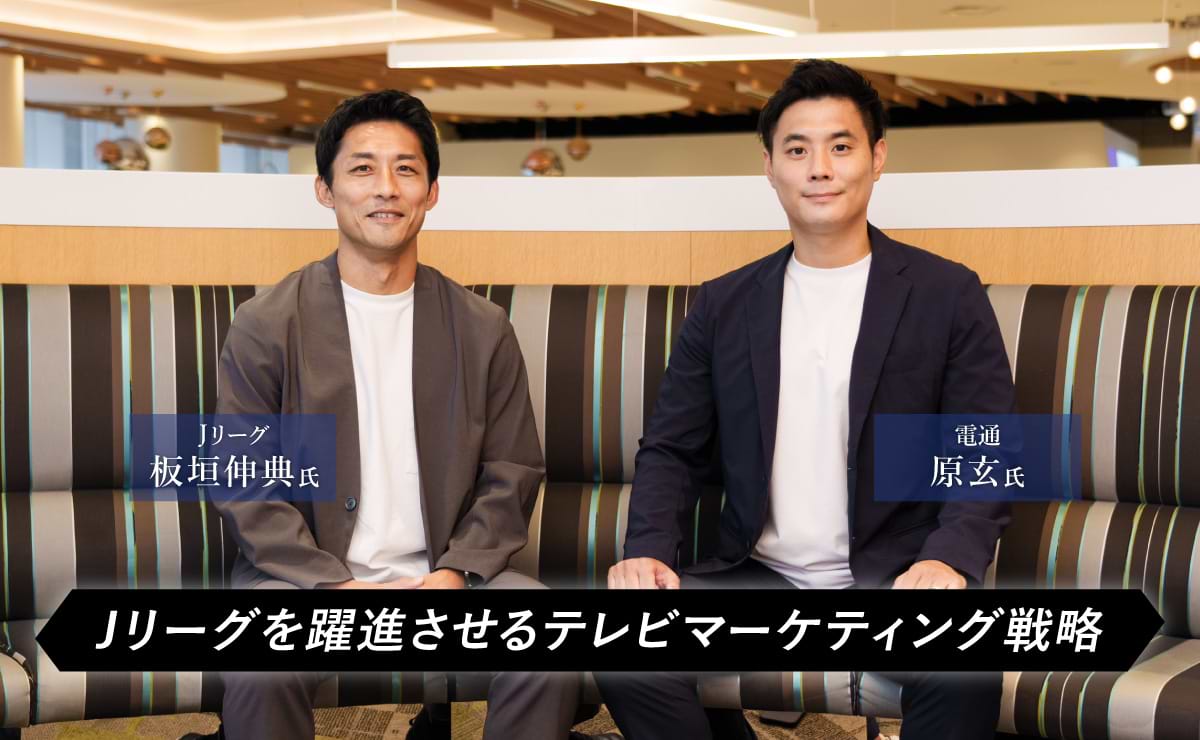
(From left) J.League's Nobunori Itagaki, Dentsu Inc.'s Gen Hara
TV Marketing: The Key to J.League's Success and Identified Challenges
──First, could you tell us what prompted the J.League to start focusing on TV marketing?
Itagaki: The catalyst was when Yoshikazu Nonomura, who had served as representative of Hokkaido Consadole Sapporo, became J.League Chairman in March 2022. During his time in Sapporo, Mr. Nonomura had successfully implemented a marketing strategy centered on local television. This led to the decision: "To gain even more support for the J.League, we will focus our efforts on television exposure." That was the starting point.
Starting in October 2022, the J.League began sponsoring soccer programs across five major regions nationwide. The following year, we expanded these programs to cover the entire country, increased the number of programs on Tokyo's key networks, and now broadcast soccer programs on all major national networks.
The primary goal of the J.League becoming a TV program sponsor is to increase attendance at J.League matches. To attract more fans, it is necessary to continuously convey the appeal of the J.League even to those who previously had no interest. Television is considered one of the most efficient tools for achieving this.
We are now expanding the successful model Mr. Nonomura built during his time in Sapporo nationwide. Last year, both J.League attendance and total club revenue reached record highs, demonstrating tangible results. While television alone cannot be solely credited, we believe the approach is fundamentally sound.
──Could you share some challenges you've encountered while advancing television marketing?
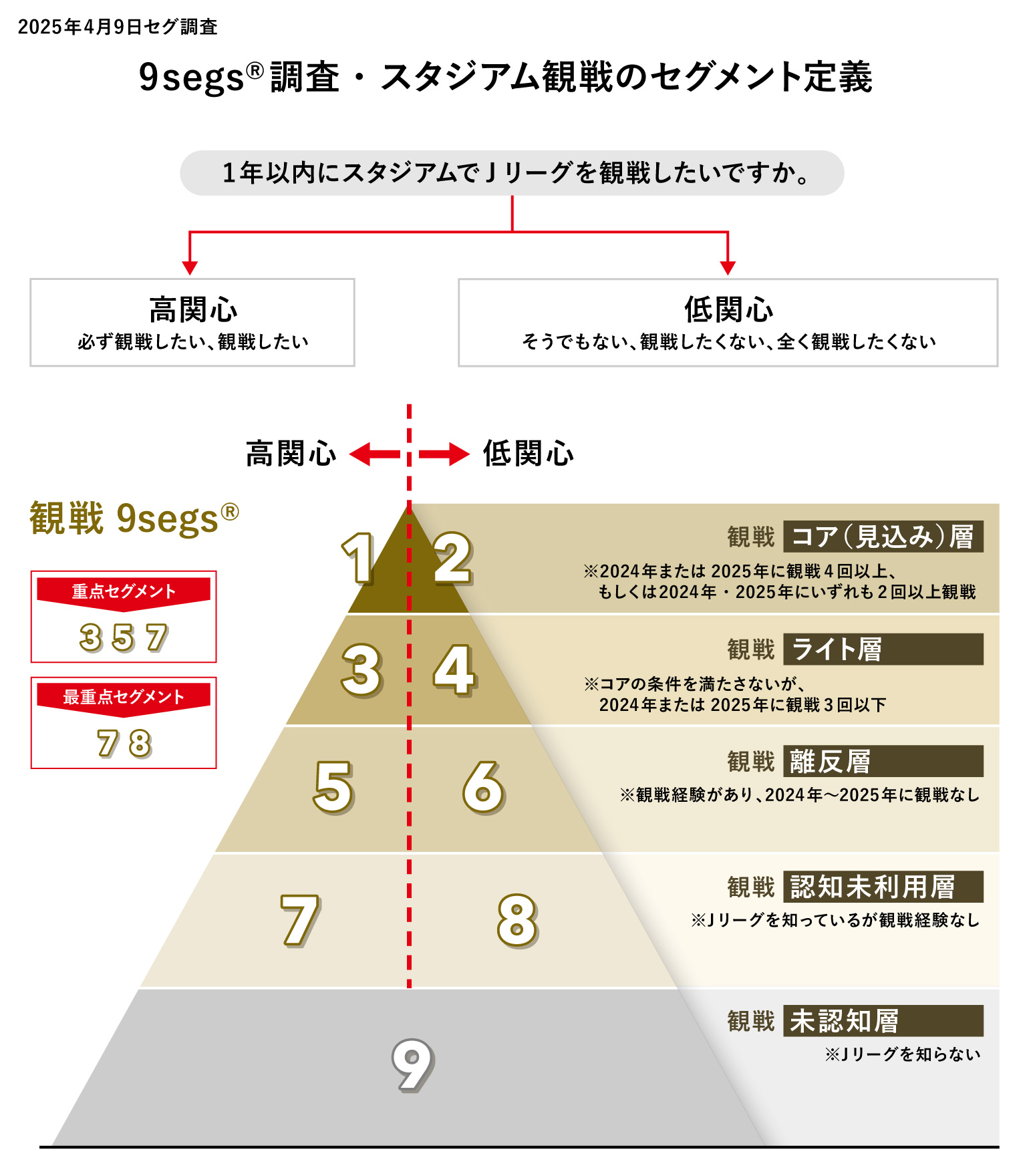
Itagaki: One challenge is visualizing the effectiveness. The J.League analyzes its customers across nine segments, including specific target segments we've defined.
The reason for utilizing television is to continuously deliver the appeal of the J.League to the target audience. While internet surveys showed we were reaching the target, we couldn't track information beyond that.
We felt it was a major challenge that we couldn't visualize the effects beyond that—specifically, what kind of people we were reaching and whether it was actually leading to actions like ticket purchases.
Hara: That's why I proposed to Mr. Itagaki, "Why not use 'STADIA360' to visualize what you were concerned about: 'How much is reaching the target audience?', 'Is J.League TV exposure truly contributing to attendance?', and 'Are the segments showing the intended behavior?'"
After several discussions with Mr. Itagaki, we decided to start with an attendance survey, leading to the adoption of "STADIA360."
With the evolved "STADIA360," we can now observe fan behavior.
──Could you tell us more about "STADIA360"?
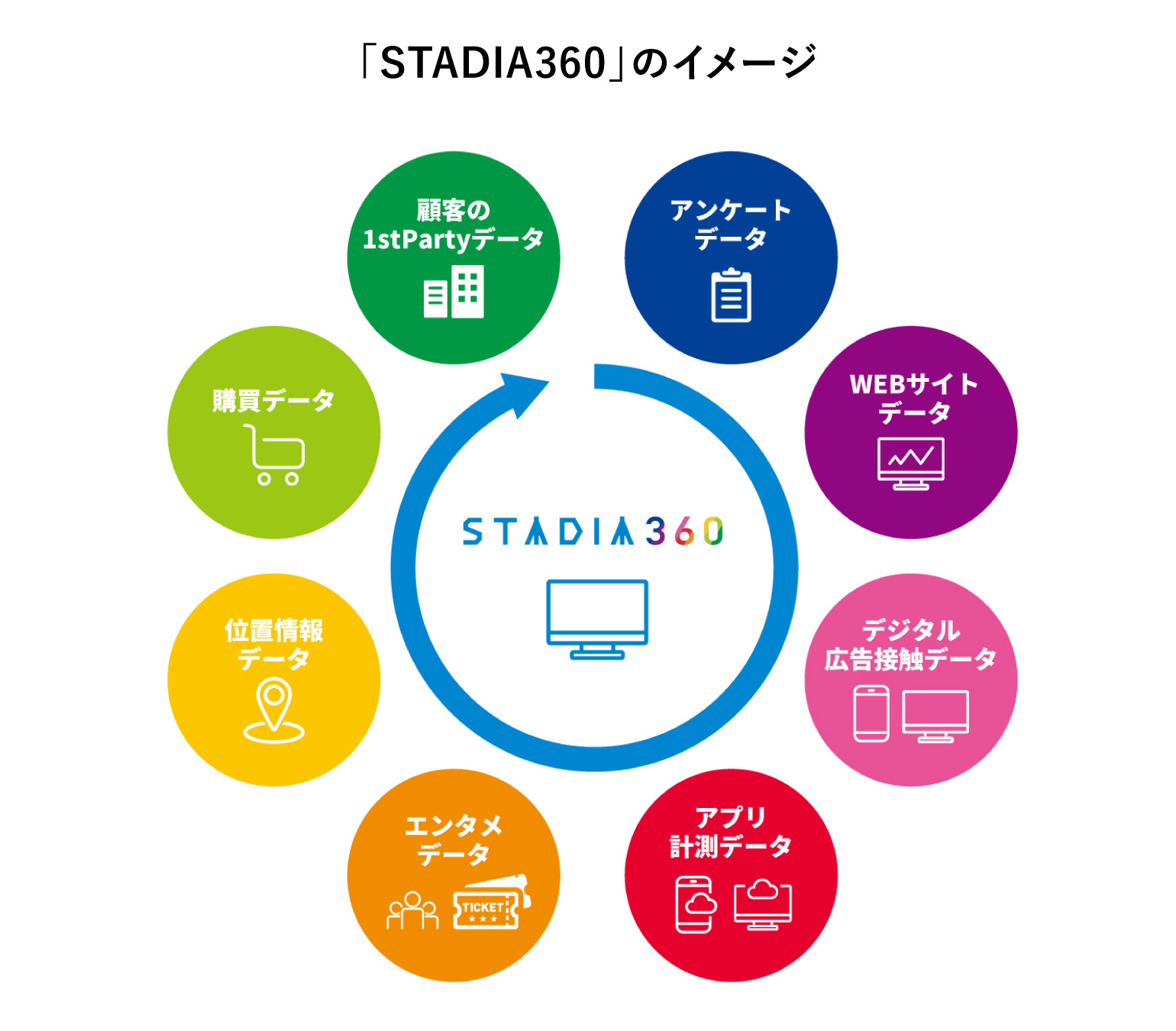
Hara: "STADIA360" is an integrated marketing platform that enables digital ad delivery and effectiveness verification based on TV manufacturer-sourced viewing data, obtained with user consent, across approximately 15.6 million connected TVs (TVs connected to the internet) in Japan.
To break it down further, it's a platform that links TV viewing data with various marketing KPIs. It's a solution that can connect TV viewing data with consent-based user data sets held by over 40 data holders, such as location data and purchase data.As advertiser needs diversify—with TV commercial effectiveness KPIs now encompassing questions like "Did viewers actually visit the store?" or "Did they make a purchase?"—STADIA360 enables TV effectiveness verification from multiple perspectives.
There are two primary use cases for "STADIA360": delivering targeted ads based on connected TV viewing data, and verifying the effectiveness of TV commercials, programs, and overall exposure. This case falls into the latter category, where it's being used not only for J.League's diverse commercials but also for verifying the effectiveness of TV exposure.
──Please tell us what you implemented using "STADIA360" and what it enabled.
Hara: There are two main things. The first is visualizing the impact of TV programs and exposures. We use "STADIA360" to visualize "which TV program exposures influenced 'increased attendance,' one of the KPIs the J.League prioritizes."
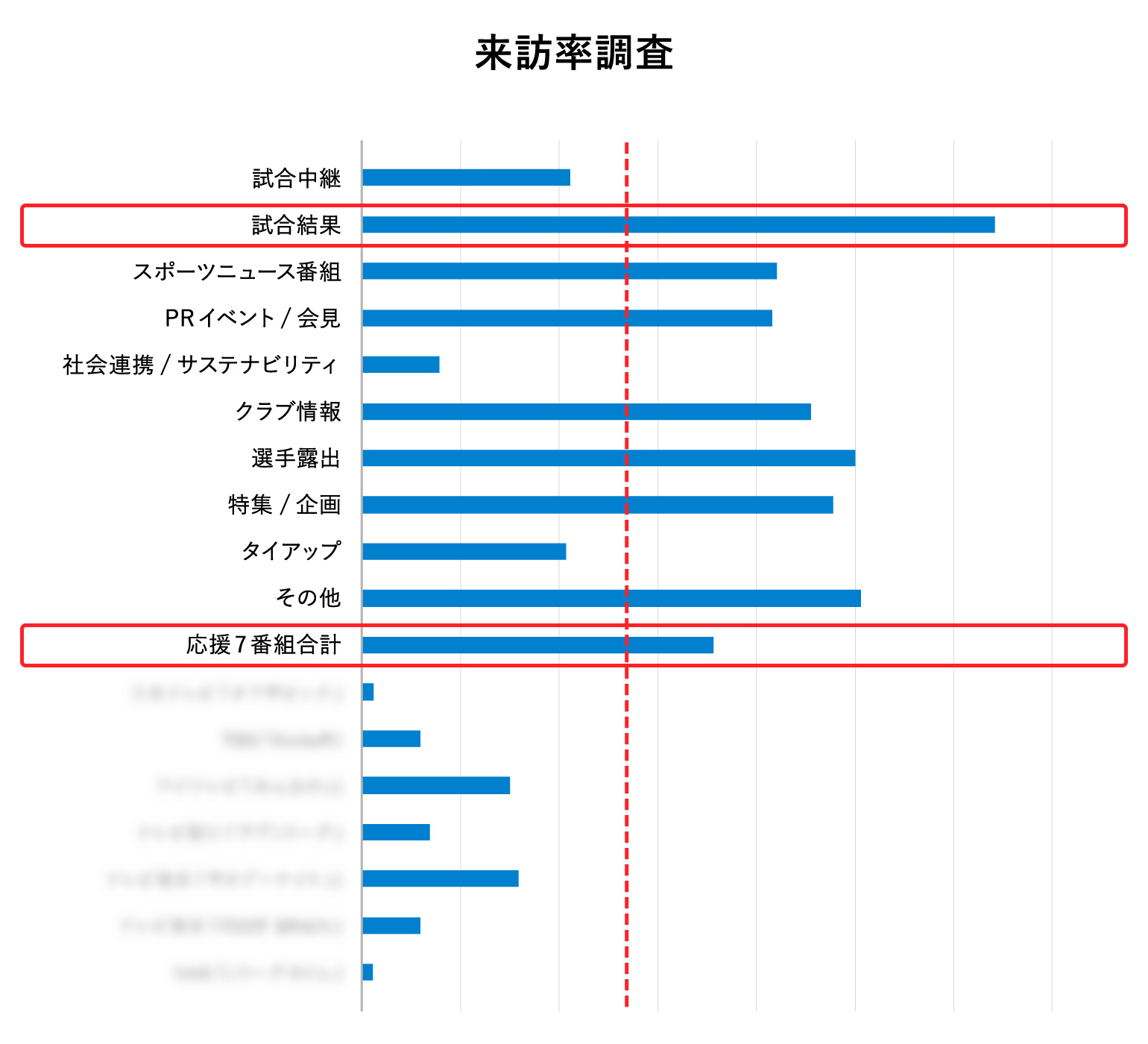
Specifically, we load viewer data for each TV program and TV exposure data (like sports news and match results selected by the J.League) into "STADIA360" for aggregation. This allows us to calculate the audience for J.League-related programs and exposures. By linking this calculated data with location information from NTT DOCOMO users who gave permission, we investigated "which program's audience had the highest reach" and "whether visit rates to J.League venues increased."
The second aspect is visualizing fan behavior. As mentioned earlier, the J.League has established segments based on the 9segs® survey, a customer-centric marketing framework, to serve as metrics for fan marketing. Using STADIA360, we then analyzed how individuals, for example, who were previously in the light segment changed after being exposed to J.League-related TV programs or TV exposure.
We analyzed how individuals classified as light users in the January survey saw increased awareness and interest by April after exposure to TV content. We also compared interest levels based on program viewing to visualize TV's effectiveness.While we conducted analysis for January and April 2025, we plan to conduct an additional analysis this October. This will allow us to visualize how TV exposure reached individuals changed from the situation before the J.League season started. (Interviews conducted in October 2025)
Visualizing "exposure that reaches the target audience" and "efficient exposure"
──Please share your impressions after seeing the STADIA360 analysis results.
Itagaki: Our strategic target is the nearly 40 million people who have never attended a J.League match.
Before analyzing with "STADIA360," we had some hypotheses about how our strategic target engages with the J.League through TV, but we didn't fully grasp it. Seeing the "STADIA360" survey results clarified several things for us.
One was regarding the information reaching our strategic target. We discovered that J.League match results exposed via TV reach a very large audience. On the other hand, soccer programs sponsored by the J.League didn't reach the target as effectively compared to other exposures. However, we found that the visit rate to stadiums among those who were exposed was high.
A major outcome was gaining concrete insights into future approaches: we should continue to steadily increase "exposure that reaches the target audience," and also place greater emphasis on "efficient exposure" to reach more people.
──Is there anything you'd like to share based on the analysis conducted with "STADIA360"?
Hara: This time, we conducted analysis with various innovative approaches. For example, we narrowed the analysis target to the light audience who did not visit the stadium in 2023 and analyzed "which TV programs or exposures led them to visit in 2024."
As Mr. Itagaki mentioned earlier, it was also positive to see results indicating that watching TV programs sponsored by the J.League correlates with higher stadium visit rates. We found that match results, which tend to receive relatively high TV exposure, are most effective at reaching the target audience. This analysis also confirmed that the J.League's approach to exposure was correct.
We also want to visualize the data further to explore the effectiveness of TV marketing.
──Could you share your outlook on future marketing, including television?
Itagaki: While "STADIA360" has made TV's impact visible, I believe more detailed visualization will be required going forward.
We want to visualize "exactly what kind of exposure is effective in driving high engagement." Since Chairman Nonomura took office, exposure volume on Tokyo's key networks has been one of our most critical metrics. Thanks to this, J.League exposure has increased 1.6 times year-on-year. However, we haven't been able to thoroughly track what specific exposure contributes to driving high engagement.
Moving forward, we plan to conduct group interviews, for example. We want participants to review TV exposure like J.League soccer programs and match results, as well as tie-ins with variety shows, to observe "what kind of exposure leads to changes in the target audience's feelings and attitudes."
――Thank you for sharing your valuable insights today.
Official Incorporated Association Japan Professional Football League (J.LEAGUE)
Business Marketing Division, Promotion Department
Director
After working in sales for a comprehensive real estate and housing information site, I joined the J.League in 2011. I gained experience in partner management, business strategy, and business areas utilizing video. Since around 2020, in my current department, my primary mission has been to increase public interest in the J.League. I am engaged in work that delivers the appeal of the J.League using various media.
Gen Hara
Dentsu Inc.
Data & Technology Center, Media Content Data Department
Senior Planner
After joining the company, he was assigned to the Media Services / Radio,TV Division, where he handled sales for television time within the Nippon Television network. He later worked at the Data & Technology Center, responsible for product development and analysis. From 2019, he promoted sales strategy and product development at Supership Inc., returning to his original role in 2022. As of 2025, he is in charge of "STADIA360," driving solution development and product sales.