By 2025, generative AI has rapidly permeated both the business world and our daily lives.
Amidst this, we held a workshop gathering employees from the Dentsu Group. A workshop to candidly discuss generative AI, named "Coffee Shop: AI and Me."
Amid the complex environment surrounding generative AI, with its diverse positive and negative aspects, the workshop aimed to explore better ways of engaging with generative AI by asking, "How do employees on the front lines feel about generative AI right now?"
The workshop was organized by the AI Governance Committee, the Dentsu Group organization overseeing AI utilization. To incorporate an external, objective perspective, it was co-hosted with Osaka University's ELSI (Ethical, Legal and Social Issues) Center, which addresses ethical, legal, and social issues.
Held over two days (DAY1 and DAY2), the workshop brought together employees from diverse roles, generations, and genders—including creators, business producers, and marketers—to share their honest feelings about generative AI.
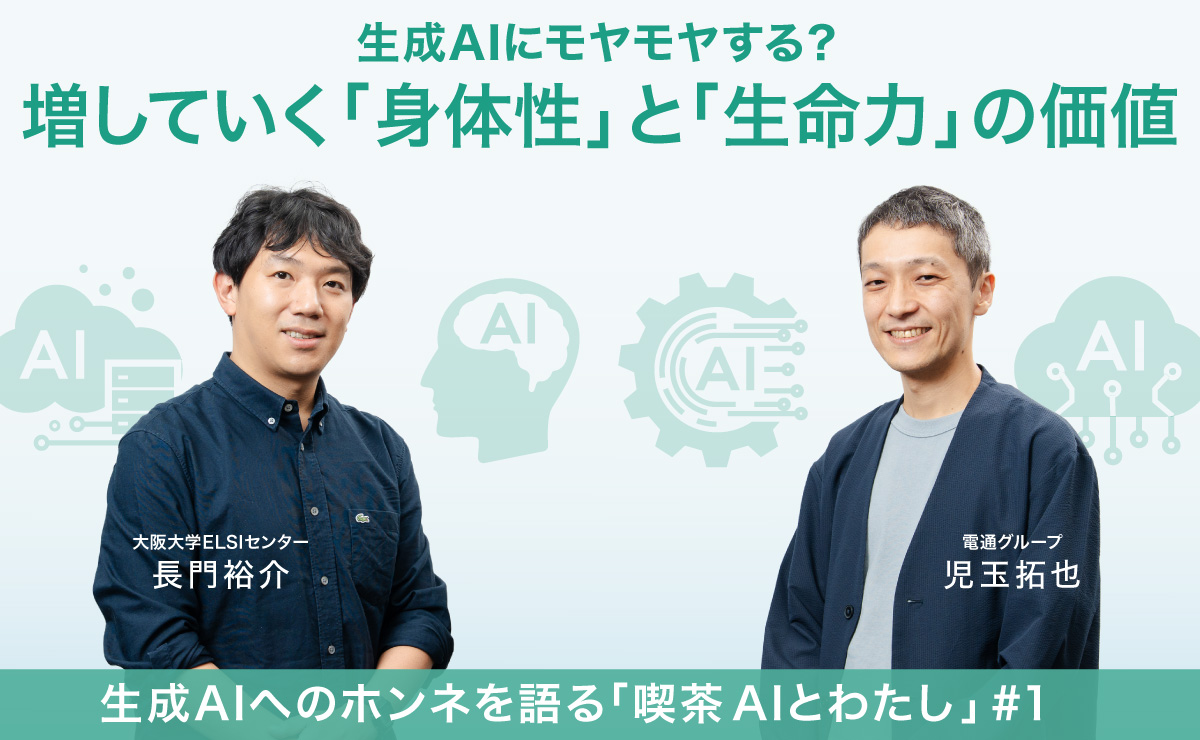
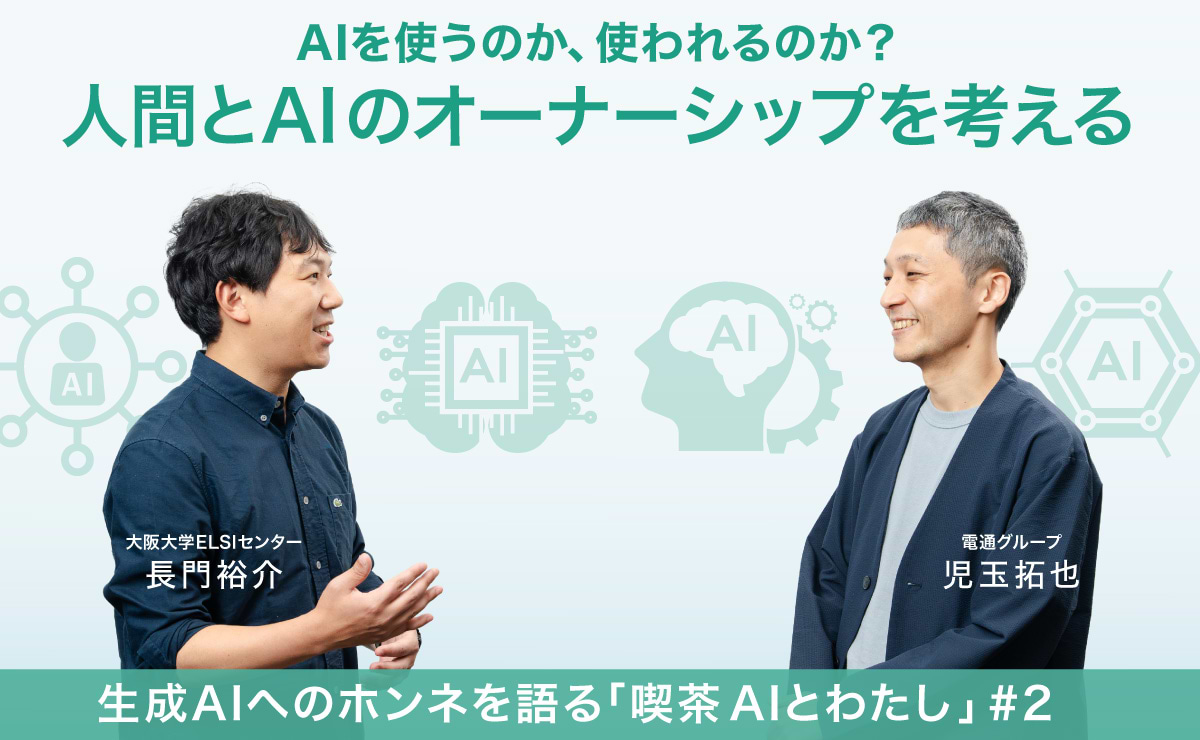
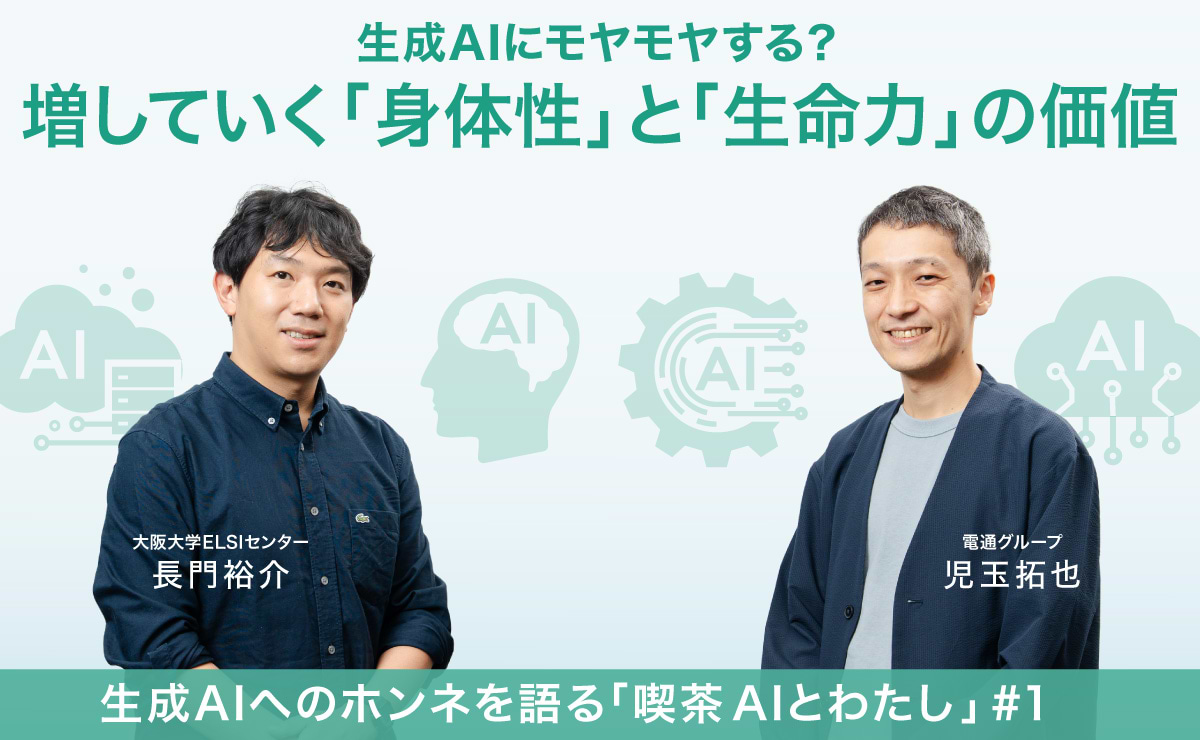
In this article, Professor Yusuke Nagato from the Osaka University ELSI Center and Takuya Kodama, who promotes generative AI utilization within the Dentsu Group, reflect on the "keywords of genuine feelings" that emerged from the workshop.
<Workshop Overview> On DAY1, 6-7 non-creative role employees participated, and on DAY2, 6-7 creative role employees from the Dentsu Group took part. Facilitated by Professor Keiichiro Suzuki of Osaka University's ELSI Center, participants candidly shared their genuine feelings about generative AI.
<Examples of Naturally Emerged "Honest Keywords"> How to deal with the emerging AI gap / "AI can do it in an instant, right?" / Where does ownership lie? / Being honest with emotions / Are we working with training data? / Living healthily with AI / Curiosity / The vitality of work / Work is about eating and being eaten / Physicality, the five senses / Productivity increases. So does labor intensity / Why are we creating this? / Resetting positions and titles
The Growing Importance of "Physicality" and "Vitality" as We Use AI More
Kodama: Thank you for your hard work at the workshop. I participated as a regular attendee both times myself, and I think both days were very fulfilling sessions where various keywords emerged.
While many opinions were shared across the two sessions, I believe several common themes emerged. Professor Nagato, were there any honest keywords that particularly caught your attention?
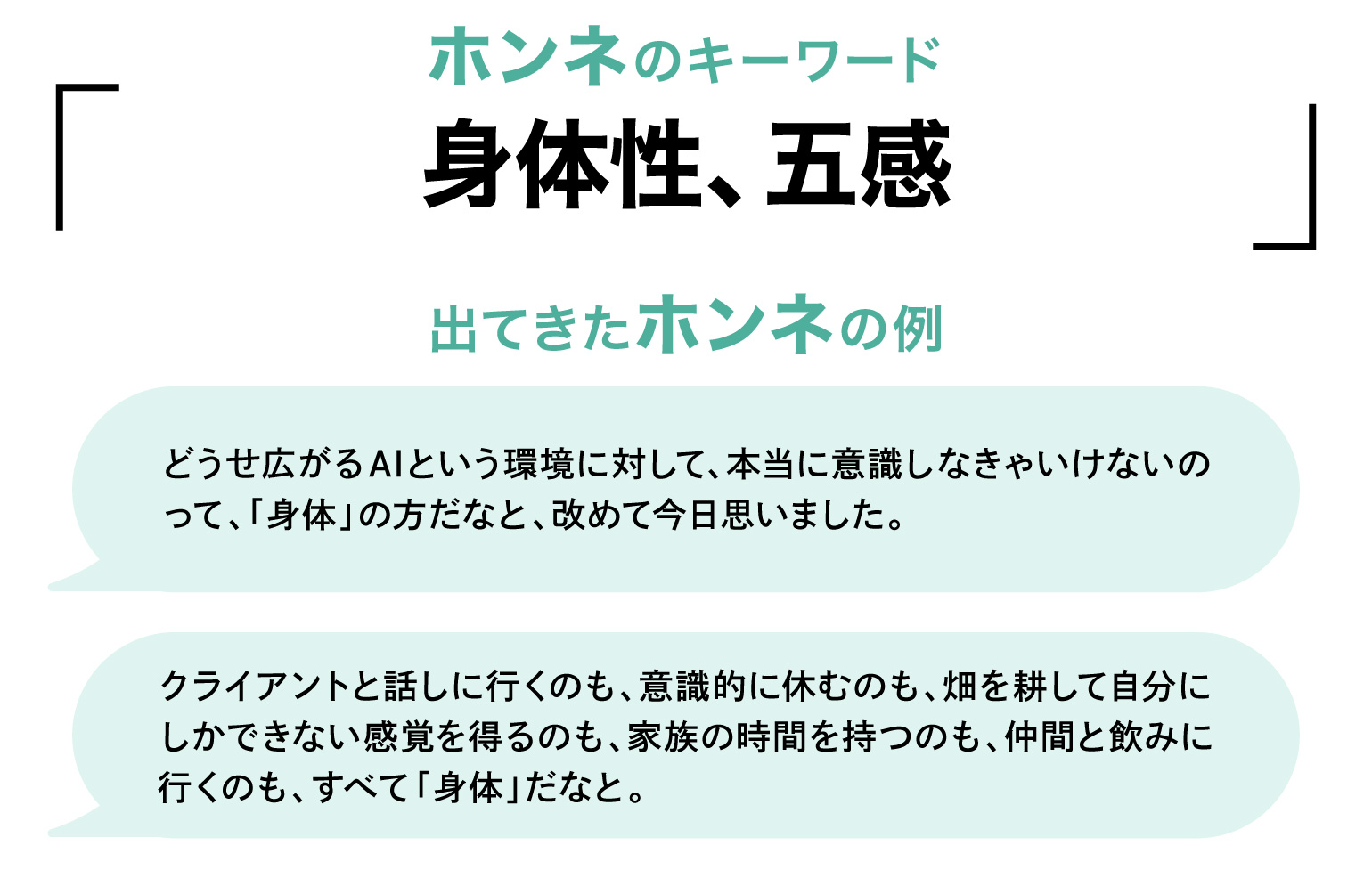
Nagato: The keywords that caught my attention were "physicality" and "vitality." Many participants mentioned them, and I found myself wanting to reconsider what they signify.
Kodama: During the workshop, the topic "What would you do if AI reduced your work time from 7 hours to 1 hour?" came up, and someone suggested, "You could use the remaining 6 hours to test the client's products." That kind of "hands-on experience," or what we call "physicality," definitely provides information and sensations that AI absolutely cannot replicate.
However, I also sensed that everyone was imbuing the term "physicality" with a more fundamental meaning. It's less about real-world experiences being useful for work or complementing what AI can't do, and more about activities that help us "maintain our humanity." In that sense, there was also talk about how the importance of human activities like "drinks with colleagues" or "hobbies like fishing" is increasing.
Nagato: Relatedly, the word "vitality" also came up. One aspect was about wanting to hone one's own "vitality as a human being," which is precisely an extension of "physicality." The other theme was about "the vitality inherent in a work" or "the vitality felt from a work." When evaluating creativity, the discussion was that the perspective of whether one feels "vitality" in that creativity will become increasingly important going forward.
Kodama: Personally, I found the second perspective—the "vitality of the work"—particularly interesting. Choosing watercolors to give a piece vitality, or handwriting a proposal... Perhaps there's a perceived value in the vitality and strength that comes from things made by human hands.
On the other hand, as AI increases the speed of work, the time and cost of meticulous handcrafting might become less acceptable. So, how to preserve that "vitality" might become a future challenge.
For example, when I'm brainstorming ad concepts for clients, I get really pumped when a good idea hits (laughs). That "getting pumped" feeling fuels the idea's expansion and boosts the energy to drive it forward. In that sense, I think we need to find new ways to "ignite" the passion for AI-generated concepts.
Nagato: It's interesting to hear that the "value" lies in the vitality born from handcrafting. As a philosopher, I'm deeply fascinated by discussions about where "value" originates. There are two main perspectives on "value": one where humans project value onto an object and find it moving, thus creating "value"; and another where the object inherently possesses "value" that humans recognize. I believe both perspectives are necessary.
Humans possess the sensitivity to feel excitement, and seeing the object creates "value." The same applies to how we engage with generative AI. Our sensitivity, for better or worse, shapes the value we assign to AI-generated creations. That's precisely why cultivating an evaluative eye becomes essential.
Kodama: If the evaluator lacks vitality, curiosity, or sensitivity, they won't find the ideas AI produces interesting, right?
Nagato: Exactly. During the workshop, when we discussed "how to engage with generative AI," participants repeatedly mentioned enjoying analog, real-world activities like fishing, woodworking, or social gatherings. These physical experiences prompt reflection: "What do I truly enjoy? What moves me?" Cultivating discernment through such foundational activities struck me as characteristic of people in this new era who are genuinely trying to do something interesting.
Kodama: Thank you. By physically touching the "substance" outside the device, or by creating something with their hands, people cultivate their sensitivity and can properly evaluate the "value" AI creates. I realized many are instinctively sensing this and acting on it.
How will AI-driven "title resets" change organizations and individuals?
Nagato: Next, could you share the keyword that really caught your attention, Kodama?
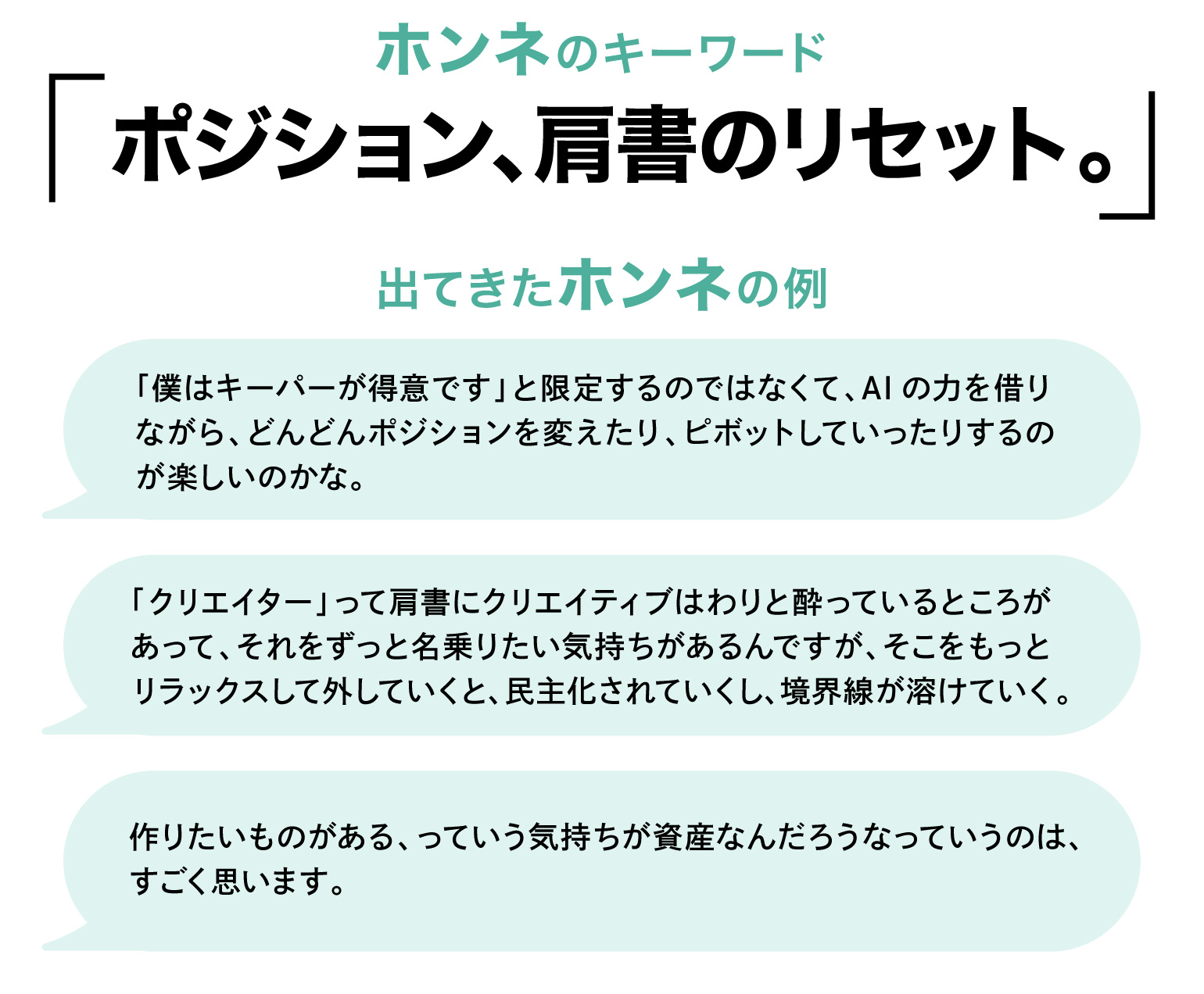
Kodama: There was the keyword "title reset." Actually, this theme was one of the reasons I thought, "I have to do this workshop."
At Dentsu Inc., roles like Creator, Business Producer, and Marketing Planner were loosely separated by their respective domains. Each person took pride in their title and approached their work accordingly. The idea that AI could enable one person to handle all these roles simultaneously is incredibly exciting.
On the other hand, I worry that as AI expands what's possible, people might barge into other domains without understanding the mindset cherished within those circles. I feared this could lead to crucial aspects of the work being overlooked or problems arising.
However, after hearing from participants this time,
I was surprised to find many people thinking, "Such situations are now unavoidable, so we should embrace them as opportunities and expand our own work."
This mindset was surprisingly common among many participants. Perhaps there's no need to feel anxious about it.
Nagato: What struck me was when one participant shared an anecdote: "When facing a competitive presentation for a certain project, I tried to see how much I could handle on my own." This was a creative professional who said they did everything themselves—marketing research, material creation—all alongside generative AI. And they got results.
They said, "By just trying it myself first, I actually came to understand my own strengths and weaknesses." I found that really interesting. Honestly, I was also amazed that such an approach was even allowed (laughs).
In terms of personal boundaries, I think a reset of job titles will happen. You'll clearly see "I can do this and that with generative AI, but not this." It means seeing your potential within a framework different from traditional job titles.
On the other hand, it seems that Dentsu Inc. folks aren't thinking, "All my responsibilities will disappear." Instead, they're using AI to expand their domains, considering "what kind of work we can do now, how the organization can be renewed." My work gives me insight into how various companies and organizations engage with AI, and avoiding the common "AI will take our jobs" mindset feels like a distinct Dentsu Inc. characteristic.
Kodama: After we reach a world where everyone can do "something" by mastering AI, I think people will likely be divided even more than now based on their strengths and weaknesses, their interests, their affiliations, their careers, and their titles. I believe differences will emerge at a more fundamental level than superficial ones.
Connections with people and opportunities for learning will become increasingly important.
Nagato: We've heard a lot about generative AI changing how everyone works, but there was also much discussion about remote work and the pandemic. I feel the "changes in work styles" happening in society and at Dentsu Inc. aren't solely due to generative AI—they're complex, multifaceted shifts. I think it's key to discuss the AI era while also considering the "significance of remote work." What do you think?
Kodama: I agree. The impact of both pandemic-era remote work and AI is continuous. Both influence work styles by reducing interpersonal communication in the workplace. During the session, someone mentioned that "Dentsu Inc.'s strength lies not just in individual skills, but in the inherited human interactions." From that perspective, I think the pandemic and generative AI will significantly impact Dentsu Inc.
Nagato: One young participant described the pandemic as "nothing but a void" and "just wasted time." I think that likely stems from a feeling of "deep frustration." When I discuss the pandemic with students at Osaka University, many express this same frustration. It's frustration over "losing opportunities for skill development and gaining diverse experiences."
Kodama: Now that the pandemic has made us realize how crucial human connections and learning by observing seniors are, I want to ensure generative AI doesn't threaten that again.
For example, saying "Let's stop assigning meeting minutes to juniors and have AI do it instead" seems good from an efficiency standpoint. But actually, creating meeting minutes was a huge learning opportunity for young people. AI takes away that learning opportunity. Isn't that just repeating what the pandemic did by taking away learning opportunities? I felt we need to carefully balance that.
Nagato: It's a tricky area, isn't it? Humans have this desire, right? We want our juniors to learn in the same way we did when we were growing up. But realistically, that rarely happens across generations.
I think many of you share this sentiment: "I don't want people to feel the same frustration we experienced with remote work during the pandemic when generative AI becomes widespread." Especially those in their late 20s and 30s, who will soon be in positions to mentor juniors, are likely very concerned about this. That's why I was listening intently to your discussion.
Kodama: You're absolutely right. For me, "AI" and "remote work" were completely separate things, so realizing they're connected felt really fresh. It made me think deeply about what it means to use AI while effectively maintaining human connections.
Actually, after the first workshop, there were a couple of weeks until today, and I've been significantly increasing how often I come into the office.
Nagato: Really?
Kodama: I started thinking, "Maybe going to the office is better after all" (laughs). I really feel this experience made me realize its benefits. This ties back to the earlier discussion about "physical presence." Precisely because we're in the era of generative AI and remote work, there's meaning and value in deliberately coming into the office to talk with real people face-to-face.
Nagato: I see, that's interesting. So you want to consciously control your own "relationship" with generative AI and remote work, right?
Center for Co-creation of Social Technologies (ELSI Center)
Lecturer (Ethics, Value Theory, Social Philosophy, Information Ethics)
Lecturer, Osaka University Center for Collaborative Research on Social Technologies. Withdrew from Keio University Graduate School of Letters after completing doctoral coursework. Specializes in ethics, social philosophy, and ELSI (Ethical, Legal, and Social Issues) in information science and technology. Co-authored works include "An Introduction to the Philosophy of the Meaning of Life" (Shunjusha, 2024) and "An Introduction to ELSI" (Maruzen Publishing, 2025).
Kodama Takuya
Dentsu Group Inc. / dentsu Japan
Group AI Strategy Team / Chief AI Master
After working as a client-facing producer for digital platform companies, he has been promoting the use of AI both within and outside the company since 2018.
He is currently affiliated with Dentsu Group Inc., where he is involved in the AI and technology strategy for the entire Dentsu Group, encompassing not only Japan but also overseas operations.

 "Coffee Shop: AI and Me" – Speaking Frankly About Generative AI [1/2]