By 2025, generative AI has rapidly permeated both the business world and our daily lives.
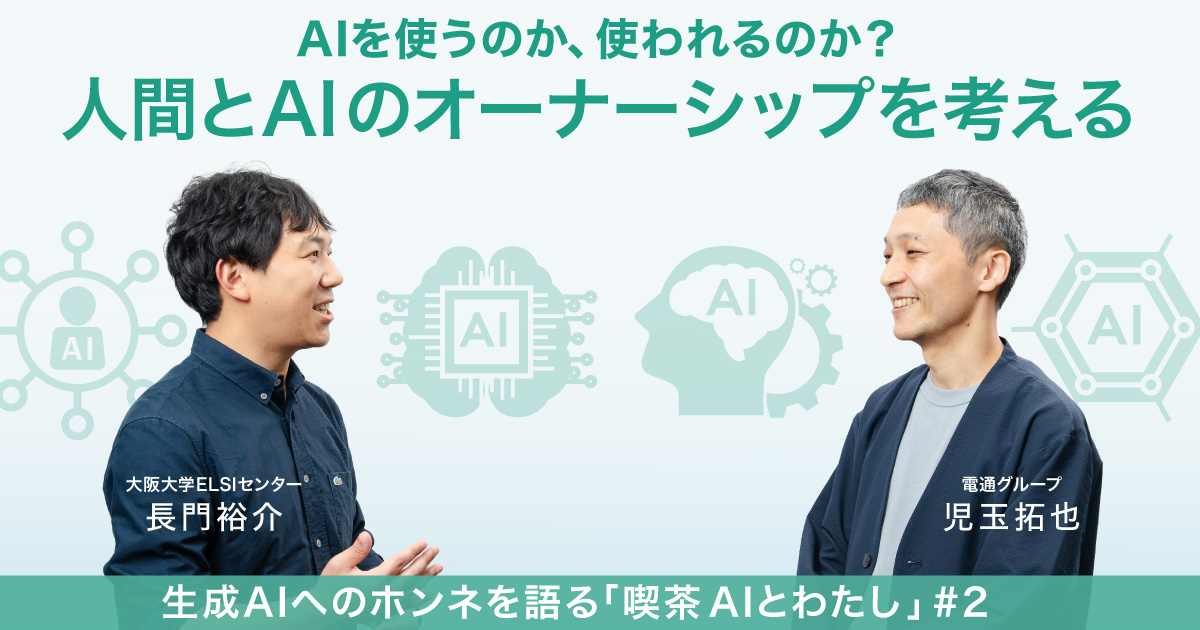
Amidst this, we held a two-part workshop gathering Dentsu Group employees. It was a workshop to share honest thoughts about generative AI, named "Coffee with AI and Me."
Amid the complex environment surrounding generative AI, with its diverse positive and negative aspects, the workshops aimed to explore better ways of engaging with generative AI by asking, "How do employees on the front lines feel about generative AI right now?"
In this series, Professor Yusuke Nagato from Osaka University's ELSI Center, who co-hosted the workshop, and Takuya Kodama, who promotes generative AI adoption within the Dentsu Group, reflect on the "key honest insights" revealed during the workshop.
Following the first part, this second installment focuses on misunderstandings about AI-driven efficiency and the concept of ownership.
<Workshop Overview> On DAY1, 6-7 non-creative role employees from the Dentsu Group participated, and on DAY2, 6-7 creative role employees participated. Facilitated by Professor Keiichiro Suzuki of Osaka University's ELSI Center, participants candidly shared their honest feelings about generative AI.
<Examples of Naturally Emerged "Honest Keywords"> How to deal with the emerging AI gap / "AI can do it in an instant, right?" / Where does ownership lie? / Being honest with your feelings / Are we working with training data? / Living healthily with AI / Curiosity / The vitality of a work / Work is about eating and being eaten / Physicality, the five senses / Productivity increases. So does labor intensity / Why are we creating this? / Resetting positions and titles
Cultivating Sensitivity to Overcome "AI Can Do That in an Instant, Right?"
Nagato: In Part 1, we discussed how Dentsu Group members, while engaging with generative AI, have come to recognize the importance of concepts like "physicality" and "vitality." Mr. Kodama, were there any other honest keywords that stood out to you?
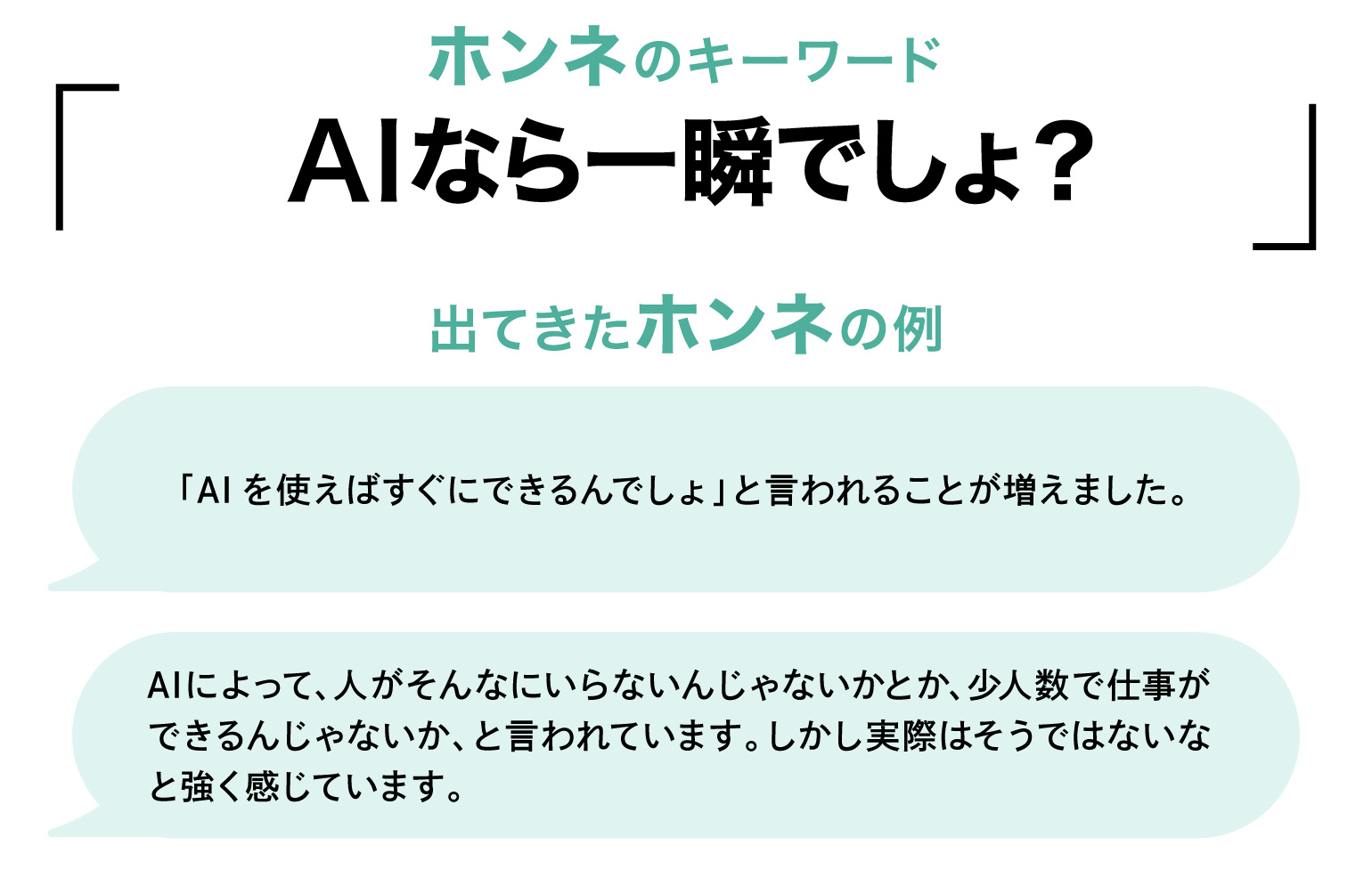
Kodama: "AI could do that in an instant, right?" It makes people think, "You could just use AI to do that easily, right?" about work that used to be done with artisanal skill. Clients or other departments within the company might say that. It's a bit scary to see the perception and expectations for what we create declining, even if it's based on misunderstandings.
It also raises the question of whether those evaluating or commissioning the work can properly assess what AI cannot create or achieve.
Nagato: Regarding this, someone mentioned in a pre-survey that "the rise of AI believers is causing problems." That phrasing really stuck with me. I definitely think, "Yeah, that's a problem."
But even before generative AI existed, I think advertising creation was often misunderstood. It's hard for the general public to grasp how much expertise and skill goes into video, photography, and copywriting. I suspect quite a few people didn't realize advertising creation was that complex. We've been battling these kinds of misunderstandings all along, so with generative AI now entering the picture, I wondered how people feel about this environment and these misconceptions.
Kodama: Exactly. The cycle of thinking "We don't need Dentsu Inc. anymore, we can do it ourselves" and then realizing "We still need professional expertise" isn't unique to generative AI; it's been happening for a long time. Each time, I believe we've used our ingenuity to help clients recognize the value that only professionals can deliver. I think the same ingenuity is needed when it comes to generative AI.
Nagato: But even if it's a recurring pattern, isn't the wave of generative AI just too big compared to previous waves?
Kodama: That's true. But I'm actually quite optimistic. While AI tools have become accessible to everyone, allowing anyone to quickly create visually high-quality work, I believe the day isn't far off when everyone realizes that "you simply can't reach the realm of true professionals by just doing things normally."
Nagato: I see. Precisely because it's so easy to create something that looks plausible, the gap with professionals becomes starkly apparent.
Kodama: On the other hand, there's also the view that more people are thinking, "This level of quality is good enough."
Generative AI can produce things that are "perfectly fine to run as ads as-is," so there are definitely situations where people think, "This is good enough." But is that really okay? How do we fight against that kind of compromise? I think humans need to make one last push.
Nagato: It's similar to saying, "These instant noodles are amazing these days. They're practically as good as what you get at a restaurant," yet people still go to ramen specialty shops. That "last-ditch effort" is a really interesting point. I think it's about fighting against all the costs that come with that struggle.
I realized it's crucial for everyone, including clients, to cultivate discernment and sensitivity while approaching advertising with the mindset that "advertising is a form of culture, so let's cherish it."
Kodama: If we don't move in that direction, I fear an era of mass-produced, low-quality content driven by generative AI is fast approaching.
Nagato: Even so, I feel this workshop offered a glimpse of a brighter future. The discussions about "vitality" and "human connections" in the first part clearly conveyed that even in the age of generative AI, "people" remain our greatest asset.
Is AI a tool for humans? A partner? A threat?
Kodama: Building on our previous discussions, I'd like to focus on the following keywords: "Where ownership lies," "How to interact with AI," and "Avoiding being used by AI."
It was striking how many people said that despite AI being supposed to make life easier, they "actually feel busier" or "workloads have increased." Considering everyone's opinions, what mindset seems best for finding a "good way to work with AI"?
Nagato: One keyword for the 2020s was "Bullshit Jobs." Coined by anthropologist David Graeber, it essentially refers to "work created for the sake of work, with many people employed solely to perform it." And those doing this work are white-collar employees earning substantial salaries.
In other words, I think it's about how companies seeking to improve productivity end up introducing various tools and systems that actually increase bullshit jobs, creating roles where people are paid high salaries just to handle those tasks.
Hearing the common argument that "using AI actually increases the amount of work" made me realize it's not as simple as "AI will eliminate bullshit jobs." It's unlikely that introducing generative AI will just make boring tasks disappear, freeing people up to do more creative work.
What constitutes necessary versus unnecessary work is far less intuitive than we might think. For example, determining whether "taking meeting minutes is a bullshit job" is quite complex. When you actually take minutes, you gain significant insight into what each department is doing, so it's hard to simply dismiss it as unnecessary work.
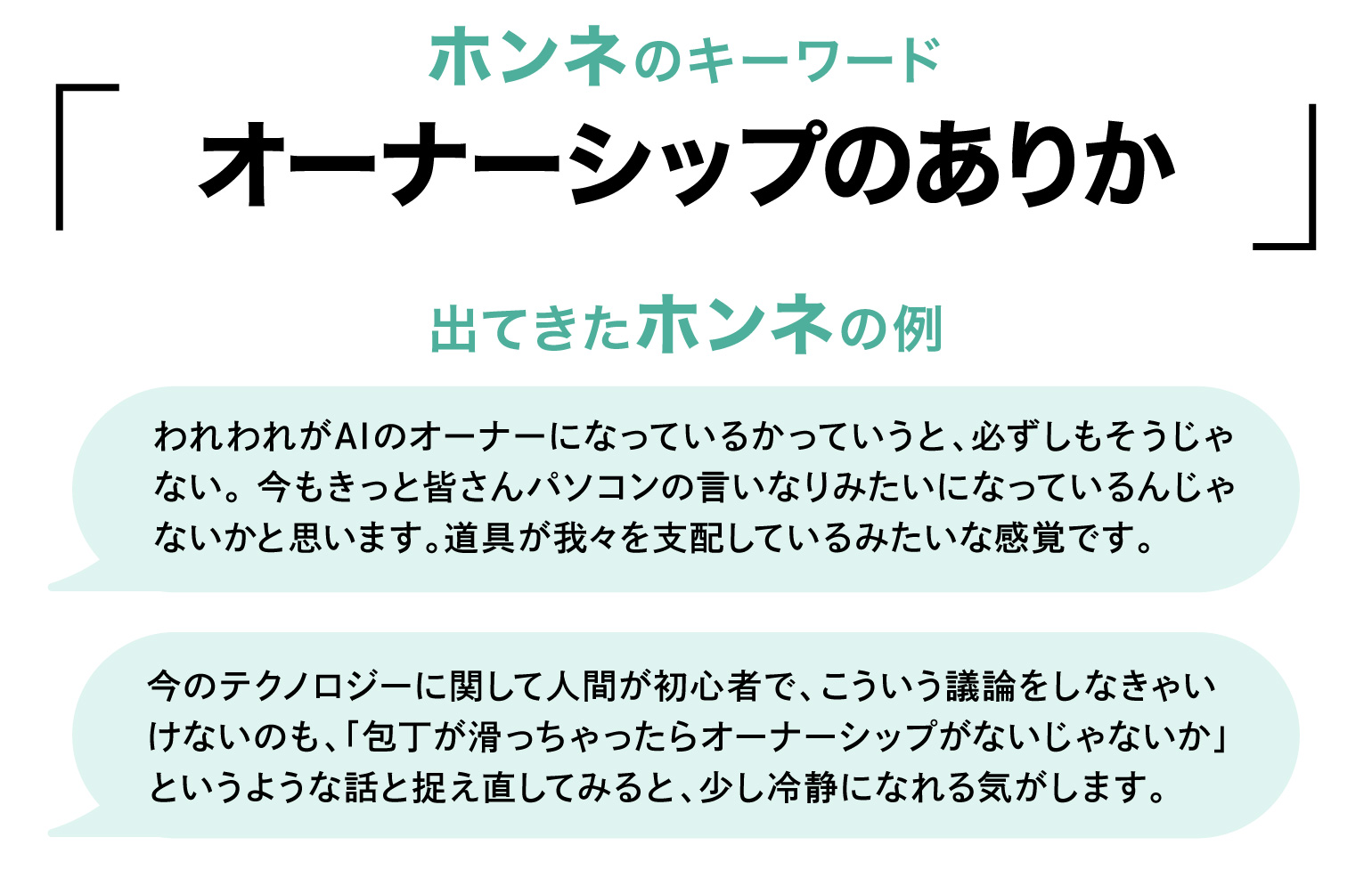
During the workshop, someone mentioned "how to maintain ownership when working with AI." Ultimately, mastering AI and getting it to work effectively isn't simple. You need the fundamental "judgment skill" to decide, "If I delegate this to AI, I can focus here." I think we should first recognize that "determining what's truly necessary for humans is difficult in itself."
Kodama: It's definitely difficult. Deciding "which tasks should humans do, which should AI do?" or "should I delegate to juniors or handle it myself?" involves so many variables it can't be decided lightly. There are surely many jobs that "can be automated, but shouldn't be automated."
I believe humans need to firmly hold the reins, including making that discernment. Frankly, I don't think contrasting AI and humans is particularly meaningful either. Ultimately, it comes down to what humans want to achieve. We need to think about AI utilization with a meta-perspective – taking a bird's-eye view of both AI and ourselves to determine the best allocation of roles.
Nagato: Connecting back to the ownership discussion, I think both Mr. Kodama and I lean toward the "tool theory" (AI = tool). On the other hand, I suspect many in the younger generation embrace the "partner theory" (AI = partner). To them, AI must appear entirely different.
Furthermore, I suspect there are even some within the same company who hold a "threat theory" (AI = threat). What concerns me is whether "tool theorists," "partner theorists," and "threat theorists" can actually communicate effectively with each other.
Kodama: How people perceive AI really varies from person to person. I felt it's crucial to maintain a proper balance with sound imagination, avoiding overly simplistic tool perspectives or overly enthusiastic partner perspectives.
Focusing on the relationship between generative AI and "one's own life"
Kodama: Finally, could you share your overall impressions looking back on the two-day workshop?
Nagato: Above all, I was struck by how exceptionally much the Dentsu Inc. participants focused on "their own stories." Previously, our Osaka University ELSI Center has conducted numerous lectures and seminars on generative AI for companies. In those sessions, the focus was often on "company perspectives" – things like "We want to introduce generative AI to boost company productivity" or "We want to improve this aspect of the company."
In contrast, at this Dentsu Inc. workshop, I felt there was a lot more "personal storytelling" – about their own work, skills, past roles, and future opportunities for skill development.
Amidst the massive wave of generative AI now surging forward, I found it very distinctive compared to other companies that the focus was primarily on "what happens to me." It felt like they were thinking more about how each individual could become stronger, rather than just how the company could become stronger by introducing generative AI. I sense that this is precisely the characteristic and strength of Dentsu Inc.
On that note, I'd actually like to ask you, Mr. Kodama. Why do so many people within the Dentsu Group view the introduction of generative AI so positively?
Kodama: This is my personal opinion, but I believe that companies like Dentsu Inc., which solve problems through creative power, must always offer something new. That's precisely why all employees hold the value of "continuing to do things differently than before."
Consequently, even when new stimuli come from outside, rather than clinging to past methods, they tend to think, "We can use this to create something new."
Business producers (traditional sales roles) might explore new revenue possibilities, while creative staff might create something new. I think there's a tendency to find that big change interesting and dive right in.
Nagato: I see. I definitely sense that tendency. It was very striking how everyone positioned the arrival of AI as a personal experience, saying things like, "I joined the company in such-and-such year, have done this kind of work until now, and within my career, AI has meant this."
Kodama: Of course, there are people skeptical or critical of generative AI. And even among those approaching it positively, I saw again that lingering unease exists. But the major trend seems to be a stance of "This is unavoidable," followed by "So, how can we use it?"
Corporate Culture and Strengths Revealed Through Approaches to Generative AI
Nagato: I think this workshop also provided a clear glimpse into the ethos and culture of Dentsu Inc. as a company.
For example, when we consult with companies about introducing generative AI, we suggest creating usage guidelines as "guardrails" against risks. Companies can't avoid using generative AI itself, but going full throttle carries the risk of falling off a cliff. That's precisely why we propose establishing these guidelines as guardrails to prevent risks. By operating within them, you can actually push the limits more effectively.
However, Dentsu Inc. seems focused on blazing new trails where no one has gone before. I sensed a mindset that avoids setting overly conservative boundaries.
Kodama: Ah, of course Dentsu Inc. has AI usage guidelines too. As a company, "guardrails" are necessary. But rather than rigidly setting guardrails and defining "permissible paths," clearly communicating "this path carries these risks" might suit Dentsu Inc. better. It leaves room for us to devise our own solutions while considering a certain level of risk.
Nagato: I thought so too.Another point, which came up in response to a question from the ELSI Center, was the discussion about "skill inheritance" with the introduction of generative AI. I had expected that since the creative work Dentsu Inc. handles is in a craft-like world, it would be a workplace where you learn "how to make things" through actual guidance from seniors. So, I thought many people might mention that "if AI starts handling various things, skills won't be passed down." But surprisingly, many people didn't seem to think that way.
While work methods and tips might be learned from seniors, many people fundamentally believe that the most core part – "creation" itself – requires you to figure things out on your own. I found this surprising. This might also connect back to the idea that the "individual" is strong.
Kodama: I also had a discovery on that point. Namely, I realized the strength of the Dentsu Group organization lies not only in its methodology for developing creative ideas, but also in its ability to shape those ideas into a form that can be agreed upon. I was reminded that there's a strong emphasis on soft skills like presentation skills, proposal ability, or the ability to construct logic, as well as communication skills, while the actual ideas for creating things are largely entrusted to the individual.
Nagato: Exactly. I also clearly understood that Dentsu Inc.'s characteristic is placing emphasis on communication methods, meaning interpersonal skills.
Kodama: I see that as another key takeaway. While I promote AI adoption within the Dentsu Group, I don't think I've often consciously considered "Dentsu Inc.'s corporate ethos" in that context. The relationship between generative AI implementation and "corporate ethos" might be a perspective demanded not just of Dentsu Inc., but of Japanese companies going forward.
Nagato: Exactly. At the Osaka University ELSI Center, we receive AI implementation consultations from various companies. Understanding the "corporate culture" is crucial for considering the optimal AI implementation. This "corporate culture" is what we referred to earlier as the company's "ethos.""Ethos" shares its root with "ethics." I believe a key takeaway this time was that participants were able to reaffirm the "ethics" that Dentsu Inc. as a company has always valued.
I sensed a kind of "self-centeredness in a good way" among the Dentsu Group employees, who place great importance on people. They could say things like, "Improving my skills" or "Being able to work comfortably" are incredibly important for the company. I genuinely felt, without flattery, that with people like this, AI wouldn't become the "master" and they the "servant." They'd be able to ride it well.
Kodama: Professor Nagato's talk really gave me courage! A major takeaway this time was understanding that Dentsu Group employees, while facing generative AI in their work and holding doubts or uncertainties, are fundamentally approaching it with a positive mindset. I definitely want to hold another workshop with different members at another time.
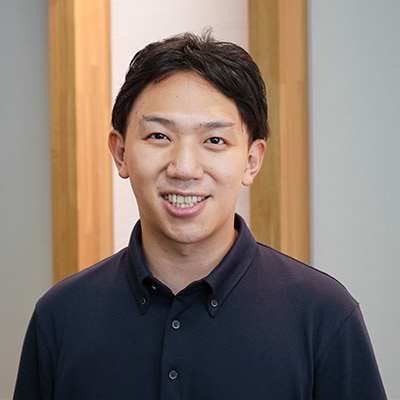
Center for Co-creation of Social Technologies (ELSI Center)
Lecturer (Ethics, Value Theory, Social Philosophy, Information Ethics)
Lecturer, Osaka University Center for Collaborative Research on Social Technologies. Withdrew from Keio University Graduate School of Letters after completing doctoral coursework. Specializes in ethics, social philosophy, and ELSI (Ethical, Legal, and Social Issues) in information science and technology. Co-authored works include "An Introduction to the Philosophy of the Meaning of Life" (Shunjusha, 2024) and "An Introduction to ELSI" (Maruzen Publishing, 2025).
Kodama Takuya
Dentsu Group Inc. / dentsu Japan
Group AI Strategy Team / Chief AI Master
After working as a client-facing producer for digital platform companies, he has been promoting the use of AI both within and outside the company since 2018.
He is currently affiliated with Dentsu Group Inc., where he is involved in the AI and technology strategy for the entire Dentsu Group, encompassing not only Japan but also overseas operations.

 "Coffee Shop: AI and Me" – Speaking Frankly About Generative AI [2/2]