※Reprinted from DHBR Online Advertisement, published December 10, 2025
Summary: As regional media are called upon to redefine their raison d’être, they must deeply reflect on how to “balance public service with profitability.” This dialogue outlines the path for regional media to evolve into problem-solving producers.
The challenges facing Japanese society—such as population decline, large-scale disasters, and the urban-rural divide—are growing increasingly complex. Against this backdrop, community-rooted media are being forced to redefine their roles.Keiko Murakami, who has long been involved in media research, and Hisaya Suga, Growth Officer at dentsu Japan, held a discussion on the theme of “The Potential of Regions and Media.” Their perspectives intersect on topics ranging from the balance between “public interest” and “economic viability”—which regional media must address—to the potential for regional media to serve as solution providers for local challenges.
Suga: Ms. Murakami, after working as a director for news programs at NHK, you conducted research on regional media at the NHK Institute of Broadcasting and Culture. We’ve exchanged various insights on regional media on numerous occasions.
Murakami: I didn’t specialize in local media from the start; my research began when I was compelled to consider the role of NHK’s regional broadcast stations.I believe it is important for NHK to focus on what private media cannot do—that is, “subtractive public service”—and to that end, I have studied the operations of local private media. In particular, what I learned from local commercial broadcasters is that promoting economic circulation enriches the region and leads to securing the livelihoods, pride, and dignity of the people who live there.
I used to view public service in a much narrower sense, but now I believe that “balancing public service with profitability”—or combining the two—is the single most important key to enhancing the sustainability of regional media. I am most interested right now in regional media generating solid profits as social enterprises, utilizing not only advertising revenue but also public funds for regional revitalization and problem-solving.
Suga: So, by circulating the economy, there is a great deal that can be saved. In terms of media structure, the U.S. operates almost entirely on commercial media, and the presence of public broadcasting is very small. Conversely, in Europe, license fee collection rates are high, and public broadcasting plays a very significant role in every country, starting with the BBC in the UK.
In Japan, Article 1 of the Broadcasting Act explicitly states that broadcasting “shall contribute to the development of a sound democracy,” and both commercial broadcasters and NHK are governed by the same law. It is precisely because of this dual system of NHK and commercial broadcasters that Japan has been able to preserve its own unique, comprehensive programming model—one that is neither American-style nor European-style.
Murakami: In the sense that they use public airwaves to deliver information and programming to a wide audience, both NHK and commercial broadcasters possess a “public nature of broadcasting,” and this dual system has ensured that diverse information and programming have been provided to viewers and the public in Japan.However, with the spread of the internet and smartphones in the 21st century, and amid drastic changes in viewing habits and the advertising business, we have been forced to confront the question of what our true role should be—that is, the theme of “public service as media.” The reason I feel I learn so much from local media, including local stations, is that many of these organizations continue to intuitively grasp “what public service means to them.”
Suga: Defining “public service” itself is very difficult. Of course, suspending all regular programming to switch to emergency coverage during a disaster is a form of public service, but on the other hand, sports broadcasts and variety shows can also be considered a form of public service in that they enrich people’s lives.
The concept of the public sphere tends to be viewed narrowly, but perhaps we have reached an era where we need to redefine it to include not only public service but also the role of media in stimulating the economy and enriching people’s lives.
Murakami: I believe each media company is now required to carefully consider and clearly articulate what “public service” means to them.
The “9 Functions” Expected of Local Media
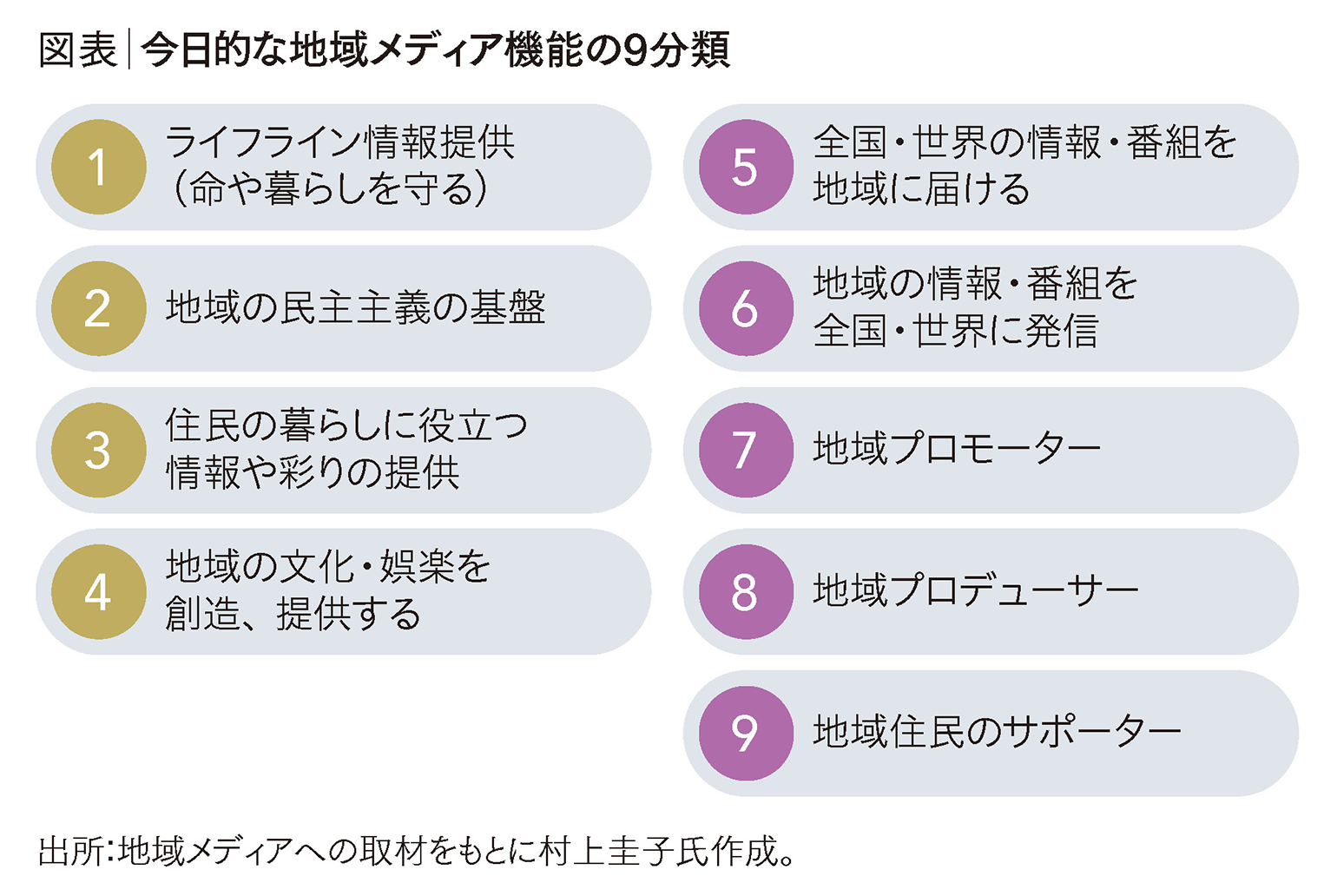
Suga: Even now, having returned from my secondment to TVer, I often have opportunities to discuss the raison d’être of local stations with colleagues there. The “Nine Categories of Contemporary Regional Media Functions” summarized by Mr. Murakami are very clear, so I have introduced them many times.
Murakami: I don’t think a single company needs to shoulder all these functions; it’s fine for different media outlets to have distinct roles and priorities. Private media have long built up functions such as ③ providing information useful for daily life and ④ creating culture and entertainment. In terms of business expansion, I believe the functions of ⑦ regional promoter, ⑧ regional producer, and ⑨ supporter of local residents will become even more important than before.
On the other hand, from the perspective of public service, ① providing essential public service information and ② serving as the foundation of local democracy are indispensable. While “the foundation of local democracy” is indeed the role of journalism, I would like to raise the question: isn’t daily news coverage limited to simply conveying “press releases” from the government and police in an easy-to-understand manner? The daily news is where broadcasters are truly put to the test. How do we document the day-to-day? The culmination of that effort becomes the foundation of local democracy.
For example, it’s difficult to generate interest in local government or council matters. That is precisely why the media is called upon to foster a sense of civic responsibility by making citizens feel that these issues are “their own concern.”
Suga: “Making it a personal concern” means whether we can stir people’s emotions and actions by conveying information—and this connects directly to the marketing strategies we advertising agencies think about every day.
Delivering the necessary information to the right people, at the right time, and in the right format. It’s not enough to simply deliver it; it has no meaning unless it brings about some kind of change. From that perspective, I believe a marketing mindset is essential for local media as well.
Murakami: You’re absolutely right. If evening news programs are too slow, it’s only natural to provide breaking news online. While online distribution and app development for local news have advanced significantly in recent years, the question remains regarding “quality”—which is directly linked to the media’s credibility. I feel we’re still in a trial-and-error phase there.
Suga: Local TV stations and regional newspapers often cover an entire prefecture, but take Nagano Prefecture, for example—it’s divided into four regions: North Shinano, East Shinano, Central Shinano, and South Shinano, each with distinct characteristics. Couldn’t they complement each other with media covering even smaller areas than the prefecture, such as cable TV or community FM stations?
Murakami: There are already such initiatives underway. For example, Minami Nippon Broadcasting in Kagoshima and Hokkaido Broadcasting are actually collaborating with other regional media outlets to broadcast and publish online information that they cannot cover on their own.
I believe that one strategy for local stations to survive is to become a “platform” that aggregates information from various local media outlets and local governments. By forming a finely meshed platform, I believe we can ensure that even regions with small populations and scarce resources are not left behind, and it will become easier to identify common challenges and work toward their resolution.
"Offering both encouragement and constructive criticism" to solve regional challenges
Suga: You mentioned regional challenges. What role should the media play in addressing them?
Murakami: I believe the greatest challenge in a society facing population decline boils down to this: how can we ensure that people living in these regions can live with pride, while maintaining overall economic viability, in a context where we can no longer expect the same level of economic growth as in the past?
Maintaining infrastructure in depopulating regions is difficult, which is why “compact city” initiatives are being discussed in various areas. Such discussions arose after the Noto Peninsula Earthquake as well. While there may indeed be economic rationality to this approach, it completely fails to empathize with the feelings of those whose familiar hometowns have been destroyed. To move forward while protecting people’s dignity, it is crucial to design a process that fosters a sense of personal ownership regarding each region’s challenges and facilitates “consensus building.”
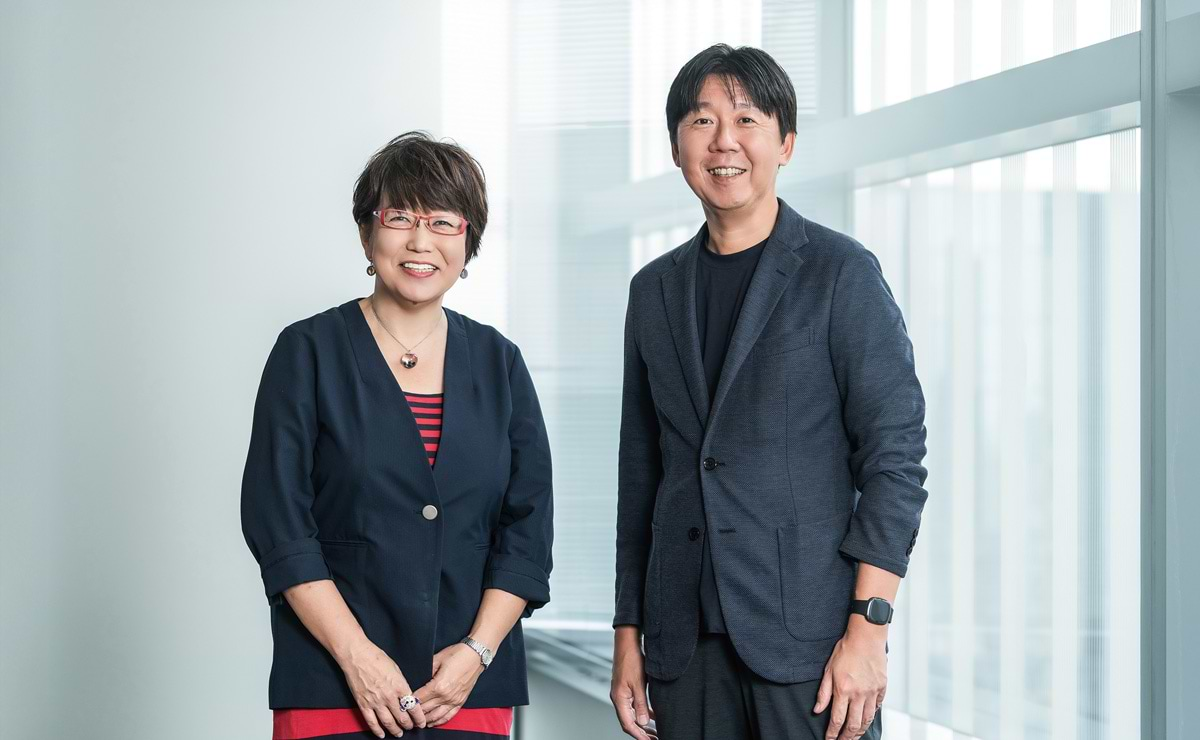
Keiko Murakami, Media Researcher (Senior Fellow, Tokyo Foundation)
Suga: It is precisely in that consensus-building process that the media, as a pillar of democracy, plays a major role. By scrutinizing the pros and cons of policies being debated in government and the legislature, the media can provide residents with the information they need to consider these issues as matters that directly affect them. Especially now, as political divisions deepen, the media’s role in fostering consensus is coming into sharp focus.
Murakami: At Ishikawa Television, there is a producer named Yukio Iokigashira who created three documentary films, including “Noto Democracy.” Regarding the role of local media, he states, “It is not enough to merely monitor those in power; evaluation is also important. However, offering praise is the most difficult thing for the media to do.”
Putting those in power on the defensive might look “cool” for the media. However, if that results in local government becoming dysfunctional, it is the citizens who suffer. That is precisely why I believe local media particularly needs a perspective that combines oversight with support—in other words, one that offers both criticism and encouragement.
Suga: With so many difficult issues to resolve, it’s hard for the government to implement solutions that everyone will accept.
Murakami: That is precisely why it is important for the media, as a member of the community, to take responsibility and work toward better solutions one by one. For example, expanding local resources into broader markets. Many local stations are already working on this—it’s an area where they truly excel—but regions with abundant resources are actually few and far between. For more difficult challenges, I hope local media will actively participate in finding solutions by collaborating with local governments and startups with strong IT capabilities.Initiatives such as using digital technology to monitor elderly people who wander off, monitoring bear sightings in real time, and managing agriculture, forestry, and fisheries operations with sensors are already underway.
These functions correspond to the “Regional Promoter,” “Regional Producer,” and “Community Resident Supporter” categories mentioned earlier.If local media approaches this not merely as a promoter marketing the region to the rest of the country, but as a producer working side-by-side to solve local issues—and, by extension, as a supporter ready to resolve individual residents’ problems—it can lead to the creation of new businesses that can be scaled to other regions. Furthermore, I believe these efforts can also inform the perspective of news programs, which form the foundation of local democracy.
Suga: It certainly seems like there are plenty of business opportunities. In one regional city, for example, a bank could no longer manage the effort of restocking ATMs, so they promoted cashless payments to local shops and elderly residents, enabling people to live their daily lives without keeping cash on hand. I believe there are many issues in local communities that can be resolved through technology.
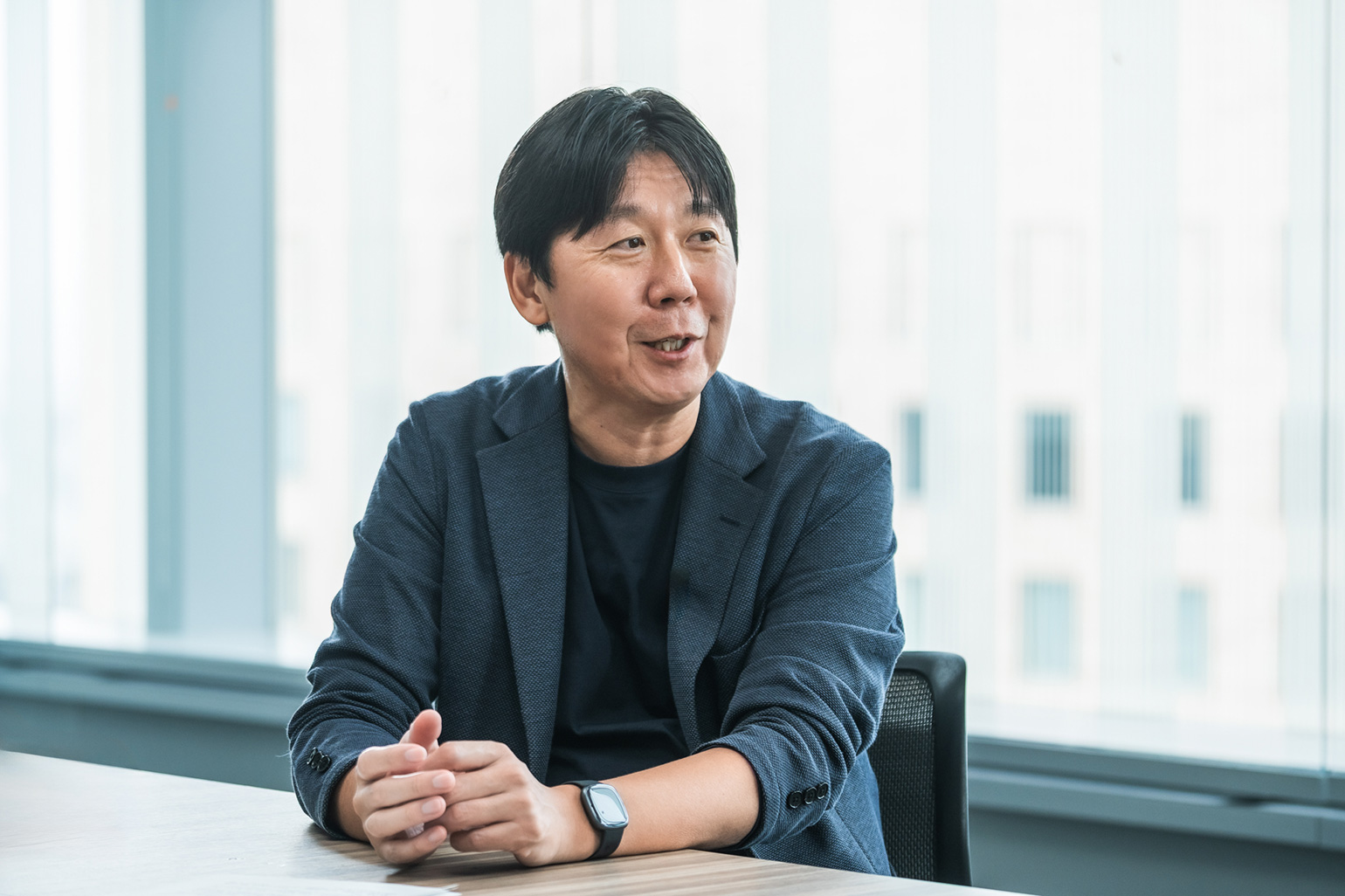
Hisaya Suga, Growth Officer, Dentsu Japan
Hopes for Content Innovation and Creating Spaces for Consensus Building
Suga: The line between traditional media and online media is becoming increasingly blurred. How do you think traditional media will change in the internet age?
Murakami: I’m not particularly pessimistic. I think the television broadcasting industry, having been the “king of media” in the 20th century, had become somewhat complacent. Meanwhile, the internet saw a rapid increase in engaging content that connected with users, and it began to attract an audience centered on younger generations. However, a backlash is also taking place. Issues such as the spread of fake and misinformation online, as well as “echo chambers” that amplify conflict and division, are now being recognized.
In this competitive environment with online media, traditional media will likely strive to innovate their content once again, and this will lead to the creation of compelling content. Rather, we should view this positively as the establishment of a fair competitive environment.
Building on that, what existing media must consider taking a step further is what they can do to “shape the public discourse.” While the Broadcasting Act mandates the presentation of multifaceted perspectives on issues where opinions clash, simply listing opposing views or airing superficial debate programs will likely fail to capture the public’s interest.
Suga: How can we create content that viewers will accept? Producers of variety shows possess a wealth of ideas and know-how in this regard. There seems to be room to leverage their expertise.
Murakami: For example, if we could use AI to visualize, through data, how diverse opinions are distributed and where one’s own opinion fits within that spectrum, it might promote mutual understanding and consensus-building. This isn’t just about streamlining processes; it’s about using AI as a creative brain for production. By incorporating creators’ ideas into this framework, we could enhance the appeal of the content.
Earlier, Mr. Suga mentioned the public nature of sports and variety shows. Whether it’s news, sports, or variety, by thoroughly examining the question of “what does public nature mean to us,” we should be able to create new content suited to the current era.
Suga: I’ve come to understand that it’s crucial to ask ourselves why we exist and articulate our purpose in order to explore “publicness in the broadest sense” as a media outlet.
After working at Dentsu Inc. System Development Office, Integrated DC, MC Planning Bureau, and TV Station NW1 Department, he was seconded to Presentcast Inc. in July 2006. He became President and Representative Director in June 2008, involved in launching gorin.jp and TVer. He returned to Dentsu Media Services / Radio,TV Division in January 2018. In January 2019, he became Director of Media Services / Radio,TV Business Planning Bureau. He was seconded to his current position in July 2020.