Dentsu Inc.’s “Future City Design Unit” is a specialized team that envisions the future of cities and lifestyles and provides support across various fields, from conceptualization to implementation ( click here for details).
In this series, we have explored what is required for future urban and community development, as well as what makes a city a happy place, from diverse perspectives.
This time, we turn our spotlight on “Cities and Artists.”
The “Future City Design Unit” believes that urban development based solely on atmosphere or aesthetic sensibilities has its limits, and that the participation of artists—professionals who give form to ideas—is meaningful. In this article, Ritsuko Sakata, who is also active as the contemporary artist RITSUKO, and Nobuhiko Komiya, a visiting professor teaching marketing at a university, engage in a dialogue. They discuss how to foster a better relationship between cities and artists.
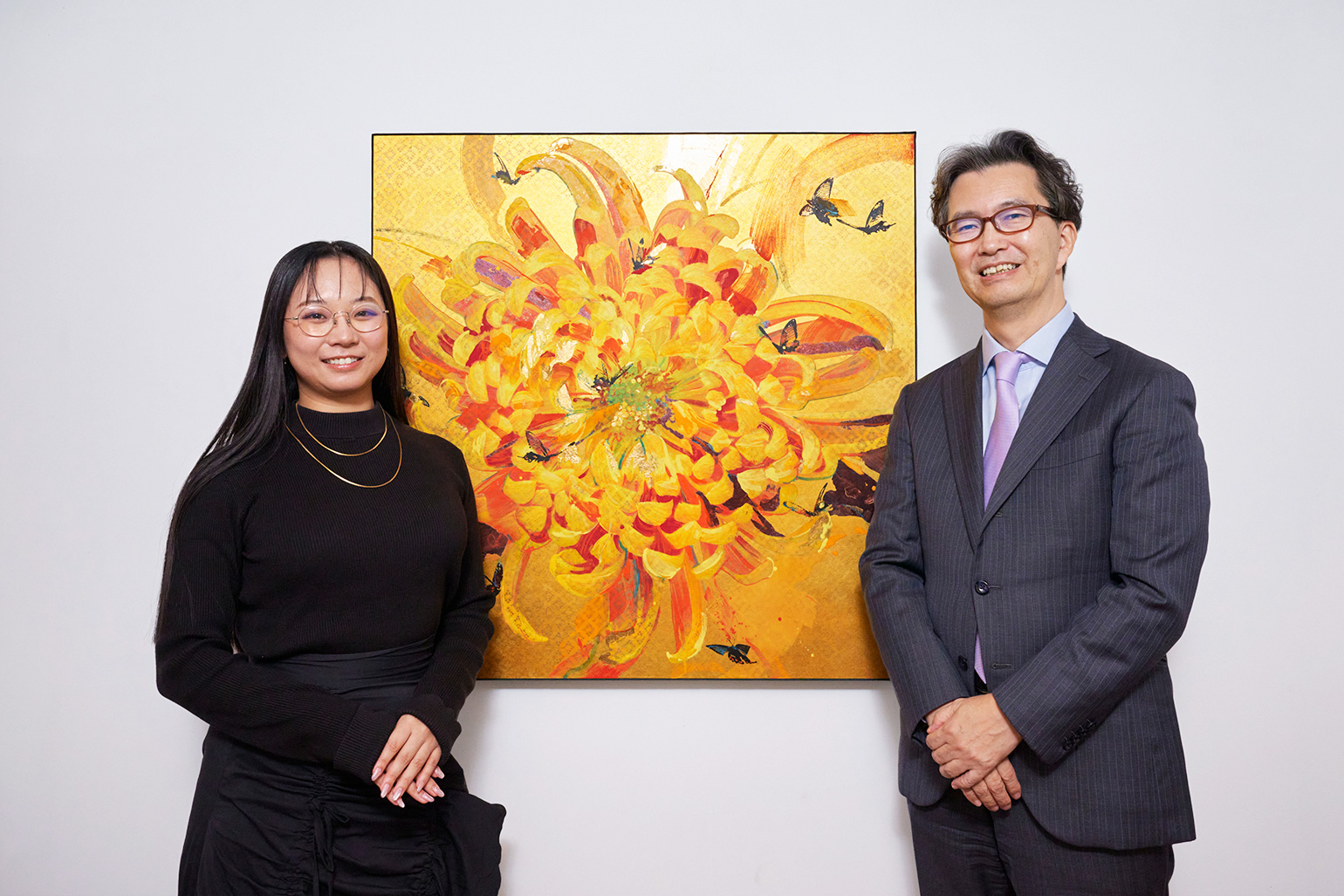
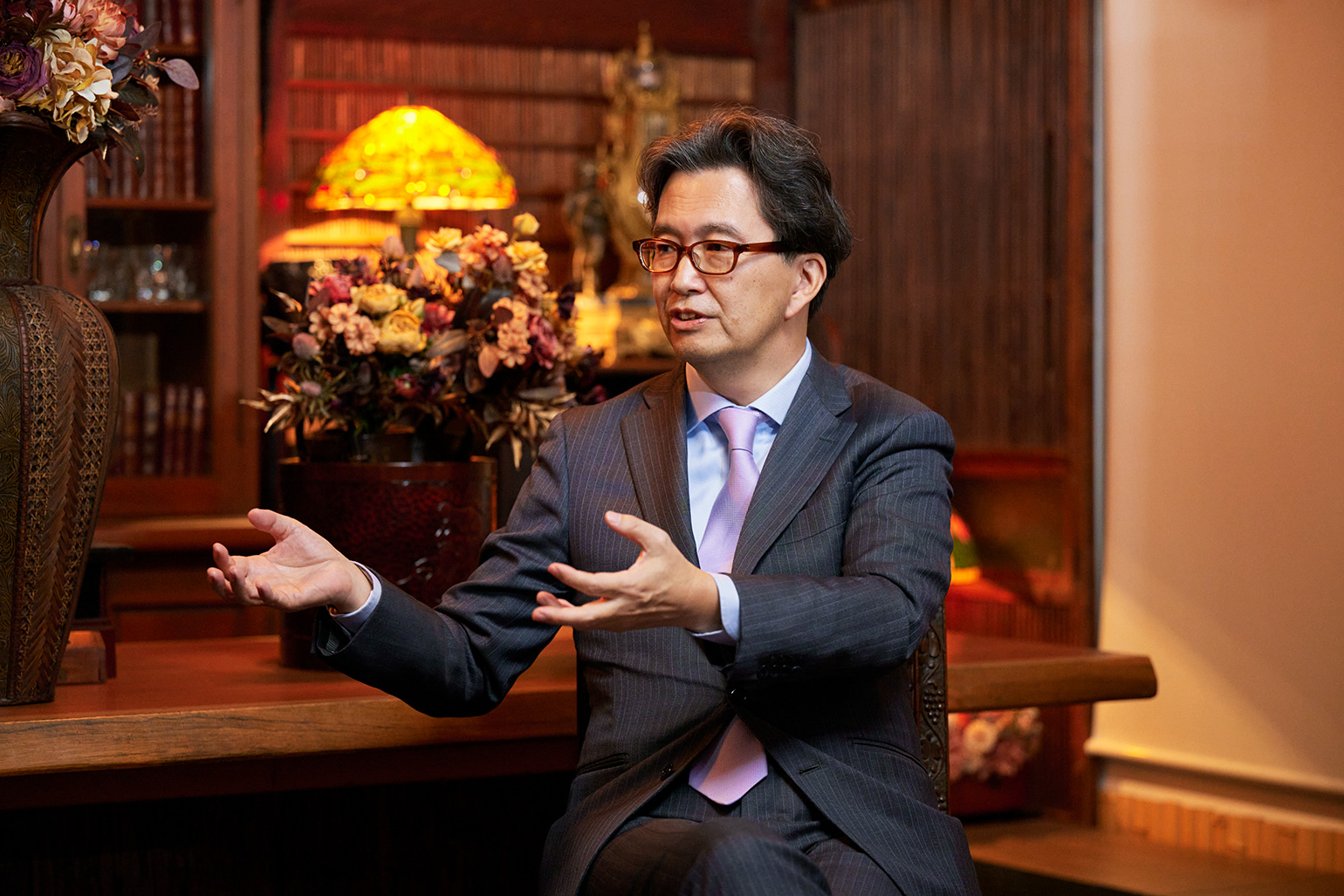
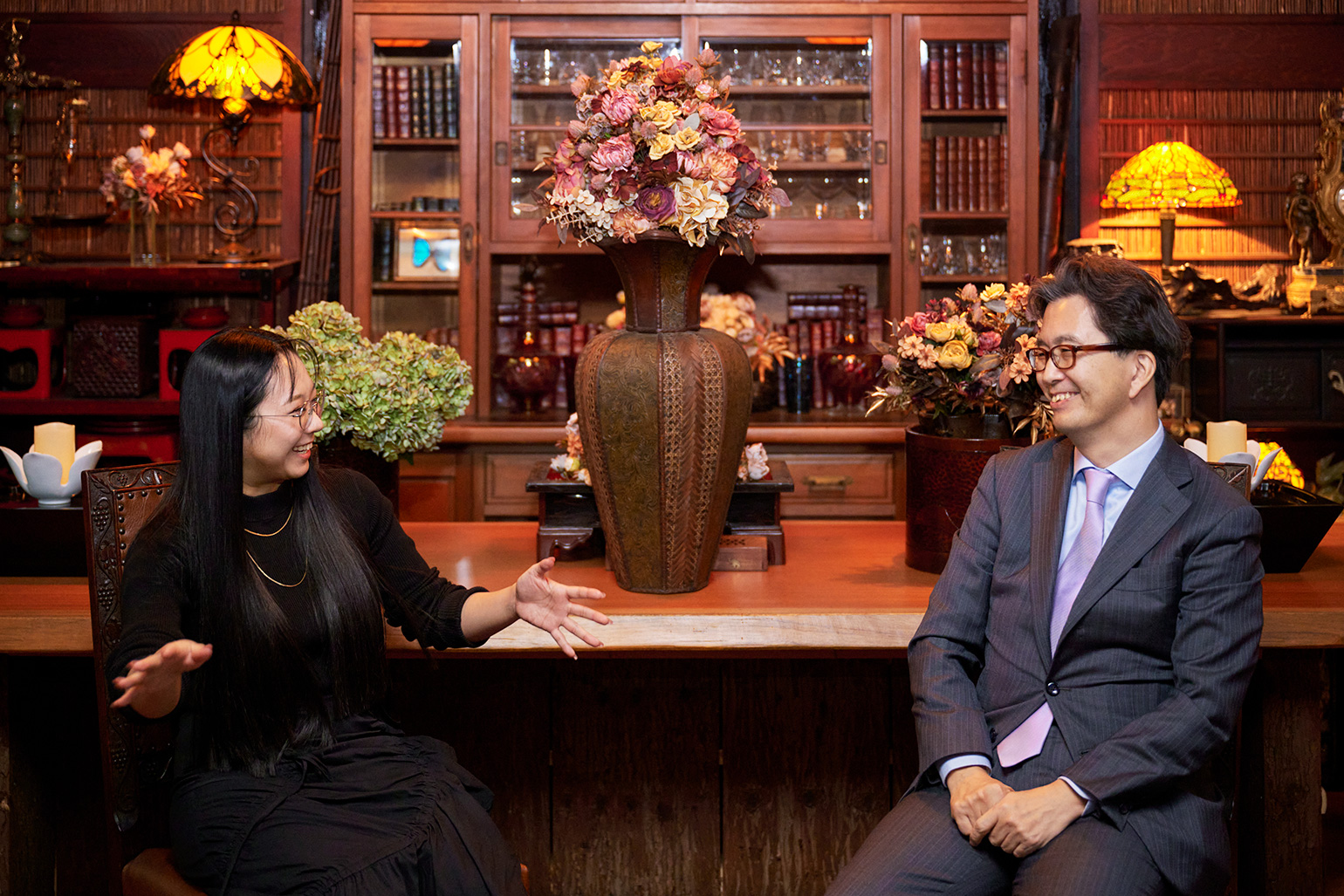
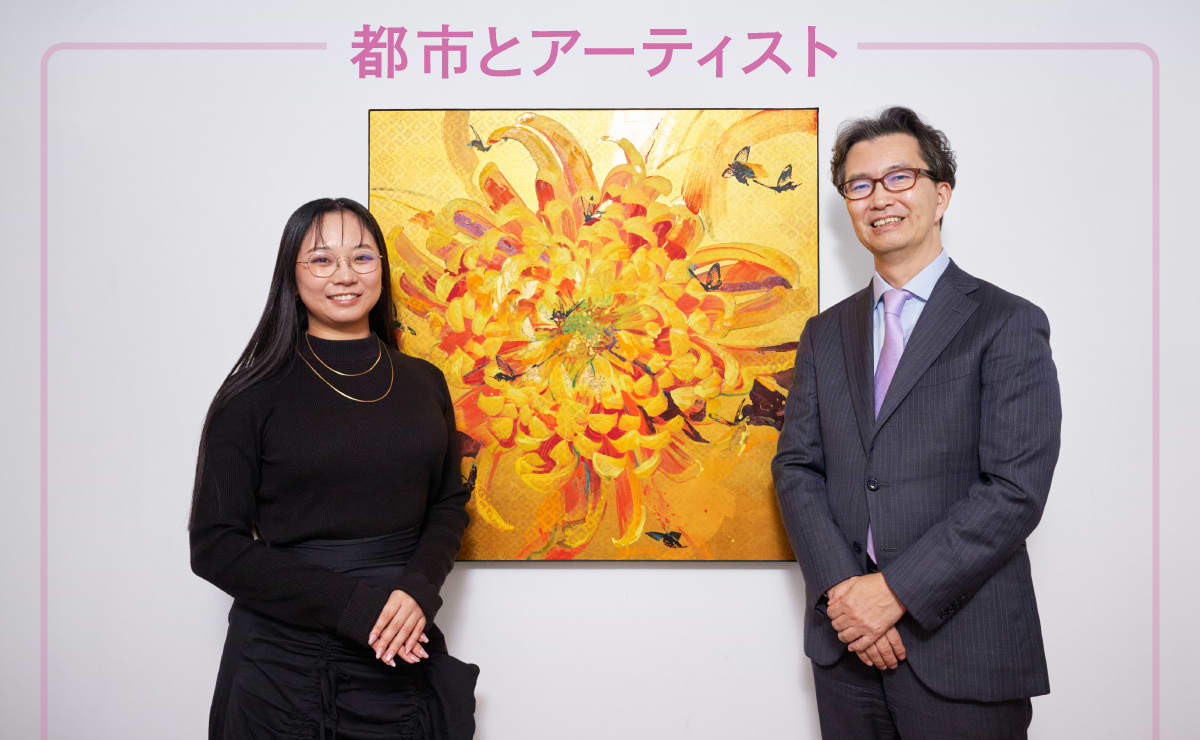
(From left) Ritsuko Sakata and Nobuhiko Komiya of the Future City Design Unit All images were taken at Shoudoh Gallery
Exploring the Potential of Dentsu Inc. and Urban Development
Komiya: Mr. Sakata, after graduating from Tokyo University of the Arts, you’ve been active as a contemporary artist while working as an employee at Dentsu Inc. What kind of work do you typically handle?
Sakata: Immediately after joining the company, I was seconded to Dentsu Digital Inc., where I worked for about five years as a media platform manager and solutions strategist. I returned to Dentsu Inc. in 2023, worked on DX initiatives, and am currently involved in the BX domain.
In college, I majored in oil painting but also created sculptures and painted Japanese-style paintings—my days were truly filled with creativity. I did consider pursuing a career solely as an artist, but I felt I needed an outside perspective to gain a broader view of the creative industry. That’s why I decided to join the workforce, and after joining Dentsu Inc., I specifically sought a position in a department where I could collaborate with creative professionals rather than being on the production side myself.
Komiya: That bird’s-eye view is wonderful. What led you to join the “Urban Future Design Unit” team?
Sakata: It all started when my supervisor approached me, suggesting it might be interesting to have an art specialist on the team. Through my research while pursuing my MBA last year, I had come to believe that culture and the arts aren’t being fully utilized within cities. I thought that by joining the team, I might be able to contribute, even in a small way, to solving these issues.
Komiya, what kind of work do you usually do?
Komiya: I’m currently working on new business development for client companies and urban development projects through co-creation involving industry, government, academia, and the public. I joined ISID (now DENTSU SOKEN INC.) and worked in sales, but after earning my MBA at age 30, I transitioned to a career as a strategic consultant. Later, as a founding member of Dentsu eM1 (now Dentsu Digital Inc.) and Dentsu Consulting Inc., I began focusing on business strategy and business development.Furthermore, I’m involved in urban development projects, including conceptualizing new urban visions and designing the relationship between visitors and the city. Currently based in the Kansai region, I’m leading various urban development projects and regional revitalization initiatives.
Sakata: So your work has expanded from consulting to urban development, and you’re designing across various fields. I sense that creativity is at the core of it all.
Komiya: Actually, Dentsu Inc.’s approach to creativity is quite similar to urban planning. We organize requirements based on the external environment and then use our creativity to build solutions. Furthermore, the process of thinking about how to evolve the value we provide and how to communicate it—even after completion—is something both fields have in common.
There are several types of urban development, and Dentsu Inc.’s approach and perspective are well-suited to both “greenfield” projects—building cities from scratch on vacant land—and “brownfield” initiatives—redeveloping existing urban areas.
Sakata: That might be a perspective that isn’t widely known.
Komiya: That’s right. Since communication designers have been active in this field recently, I believe Dentsu Inc. should become more actively involved in supporting better urban development.
However, simply compiling requirements isn’t enough to create new value. To stand out amid a proliferation of similar urban structures, I believe we need to connect with people’s emotions and move their hearts. That’s where “art” comes in, doesn’t it?
Cities where diverse communities gather are fertile ground for artists
Komiya: This strays a bit from the topic of cities, but as AI evolves, it will become easier to compile information and expressions; however, I think imbuing them with “emotion” will remain a challenge. In other words, even if AI excels at left-brain tasks, human intervention will still be necessary when right-brain thinking is required.
In that regard, even if there are established methods in art, the content of the expression is left to the creator’s sensibility. Therefore, human intervention is always necessary, isn’t it?
Sakata: That’s right. If you give AI specific parameters and ask it to “create the optimal work,” I think it can produce something to a certain extent. However, without that fundamental creative impulse—the question of “why create this?”—the work lacks “meaning.” Even if two pieces look similar, their value changes depending on whether or not the creator has imbued them with “meaning.”
Fundamentally, there is no single correct definition of art. What is considered good is left to the artist, the audience who receives it, and the critics.
Komiya: When you think about it that way, the artist themselves become the starting point, don’t they? In our line of business, we design and give form to expressions based on requests to meet our clients’ needs on a daily basis. That kind of creativity has an element of being a contract-based industry. Even though it’s the same kind of creativity, in art, everything that wells up from within the artist—their upbringing, experiences, and concerns—becomes the point of contact with the world. You could say it requires an expression that utilizes their entire being.
Sakata: Contemporary artists, in particular, often seek to differentiate themselves from others by fully mobilizing their background—their birthplace, religion, values, perspectives, and assertions. If they’re merely technically skilled, they risk getting lost in the crowd, and unless they explain their work according to interdisciplinary rules, they may not gain international recognition. In that sense, there are certain constraints on the art they create.
On the other hand, precisely because of these constraints, the more opportunities for presentation, the better. Realistically, it is a fact that urban areas offer more opportunities for presentation. Indeed, renowned contemporary artists like Picasso and Warhol have based their creative and exhibition activities in urban centers.
Komiya: So you’re saying, “Artists thrive in cities.” I find that a very interesting perspective. After all, in rural areas, the number of people capable of appreciating and evaluating an artist’s work is overwhelmingly small. A small volume means a lack of diversity. In that regard, urban areas are home to people from diverse backgrounds, with a wealth of ideas and values, aren’t they?
Sakata: Exactly. Of course, geniuses exist not only in urban areas but also in rural ones. However, if the absolute number of people capable of recognizing and appreciating that talent is small, that talent will remain buried. In urban areas, combined with the large population, the environment is well-suited for artists to thrive.
Furthermore, the pace of growth is vastly different. The more opportunities for interaction there are, the more opportunities for feedback naturally increase. What emerges from such dialogue is refined into artistic concepts and content. That is precisely why venues for presentation are so crucial for artists.
Komiya: From my perspective as someone who teaches “entrepreneurship” at a university, I’ve come to feel that artists and entrepreneurs share many commonalities. Both influence society, produce achievements or results, and their work is validated and consumed by the general public. Furthermore, the source of their creative energy lies in their own thoughts, experiences, or a sense of social awareness—this is another shared trait.
Furthermore, while working on the development of a large-scale mixed-use complex, I made a discovery regarding urban functions. The project consolidated office spaces, commercial facilities, cultural venues, and even residential spaces all into a single location. By doing so, the facility became multifunctional, and the community that gathered there became diverse. Moreover, because it provided everything necessary for daily life, we were able to maximize the time residents spent there.
At that moment, I felt that this large-scale mixed-use complex represented a microcosm of the city. An environment where many people gather and stay, and where diverse communities intersect, is the city itself—a place where facilities with a wide variety of functions come together. Therefore, it could be said that cities are fertile ground for artists and entrepreneurs, who need to be appreciated and supported by a diverse range of residents.
The Challenges of “Artists × City”: Art Displays Without Artists and High Barriers
Komiya: While the city is an important place for artists, what challenges do you think currently exist in the relationship between artists and the city?
Sakata: I feel that many current art exhibitions are still rather rudimentary. They’re often just displayed on the walls of bars or cafes, and there are still few opportunities for the artists themselves to be present at the exhibition. As a result, I think it’s difficult to convey the thoughts and background behind the work, making it hard for the general public to truly engage with it.
Another challenge is the lack of opportunities for artists to interact with one another. While creation is essentially a solitary endeavor, there are many things we’d like to share regarding the industry—such as the latest information on galleries and curators—to build a solid foundation for our careers. However, it’s not uncommon for artists to be too proud to ask each other for such advice (laughs).
Komiya: Startups also exchange information among peers, so I feel a certain kinship there. For entrepreneurs, there’s a functioning system where investors support startups as an industry. Do similar investors exist for artists?
Sakata: For artists, it’s the so-called patron. Actually, in the art world as well, there was a contemporary art bubble from around 2017 to 2019. Back then, books related to the contemporary art market and art investment were published, and the topic was increasingly discussed in the context of investment. People believed that if they purchased a work, its value would rise in the future, so it was treated as a kind of investment product. However, in reality, the value didn’t always rise as much as expected.The reality is that, given the specialized and complex nature of the valuation system, it’s difficult to say that it’s as stable as typical investment products.
Komiya: I see. However, just as startup investing was originally known only to a select few, I think the number of people who recognized art as an investment product was limited. That’s precisely why, in order to increase the number of supporters, art may need to become a more familiar presence.
Sakata: I agree. However, the art world is still considered to have high barriers to entry. In the past, Japan had patrons who established institutions like the Pola Museum of Art and the Mitsubishi Ichigokan Museum and provided significant support to artists.The fact that such wealthy patrons have disappeared is one of the reasons the art market has cooled off. The presence of supporters plays a crucial role in fostering artists’ growth, expanding educational opportunities, and guiding their creative mindset in a positive direction. This shortage of patrons is certainly a significant blow to artists.
Artists × Cities: What’s Needed Is Education in Added Value
Komiya: Regarding the shortage of patrons, it is certainly important to nurture artists and produce their work through support. However, I felt it was also necessary to reform training systems from an educational perspective.
For example, in Spain, children now cite “chef” as a career goal more often than “soccer player.” This is due to TV programs featuring star chefs.Take the regional city of San Sebastián, for instance. Through collaboration between industry, government, and academia, they established a new university department. Beyond simply improving culinary skills, they systematically educated students on the impact chefs have on society—covering business perspectives such as cash flow and supply chains, as well as initiatives addressing environmental issues. As a result, star chefs emerged one after another, and the city has grown to be recognized as a global culinary capital.
Similarly, I believe that by providing artists with education on various forms of added value and establishing an environment to nurture them, we can create cities that become sanctuaries for artists. Furthermore, as artists gather in these sanctuaries, new competitive dynamics will emerge, which could lead to the revitalization of the city.
Sakata: Indeed, it may not be enough for artists to simply adopt a passive stance, hoping that people will view or purchase their work. I, too, am interested in developing an art literacy program aimed at contemporary artists and those involved in the contemporary art scene. This builds on research I conducted during my graduate studies, which I completed last year—it’s a program designed to share accurate knowledge and established norms regarding contemporary art, including with artists themselves.
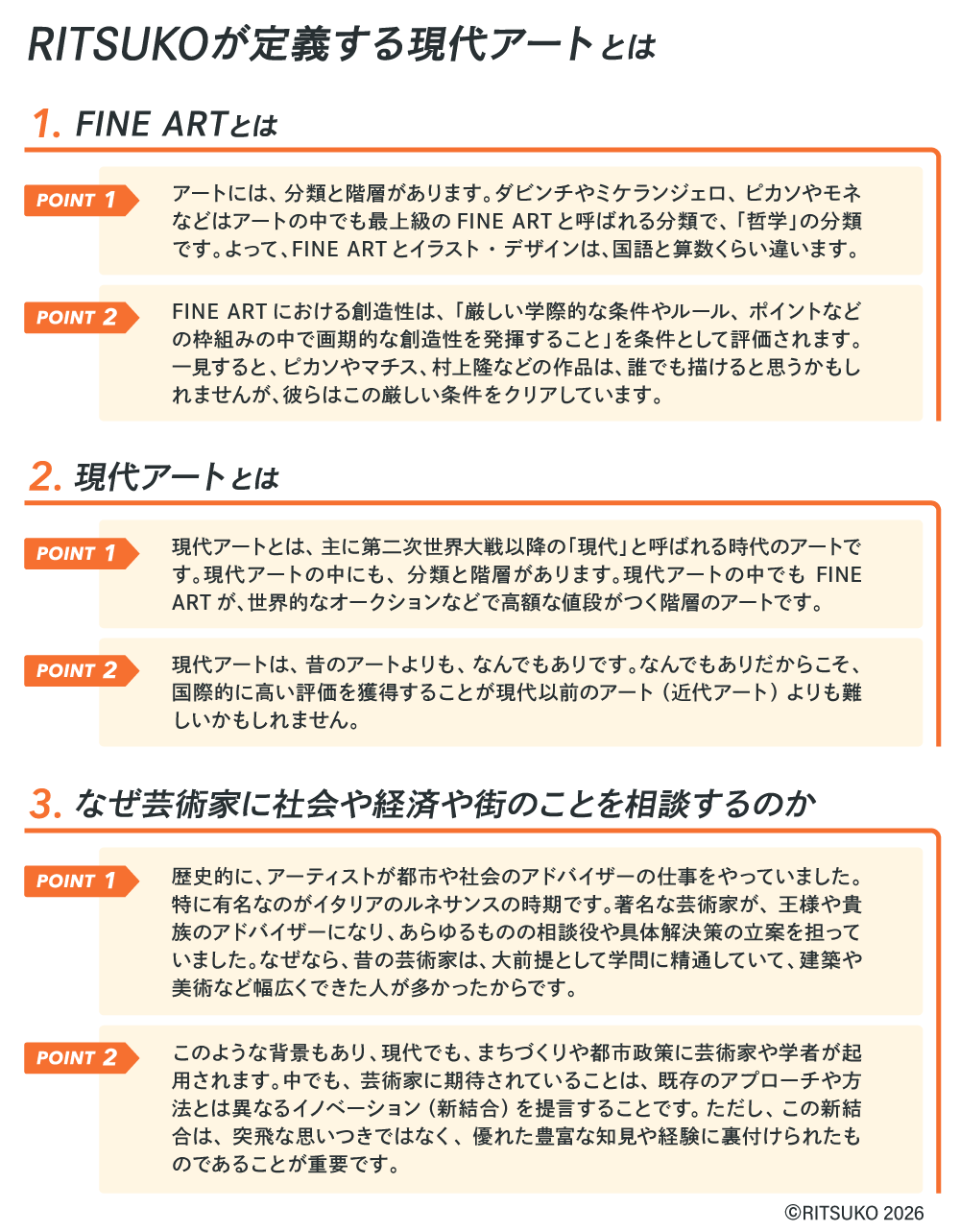
Contemporary art, at its core, is rooted in “philosophy.” It stems from a way of thinking dating back to ancient Greece, where the “Arts” governed the origins of all disciplines. Jewish philosophical concepts were later incorporated, and the market that emerged—a fusion of financial asset value and academia—is what we now call contemporary art. However, there are many artists who simply imitate the superficial aspects of contemporary art without understanding this lineage.
Komiya: It’s the most essential subject to teach, isn’t it? We unconsciously make value judgments—distinguishing between good and bad—based on the legacy accumulated by our predecessors in fields like philosophy and religion. I believe creators need to interpret and internalize that legacy in their own way. That’s precisely why we need to study philosophy—or rather, the liberal arts—as a foundational education.
Sakata: Exactly. I believe contemporary art, too, must be created based on a liberal arts-oriented mindset at its core.
I also believe it would be effective to establish galleries with resident gallerists, rather than relying on the rental galleries that are currently mainstream. Doing so would create a space where artists always have access to curators and gallerists they can consult with, making it possible to support their creation and presentation of work.
Furthermore, to address the high barriers that have been a bottleneck, I’d like to start by expanding the base of people who engage with art—for example, through collaborative workshops among artists.
Komiya: I think that’s wonderful. Even in the fields of food and startups, which we discussed earlier, it’s common for individuals to gather peers and form monetizable communities in order to enhance their own value while pursuing their careers. I believe that in the future, cities that successfully incorporate such mechanisms into the art sector will become even more vibrant.
At the same time, rather than becoming overly dependent on support, communities, or specific venues, isn’t it also necessary for artists themselves to take the initiative in establishing their own platforms for expression?
Sakata: You’re absolutely right. I try to establish my own platforms for expression as much as possible, but I feel that the current art school education system still places too much emphasis on patrons. That’s why I believe we need to build a systematic training system—beyond just technical skills—to create an environment where artists can monetize their work themselves. Having such a space within a city naturally becomes a reason for artists to gather there. In terms of creating that environment and designing communication, I envision Dentsu Inc. taking on the role of an “Art Communication Salon.”
Komiya: I see. So, in other words, you’re envisioning a new “Art Innovation Center”—one that’s neither a museum, a gallery, nor a curator. Our team includes artists as well as diverse experts in fields like architecture and business design. Let’s work together as a team to build a space dedicated to nurturing artists.
A City with as Much Art as It Has Restaurants! What Artists Can Do for a “High-Well-Being City”
Komiya: Finally, what do you think artists can do to contribute to the “high-well-being city,” which is the theme of this series?
Sakata: I don’t think artists themselves think much about whether they can make society happy. They simply express and present what they personally find enjoyable. I believe that when someone receives that, resonates with their feelings, or is influenced by it, happiness spreads. It’s like being a “happiness transmitter.”
The more artists there are who act as “happiness transmitters,” the more likely it is that people will find someone whose values and tastes align with their own. And I believe that will foster various forms of happiness. That’s precisely why artists need to gather in cities; by sharing their work, I think they can contribute to creating cities with high levels of happiness.
Komiya: Just as restaurants have become part of the social infrastructure by being so widespread in cities, we may need to create more spaces where artists can showcase their work and, by extension, build cities where art is an integral part of the fabric.
Returning briefly to the topic of AI, I believe that in the future, value will lie in what only humans can do. Of course, it’s possible for machines to produce food or artworks. However, people empathize precisely because those creations reflect a person’s way of life, values, and ingenuity. Just as we support chefs and startups, I think this sense of “empathy”—the idea of “I’m buying this because this person created it”—will become an integral part of consumer behavior.
Sakata: For city dwellers as well, I think this will lead to revitalization—whether by expressing their own views in response to an artist’s ideas or by purchasing artworks.
Komiya: That is precisely why it is important for people to gather in cities. In the future, “compact cities”—where everything is consolidated and streamlined—will become the mainstream of urban development. While cities become more functional, I believe we will also see a revival of humanity, with diverse people gathering and communicating. In that context, won’t the art created by people and the artists themselves become vital figures?
Business Transformation Division 2, Growth Branding Department
Communication Planner / Urban Future Design Unit / Contemporary Artist
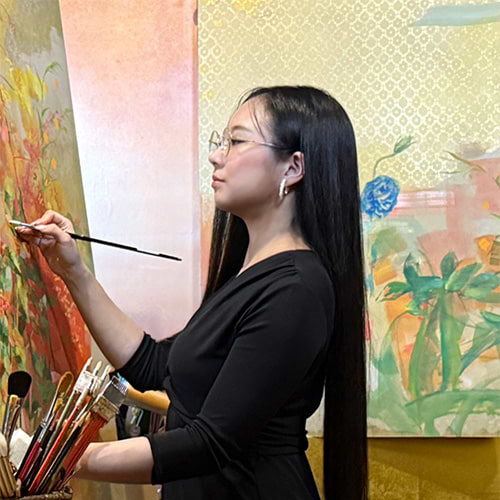
After graduating from the Oil Painting Department at Tokyo University of the Arts, he joined Dentsu Inc. From his university days to the present, he has been exhibiting his paintings as the contemporary artist “RITSUKO.”At Dentsu Inc., she was seconded to Dentsu Digital Inc. and is currently based in Dentsu’s BX division. Leveraging her expertise in both creative and digital fields, she handles concept and strategy design/planning within the BX division. She conducts research on the industrialization of culture and the arts and earned an MBA (Master of Business Administration) in 2025. She is a member of the Urban Future Design Unit.
Senior Innovation Director / Urban Future Design Unit
Specially Appointed Professor, Graduate School of Business Design
Board Member, Japan Marketing Association.Specializes in holistic new business development that integrates the left and right brain, online and offline, strategy and practice, and has a proven track record in business transformation and marketing strategy development for a diverse range of clients. Additionally, as an intrapreneur, he participated in the founding of ISID Deloitte, Dentsu eM1 (now Dentsu Digital Inc.), and Dentsu Consulting Inc. Currently, he is engaged in startup support and the production of co-creation projects. Member of the Urban Future Design Unit.

 Urban Future Design Unit: Pursuing Happiness in the City [11/12]