Note: This website was automatically translated, so some terms or nuances may not be completely accurate.
 The Challenge of Attention Planning [1/2]
Will “Attention” Change How Ads Are Evaluated?—Three Companies, Including KDDI, Explore the Potential of a New Common Metric

Maiko Yanagida
Pinterest Japan

Mitsuru Gosha
KDDI Corporation

Masashi Hatayama
Dentsu Inc.

Stephen Leung
Dentsu Japan International Brands
Even with the same number of impressions, there can be a significant difference in advertising effectiveness—and the factor driving that difference is the “attention” that consumers actually direct toward the ad.
As digital advertising metrics shift from quantity to quality, Dentsu Japan International Brands Inc. (hereinafter DJIB) conducted the “Attention Economy Survey” in collaboration with KDDI and Pinterest as part of its “Attention Economy” project.
This survey analyzed the relationship between actual visual behavior captured via eye-tracking* and brand outcomes. It examined the potential of “attention” as a common metric that can be used to compare results across platforms and ad formats. The findings revealed that the value of advertising is shifting from “how much it reached the audience (quantity)” to “how meaningfully it was viewed (quality).”
In this article, based on a roundtable discussion among KDDI, Pinterest (Pinterest Japan), Dentsu Inc., and DJIB, we explore the potential of leveraging attention and the future of advertising evaluation.
*Eye tracking: A technology that uses specialized sensors or cameras to track and analyze a person’s eye movements and gaze.

<Table of Contents>
▼The Fundamental Question of “Was It Really Seen?” Even in the Digital World
▼Reevaluating Media Value Using “Attention” as a Common Metric
▼The True Nature of “High-Quality Attention” Revealed onPinterest
▼From “Being Seen” to “How It Is Perceived”—The Turning Point That Determines Success
▼Beyond Visualization—Turning Attention into a “Growth Metric”
The Fundamental Question of “Was It Really Seen?” Remains Relevant in the Digital Age
Even in digital advertising, the question of “Are ads actually being seen?” is regaining importance.
At KDDI, we have historically prioritized determining whether TV ads are actually being seen, and have continuously verified and improved ad effectiveness based on this. Since 2019, we have introduced attention metrics; after confirming their correlation with ad awareness, we have been applying them to the selection of TV programs and OTT media*.
In contrast, for digital advertising, we have historically relied on log-based metrics—such as reach and complete view rates—to evaluate and improve our campaigns. However, we were aware of the potential discrepancy between the numbers in reports and how ads are actually “viewed.” This is because even when an ad is displayed on the screen, it does not necessarily capture the user’s attention, and there are cases where a video is deemed to have finished playing even though it was not viewed sufficiently.
Consequently, KDDI shifted its focus from merely “how much was delivered” to “how much was actually watched.” There is a growing need for new evaluation metrics that verify the fundamental effectiveness of digital advertising as well.
*OTT media: A general term for content distribution services accessible via the Internet, bypassing traditional television broadcast networks.

Reevaluating Media Value Using a Common Metric: “Attention”
To address these challenges, a Dentsu Inc. team led by DJIB, in collaboration with KDDI and Pinterest, developed an approach to evaluate digital advertising using “Attention” as a common metric.
This initiative aims to visualize “how much the content was actually viewed”—a metric that traditional metrics like impressions and reach struggle to capture—and to compare and verify the value of platforms and ad formats in a way that more accurately reflects reality.
The study utilized eye-tracking technology provided by the third-party measurement firm Lumen Research. It surveyed 1,050 residents of Japan, recreating a natural mobile browsing environment to measure “where” and “how long” users looked. The study analyzed the relationship between attention (viewing intensity) during ad exposure and brand outcomes (awareness and favorability) across four major social platforms and seven types of ad formats.
A key metric in this study was APM (Attention per Mille), which combines viewability and average viewing time. This metric enabled us to compare attention levels across platforms and ad formats, establishing a foundation for evaluating media value from the perspective of “how much attention was captured.”
The Nature of “High-Quality Attention” Revealed on Pinterest
This study revealed that visualizing attention allows for a deeper understanding of differences in ad effectiveness. Among the platforms we examined, Pinterest stood out in particular.
The study found that Pinterest’s Premier Spotlight (reserved) and Wide Video (programmatic) ads recorded high viewability rates and APM. Although these are “in-feed” ads that appear just like regular posts, they still garnered significant attention, demonstrating that high screen real estate alone does not guarantee attention.
We also observed that, compared to other platforms, users on Pinterest tend to scroll up to 13 times slower, carefully examining content as they explore information.
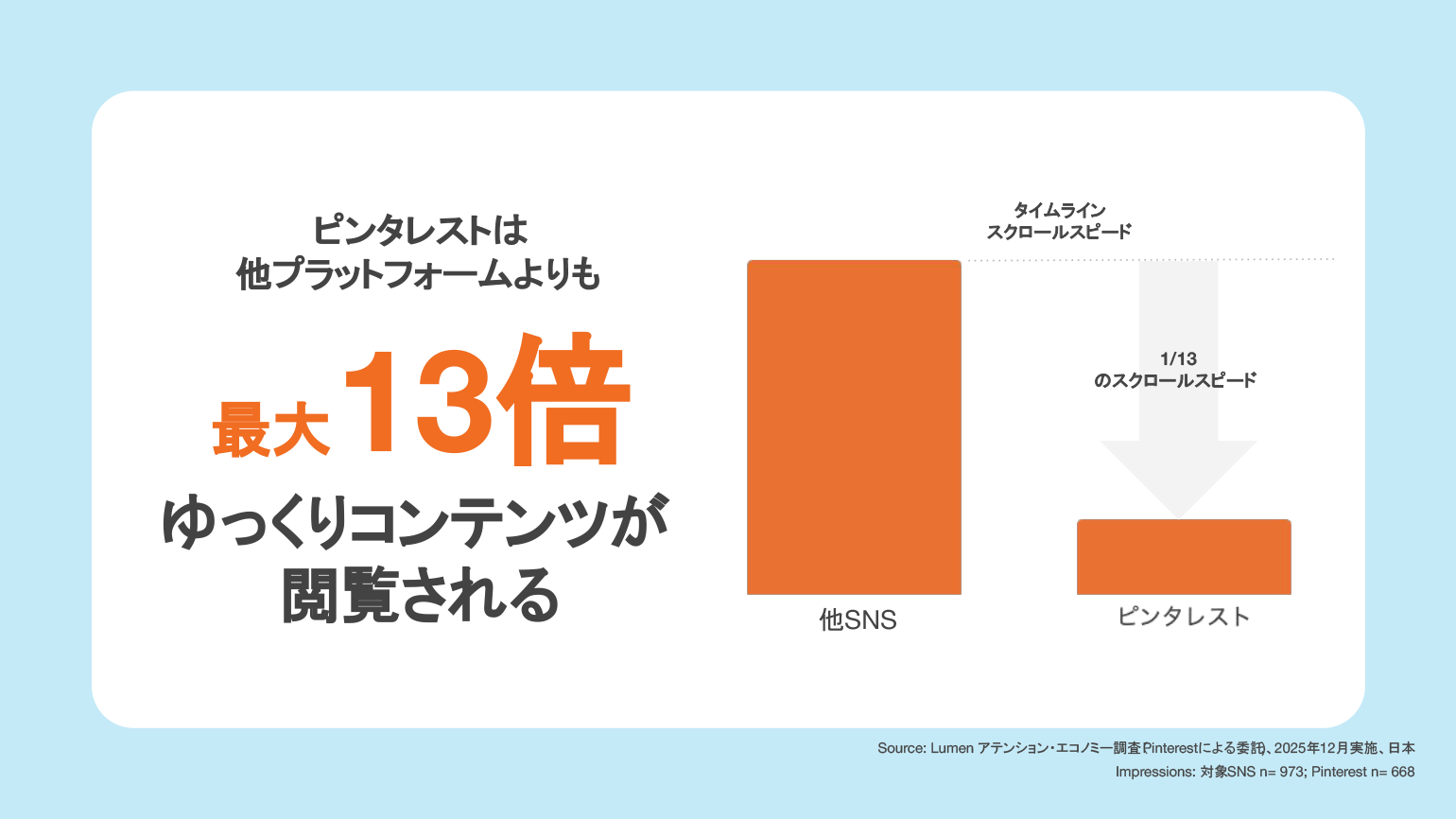
This is because Pinterest is an exploratory platform where users search for ideas about “what they want to do next” or “what they want to buy next.” Since users encounter ads while actively engaging with information, the environment fosters more than just exposure—it creates conditions conducive to understanding and recall.
Furthermore, we observed a tendency for brand recall to increase among users who were in a positive frame of mind while using the platform. These results suggest that it is not just platform differences that affect the quality of attention, but also the user’s mood and context at the time of exposure.
From “Being Seen” to “How It Is Perceived”—The Turning Point That Determines Results
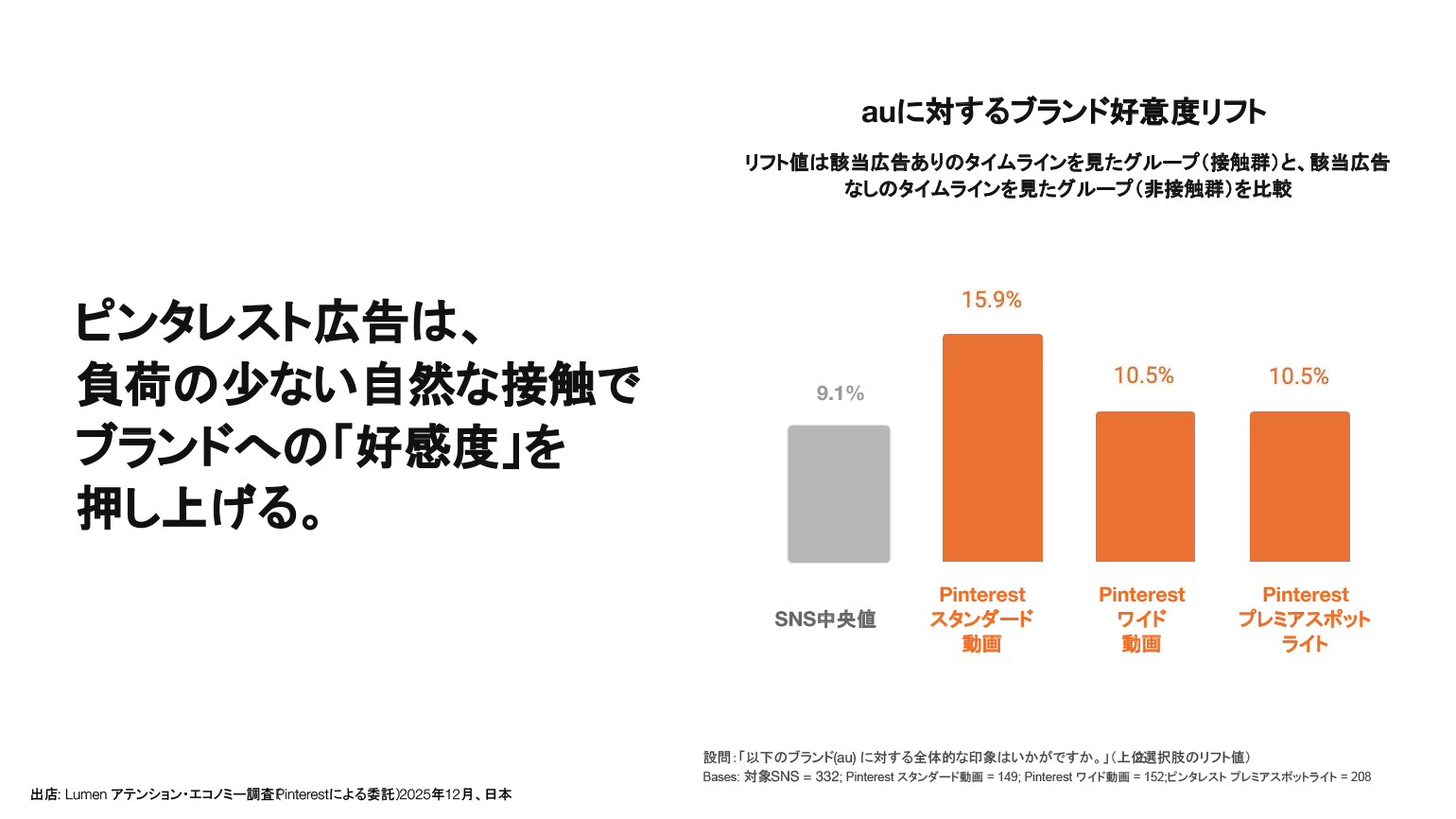
When examining the relationship with brand performance, we confirmed that ad formats with higher levels of attention tend to drive greater brand recall. Additionally, KDDI’s Pinterest ads achieved the highest lift in favorability among the platforms surveyed.
This indicates that, in addition to ads simply being “seen,” “how they are perceived” also influences brand performance.
In this study, creative design was also prioritized to increase attention. For au’s ads, the campaign leveraged the character assets accumulated over many years while combining brand colors, short and clear copy, and eye-catching elements to create a composition that easily leads to brand recognition even in a short amount of time. By combining static images and video, the campaign aimed to balance capturing initial attention with providing supplementary information.
Specific insights were also gained from the analysis of these creatives. Heatmaps showed that the static banner at the top attracted a significant amount of initial attention, suggesting that the design—which clearly conveyed the brand name and message right from the start—may have contributed to brand recall. Furthermore, the structure in which the video supplemented this information is believed to have led to improved understanding and higher engagement.
Thus, this study demonstrated that on Pinterest, high-quality attention is achieved when user context, ad formats, and creative design align effectively.
Beyond Visualization—Turning Attention into a “Growth Metric”
Based on this analysis, KDDI can expect to develop media plans and operational improvements that more accurately reflect reality by incorporating “attention” as a new metric alongside existing ones.
Furthermore, for Pinterest, given its nature as a platform where users carefully explore information—rather than simply being a space for high volume of impressions—the results revealed its potential as a venue well-suited for conveying brand messages and brand identity.
This study demonstrated the importance of reevaluating the value of digital advertising with attention as the starting point, and of taking a holistic approach to media selection, format design, and creative development. Moving forward, the Dentsu Group plans to utilize attention as a core metric in media selection, creative development, and delivery optimization, further strengthening the connection between these efforts and brand and business outcomes.
Viewing advertising value not only in terms of “volume” but also “quality”—this initiative can be considered a significant step toward putting that into practice.
[Survey Overview]
・Target Area: Japan (Nationwide)
・Target Demographics: Social media users aged 18–65 (equal allocation by gender and age)
・Sample Size: 1,050 people
・Survey Method: Online survey
・Survey Period: December 2025
・Research Agency: Lumen Research (commissioned by Pinterest)
Was this article helpful?
Share this article


Newsletter registration is here
We select and publish important news every day
For inquiries about this article
Author
Maiko Yanagida
Pinterest Japan
Measurement Solutions Department
Measurement Lead
As Measurement Lead in the Measurement Solutions Department at Pinterest Japan, he supports data-driven decision-making by designing effectiveness verification for advertisers and agencies and visualizing the contribution to brand value and sales.
Mitsuru Gosha
KDDI Corporation
Communication Design Department, Media Planning Group
Group Leader
1998: Joined the current KDDI; engaged in sales to agencies for mobile and fixed-line services;2012: Worked in the Advertising Department on digital media planning, creative production, and social media management; 2018: Seconded to group company Supership Inc.; 2021: Returned to KDDI to work on new businesses utilizing 5G and AR/VR; 2023: Returned to the Communication Design Department (formerly the Advertising Department) to oversee planning for all advertising media.
Masashi Hatayama
Dentsu Inc.
Business Producers Division 6, Experience Design and Production Department
Associate Experience Design Producer
Joined Dentsu Digital Inc. as a new graduate. In the AP Division, he was responsible for end-to-end advertising operations and account planning. He primarily worked on developing digital media strategies for telecommunications carriers and has been on secondment to Dentsu BP Bureau since 2025.

Stephen Leung
Dentsu Japan International Brands
Associate Director
Engaged in operations and business development at Dentsu Hong Kong and Google Hong Kong. Currently serves in the Integrated Solutions Department at Dentsu Japan International Brands Inc., responsible for partnership operations with domestic and international media. The mission is to provide optimal and innovative media solutions to the Dentsu Group and its clients. Additionally, works on developing proprietary solutions that deliver unique value to clients' business challenges.