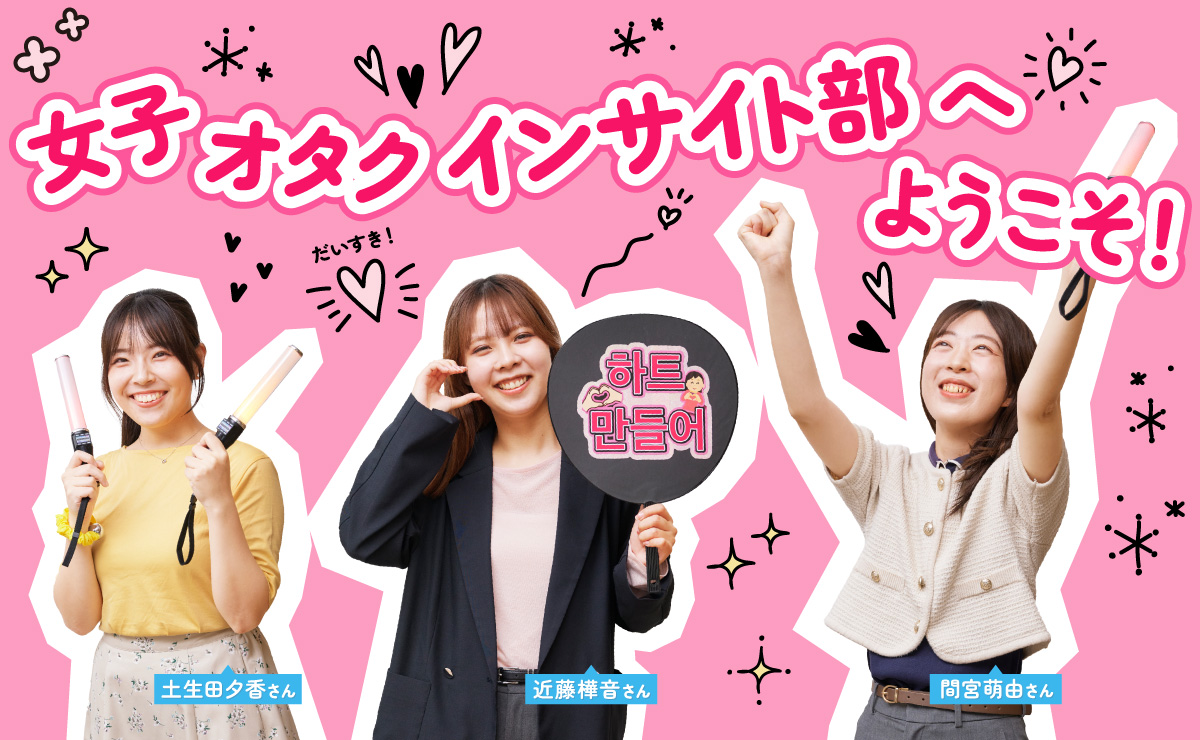
“BUKATSU” is a project of Dentsu Inc.’s Marketing Division 2 (hereinafter referred to as the 2MK Bureau) that operates under the theme “Turning What You Love into Your Strength,” with activities rooted in employees’ personal interests and passions. In this final installment, we introduce the “Women’s Otaku Insight Division.”
In recent years, “oshi-katsu” (activities centered around supporting one’s favorite idol or character) has been gaining attention in the marketing field. Many companies are taking note of the intense consumer behavior and community-building associated with this phenomenon. However, the insights behind “oshi-katsu” are extremely nuanced, and a superficial understanding alone is insufficient to capture the hearts of fans.
The “Women’s Otaku Insight Club” tackles marketing challenges armed with real-world insights gained from their own “oshi-katsu” experiences. How do the three members—who love diverse genres ranging from K-POP and Japanese idols to 2.5-dimensional stage productions—translate their personal experiences into their work? We spoke with club members Moeyu Mamiya, Kanon Kondo, and Yuka Habuta.
Turning Passion into a Career: The “Women’s Otaku Insights Division” Launched by Three Young Women
—First, could you please introduce yourselves and describe your typical work duties?
Mamiya: I usually work as a strategic planner, developing marketing and communication strategies for clients. I provide support that extends beyond TV commercials to areas such as product development and branding.
Kondo: I primarily handle media planning. My main responsibility is to propose the optimal media mix—such as TV and digital—and budget allocation based on the client’s budget. I also select TV programs that match our sponsors’ profiles during the programming lineup changes and analyze shows using viewership data.
Habuta: I’m in charge of designing surveys for various industries and strategic planning based on the survey results. I also support new business initiatives, such as clients’ expansion into overseas markets.
──Please tell us how you all—who usually handle different responsibilities—came to launch the “Women’s Otaku Insights Department.”
Mamiya: Originally, within 2MK, there was a project called “BUKATSU,” launched to help staff members turn their personal interests into work opportunities, and the “Women’s Otaku Insights Department” was established in 2024.
In recent years, “supporting your favorite idol or character” has become a major trend, and among the young women at 2MK, there were several members who enjoyed these activities on a daily basis. As we talked with them, we realized that even though we use the term “supporting your favorite idol or character,” there are actually many different shades to it, and that particularly enthusiastic women have unique insights and behaviors. We wondered if we could apply that to our work, and that’s how the department was launched. Currently, the three of us are running the department.
We’re involved in this work by drawing insights from our daily “oshi-katsu” activities, analyzing them, and considering how to apply those insights to our day-to-day work and how best to support our clients.
──It’s striking that you deliberately use the term “female otaku.”
Mamiya: Yes. While Dentsu Inc. likely has many opportunities to analyze “fandom activities,” we’ve narrowed our focus even further. On social media, women who engage in these activities often refer to themselves collectively as “female otaku.”Among these “female otaku,” there are those who enjoy “oshi-katsu” with a high level of passion and significant investment of time, money, and effort—such as gathering information on their favorite idols or creating dedicated social media accounts to interact with others who share their interests. They represent the core “oshi-katsu” demographic. We launched this initiative with the intention of focusing on these individuals and doing what only we can do. I believe that’s where our uniqueness lies.
Moe Miyama
K-POP, Female Idols, and 2.5D: Three Distinct Approaches to “Supporting Your Favorite”
—So, could you each tell us what you’re into, along with the specifics of your “fandom activities”?
Kondo: I’m into male K-POP idols. I support a wide range of groups, including SEVENTEEN, TREASURE, and RIIZE. What got me hooked was seeing a video pop up on TikTok—I was shocked to think, “There are people this cool out there!”—and also the influence of my older cousin.
My “fandom activities” mainly fall into three categories. First, attending concert tours in Japan. Second, “pilgrimages to sacred sites.” I visit places my favorite idols have been to during performances—like a specific abura soba restaurant or a shrine—and take photos in the same spots. Third, buying products my favorite idols endorse as ambassadors. While items that are too expensive are out of the question, I generally try to purchase things like cosmetics and apparel.
Habuta: I’m a fan of both Japanese and Korean female idols. I’ve loved Korean idols ever since the KARA era, and I follow a wide range of idols, from the older generations to the current ones. I also support a broad spectrum of idols, including those from Stardust Promotion—home to groups like Momoiro Clover Z—and Hello! Project (Haropro).
When it comes to Japanese idols, I participate in lots of events where I can meet them in person—not just concerts, but also handshake events, autograph sessions, and Cheki sessions. I tend to go to events held in smaller venues more often, which I really enjoy. Collecting merchandise and displaying it at home is also part of my “oshi-katsu” (idol fandom activities).
──Even though it’s all about supporting “idols,” does the atmosphere at events differ depending on the fan base?
Habuta: It’s completely different. For example, =LOVE has a lot of female fans. With Hello! Project, the fan base tends to be a bit older, and I get the impression that many people watch over the idols’ growth from a “parent’s perspective.” Since I’m on the shorter side, when I seem to be having trouble seeing at festivals, people sometimes say, “Go up front!” and let me take their spot.
Mamiya: I’m a bit different from the other two. I like female artists like Chanmina and HANA—who aren’t specifically labeled as “idols”—and I join their fan clubs to attend their live shows and fan events.
My other main interests are manga and anime. Rather than focusing on specific titles, I read whatever’s popular and share my thoughts on the works. For the past two or three years, I’ve also been hooked on 2.5-dimensional stage plays. At first, I’d go to see them because of the playwrights or directors, but eventually, I’d end up with a favorite actor and start attending their other stage productions as well. Even for the same play, there are daily ad-libs, so I’ve sometimes gone to see a performance I really liked nearly ten times.
I also decorate trading cards and take acrylic stands to trendy cafes to take photos with friends. I’m the type who has no qualms about connecting with people who share my interests on X and meeting them in person. Now, I’ve built a “fandom activities” community, and I’ve even made friends who are so close that we hang out even when we’re not doing fandom-related things.
──What is the source of your motivation for “oshi-katsu”?
Habuta: The female idols I like generally have short careers. Watching them continuously hone their singing, dancing, and visuals during that brief time feels like witnessing an intense slice of their youth. I’m drawn to that passion and support them because of it; I also admire their constant drive to improve and their cuteness.
Kondo: For me, it’s simply “comfort.” When I’m tired, watching videos of my cool favorite idol enriches my heart and gives me the motivation to think, “I’ll do my best starting tomorrow” or “I’ll try to be even cuter.”
Mamiya: In my case, the context is a little different. Among the artists I support, there are some who promote the concept that “it’s okay to have flaws.” Seeing those people give their all makes me feel as if I’ve been validated—that “it’s okay for me to be just as I am”—and that’s a source of comfort for me.
I think this is the interesting part: while some fans, like Ms. Kondo, are motivated by “aspiration and ideals,” others, like me, are driven by “a sense of connection and self-redemption.” Even though the sources of motivation are polar opposites, the end result takes the same form—“supporting my favorite artist.” I believe it will become increasingly important in the future to carefully gather these diverse insights and incorporate them into our planning.
──Do you sense any characteristics unique to female otaku?
Habuta: When I watch audition shows, I feel that female fans have a very strong “nurturing instinct”—a desire to “help these girls become successful.”
Kondo: They also vote with great determination. They’ll think strategically about who to help debut and vote accordingly.
Mamiya: There are also many female otaku who, driven solely by the power of their love, produce fan videos of such high quality—the kind that would cost a fortune if commissioned by the official agency—all for free. I think responding to that desire to nurture their idols is also a crucial perspective when it comes to engaging fans.
Kano Kondo
“Understanding” Is the Key: Promotional Examples That Set Fans Ablaze
—Your passion really comes through. How do you apply those “fan activities” experiences to your work? Could you share some specific examples?
Kondo: I was involved in a product promotion campaign featuring K-pop idols. I had previously made it known within the station that I was a fan of K-pop idols, so a senior colleague approached me and gave me the opportunity to participate in the campaign.
Specifically, I came up with the content for the launch post on X and planned the timing of Instagram posts. Since it was crucial to target the times when fans would be most excited, I suggested, for example, posting at times corresponding to the numbers in the idol’s birthday.
—That’s a perspective only a fan could have.
Kondo: Yes. I also made a point of incorporating context that only fans would understand.In the world of K-pop idols, there’s a concept called “Kemi” (short for “chemistry,” referring to the good rapport between members and the dynamic that results from it), and fans often have favorite pairings. For promotions, I thought fans would be delighted if the idols struck poses unique to a specific pair in their photos. Also, for another campaign, I asked the creators to include shots of the idols smiling—something they don’t usually show.
──When analyzing insights, do you rely not only on your own experience but also on research?
Mamiya: Yes. While our initial insights often stem from our own personal “n=1” experiences, when making proposals to clients, we always conduct simple quantitative surveys to ensure our ideas are backed by data. We place great importance on the process of verifying subjective hypotheses with objective data.
──How was the response to the campaign?
Kondo: It generated a huge response—it even trended on X. Regarding the posting times, which we were particularly particular about, I was initially worried whether anyone would even notice. But as we continued posting, we started receiving comments like, “I’ve been waiting for this today!” and “Thanks for the cool post,” which made me very happy. I’ve also heard that in another promotion, some stores even ran out of stock. While the idols themselves obviously play a huge role, I feel that our attention to detail may have helped fuel the fans’ enthusiasm.
Mamiya: In my case, when listening to clients’ concerns, I often suggest, “We might be able to apply insights from ‘oshi-katsu’ here.” Especially for projects aimed at getting younger generations to learn about or take an interest in a product or service, I’ve made proposals based on insights into female otaku who engage in “oshi-katsu,” and those ideas have actually led to concrete campaigns.
For example, in a project for Hoyu, the challenge was to get Gen Z interested in the act of “self-hair coloring” itself. Since Gen Z often gets their hair colored at salons, it seems many of them aren’t even familiar with the concept of “self-hair coloring” to begin with. The goal was to raise awareness of this practice among younger generations and spark their interest.
So, Dentsu Inc. proposed a strategic approach that would naturally integrate into young people’s daily routines, and as part of that, we implemented initiatives centered around “fandom activities.” Specifically, we collaborated with AKASAKI, a popular singer-songwriter on TikTok, and solicited “stories about their first time trying at-home hair coloring” via social media. We then launched a campaign in which AKASAKI created a new song based on those stories.
──That’s an interesting project that really engages fans.
Mamiya: Behind this initiative were fan insights such as “I want my favorite artist to read my posts” and “I want to feel that my presence is having an impact on my favorite artist.” Additionally, for up-and-coming creators like AKASAKI, there are fans in slightly older age groups who harbor a parental-like sentiment—a desire to “support and nurture” them. This initiative was designed to capture those insights as well.
During the campaign period, we had AKASAKI host Instagram Live sessions where he read the submitted stories and previewed songs still in the works, fostering a sense of real-time participation among fans. The final song, “Kiss Kiss Kiss,” was released along with its music video.
──How successful was this campaign?
Mamiya: This time, rather than focusing on product sales, we used metrics such as awareness of self-coloring and the “personal relevance” score. Overall, the campaign succeeded in improving the “personal relevance” score among the target demographic.
Yuka Habuta
The desire to “just be a fan” and the perspective of a planner
──In terms of turning your passion into a career, what was enjoyable, and conversely, what was challenging?
Kondo: What I enjoyed most was being able to incorporate into our campaigns the feelings I experience daily as an otaku and the detailed analyses I conduct—and seeing that receive such a positive response from the public. It made me truly happy to see messages of gratitude like, “Thank you for that cool post.” Also, even though I’m still young, being given the autonomy to voice my own opinions and present proposals directly to the client was incredibly rewarding.
The challenging part was that otaku have a critical eye, so I had to pay meticulous attention to avoid causing a backlash. Also, even ideas that, from a fan’s perspective, I thought would “definitely be a hit!” sometimes couldn’t be realized due to the wishes of the talent’s agency. Striking that balance was difficult.
Mamiya: Even though I’m an otaku myself, I tend to take a step back and observe the otaku community from a bird’s-eye view, so I enjoy applying that perspective to solve clients’ challenges. As a planner, I find it rewarding to “translate” the complex emotions unique to otaku and serve as a bridge between clients and the otaku community.
That said, to be honest, I do feel a little bit like, “When it comes to content I truly love, I just want to engage with it as a regular fan.” But it’s practically an occupational hazard—even when I’m supporting my favorite idols, I find myself thinking, “This marketing is interesting” or “They launched this collaboration to target this specific audience.” So from now on, I want to actively get involved with the content I love as well.
Can Companies Become “Comrades”? What Kind of Communication Moves the Hearts of Otaku?
—How do fans feel when purchasing products or services resulting from collaborations between their favorite idols and companies?
Habuta: For me, it’s an opportunity to really feel the group’s growth and increased recognition. When they partner with a product that everyone knows, people who weren’t interested in my favorite before will say to me, “Your favorite is in a commercial,” and I’m happy to think, “Ah, they’ve become famous.” That’s an expression of my identity—it’s a chance to show the world that I’m a “fan” of this person, and it gives me a sense of being able to express my individuality.
Kondo: I also relate to that sense of seeing my favorite grow. On top of that, since my favorite is a man, I’ve recently realized I have this desire to “enjoy a matching look by owning the same things as him.” It’s a little different from wanting to be like a female idol I admire; perhaps there’s a mindset where, by owning the same things, I want to experience a feeling that’s close to having a boyfriend—even though he isn’t one.
Mamiya: When the three of us discussed this, we concluded there are two main contexts. One is the context of “support” and “evangelism” that the two of you just mentioned. People derive satisfaction from voluntarily taking on the role of a patron or acting as a spokesperson for the idol. The other, which I see as a more latent insight, is the “reaffirmation of one’s own identity.”I think there’s also an aspect of self-expression—the idea of “me, supporting this person”—that comes through the entire process of purchasing a product, owning it, and sharing it on social media.
──Based on these insights, what do you think are the key points for companies to capture the hearts of women who support their favorite idols?
Habuta: Simply hiring a celebrity and running a giveaway campaign will result in nothing more than a temporary buzz. What’s important is whether fans can sense the company’s “love for their favorite.” When a campaign is crafted with a deep understanding of their favorite’s history and context, fans feel, “This company didn’t just hire them because they’re popular—they love them just as much as we do.” When that happens, fans view the company as a “partner in cheering them on,” and that sense of gratitude leads to long-term purchasing behavior.
Kondo: That’s right. Our job is to create “context” between the product and the celebrity. We thoroughly research the celebrity’s background and the stories circulating among fans to identify the points where fans feel, “They really get it.” I believe whether or not we can establish that context is what determines the success or failure of a campaign.
Mamiya: When fans feel that a company respects their favorite idol—someone who’s important to them—and has taken the time to truly understand them, they develop a sense of camaraderie with that company. The key is pinpointing exactly what makes fans feel that the company “gets it.” That’s the role of the planners who design the ads, and as women who are both otaku and planners ourselves, we believe this is an area where we can really make a difference.
Profile: After graduating from Kyoto University, he joined Dentsu Inc. as a new graduate. Armed with a keen sense of societal trends and the ability to articulate ideas that connect people, he has been involved in a wide range of projects, from formulating client communication strategies to business strategy, product development, and planning that incorporates branding.
Profile: As a planner focused on media planning for a variety of clients, I am engaged in integrated media planning spanning mass media to digital media. In addition, during television program lineup changes, I select programs that align with sponsors’ needs and conduct program analysis aimed at improving viewership ratings.
With experience in planning across diverse industries—including home appliances, automobiles, local governments, food, and apparel—I continue to hone my expertise in a wide range of fields while working on increasingly effective planning strategies. Having passed the written portion of the Certified Public Accountant exam, I bring an analytical perspective informed by my knowledge of bookkeeping and accounting.

 Turn Your Passion into Power—Starting "BUKATSU"! [7/7]