In recent years, the relationship between cats and humans has undergone a major transformation, ushering in a new era.
In this series, “Neko Labo Newsletter,” members of “Neko Lab Tokyo” (hereinafter “Neko Labo”)—a cat-specialized innovation team established within Dentsu Inc.’s creative R&D organization, “Dentsu Lab Tokyo”—will take turns contributing. We’ll be sharing the latest cat-related projects and unique research and development initiatives that combine technology and creativity.
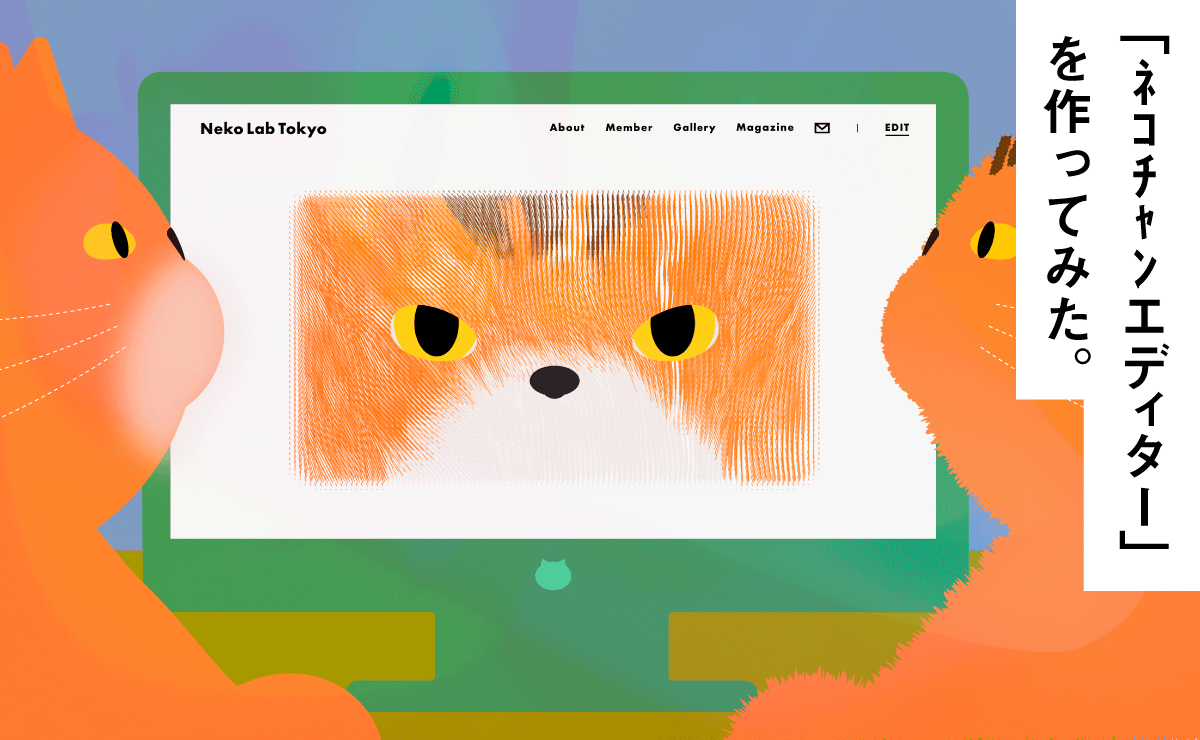
In this installment, we’ll introduce Neko Lab’s website, which we’re launching in time for “World Cat Day” on August 8.
In a roundtable discussion, Neko Lab members—Art Director Momoko Negishi, CM Planner/Copywriter Mizuho Akizawa, and Dentsu Lab Tokyo Creative Technologist Kanata Yamagishi, who was solely responsible for the implementation—look back on the production process.
*Note: The “Neko-chan” in “Neko-chan Editor” is officially written using half-width characters.
Negishi: I’m Negishi, the art director. I was in charge of the visuals for this website. I’ve been creating cat-themed artwork since I was a student, and I also draw the illustrations for this “Nekochan Collab Newsletter” series.
Akizawa: I’m Akizawa, a commercial planner and copywriter. I don’t currently live with a cat, but I joined Nekoboro because I wanted to draw on my experience with Mitori, the cat I used to own. For this project, we weren’t planning to create a website at first—we were actually trying to design a logo for Nekoboro, right?
Negishi: That’s right. At first, we were talking about how it would be interesting to create a “dynamic identity*” using technology, in keeping with the NekoLab spirit.
*Dynamic Identity = A design approach that doesn’t fix the design to a single form, but allows it to change flexibly according to purpose, situation, and context.
Negishi: However, this type of logo requires programming to control it, which was too difficult for us since we had no experience with it, so we decided to ask Mr. Yamagishi—a creative technologist who specializes in computer-based visualization—to help us.
Yamagishi: I’m Yamagishi, and I usually create graphics using a technique called “creative coding” and explore new forms of expression by building tools from scratch.
When I was asked to create a moving logo with a cat theme, I’d never actually owned a cat, so I started by spending time with cats at the team members’ homes. It was fascinating to experience the reality of cats as living creatures—things like their tears and shedding fur—which you rarely notice just by observing them from a distance. Though, to be honest, that didn’t end up making its way into the final design (laughs).
Akizawa: For a cat-themed logo, we came up with all sorts of ideas, like “Schrödinger’s Cat” or “everyday items that look cat-like from a distance.” Ultimately, we thought that a cat’s distinctive characteristics are best expressed through its “eyes”—since a cat’s expression and overall impression can change dramatically depending on its shape and the movement of its pupils—so we started prototyping with “cat’s eyes” as our starting point.
Expressing “cat-like qualities” through data?
Yamagishi: Come to think of it, early on we were also considering visualizations based on data related to cat behavior.
Negishi: Yes. For example, the fact that cats are most active at dawn and dusk is called “crepuscularity,” so we started by researching that and gathering various data related to cats.
Akizawa: There’s a common image of cats sleeping all day, and there’s a theory that the word “neko” (cat) derives from “neko” (sleeper). We also referred to scientific data on cats’ sleep duration and patterns. We wondered if we could use these “cat behavioral patterns”—such as ‘crepuscularity’ and sleep duration—as parameters for our visualizations.
Yamagishi: A cat’s pupils narrow in bright light and become round in the dark, so we also investigated the relationship between light intensity and pupil size. Research shows that when illuminance increases tenfold, the pupil diameter shrinks by about 1.5 to 2 millimeters.
Negishi: We also came up with the idea of using AI to simulate a cat’s fur color and pattern, since these are said to be determined by genetics.
However, the more we researched, the more we felt that the cuteness we associate with cats might not be fully captured by data alone…
Akizawa: Exactly. While drawing on scientific insights, we ultimately prioritized striking a balance with stylized designs that make you think, “That’s definitely a cat!” the moment you see them.
We were supposed to make a logo… but ended up creating the “Cat Face Maker”
Akizawa: As we continued our discussions, we started thinking, “Wouldn’t it be more interesting to turn this into an interactive experience rather than just a logo?” That’s how it evolved into the current “Neko-chan Editor,” which lets you create not just the eyes, but the entire cat face.
Since it was an independent project, being able to change direction midway was a huge advantage.
Negishi: With a logo, you inevitably have to settle on a single final design. But as we continued prototyping, we became increasingly convinced that there isn’t just one single definition of “cat-like.”
The shape of the eyes, the pattern, and the coat texture are all completely different for every cat. Rather than stripping away those differences to create a single logo, I began to think that a system allowing us to freely express the individuality of each cat would be more true to Nekobaro’s spirit.
Yamagishi: Technically speaking, that approach was a better fit, too. Rather than creating a program to animate the logo, I felt we could better showcase the fun of the technology by designing it as a tool where users can adjust parameters to change the cat’s expressions and patterns.
Akizawa: Letting users create their own cats and play with them is a better way to convey the cats’ individuality and charm through hands-on experience, isn’t it? From there, we decided to build the entire website around the “Neko-chan Editor.”
Negishi: That’s why the Nekoboro logo still isn’t finished (laughs).
How to Draw “Eyes” That Define a Cat’s Expression
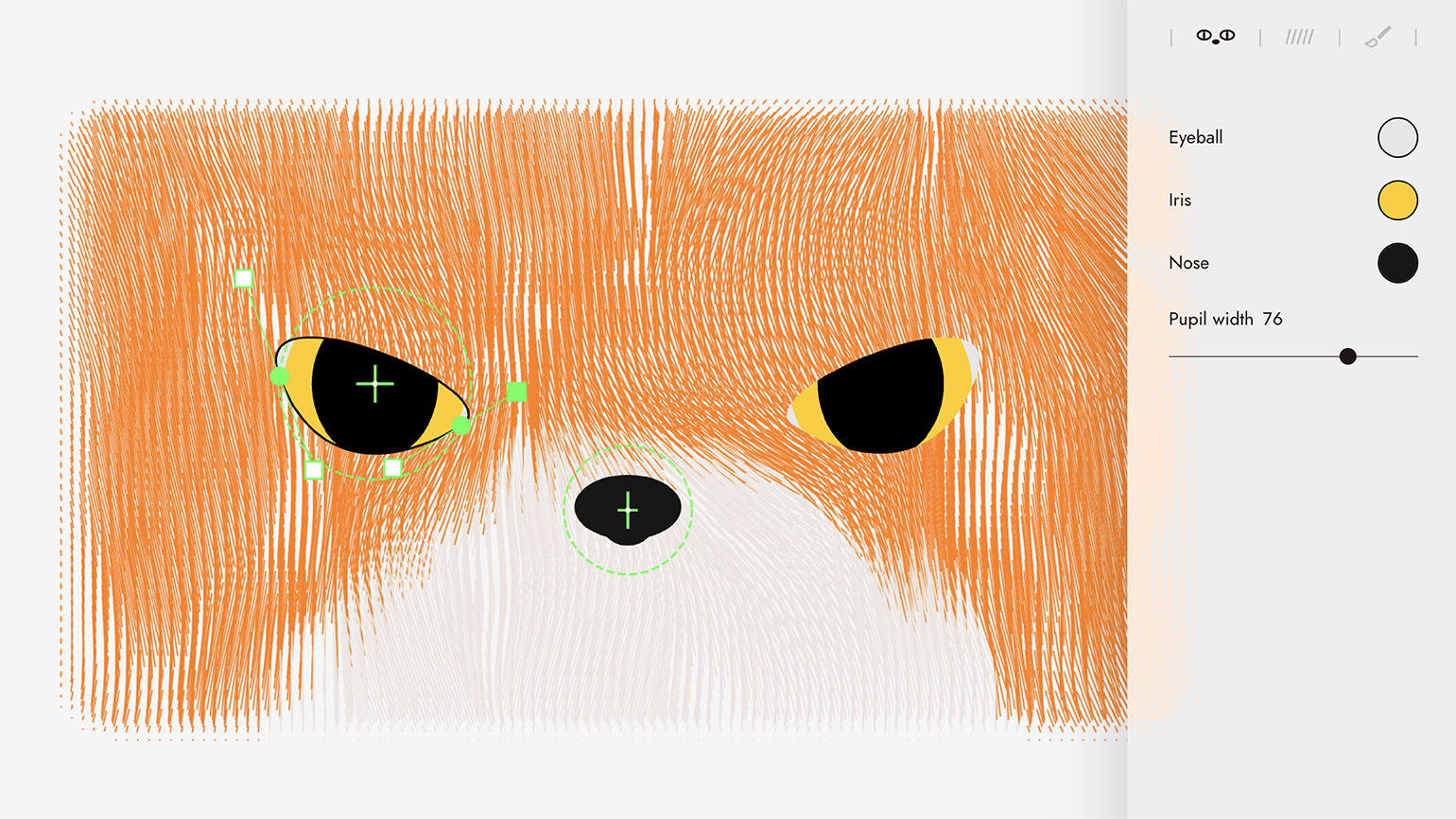
Yamagishi: The “Neko-chan Editor” consists of two main functions: the Eye & Nose Editor and the Fur Editor. First, we asked Mr. Negishi to establish the stylization direction and the ideal expressions, and we then implemented those into the tool by recreating them.
Negishi: Yes. Based on the cat illustrations I usually draw, I carefully refined each element one by one—the outline of the eyes, the iris, the size and color of the pupils, and the positioning of the eyes and nose. Even for the same cat, just slightly widening the pupils can make it look younger or more dignified, so we designed the tool to allow for adjustments to those subtle differences.
Akizawa: In the early prototypes, the design offered too much freedom—for better or worse—allowing users to change the eyes to shapes and sizes that wouldn’t exist in reality, so we fine-tuned the balance between cat-like realism and a sense of playfulness.
The “Eye and Nose Editor,” which lets you adjust pupils, eye shape, and color
The Balance Between Realism and Cuteness: How to Achieve the Ideal Coat Texture?
Negishi: What we focused on most this time was how to express the cat’s fur texture and patterns. At first, we considered representing the fur graphically using the density of stripes, but we were struggling because simple stripes couldn’t capture the complexity of the patterns. That’s when Mr. Yamagishi suggested a method we would never have thought of ourselves. What was it again…? Something like “noise.”
Yamagishi: It’s Perlin noise (laughs). It’s a pseudo-random number algorithm used in CG and game development to artificially create smooth “fluctuations” and “textures” found in nature—it’s used to render realistic patterns like clouds, smoke, flames, and rock surfaces.
I thought, “Why not try using this to render a cat’s fur?” As we ran through numerous prototypes, we discovered that using Perlin noise allowed us to create a wide range of expressions—from smooth fur to shaggy fur, and from delicate, realistic textures to abstract, graphical appearances.
Image of Perlin noise used to render fur
A wide variety of fur textures created by adjusting parameters
Negishi: Thanks to this “something-or-other noise” (laughs), we’ve been able to express nuances in fur that would have been difficult to achieve with analog methods. On the other hand, if it looks too realistic, it can come across as a little scary, so we were mindful of maintaining its graphic cuteness right up to the very end.
Akizawa: We’ve also implemented a painting feature to recreate patterns like bicolor, calico, and tabby.
Yamagishi: When I had Mr. Negishi and Mr. Akizawa try it out, I was delighted to see them use it in ways I hadn’t anticipated—like drawing pandas instead of cats or adding a flower field in the foreground. I sensed the potential for this to become something everyone can enjoy as UGC (user-generated content).
Use the painting feature to enjoy free expression.
The Convergence of Design and Technology
Negishi: Around this time, we decided to set the project’s goal as “Let’s make this the website itself.” We made the top page the “Neko-chan Editor,” used visuals created with this tool for the member introductions, and structured the site so that the content could be archived.
Akizawa: Since Yamagishi-san quickly created a prototype, it was easy to come up with additional ideas. For example, the mechanism where a ladybug appears if you leave each page idle for a while—initially, the ladybug just followed the cursor. It was precisely because we were able to verify that at an early stage that we could develop the site into one where the longer you stay, the more new discoveries you make. But I think it must have been tough for Yamagishi-san because we kept asking for all sorts of changes…
Ladybugs that appear when you linger on a page. A small touch that makes you want to explore the site
Yamagishi: Not at all (laughs). Actually, for this implementation, we also used AI-powered Vibe Coding (*). Tasks that used to take several days can now be reproduced in just a few minutes. We were able to make on-the-spot corrections while discussing things face-to-face, and build UI elements for fine-tuning each item to incorporate that sense of comfort that’s hard to put into words. I really felt that the development process itself had changed significantly.
*Vibe Coding = A method of development where you convey your vision for the app you want to build to AI using natural language, and the AI generates the code as you go.
Negishi: Mr. Yamagishi, do you often collaborate with art directors and designers on projects like this one?
Yamagishi: That’s right. Even under the title “Technologist,” there’s a wide range of specializations—from people who are strong with machines to those who excel at broad-ranging research—but I’m the type who enjoys exploring new visual expressions and experiences through technology. So, I’ve had several projects where I’ve teamed up with art directors who share the mindset of “I want to start from the very beginning of the creation process to explore new forms of expression” to take on experimental graphic design challenges.
Negishi: Our work rarely gets done entirely on our own; we often collaborate with various specialists, such as copywriters, photographers, and illustrators. This was our first time working with a team well-versed in technology, and it led to many forms of expression and ideas that we never would have come up with on our own.
Beyond “Neko-chan Editor”
Akizawa: It would be a shame to let this end as just a “tool for creating cute cat icons,” wouldn’t it? For example, we could partner with cat rescue organizations to use this tool to showcase cats up for adoption or format the content so it’s easy to share on social media. I’d be happy if people used it as a gateway to discovering the charm of cats.
Negishi: We also discussed the idea of shining a spotlight on cats like calico cats, which are often described as “cute but don’t tend to gain much popularity.” While it can be hard to convey the charm of calico patterns in photos, graphically expressing the beauty of their markings and individuality might serve as a catalyst for people to realize, “They’re actually this cute!” It would be great if we could create features that encourage people to focus not just on their appearance, but on the unique personality of each individual cat.
Yamagishi: Technologically, there’s still plenty of room for development. Right now, it’s a tool for freely creating cats, but by combining AI and image analysis—such as extracting distinctive features from photos of your own cat or reproducing expressions and fur textures more naturally—I think the possibilities will expand even further.
Negishi: It seems like we could turn the cat faces we create into merchandise, use them at events, or even collaborate with cat-themed characters and IPs. I’d also like to create experiences where cat lovers can connect with one another through their own cats.
Akizawa: Nekobora is a project team dedicated to improving the relationship between cats and people through curiosity and creativity. “Neko-chan Editor” is our first step. We hope to grow this project into one that uses fun and cuteness as a starting point to inspire people to think about shelter cats and life with cats.
I handle a wide range of planning projects, from copywriting and commercial concepts to radio, PR campaigns, and exhibition planning. I joined Nekaboro after experiencing the process of nursing and saying goodbye to the cat I lived with. I don’t currently live with a cat, but I hope to welcome one back into my life someday.
He works on cross-disciplinary design spanning character design, visual identity, and graphics. He has lived with eight cats over the years and has continued to create cat-themed works as his life’s work since his student days.
To create new experiences and graphics, I start with tool development and prototyping to explore unique forms of expression. I have experience raising parrots and stag beetles. I haven’t had a cat yet.

 Nekobako Newsletter [6/6]