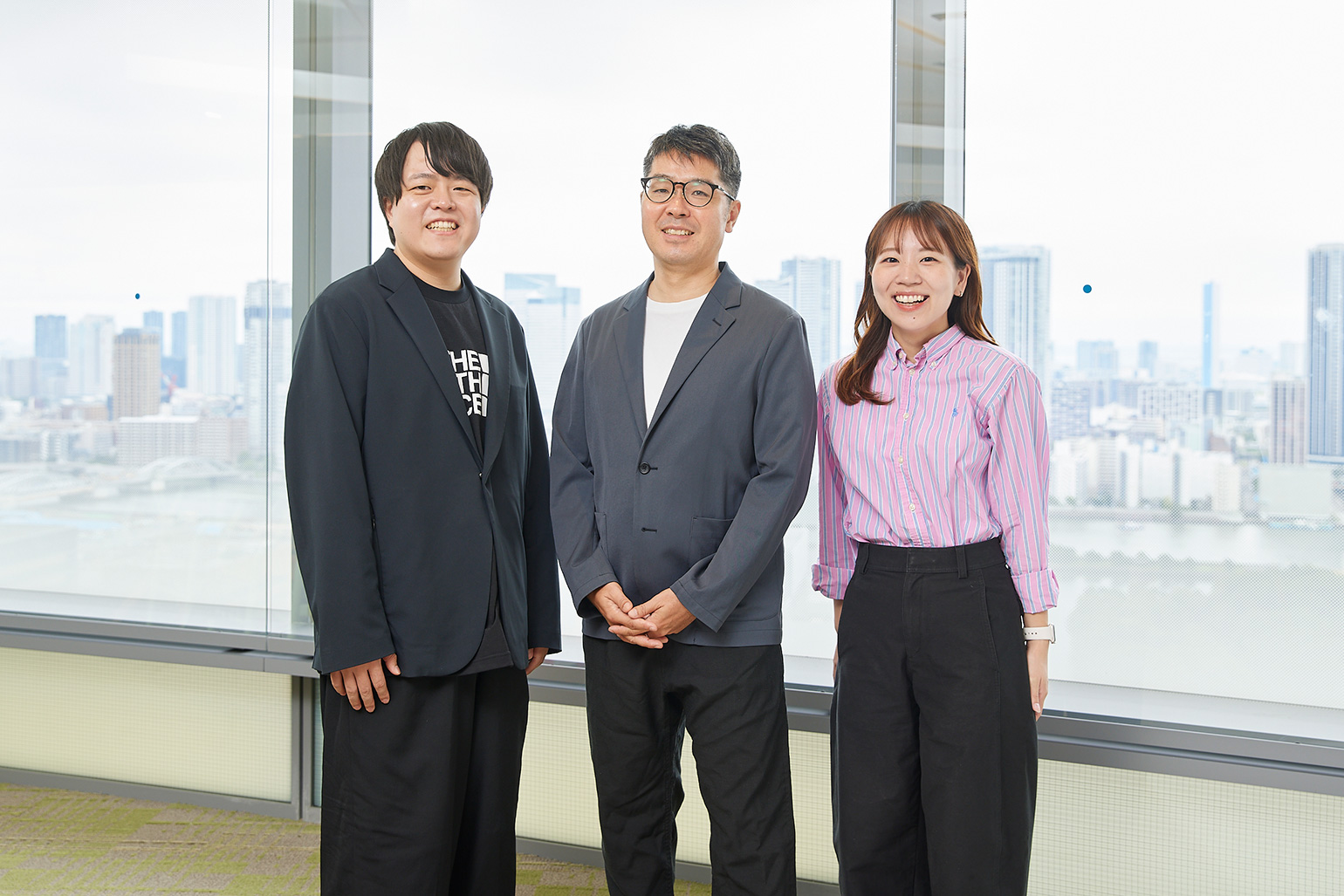
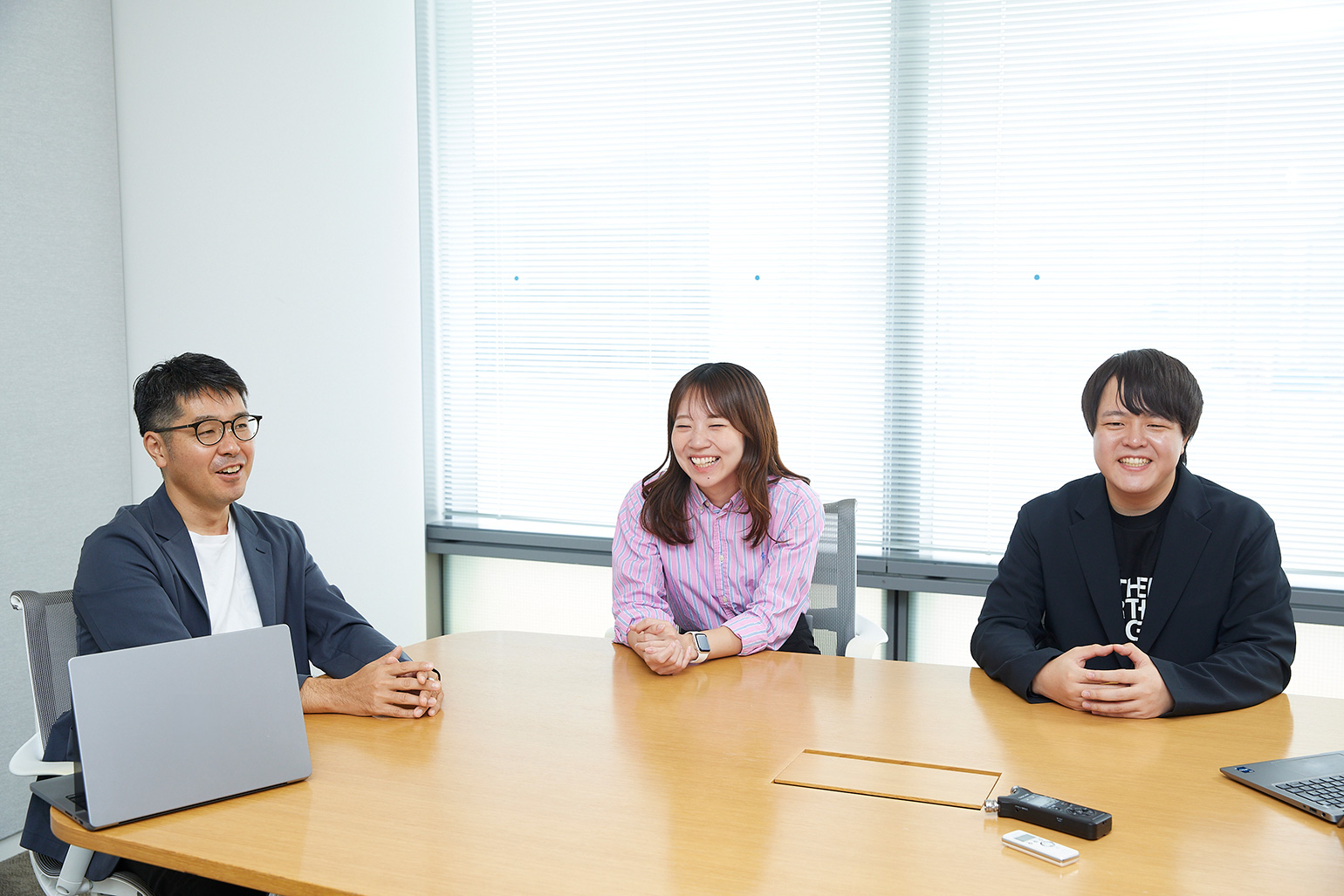
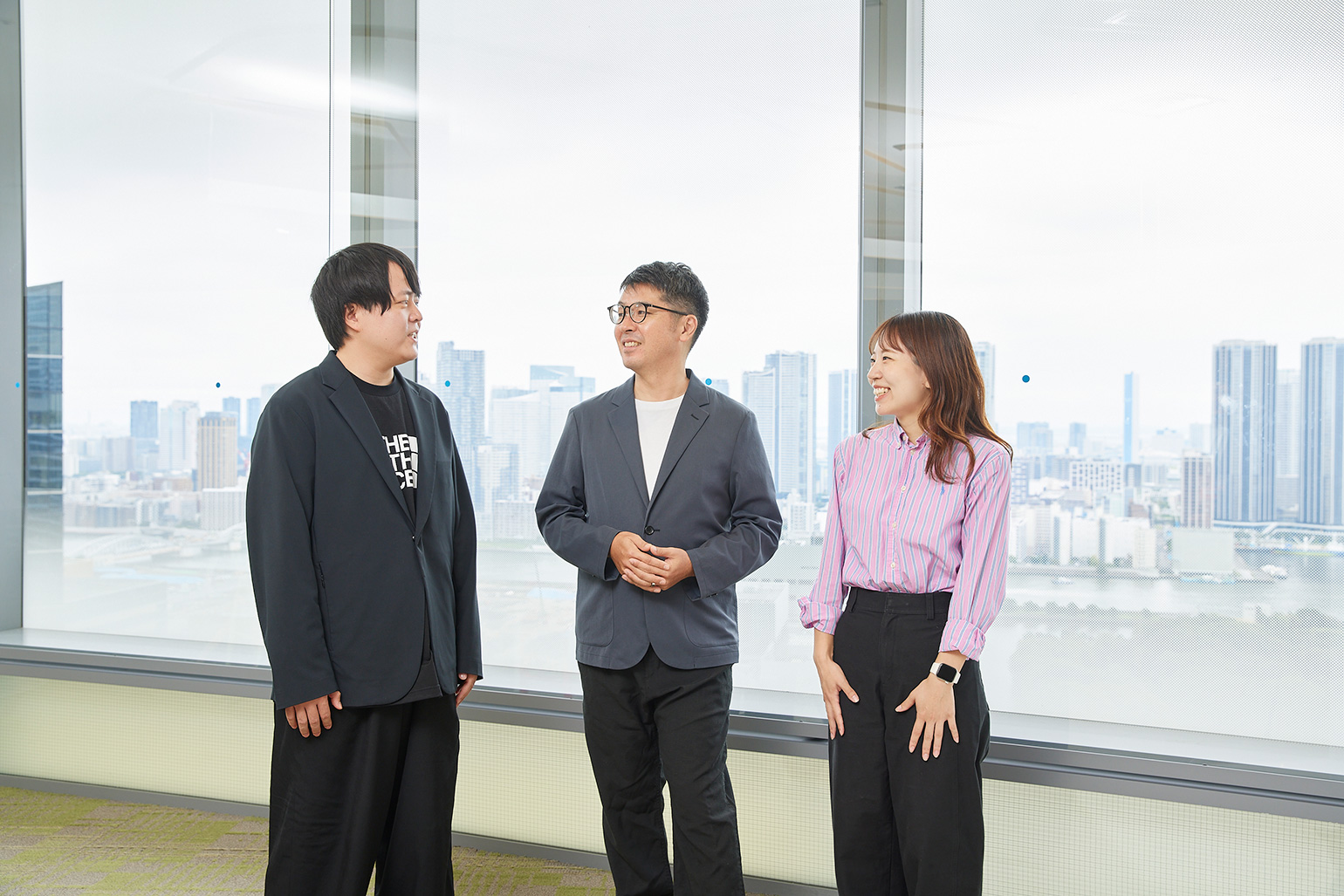
From left: Ryota Akimoto, Hajime Sasaki, Nanako Ochi
How will AI transform our “shopping experience”?
AI is evolving from a mere information-search tool into a partner that supports decision-making. Its presence is growing day by day, particularly in the context of “shopping.”
For this article, we interviewed Ryota Akimoto and Nanako Ochi from “with AI Lab ”—Dentsu Digital Inc.’s AI research institute dedicated to investigating and studying “the future just half a step ahead”—as well as Hajime Sasaki, a former associate professor at the University of Tokyo who participates in the lab as a researcher.
Based on the results of a consumer survey conducted by the with AI Lab, we delve into the future of “positive shopping experiences in the AI era.”
Shopping Where You “Consult” AI vs. Shopping Where You “Decide for Yourself”
Nanako Ochi
—Please introduce yourself.
Ochi: I’m Nanako Ochi from Dentsu Digital Inc. I’m part of the Data & AI Solutions Center, and my day-to-day work involves figuring out how to integrate our company’s technology with platform providers. At the with AI Lab, I’m engaged in activities that bridge the gap between academic perspectives and the business world. As part of these efforts, I’m also co-authoring a research paper with Professor Sasaki.
Akimoto: I’m Ryota Akimoto, also from Dentsu Digital Inc. I’m part of the AI Transformation Division. My main role involves consulting to support clients with their AI-related challenges, starting with a thorough review of their business workflows and providing ongoing guidance. While my day-to-day work focuses on solving problems from a corporate perspective, at the with AI Lab, I take a consumer-centric approach to explore how AI is integrating into daily life—and what lies just half a step ahead.
Sasaki: I’m Sasaki. At the University of Tokyo, I researched “how people master and adapt to technology once it is integrated into human society.” I contribute to the with AI Lab from a researcher’s perspective.
Ochi: The with AI Lab operates with the premise of “predicting the future half a step ahead.”The lab consists of three teams—A, B, and C. Team B, to which Akimoto and I belong, is researching the question: “How is AI attempting to reshape the rules of society and information?” We’re considering the future from multiple angles, incorporating insights from experts like Professor Sasaki. Today, we’d like to deepen our discussion based on the results of a consumer survey conducted by Team A.
──Let’s talk about the survey results. To what extent do consumers rely on AI when shopping?
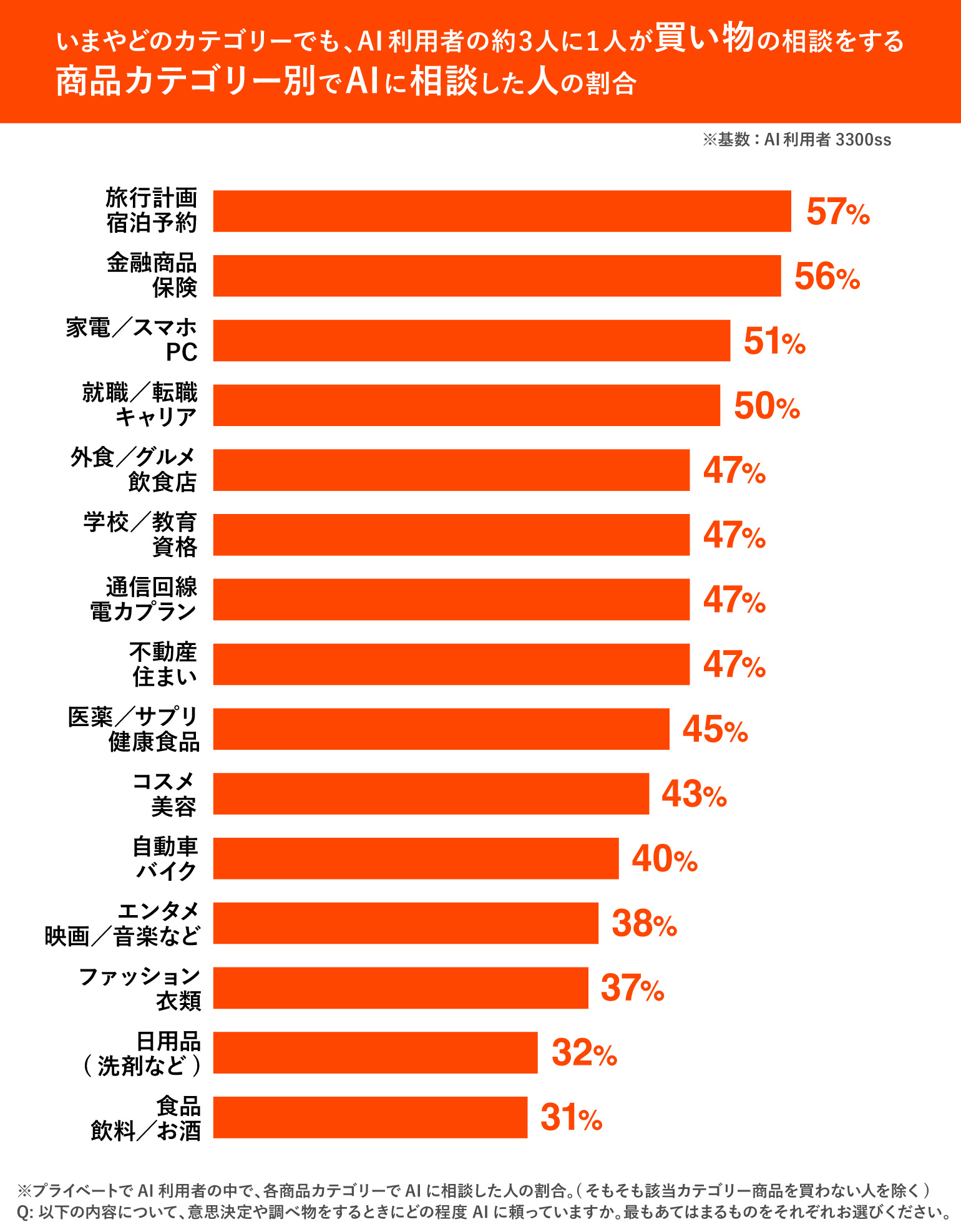
Akimoto: First, looking at the big picture, the results show that about one in three AI users consults AI when making purchasing decisions (*). However, this percentage varied significantly by product category. Travel had the highest rate at 57%, followed by financial products and home appliances.
Akimoto: These high-involvement categories—where consumers are likely to conduct careful comparisons based on specifications, functional value, and price—require a high level of expertise and often necessitate gathering information that lies slightly beyond one’s own knowledge. It appears that AI is beginning to replace the “experts” consumers would have consulted in the past, such as travel agency counter staff or electronics store clerks.
Ochi: On the other hand, categories such as food, daily necessities, and fashion—where personal preferences and particular tastes are strongly reflected—tend to have lower consultation rates. Fashion, in particular, is a field where individual preferences play a major role, so people likely have a strong desire to make decisions based on their own instincts.
In terms of product value, the higher the functional value—that is, the more important spec comparisons are—the higher the proportion of consumers relying on AI. On the other hand, for products where emotional value is prioritized—such as those chosen because a role model used them, or where the interaction with a sales associate is part of the experience—the rate of consulting AI tends to be lower.
What is the decisive difference between the search era and the AI era?
Ryota Akimoto
—I see. So, for now, does that mean the more high-involvement a product is, or the higher its functional value, the more likely consumers are to consult AI? Professor Sasaki, what are your thoughts on these results?
Sasaki: I think you’re both correct. For things like travel planning or financial products—where there are a great many “variables” to consider before reaching the goal (purchase)—it’s natural to want to rely on AI rather than trying to process everything in one person’s head. However, if that’s all there is to it, it’s hard to see the difference from traditional “search.”
What fundamentally distinguishes AI from search is its ability to provide hints about categories and variables the user hadn’t even considered. With search, you can only enter words you already know; while it excels at “deepening” knowledge, it has limitations when it comes to “broadening” it horizontally.
To summarize, “the unknown that the user knows by name” can be reached through search. On the other hand, the unique value of AI lies in the fact that, when the user provides a context, it returns “the unknown that exists in the data but is unknown to the user.”
──It’s true; compared to search, I feel like AI tends to naturally provide unexpected insights in response to my questions.
Sasaki: What emerges from this survey is the question of whether users “know that they don’t know.” When it comes to travel—for example, “I want to go to this place, but I don’t know much about the local area”—people ask AI because they’re aware of their own ignorance. The same goes for financial products; people recognize that they’re complex and hard to understand. I think consultation rates are high in areas where people are aware of their own lack of knowledge.
Conversely, when it comes to food and daily necessities, I think these results reflect the mindset that “I know my own preferences best, and there isn’t much I don’t know.” In fact, these categories represent “the unknown where data itself doesn’t exist,” making them areas where AI struggles to demonstrate value. For example, things like taste, texture, and comfort cannot be quantified as data and fall outside the reach of current AI, so people tend not to seek advice from AI in these areas either.
──Given that the rate of consulting AI about shopping is very high, to what extent do consumers entrust the “final decision”—that is, “which one to actually buy”—to AI?
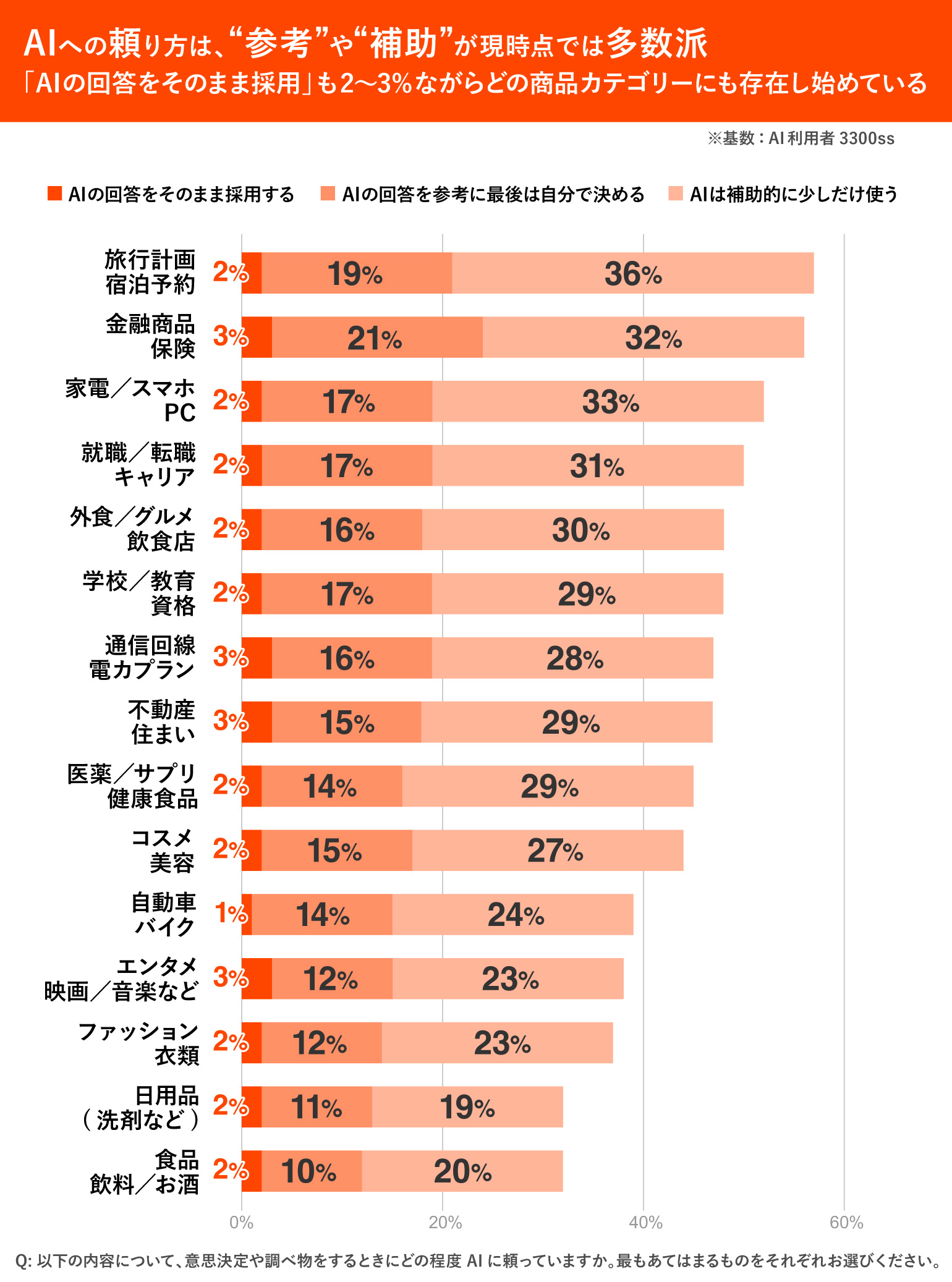
Ochi: This is quite clear: the vast majority of people say, “I use the AI’s response as a reference, but I make the final decision myself.” The number of people who “adopt the AI’s response exactly as is” is limited to just 2–3%.
There are also slight differences depending on the product category; with music, for example, it seems common for consumers to learn about a product for the first time through a recommendation and then proceed to purchase it. For items that are inexpensive and easy to try—rather than high-priced items that require careful consideration—there is a tendency for consumers to be more likely to follow AI recommendations.
*Percentage figures are rounded to the second decimal place, so the total may not always add up to 100%.
Akimoto: However, this 2–3% figure can also be seen as a “seed” for how people interact with AI. Our research shows that the “AI-native” demographic—those who use AI regularly—tends to accept AI suggestions as is to a slightly higher degree.
While there is anxiety about “hallucinations” (AI generating information not based on facts), trust may be growing as people use it more frequently, and the number of people entrusting their decisions to AI may be gradually increasing.
Sasaki: It’s interesting that the 2–3% figure is nearly uniform across all categories. This suggests that the issue lies not in the nature of the category itself, but in human psychology—specifically, the fact that “it’s psychologically difficult to act with resolve alone, without knowledge”—and that 2–3% represents the threshold for this.
Furthermore, this figure may change as interfaces evolve in the future. Current chat-based AI systems, precisely because they present so many options, can actually cause users to feel overwhelmed. If services emerge in the future—such as AI agents—that seamlessly guide users through the purchasing process, the percentage of users who “go ahead and adopt the recommendation” may increase.
Akimoto: And one more thing—I’ve personally consulted AI when deciding on home appliances and the like, and even when I think I’ve made the choice myself, I have the sense that I’ve actually been guided by the AI to some extent. So, this 2–3% is merely the conscious, self-reported figure; the latent percentage of people who unconsciously follow AI’s recommendations might actually be much higher.
What Can’t Be Replaced by AI? Three People Reflect on Their “Great Shopping” Experiences
Hajime Sasaki
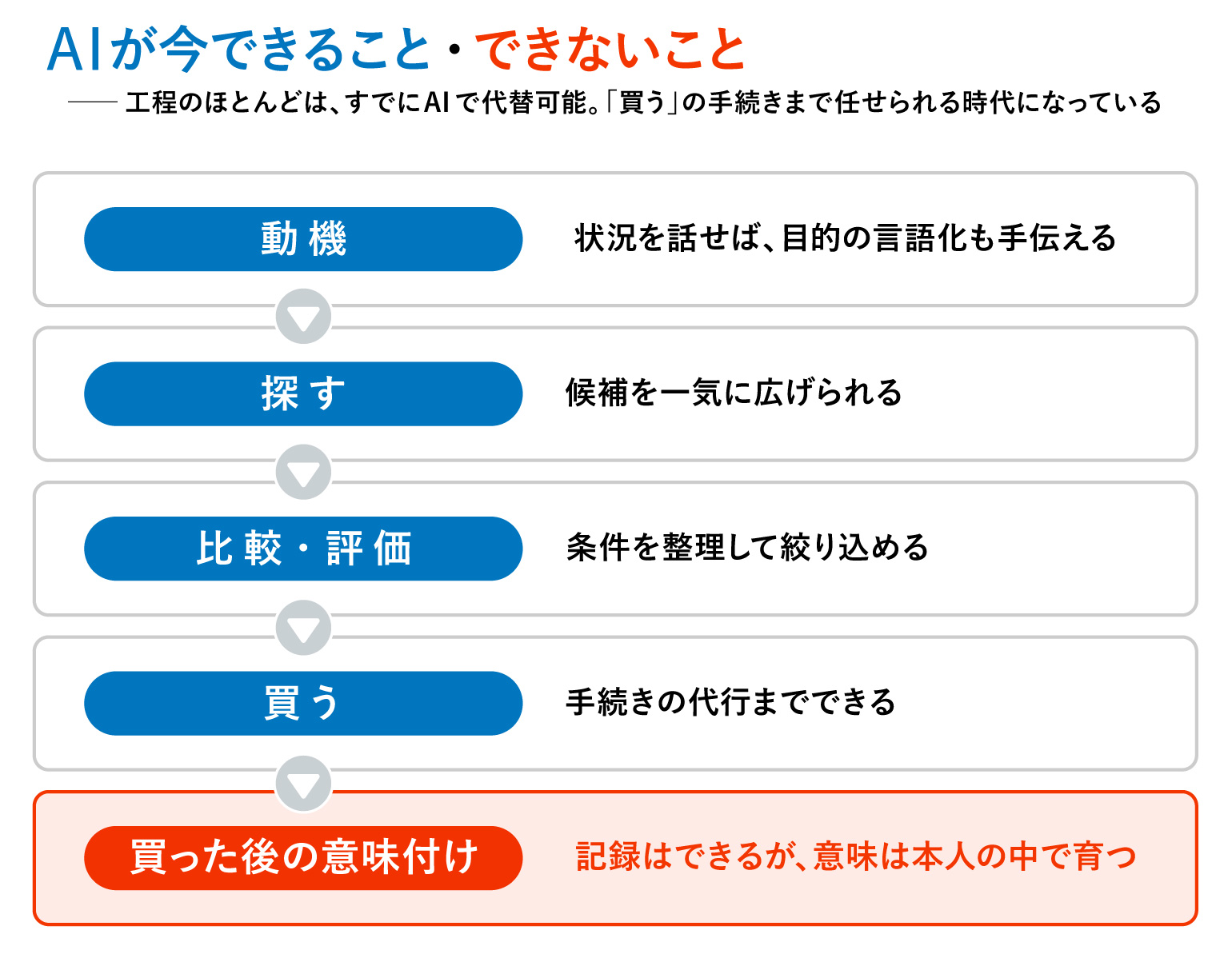
—While AI streamlines the shopping process, I don’t think the deciding factors behind the “great purchases” that stick in our memories were always based solely on rational judgment. The shopping process consists of the following stages: “① Motivation → ② Search → ③ Comparison and Evaluation → ④ Purchase → ⑤ After the Purchase.” In your unforgettable shopping experiences, which stage was the “deciding factor”?
Ochi: I was on the lacrosse team in college, and the stick I bought as a freshman is my most memorable purchase. At the time, I joined the team with a strong desire to “aim for the top in Japan,” so I went to a specialty store with a senior I looked up to—a fourth-year student.
The stick he picked out for me was a bit over-specced for a freshman, but I bought it with the determination to say, “Let’s aim to be number one in Japan together with this.” Every time I used that stick over the next four years, I’d recall my interactions with him and the passion I felt back then—it was a very meaningful purchase. This is an experience where the first step in the purchasing process—“① Motivation”—was the deciding factor.
Akimoto: My experience involves replacing the TV at home a little while ago. I’m the type who researches thoroughly before making a purchase, so I started by scouring every website and roundup article online—from the latest models to those from a few years back.After discussing it with my parents and considering my options for about two to three weeks—once I’d narrowed down my list of candidates—I happened to visit Costco and found a model with specs almost identical to my final choice, but priced over 100,000 yen cheaper. Because I’d done such thorough research beforehand, I was able to instantly recognize that “value” and make a snap decision.
I was able to use the money I saved to upgrade my sound system as well. Rather than saying my knowledge attracted a “valuable” coincidence, I think I was able to recognize the “value” in that serendipitous encounter—which is why I consider this a “great purchase” where the “② Search → ③ Compare and Evaluate” process was the deciding factor.
Sasaki: I’ve been camping for about 15 years, and this year I replaced the tent I’d been using for many years. The first one I bought was a very large tent called the “Landrock” by Snow Peak. Back then, a friend advised me, “It’s better to buy a good one from the start.” Since this was 15 years ago, I didn’t use AI—I made my decision by doing various searches and checking out products in stores.
As a result, the time I spent with my children in that tent, the established kitchen layout, and the movement patterns and lifestyle that became second nature to me all gave that product “meaning.” That’s why, when it came time to buy a new tent, I chose the successor model of the same type without hesitation. This can’t be explained simply by the word “attachment”; it means that I had created my own “meaning” for that product.Over the long period following the purchase, the “attribution of meaning” described in “⑤ After the Purchase” became the deciding factor for the next purchase.
──Thank you for these three very interesting and distinct stories. Mr. Ochi focused on “motivation,” Mr. Akimoto on the “chance” that comes after “searching and comparing,” and Mr. Sasaki on “the meaning attributed after purchase”—the deciding factors were beautifully diverse. In these experiences, what parts do you think AI could have replaced?
Akimoto: “Searching” and “comparison and evaluation” are precisely the areas where AI excels. If I’d had AI when I was choosing a TV, I could have done it much more efficiently. Furthermore, AI might even help articulate that initial “motivation”—for example, that vague feeling of “something just not quite right.”
Sasaki: On the other hand, what AI struggles with is “finding meaning after the purchase.” Ultimately, it’s the user themselves who gives meaning to a product. As in the case of my tent, the value and attachment that grow after purchase are highly personal experiences—an area where current AI cannot intervene. Not every experience is converted into data. Perhaps the current limitation is that, in principle, AI cannot handle emotions or memories that humans have chosen not to turn into data.
Akimoto: In the future, I think it may become harder to perceive the experiential value in areas that AI can replace, such as “comparison and evaluation.” However, if the purpose of shopping is not simply “buying” but “using,” then AI should shorten the process leading up to the purchase, lead to a better “usage” experience, and ultimately increase the value when viewed from the perspective of the overall user experience (UX).
—What is the biggest difference in the shopping experience between the “search” era and the “AI” era?
Sasaki: The decisive difference lies in the quality and quantity of the “information we can convey.” With “search,” we could only enter words we already knew into the search bar. But with “AI,” we can convey the context of our situation, our purpose, and our feelings exactly as they are.
As a result, AI has begun to transcend categories and present options that lie beyond our vocabulary and even beyond our existing understanding. It’s no longer just about deepening our knowledge—it’s about expanding it exponentially. I believe this is the biggest change.
Encounters Beyond Our Cognition: The Door to “Hidden Knowledge” Opened by AI
—Could you tell us a little more about how AI presents options that lie beyond our cognitive boundaries?
Sasaki: As I mentioned earlier, while search can “deepen” our knowledge, it cannot “broaden” it in the way AI does—by pulling ideas from unexpected places and connecting things that seem unrelated at first glance. The ability to explore beyond the “boundaries” of our own vocabulary and categories is the biggest change.
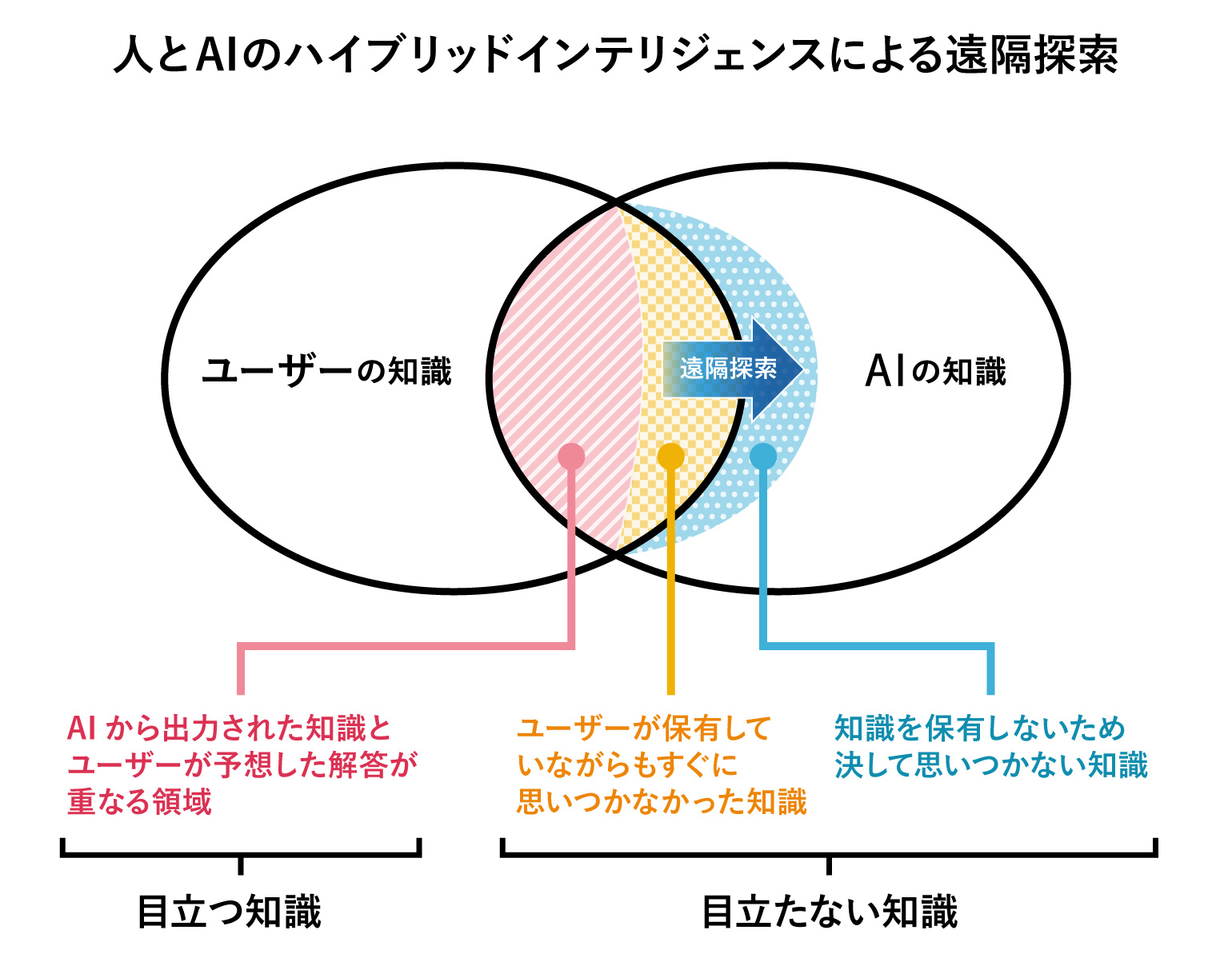
Source: Akimitsu Hirota (2024), “The Effect of ‘Remote Exploration’ Using ‘Unexpected Relationship’ Information to Promote ‘Hybrid Intelligence,’” *Marketing Journal* 43(3), based on Yamakawa & Kiyokawa (2020), *Cognitive Studies* 27(4)
Sasaki: This diagram illustrates the relationship between human and AI knowledge. The red section represents “prominent knowledge”—information known to both users and AI. The yellow and blue sections represent “non-prominent knowledge” that has become accessible through AI (*1). Yellow refers to “knowledge that one would recognize if told, but wouldn’t have thought of immediately,” while blue refers to “knowledge that was completely absent from one’s own knowledge base and would never have occurred to them.”
A good example of the “outside of cognition” is a joint project once conducted by NEC and Kagome. The project involved using vegetables to explore new flavor combinations for pudding, and the AI arrived at an unexpected combination: “carrot and white wine pudding” (*2). However, this was actually based on a recipe for the French dish “carrot rapé,” so it was firmly grounded in culinary logic.This is precisely the kind of knowledge found in the yellow zone—something a human pastry chef might not immediately arrive at, but which makes perfect sense once explained. Engaging in dialogue with AI can be described as an act that explosively expands this yellow zone.
These are examples of “hybrid intelligence,” where new discoveries emerge from the overlap of human and AI knowledge. Our knowledge consists of “salient knowledge”—information we can recall immediately—and “insalient knowledge”—information we understand when pointed out but cannot immediately retrieve. AI sheds light on this “insalient knowledge” and even expands our scope of exploration into areas we were completely unaware of.
*1 Yamakawa, M., & Kiyokawa, S. (2020). A commonality search between unrelated objects facilitates retrieving less salient knowledge. Cognitive Studies, 27(4), 527–539.
*2* Akimitsu Hirota. (2024). The Effect of “Remote Exploration” Using Information on “Unexpected Relationships” to Promote “Hybrid Intelligence”—Innovation Through AI-Generated Information and Dialogue Between Developers in the Development of “AI (Love) Pudding.” Marketing Journal, 43(3), 44–54
—It feels as though AI is expanding users’ knowledge. Are such changes also evident in the actual behavior of consumers?
Akimoto: Yes, in categories like travel, that phenomenon is indeed occurring. Rather than expanding one’s knowledge in ripples from familiar places, as was the case before, AI suddenly presents options like a distant island. Moreover, it provides a reasoned explanation tailored to the individual as to why it’s recommended, so users can incorporate it into their itinerary with a sense of conviction.
Surveys also show that “encountering new products and services” ranks high among the changes brought about by AI use, so it’s safe to say that people are already beginning to encounter things beyond their existing awareness.
Ochi: Taking my lacrosse experience as an example, in the past, the only specialty stores where you could buy equipment were in Tokyo, so students in rural areas had no choice but to search online.But now, thanks to AI recommendations, even students in rural areas can easily access information—such as the equipment used by top international players or how step drills from a completely different sport like rugby can be useful for lacrosse. As a result, the overall competitive level of today’s players has risen significantly. I think this is a great example of how AI has expanded our knowledge in ways that traditional search engines simply can’t provide.
Will AI Expand the Concept of “Good Shopping”? The Key Lies in “Personal Engagement”
—Finally, will using AI enhance the enjoyment of the shopping experience? Please share your thoughts.
Akimoto: I believe it will. I view AI as a smart “partner” who understands everything about me. If there’s someone who can suggest the best products based on an understanding of my lifestyle, the layout of my room, and even the devices I own, shopping should become much more enjoyable and fulfilling.
Through conversations with AI, we might make unexpected discoveries or realize preferences we didn’t even know we had. It’s just like window shopping, where you enjoy a conversation with a knowledgeable salesperson while selecting items. In such a future, wouldn’t we find a more creative and human-centered joy in shopping than we do today?
Ochi: I also believe that the scope of enjoyment will expand. As we’ve moved from the era of search engines to the era of AI, geographical constraints and information gaps have diminished more than ever before, allowing everyone to access knowledge from around the world. The fun of connecting knowledge from completely different fields—much like lacrosse and rugby—is another form of enjoyment that AI brings.
We’ll grow as individuals by continuously absorbing knowledge we didn’t previously possess. I believe “that process itself” will become a new source of joy in shopping.
Sasaki: I’ve come to the same conclusion—AI will expand the joy of shopping. However, there’s one important condition: the sense that “I’m actively involved.” Rather than simply buying whatever the AI tells you to, the feeling that your own questions or the information you’ve entered are the starting point is what leads to satisfaction.
Research in behavioral economics has also shown that people’s satisfaction levels vary depending on their degree of engagement—not just following given information, but “editing” it themselves or formulating their own “questions.”
The joy of mastering AI isn’t simply about receiving the optimal answer, is it? Perhaps it lies in discovering the joy of having one’s thinking expanded through dialogue with AI—thinking, “Isn’t it amazing that I was able to come up with a question from this angle?” To achieve this, the key is to input “your own unique context” into the AI—such as Mr. Ochi’s desire to “become number one in Japan” or the 15 years of memories packed into my tent.
──How can we gain that sense of “being actively involved”?
Sasaki: That is precisely the most important point when considering the future relationship between humans and AI. Deciding what information about yourself to feed into the AI—and what not to. I believe that is the role left to humans in the coming era.
The decision of “what to input and what not to” will be a challenge not only for consumers but also for companies. What data will a company use to train its AI, and what kind of shopping experience does it aim to provide? A company’s ethics and philosophy will be strongly reflected in these choices. We are entering an era where companies will be expected to use data with a spirit of hospitality—not merely to “make sales”—but to enrich the lives of each and every customer.
The smarter AI becomes, the more we will be forced to confront our own values and what constitutes “the greater good” for society. How will consumers and companies, together with AI, design the future of shopping? I believe that this diversity—along with everything else—will become part of the joy of shopping in the years to come.
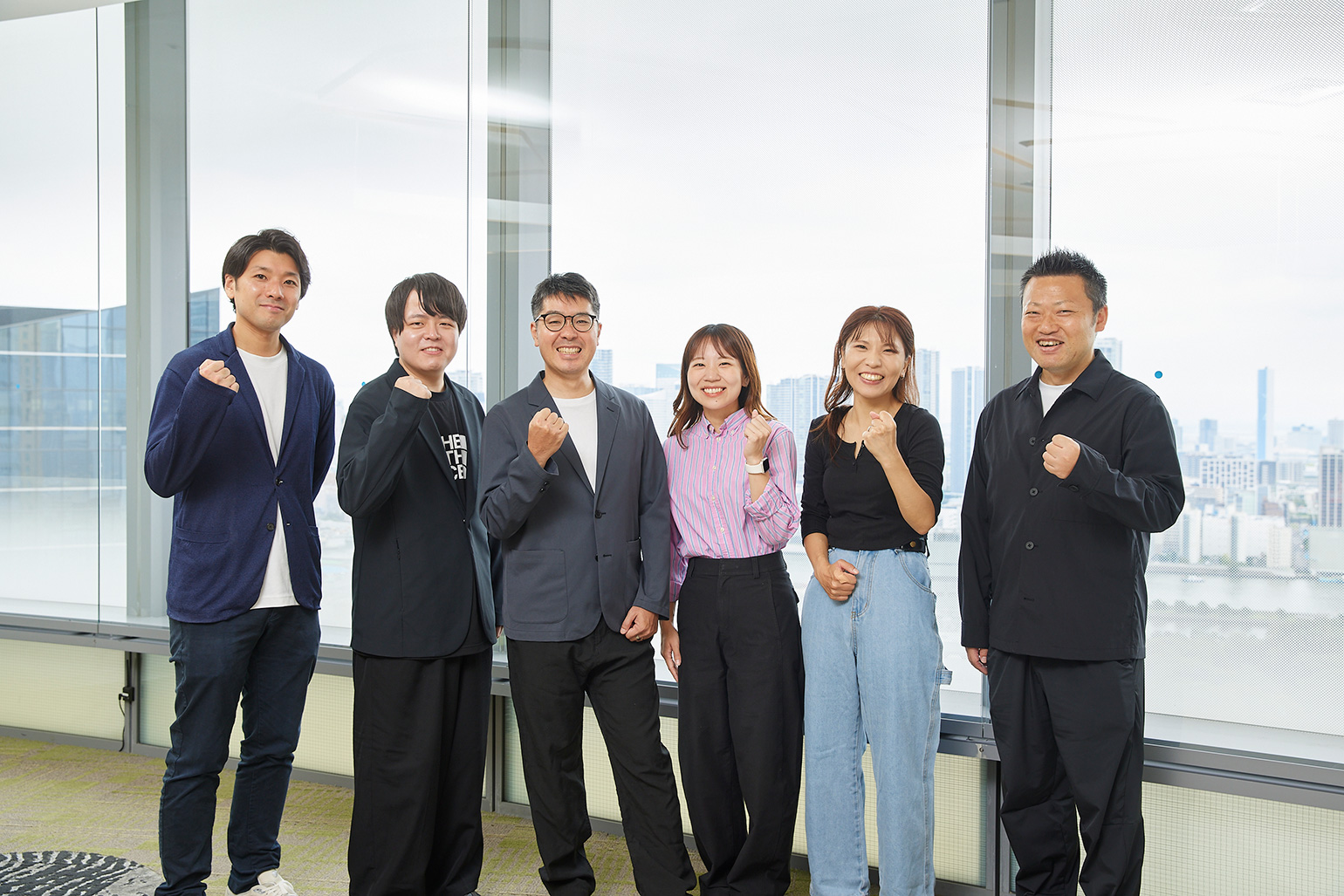
A commemorative photo with the members of the with AI Lab Team B and Professor Sasaki!
Dentsu Digital Inc. AI Native Twin / Former Associate Professor, University of Tokyo
Former Associate Professor at the University of Tokyo. Ph.D. in Engineering. Starting his career as an aircraft design engineer, he went on to work at a think tank and the University of Tokyo, where he researched the relationship between technology and social systems. His areas of expertise are innovation systems and knowledge design. He founded Ninifuni, Inc., a company dedicated to supporting individuals and organizations as they adapt to the integration of new technologies into society.
Ryota Akimoto
Dentsu Digital Inc.
AI Transformation Division, AI Consulting Division 2
Consultant
Starting from customer value and mid- to long-term future visions, I support client companies in formulating their visions and designing services. In recent years, I have also focused on systematizing future insights and strategic planning using generative AI. As a member of the Dentsu Inc. Future Business Creation Lab, I have participated in initiatives such as the Dentsu Future Mandala.
Data & AI Solutions Center, AI Innovation Division
Marketing Planner
Leveraging his experience in advertising operations and marketing communications, he supports marketing transformation through the use of generative AI. In addition to being involved in the planning and development of initiatives such as “AI for Growth CANVAS,” he is also working on partnerships with external platforms and the expansion of solutions into the APAC region.

 With AI Lab: Envisioning a “Half-Step into the Future” for Consumers and AI [2/2]