Note: This website was automatically translated, so some terms or nuances may not be completely accurate.
 The future seen from the perspective of young people, just half a step ahead [8/8]
The Future Shape of “Travel” Is Shifting from “Destination-Centric” to “Meaning-Centric”
Dentsu Inc.’s Youth Research Division (hereinafter referred to as “Dentsu Wakamon”) held a “Tsugikuru” workshop—a program for discovering signs of the future—with current college students. Under the theme “The Future Shape of [X],” the division is developing hypotheses based on reports submitted by the students ( click here for the article on the “Tsugikuru” program).
This installment focuses on “The Future of Travel” as envisioned by current college students. The theme of “travel” was also explored in a Tsugikuru workshop back in 2022. Now, four years later, we examine how students’ perceptions of “travel” have changed and explore signs of emerging new values.
Dentsu Inc. Youth Research Division “Wakamon”
A specialized division within Dentsu Inc. that continuously researches the attitudes, values, and behaviors of young people, covering areas ranging from marketing and business development to organizational and human resources. Rather than viewing young people solely through the lens of generational theory, we redefine them as “people who act based on new values.” By interpreting these values as “signs of the future,” we support companies and society in charting their next course.
<Table of Contents>
▼Travel During the 2022 COVID-19 Pandemic:“Where/What” as the Starting Point
▼Travel in 2026: From “Where/What” to “Why”
▼Travel Is Now About Not Just “Where to Go,” but Also “Who to Go With”
▼The “Self-Centered” Prioritization Behind “Why Thinking”
▼Will Future Travel Require Proposals for the “Meaning of the Journey” Rather Than Just the “Destination”?
In 2022, travel during the COVID-19 pandemic was driven by “Where/What”
In 2022, restrictions and reluctance regarding travel and social contact still lingered due to the COVID-19 pandemic. Reflecting these social conditions, the ideas proposed by students at the time included “contactless travel” enjoyed in vehicles or online, “refresh and detox trips” to heal from pandemic fatigue, and “liberating trips” to escape daily life and experience freedom and the extraordinary.
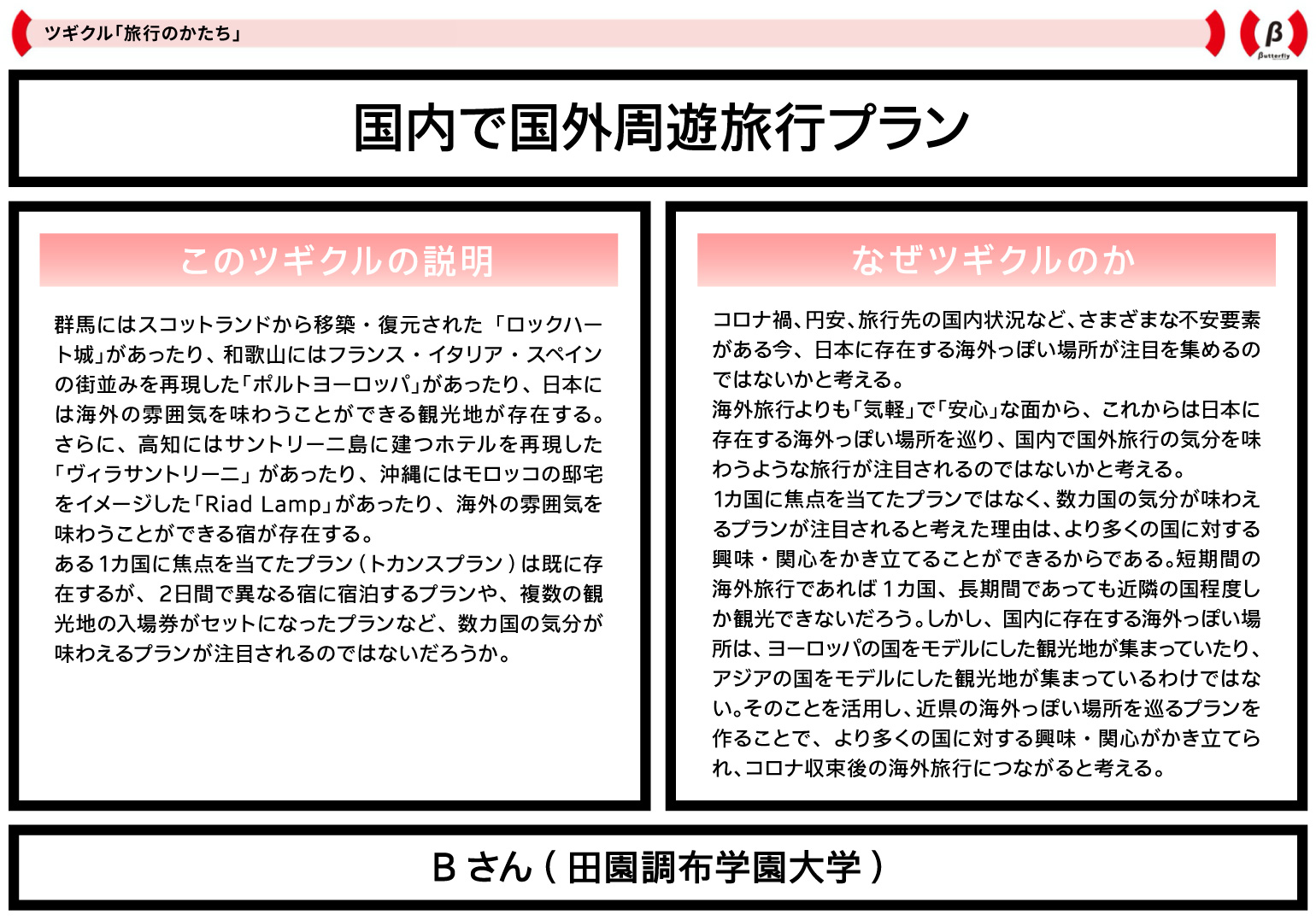
Looking back, it seems that many of the ideas at that time were based on the “Where/What” of travel—that is, “where to go” and “what to do there.”
Now, four years later. In 2026, with the movement restrictions caused by the COVID-19 pandemic now a thing of the past, how have young people’s expectations for travel changed?
Travel in 2026: From “Where/What” to “Why”
As we discussed the future of travel with students this time, what became clear was a shift in awareness regarding the very purpose of travel itself. Whereas in 2022 we saw many proposals centered on “Where” and “What”—such as “Where should we go?” and “What should we do?”—this time, ideas inspired by the “Why”—questions like “Why go there?” and “What do you hope to gain from this trip?”—stood out.
For example, there was “health-oriented travel,” which incorporates activities like walking and meditation into the itinerary to restore physical and mental well-being. There was also “ad-lib travel to test oneself,” where travelers deliberately immerse themselves in environments with no “right answers” to challenge their judgment and adaptability. Furthermore, the idea emerged of viewing solo travel as “the last bastion of self-growth,” with travelers setting out to confirm their personal development.
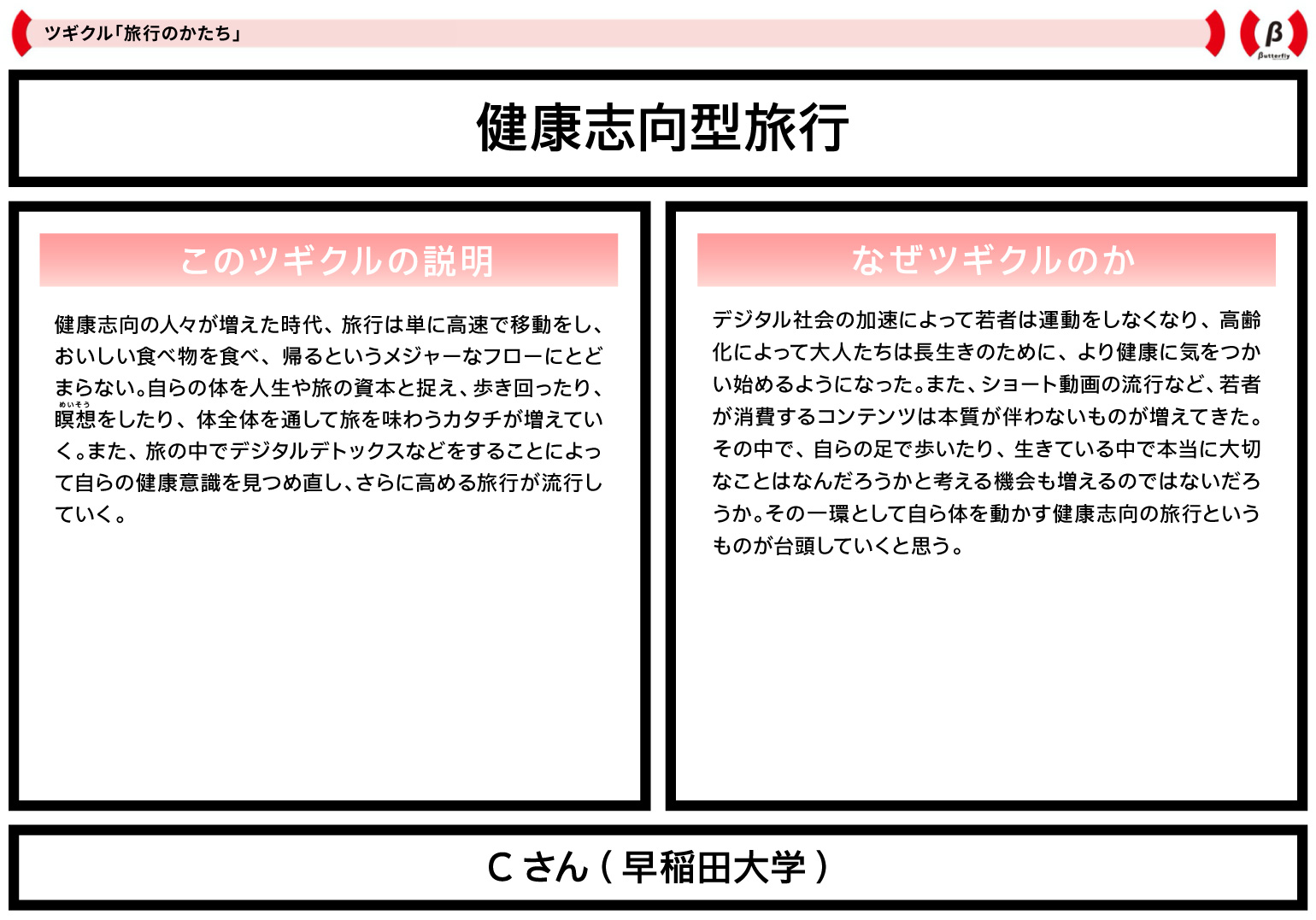
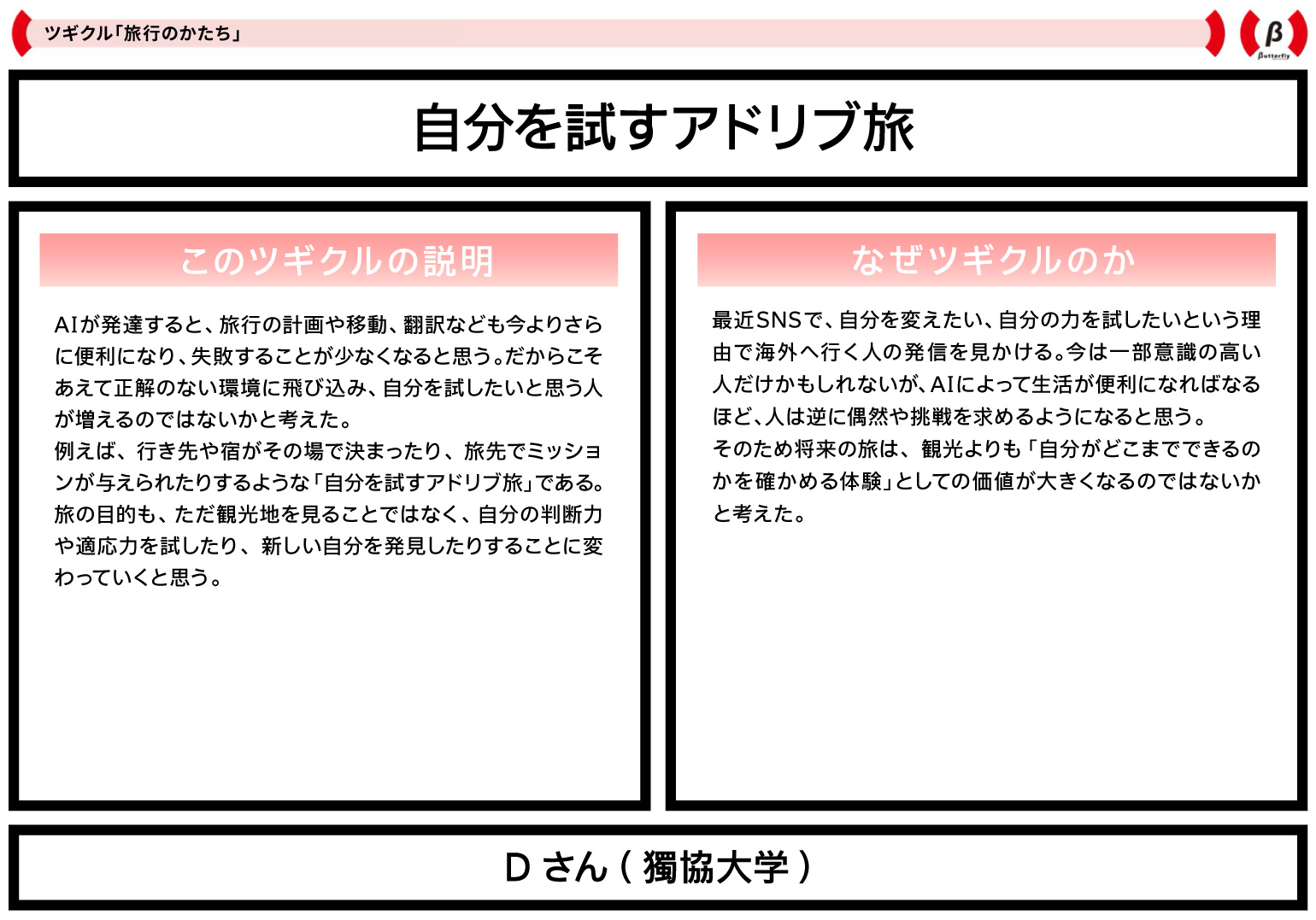
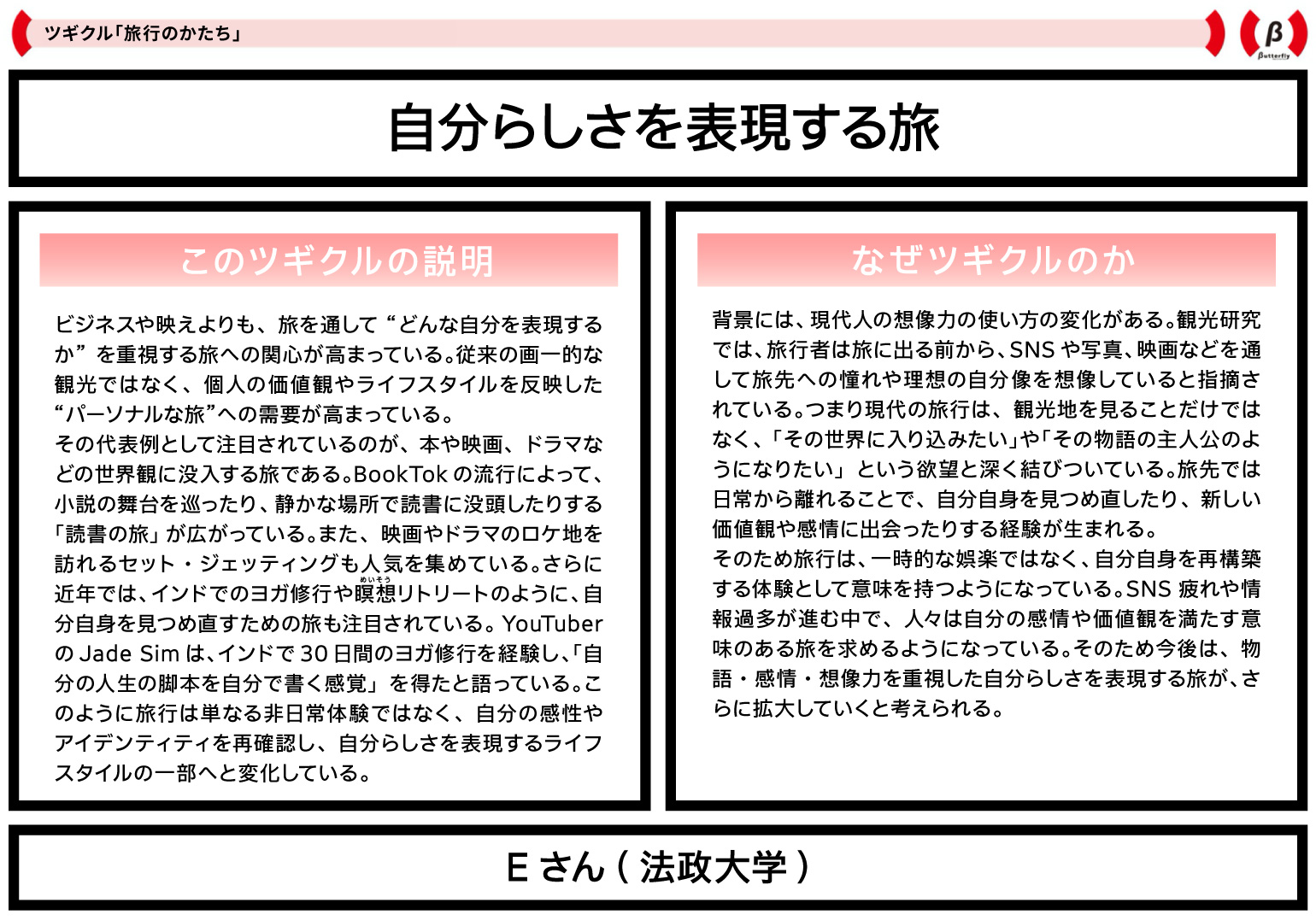
What these ideas have in common is that they don’t approach travel solely from the perspective of destinations or activities—such as “I want to go here” or “I want to do this.” Instead, travelers start with a desire: “I want to grow as a person,” “I want to restore my physical and mental well-being,” or “I want to assess who I am right now.” They first identify what they want to gain, and then choose travel as the means to achieve it. Isn’t this the emergence of a new kind of travel—one that works backward from the “Why”?
Travel has come to be about not just “where to go,” but also “who to go with”
And when you start planning a trip based on the “why,” another factor changes: “who you go with.” The clearer you are about what you want to gain from the trip, the more important it becomes to ask, “Can this trip truly fulfill that purpose?” As a result, it seems people are thinking more carefully than ever not only about their destination and how they’ll spend their time, but also about the people they’ll be traveling with.
Of course, “how well we get along” has always been a major criterion for choosing travel companions. However, listening to the students’ stories this time, it became clear that they’re placing importance not only on that but also on “travel compatibility”—such as “how we enjoy the trip,” “how we plan it,” and “what we want to do at our destination.”
One student report even described the “next-generation” way of traveling as deciding whether to travel with someone based on the results of a personality test.They seek to understand differences in advance—such as whether someone “wants to plan everything meticulously” or “prefers to go with the flow.” Rather than avoiding differences in mindset altogether, they consider in advance the possibility that one person might feel forced to compromise or that one might restrict the other’s way of enjoying the trip. In other words, they’re no longer just choosing travel companions because “we get along well,” but are now considering whether “with this person, I can have the kind of trip I want.”
The “self-centered” prioritization behind “Why Thinking”
So why are these changes emerging in the way young people travel? One hypothesis that emerged from our discussions with students is that there is a growing tendency to base choices in various aspects of life on the criterion of “what’s best for me.”
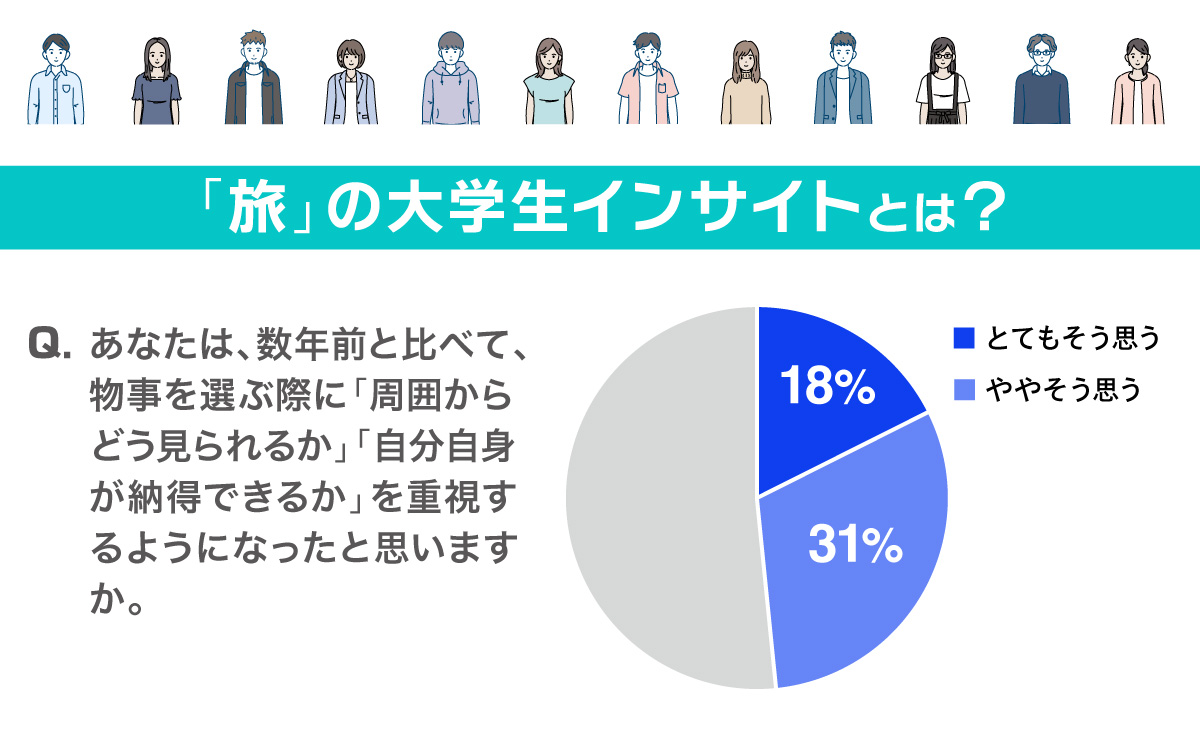
In fact, when we conducted a survey of college students nationwide using “CircleApp”—a communication app specifically for college clubs—and asked, “Compared to a few years ago, do you think you’ve come to prioritize ‘whether you’re personally satisfied’ over ‘how others perceive you’ when making choices?” 18% responded “I strongly agree” and 31% responded “I somewhat agree,” meaning that about half of the respondents indicated they now place greater importance on “their own sense of satisfaction” than before.
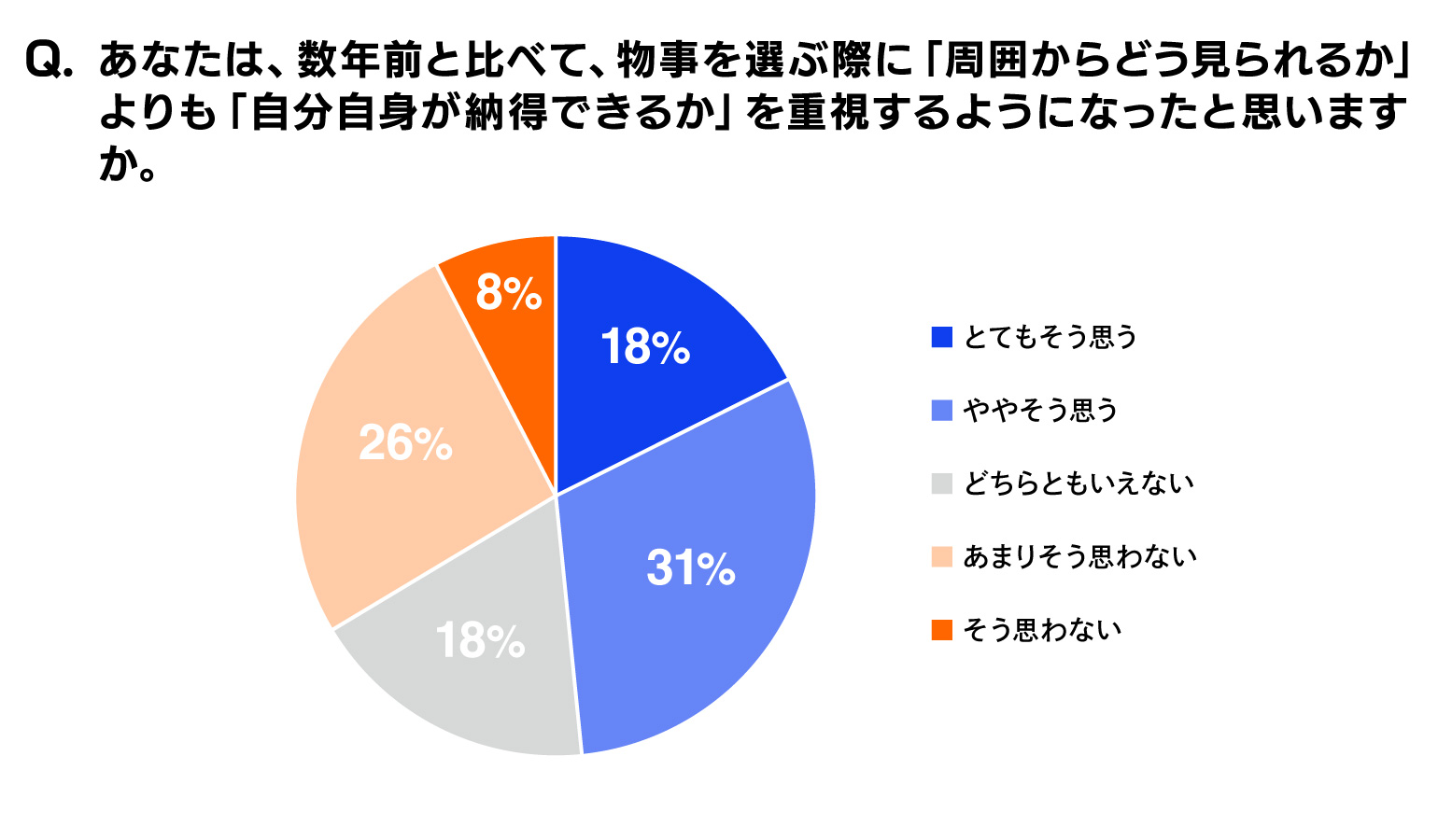
So, why have they come to prioritize “personal satisfaction”?
When asked for the reasons, the most common response was “Because I sometimes feel tired of trying to conform to others” (32.0%). On the other hand, “Because I reevaluated how I spend my time and interact with others after experiencing the COVID-19 pandemic” accounted for 11.2%, while “Because I’ve been exposed to a variety of values through social media and other channels” accounted for only 5.6%.
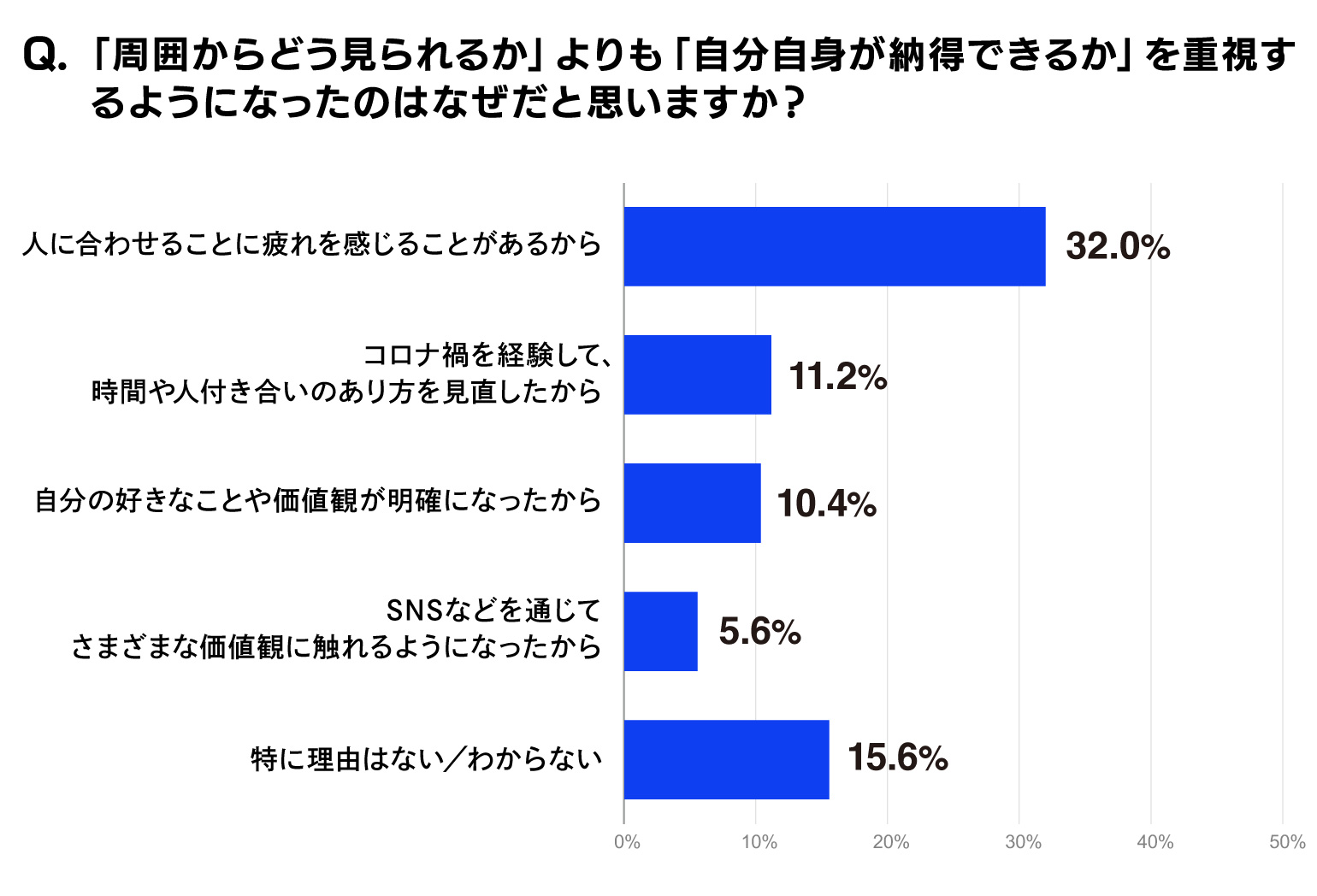
These results show that, more than simply reevaluating how they spend their time and interact with others in the wake of the COVID-19 pandemic, “fatigue from conforming to others” is a strong underlying factor driving this emphasis on personal satisfaction.
So, where does this “fatigue from having to conform to others” come from?
Here, we focused on the environment in which young people have lived up to this point. During the pandemic, they were required to show “consideration for others” more than ever before—not only by taking personal infection prevention measures but also by behaving in ways that would not cause anxiety among those around them. Furthermore, it was a time when they frequently witnessed situations on social media where casual remarks or actions led to unexpected criticism or online backlash.
Of course, based on this survey alone, we cannot definitively conclude that the COVID-19 pandemic or social media directly caused this “fatigue from conforming to others.” However, having experienced an environment where it became routine to constantly ask, “Will my actions make someone uncomfortable?” or “Am I being considerate enough in every possible way?” may have led to a state that could be described as “over-consideration.”
And isn’t the backlash against this “over-consideration”—as evidenced by the emergence of the term “menpa” (mental performance)—the reason why a value system that prioritizes “whether I feel comfortable” and “whether I am mentally fulfilled” is currently on the rise?
This “self-centered” set of priorities may be leading travelers to consider not just “where to go” or “what to do,” but also the “why”—that is, “what does this trip mean to me?” and “what will I take away from it?”
Will future travel be defined not by “destinations” but by proposals for the “meaning of the journey”?
Until now, travel services have primarily offered proposals centered on “Where” and “What”—such as “seeing breathtaking scenery,” “eating delicious food,” and “visiting famous tourist spots.” However, if young people begin to choose their trips based on “Why,” the kinds of travel proposals in demand may also change.
For example, instead of a “trip to Kyoto,” a “journey to reflect on oneself”; instead of a “trip to a hot spring,” a “journey to recharge after feeling exhausted”; instead of a “solo travel plan,” a “journey to test one’s decision-making skills.”
In other words, rather than simply selling destinations and activities, travel services will likely be expected to design and present experiences that go a step further—explaining “what that journey will bring to you.”
Furthermore, we can envision new travel experiences centered on the “why”—such as services that consider compatibility with travel companions based on your goals, or services that recommend destinations and experiences based on travel objectives like “growth,” “recovery,” “challenge,” and “self-understanding.”
For young people, travel is shifting from “going somewhere” to “going to become the person they want to be.”
Such a shift may well reshape the very nature of travel in the future.
[Survey Overview]
Research Organization: Dentsu Inc. Youth Research Department
Survey Participants: 250 undergraduate and graduate students nationwide
Survey Period: September 2026
*Percentage figures (%) are rounded to the second decimal place; therefore, the total may not always add up to 100%. Since the second question allowed for multiple answers, the total will not equal 100%.
Was this article helpful?
Share this article


Newsletter registration is here
We select and publish important news every day
For inquiries about this article
Back Numbers
Author

Mana Tsuneji
Dentsu Inc.
Marketing Division 6, Marketing Consulting Division 2
Planner