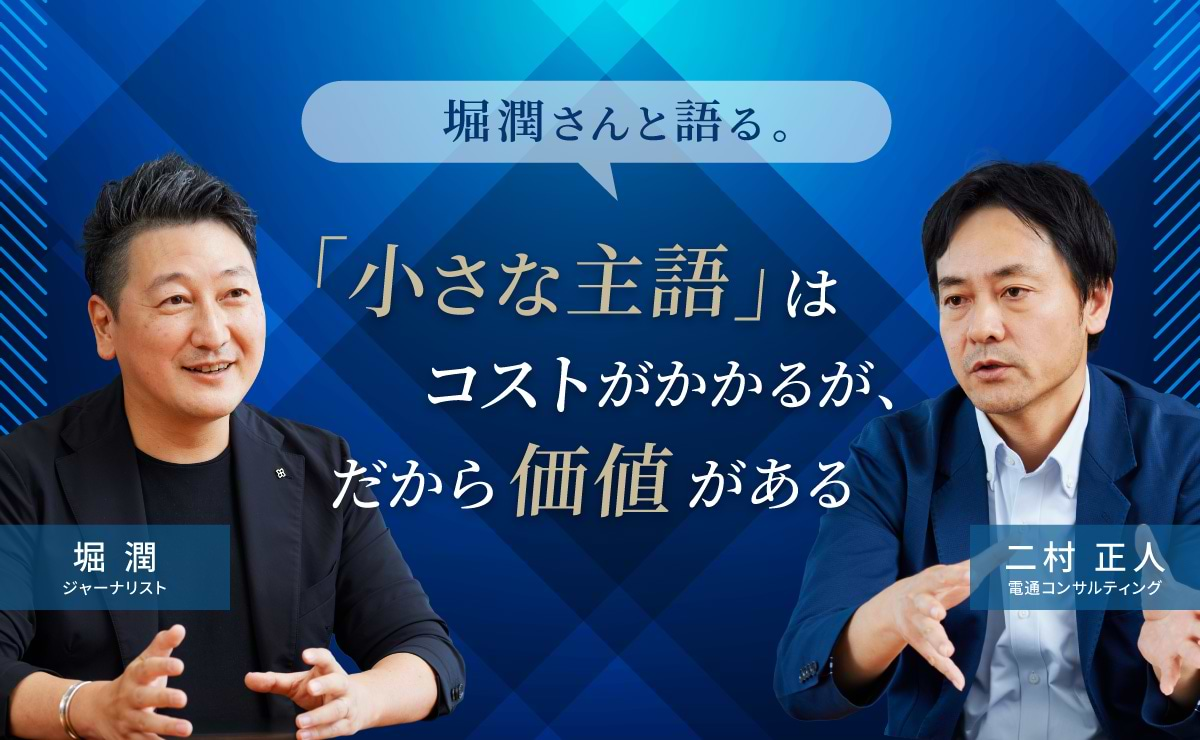
(From left) Journalist Jun Hori and Masato Futamura of Dentsu Consulting Inc.
How does “information dissemination” contribute to solving various social issues?
One of the areas in which Dentsu Consulting Inc. is involved in supporting the resolution of social issues is information dissemination, including public relations activities. Recognizing that “the ability to disseminate information” is required of consumers, businesses, and local governments alike, the company is working to revitalize communities and support the resolution of regional issues through public relations.
In this article, journalist Jun Hori—who supports content creators across Japan through “8bitNews,” a public media platform he founded— engages in a dialogue with Masato Futamura of Dentsu Consulting Inc., a consultant with many years of experience supporting regional revitalization and the resolution of social issues, including those in Fukushima and other regions.
They discussed the challenges and importance of information dissemination in local communities, as well as the mindset required to engage in such efforts.
We want to create communication where no one is left behind
Journalist Jun Hori
Nimura: At Dentsu Consulting Inc., we work in partnership with major local companies and municipal governments to support the creation of “regional co-creation platforms” that lead to regional revitalization and problem-solving.
In doing so, we frequently engage with regional banks, local media outlets, and other organizations and municipalities across the country, and we often hear about the challenges they face. Mr. Hori, after leaving NHK, you’ve been running the citizen-led media outlet “8bitNews.” Could you share with us once again what motivates you to tackle regional issues?
Hori: 8bitNews is a media outlet that practices “solution journalism” (*journalism that not only reports on issues but also accompanies and communicates the process of solving them*). Rather than us determining what has news value, we collaborate with those who say , “There’s news here!” to report on it together and work toward a solution.
When the Great East Japan Earthquake struck, I visited the disaster site as an NHK employee. I received a great deal of information from people in various positions, but due to constraints on airtime and timing, there were many instances where I couldn’t cover the stories immediately, which left me feeling frustrated.
I came to believe that one of the roles of public media is not just to “go where we want to report, ” but to “go where there is an SOS” in order to convey the diverse voices of local residents. This realization was the catalyst for conceiving 8bitNews.
Nimura: I, too, have been deeply involved with the disaster-affected areas of Tohoku—primarily in Fukushima Prefecture—since the Great East Japan Earthquake, and I am currently working with the “Fukushima Soso Reconstruction Promotion Organization” (hereinafter referred to as the Soso Organization).
The Sōsō Organization is a public-private partnership supporting the reconstruction of the Fukushima Hamadōri region; it is also known as the “Public-Private Joint Team.” It is undertaking a major initiative to promote the reconstruction of the 12 municipalities in the Fukushima Hamadōri region through public-private collaboration, and Dentsu Consulting Inc. is honored to play a part in this effort.
We provide support to Hamadori municipalities in solving a wide range of challenges—including planning, commerce and industry, relocation and tourism, education, new business ventures, and diversity—and one of these areas involves supporting their public relations and information dissemination efforts.
In a sense, since we are generalists in solving regional challenges, we felt that for the topic of information dissemination, we needed support from specialists who are directly engaged in this work at the local level, which is why we reached out to Mr. Hori.
Hori: I, too, was eager to collaborate with Dentsu Consulting Inc. because I hoped that by partnering with a firm that has expertise in public relations and information dissemination, we could take a step closer to solving regional challenges.
As a concrete example of a local challenge, I recall a story I once heard from a resident of the Hamadori region in Fukushima Prefecture. At the time, this person lived in an area deemed “difficult to return to” and had been forced to leave their hometown due to the earthquake. I’ve been following their story and speaking with them regularly as they restarted their business at their evacuation site and struggled to return home.
More than a decade after returning home, this person suddenly confided in me , “I just can’t think of this place as ‘my town’ anymore.” Reconstruction was progressing; new people and businesses were moving in, and lodging facilities and restaurants were reopening. But the landscape had changed, and not many of the original residents had returned. “I’ve been gritting my teeth and working hard to come back, but when I realized this was the world I’d been hoping for, I just felt empty,” they said.
Futamura: Those are very heavy words…
Hori: The media tends to report the straightforward narrative that “time has passed since the disaster, and the town has recovered,” but the truth is, there are actually people who feel increasingly alienated the more the media portrays the town as vibrant and thriving. To share these feelings held by local residents, we must create opportunities to share their stories.
Similar concerns are emerging all over Japan. I’d like to work with you, Mr. Nimura, and others to develop ways of communicating that ensure no one is left behind and that prevent feelings of alienation and unnecessary conflict.
Several Reasons Why Local Information Sharing Isn’t Working
Masato Nimura, Dentsu Consulting Inc.
Nimura: A major challenge in information dissemination across many regions is the difficulty of reaching prospective residents. One example is that communication efforts tend to be fragmented. Even if a single municipality disseminates information on its own, its limited scale inevitably results in insufficient information or content getting buried among the vast amount of information available.
The ideal approach is not a “point” but a “network” created through collaboration among multiple municipalities. From the perspective of prospective residents, daily life isn’t confined to a single municipality, so it’s easier to understand when information from multiple towns is consolidated. I think it comes down to the sense that the decision to live there is made based on the region as a whole.
Hori: When it comes to inter-municipal collaboration, it’s absolutely impossible to bring municipalities together without a common “banner.” In that sense, those designing the collaboration need to clearly articulate “why we are collaborating” and “what new opportunities will emerge as a result of this collaboration.”
Nimura: You’re absolutely right. There are also barriers related to personal information protection, so collaboration between municipalities isn’t easy. It’s also common for government officials and residents to instinctively compare their area to “the town next door.” But when it comes to relocation, the point of comparison for prospective residents might not actually be “the town next door.”
For example, when someone is considering moving to the Hamadori region of Fukushima Prefecture, their point of comparison might be Fukuoka, Okinawa, or even Hokkaido . By collaborating and presenting a unified message as a region, there’s a possibility that the area will be chosen as a more attractive destination for prospective residents. We’re working to promote regional collaboration by communicating this potential.
Hori: To foster collaboration, it’s also necessary for local governments to identify areas where their interests align.
Nimura: That’s precisely where coordination becomes difficult when it comes to “area-wide” outreach. It won’t move forward unless the key players are on board, and it’s also important to determine who will lead the collaboration.
Another challenge in regional information dissemination is the “fear” of sharing information. It’s not uncommon for local government officials to think, “If there’s a risk of a backlash, it’s better not to share anything.”
Furthermore, some do not view information dissemination as their own responsibility, but rather see it as the job of the public relations staff. On top of that, it’s difficult to gauge the cost-effectiveness of communications from local governments, and determining appropriate KPIs is also a challenge. Due to these complex reasons, some regions are unable to take a proactive approach to communication.
Hori: It’s really tough for local government officials, isn’t it? People tend to take it for granted that they should handle all sorts of tasks—not just communication—and any mistake can lead to criticism. That’s why I think it’s better to start by helping civil servants develop the “ability to communicate with confidence” as a personal skill, rather than approaching it as a “duty” of their official role.
On top of that, I think it’s a good idea to stay prepared on a daily basis so that when an opportunity arises where you can naturally apply that skill in your work, you’re ready to share information right away. If you try to force yourself to share information as part of your job, it’s easy to get caught up in a sense of compulsion. For example, you might think , “That town’s official Instagram is going viral, so shouldn’t we do the same in our town?”
Nimura: That’s true—I see cases like that all the time.
Hori: I don’t think the goal necessarily has to be “getting a lot of people to see your posts.” From the perspective of public media, I believe there’s value in “preserving what already exists as an archive” and “resolving issues.” In fact, that might be the very role of a local government.
The real threat to a community is being forgotten. Even if a town were suddenly wiped out by an earthquake, as long as the archives remain, we can recall the daily life that once existed there and share that story with people in other regions.
Three Key Points to Keep in Mind When Sharing Information
Nimura: I feel that many local government officials are struggling right now—either because they don’t know what or how to communicate, or because they’re communicating but don’t feel like their message is actually reaching anyone. Could you share your tips for effective communication, Mr. Hori?
Hori: I often advise people who want to share information that “communicating is about listening.” When you want to convey something to others, if you just make one-sided statements like “We have this” or “We’re doing this,” you end up leaving the other person behind. First and foremost, the person sharing the information should make “wanting to understand the other person” the cornerstone of their approach.
For example, there are countless sources sharing information about relocation, leading to a fierce PR battle across the country. From the perspective of prospective residents, this creates a situation where they become skeptical, wondering, “They’re only touting the positive aspects—is that really true?” or “What if it’s completely different once I get there?” That’s precisely why it’s crucial for local governments to demonstrate an attitude that says, “We’re here to truly engage with you.”
In Kamishihoro Town, Hokkaido, young professionals have been appointed to the town hall, and they reportedly conduct thorough interviews with prospective residents and people from other regions interested in the “Regional Revitalization Cooperation Corps” (*1). They ask in-depth questions about what people want to do, why they’re interested in the Regional Revitalization Cooperation Corps, and what kind of support they hope Kamishihoro Town will provide.
*1 Regional Revitalization Corps: A program launched in fiscal year 2009 under the jurisdiction of the Ministry of Internal Affairs and Communications. Regions facing challenges such as population decline and an aging population accept “corps members” from urban areas to work on revitalizing the region.
Hori: By listening to their dreams in this way , the town strives to provide opportunities and environments where they can feel secure in making those dreams a reality. It is only after this level of engagement is achieved that people can make the decision to move to Kamishihoro Town. And those who have been welcomed to this extent and have relocated there actively contribute to the community.
In the case of Kamishihoro Town, young newcomers are reportedly developing the tablet user interface for an on-demand transportation service for the town’s elderly residents (*2). They contribute to the community from a unique perspective—one that comes from possessing skills not found locally.
*2 On-demand transportation: A reservation-based transportation service (bus) currently being piloted in Kamishihoro Town and other areas. By operating only when reservations are made—and not running otherwise—it eliminates “dead time” caused by declining ridership and improves efficiency.
Nimura: I see. So they’re “giving back,” aren’t they?
Hori: Yes. The second point I want you to keep in mind when communicating is to “use a specific subject rather than a broad one.” For example, saying “people who want to move here” is a very broad subject. Even among prospective migrants, each person has a different background and different dreams. That’s why you need to address them using a specific subject. It’s important to carefully convey the region’s micro-level details to a “specific group” of people.
To speak using a specific subject, you need to go to the location or meet with people—in other words, it involves a certain “cost.” We’re now in an era where generative AI makes it easy to create videos, photos, and other content without incurring costs, so the value of “firsthand information”—which requires a greater investment—is increasing.
Futamura: That’s true. When I listen to local government officials, it seems they struggle to form a concrete image of potential newcomers, which may result in their messaging coming across as vague. Also, from the perspective of promoting relocation, I feel it’s important not only to communicate effectively but also to empathize with each prospective resident’s individual concerns and challenges. This is closely related to the concept of “small-scale storytelling.”
Hori: And the third point is “balancing the ratio of facts to opinions.” These days, there are many situations where we feel the fear of putting information out there—fearing unexpected criticism or unintentional misunderstandings. That comes down to the proportion of opinions.
A message that’s 100% fact carries no risk of backlash because it’s based solely on facts. However, once value-based language—such as “beautiful,” “wonderful,” or “fun”—in other words, the communicator’s opinion—is introduced, it becomes more likely to invite dissent and counterarguments.
I run workshops where I teach people in rural areas how to write news articles. During these sessions, I first ask them to take a leap of faith and write a piece that’s 100% opinion. Next, I have them write one that’s 100% facts, and finally, we work together to find the best balance by blending the two.
Nimura: 100% facts don’t really resonate with people, and 100% opinion lacks persuasiveness and is hard to accept. So this workshop is designed to help participants master that balance. You mentioned the risk of backlash, and it’s true that local government officials often have concerns about including opinions in their communications. It’s very beneficial to be able to test this out in a workshop setting. I strongly agree that striking the right balance between facts and opinions is crucial for ensuring your message is easily understood by your audience.
Hori: And surprisingly, there are many cases where the “broad subject” itself is actually an opinion. For example, saying things like “Middle-aged men are like this, aren’t they?” or “That’s just how Japan is” tends to invite all sorts of objections and counterarguments, doesn’t it? This is because the subject is too broad. Broad subjects are convenient because they don’t require much effort, and they carry a lot of weight. That’s exactly why I want to encourage people to invest more effort into their own messaging.
Nimura: Perhaps people are starting to demand smaller subjects because they’re tired of content that cuts corners by relying on broad generalizations.
Hori: I really feel that. I believe now, more than ever, we need the voices of those directly involved as primary sources. I hope more people will feel comfortable sharing their perspectives, fully aware of the various risks involved.
The Most Important Aspect of “Sharing”: Engaging in Dialogue with Yourself
Nimura: Finally, could you share your thoughts on the right mindset for sharing your message? Once people have developed the ability to share effectively, what stance do you hope they’ll take, and what challenges do you want them to pursue?
Hori: When people hear the word “sharing,” I think they often imagine having to convey a message to someone else. But the most important form of sharing is having a dialogue with yourself. Next, conveying your feelings to people who are important to you is a major role of communication skills, and I see sharing with the general public as an extension of that.
People say, “Word of mouth is the most powerful form of communication,” don’t they? I think everyone knows the impact of hearing from a family member or friend, “I found this amazing restaurant!” If you communicate without the intention of conveying your feelings to that specific person, you’re essentially just throwing out messages with no real impact toward some distant, unknown audience—and it ends up being a waste of effort. So, it’s best to start by sharing word-of-mouth-style messages with the people right in front of you.
Furthermore, the primary goal of communication is “to encourage behavioral change.” For example, if someone suddenly makes a grand statement like, “Let’s make this town better,” you wouldn’t know how to act on it, would you? But if someone asks , “Can you help me clean up the neighborhood trash collection area so bugs don’t come out?” you might think, “Okay, I’ll help out,” and that creates behavioral change. The power of hyperlocal media—like neighborhood bulletin boards, town notice boards, and community FM radio stations—that used to serve as channels for this kind of communication is gradually weakening.I want to bring back “communication that conveys everyday matters and leads to behavioral change.”
Futamura: If communicators share what they personally find compelling from their own perspective, I’m sure there will be people who resonate with it. In the context of migration, the discussion inevitably tends to become a zero-sum game within Japan, but if we reach out to an international audience, it might lead to an increase in immigrants from abroad and inbound tourists. We, too, would like to support local communities in sharing information that contributes to regional revitalization.
Representative Director, 8bitNews, Inc. / Representative Director, “Tataki o Kotoba ni Suru” Research Institute, Inc.
Journalist
After graduating from the Department of German Literature at Rikkyo University’s College of Letters, he joined NHK. Following stints as a reporter for “News Watch 9” and an anchor for “Biz-Spo,” he launched the citizen news site “8bitNews” in 2012 and left NHK in 2013. He currently appears on TOKYO MX’s “Jun Hori Live Junction” and ABEMA’s “ABEMA Prime,” among other programs.Since 2019, he has served as a visiting researcher at Waseda University. He directed the film *I Will Not Tolerate Division* (2020). His published works include *Disasters and Misinformation* (Shueisha International Shinsho, 2025).
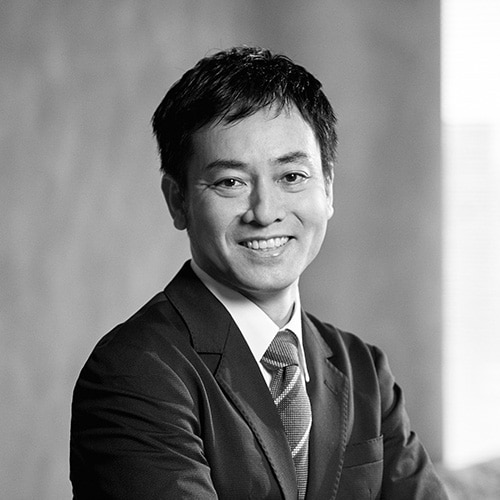
Masato Nimura
Dentsu Consulting Inc.
Principal
After working at a megabank, a startup, and a global consulting firm, he joined Dentsu Consulting Inc. His work focuses on new business planning, business plan formulation, and business execution. Since the Great East Japan Earthquake, he has focused on solving social issues through business, with a particular emphasis on Tohoku reconstruction and regional revitalization. While mindful of the interests of diverse stakeholders both inside and outside the company, he provides hands-on support in devising and implementing measures to drive businesses toward their goals.

 Thinking with the Right Brain and Left Brain: The Future of Advertising Agencies and Consulting Firms [14/14]