
Note: This website was automatically translated, so some terms or nuances may not be completely accurate.
 The Potential of "Social Sourcing" to Obtain Resources from Society [1/11]
The Dawn of Mass Media by Consumers, for Consumers
Toshiaki Hasamura
Dentsu Inc.
In this era, with the spread of the internet, we can now share information based on our own interests and passions through platforms like internet radio and video streaming.
However, ordinary citizens cannot legally use "radio waves" for information dissemination. So-called "broadcasting" possesses immense information penetration power. Unlike online communication, it operates under various restrictions and is permitted only to specific licensed broadcasters.
As you know, Japan's commercial broadcasters operate on advertising revenue. In particular, terrestrial commercial broadcasters do not charge viewers fees; they sustain their broadcasting operations through advertising revenue.
 |
Released on October 7, 2013, as a collaborative project between J-WAVE, READYFOR, and Dentsu Inc. |
On New Year's Day 2014, an epoch-making event occurred in the private broadcasting industry. FM radio station J-WAVE implemented an unprecedented initiative: soliciting and selecting program ideas from the general public (listeners), raising production funds through crowdfunding from the general public, and using those funds to produce and broadcast a special New Year's Day program.
Its name: " LISTENERS' POWER PROGRAM." A program where listeners create the shows they want to see, powered by the collective strength of all listeners.
This attempt to expand a scheme unprecedented since the start of Japan's commercial broadcasting has succeeded.
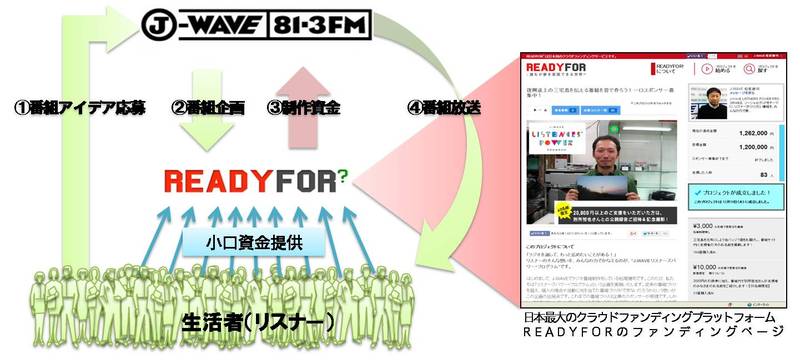 |
Scheme Overview Diagram |
This new scheme emerged from the desire to get everyday people more personally invested in mass media and potentially solve the so-called "mass media disengagement."
The core idea is that if we can create a system where each individual can create "mass communication" with their own hands—in other words, if we establish an infrastructure for "co-creating" mass media—it could significantly enhance the "engagement" between the public and mass media.
With the support of strong partners like J-WAVE and READYFOR, who share this vision, we were able to launch the initiative. This has already led to similar crowdfunded program production at other radio stations, and this trend is poised to spread to private broadcasters, including television.
In the near future, we envision elevating this system to a model that combines advertising revenue with crowdfunding, thereby enhancing three-way engagement not just between broadcasters and consumers, but also including advertisers.
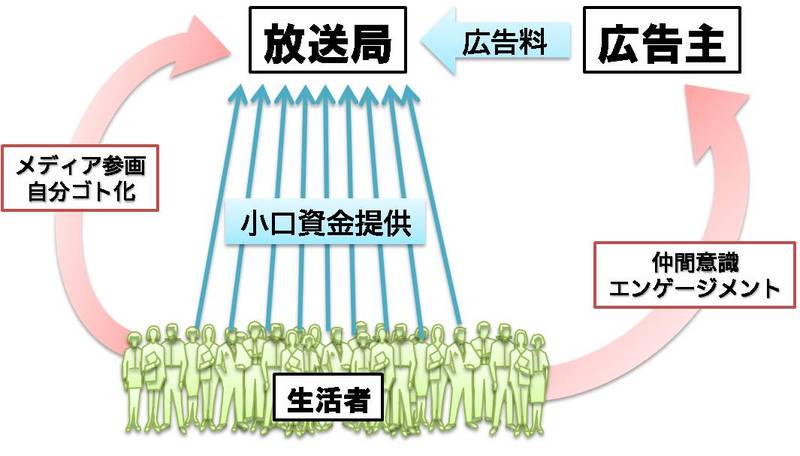 |
Three-Party Engagement Concept Diagram |
The two mechanisms adopted in this project are respectively
[1] "Crowdstorming" – Broadly soliciting ideas from external sources
【2】"Crowdfunding," which broadly solicits funds from external sources
. This practice of sourcing not only "ideas" and "funds" but also tangible and intangible resources like "skills, know-how, and labor" from external sources is collectively termed "crowdsourcing." This is a portmanteau of "crowd" and "sourcing," literally meaning to procure various elements from an unspecified multitude.
However, I deliberately choose not to use the increasingly common "cloud-" prefix. Instead, I'd like to call this form of crowdsourcing, which is premised on building co-creation relationships, "Social Sourcing." This term embodies my vision: not just vaguely extracting resources from a crowd, but aiming for a scheme premised on CSV (Creating Shared Value) – a mechanism where we co-create with everyone in society by having the society we collectively form provide the necessary resources.
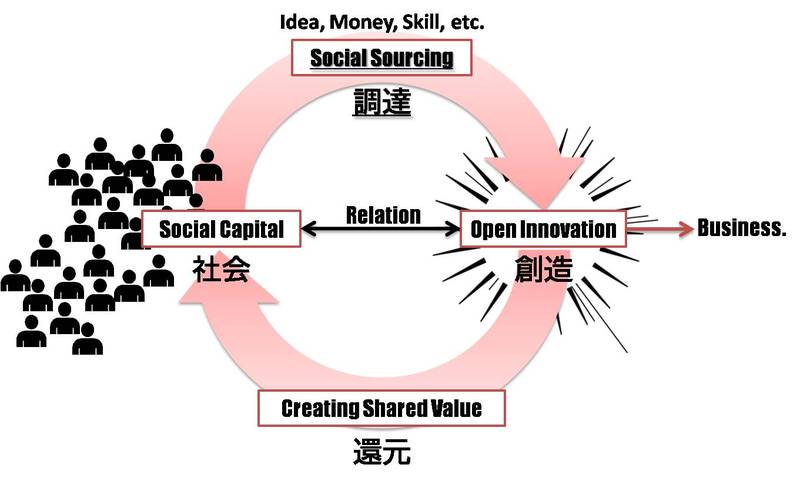 |
Social Business Scheme Diagram: Procuring via Social Sourcing and Giving Back through CSV |
In this series of columns, we will explore the potential inherent in social sourcing, which is still in its early stages, starting with J-WAVE's pioneering initiatives.
Was this article helpful?
Share this article


Newsletter registration is here
We select and publish important news every day
For inquiries about this article
Author
Toshiaki Hasamura
Dentsu Inc.
Business Development & Activation Division
During my student years, I incorporated a photography business (started a company). I covered approximately 40 countries. Subsequently, I joined Dentsu Inc. with the goal of launching a social business within an organization capable of significant social impact. While working on new business development led by Dentsu Inc., I also engaged in PRE/PFI consulting, such as advisory services for PFI concession bidding projects like airport privatization, and consulting for new commercial facility development project planning. Examples of business development include: - 2013: Conceived and participated in launching Japan's first crowdfunded mass media broadcast project, "LISTENERS' POWER PROGRAM." - 2016: Conceived and participated in establishing Japan's first FinTech industry hub, The FinTech Center of Tokyo "FINOLAB Inc.", where I remain active daily as part of the operational team. - 2018: Left Dentsu Inc.