
Note: This website was automatically translated, so some terms or nuances may not be completely accurate.
Unless We Become 21st-Century Primitives, We Won't Survive the Near Future!? 'Why We Regressed to Primitive Humans When the Internet Became Widespread'
This time, we introduce "Why We Regressed to Primitive Humans After the Internet Became Widespread," by two editors: Hiroto Kobayashi, Co-CEO of Infobahn, and Hirokazu Yanase, Chief Planning Producer at Nikkei Business.
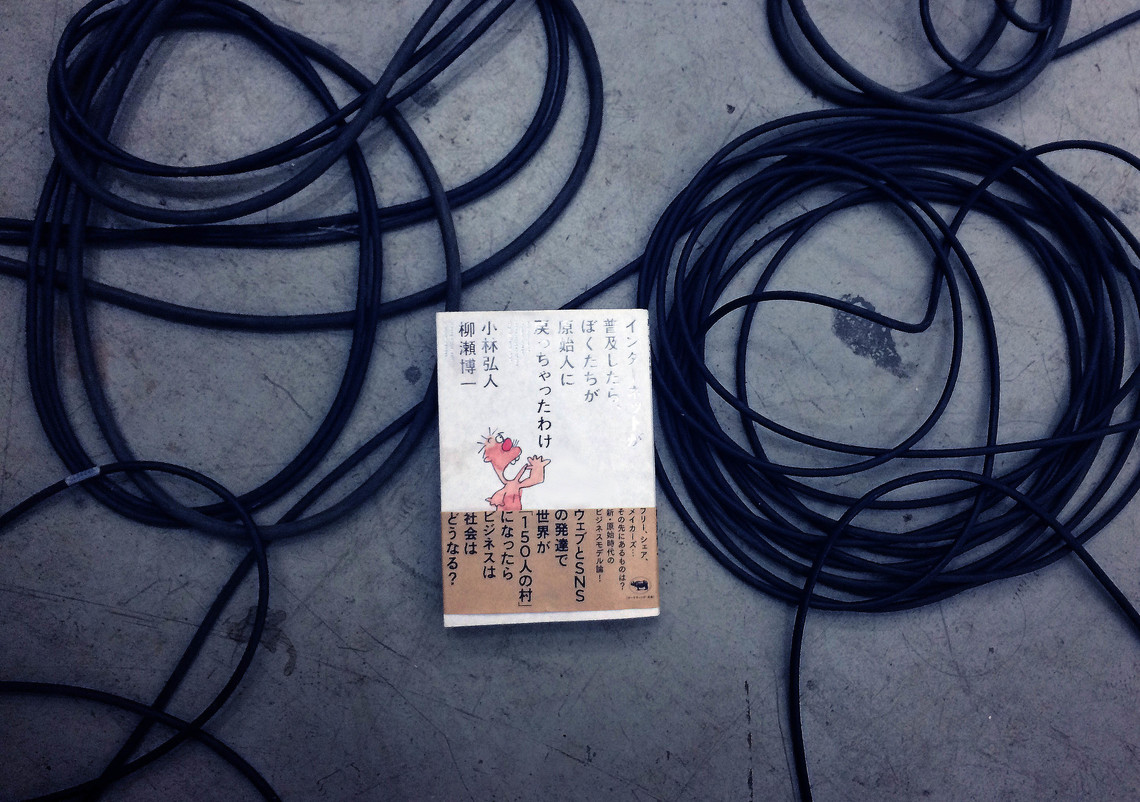
What is this book about?
This book with its intriguing title—what exactly is it about? The book is written in a dialogue format between the two authors, covering topics ranging from internet theory, media theory, marketing theory, organizational theory, sales theory, recruitment theory, all the way to discussions on athletes, idols, and even seedy snack bars—moving freely across boundaries without restriction.
Some of the books mentioned in this book include
Free (Chris Anderson/NHK Publishing)
Share (Rachel Botsman and Roo Rogers, NHK Publishing)
"Public" (Jeff Jarvis/NHK Publishing)
MAKERS (Chris Anderson/NHK Publishing)
"The Web Evolves in Groups" (Paul Adams/Nikkei BP)
"How Many Friends Do You Have?" (Robin Dunbar/Intershift)
Predictably Irrational (Dan Ariely/Hayakawa Publishing)
G rowth Hacker (Ryan Holiday/Nikkei BP)
Lean Startup (Eric Ries/Nikkei BP)
Zero to One (Peter Thiel, Blake Masters / NHK Publishing)
"Your Salary Is Determined by Where You Live" (Enrico Moretti / President Inc.)
"Learning Marketing from the Grateful Dead" (David Meerman Scott, Brian Halligan / Nikkei BP)
and others.
It even covers short-short stories by authors like Shinichi Hoshi and Yasutaka Tsutsui, giving you an idea of its broad range of topics. Several of these were also featured in our book review project.
For those who have already read these books, this volume will help you understand the connections between them. For those who haven't, you can use this book as a hub for topics, digging deeper into themes that catch your interest.
Regarding the question, "What is this book ultimately about?", the afterword states the following:
To put it bluntly, I believe this book is an "editor's primer." It is a discussion of editing by two editors who scoop up the "core" of the era from the events passing before their eyes and speak of the near future.
(Excerpt)
The two editors sensed that "editing power" could contribute to breakthroughs in every field. It is the "Force" spoken of by Yoda in the movie Star Wars. May the editing power be with you. (P.283)
This book, literally a dialogue-style discussion between two editors, gives the feeling of eavesdropping on their brainstorming sessions. It's stimulating and brimming with hints, yet it doesn't offer any definitive "This is it!" conclusions. But there's a reason for that. The book repeatedly touches on how the speed of environmental change has accelerated tremendously.
Lately, we've seen more cases online where the lifespan of "infrastructure = platforms" is clearly shorter than that of "content." The evolution of technology, including hardware, is so rapid that the platforms content rides on—specifically, the hardware and distribution systems—often decline first. There was a time when web business was all about controlling the platform, and then the money would just roll in—win! But that's no longer the case. (P.55-56)
I believe the flow of all information is now approaching the speed of human thought.
(Omitted)
At the very least, the pace of change in the information industry is getting incredibly close to the speed of human thought. Watching smartphone businesses, that's what I think. So I'm sure that even going forward, the winners won't survive for very long.
(Omitted)
So demanding things like "produce a five-year plan" is simply unrealistic. (P.206)
I think "foresight" itself is fundamentally flawed.
(Omitted)
Facebook's Sheryl Sandberg apparently said something similar—about "course-correcting every three months."
(Omitted)
Regardless of whether it's good or bad, a company's strategy simply can't last five years these days. The era of the long novel is over. I think we're moving closer to poetry than prose. (P189-190)
In such a fast-paced environment, to "scoop up the 'core' of the era from events passing before our eyes and speak of the near future," we mustn't force events into rigid molds, slice them into isolated "points," and delude ourselves into thinking we understand. Instead, we must continuously connect the many "points" scooped from the flow of the world through editorial skill, persistently drawing them as a "line" pointing toward the future. I felt this book was such an attempt.
What does "Once the internet became widespread, we basically turned back into cavemen" mean?
This book is somewhat anecdotal, making it very difficult to summarize. However, I'd like to touch on the concept that appears in the title and is referenced throughout the book: "Once the internet became widespread, we reverted to being primitive."
I felt there were two perspectives:
① We haven't changed from primitive humans
The first is that "we were no different from primitive humans after all." For years, we've been told with great enthusiasm that "the advent of the open, flat, networked Internet age will make us a new species!"—painting an ideal near-future. But as SNS and similar platforms actually spread, people gradually started realizing something obvious: setting aside the software aspects like culture, society, and people's minds, the hardware—human brain function and physical capabilities—remains unchanged from the primitive era.
It's said that the human brain can effectively manage a group of about 150 people; even in primitive times, villages larger than this would split into two. Similarly, in the SNS era, while communities may connect with many people numerically, the reality is that only a portion of them actually function and allow for meaningful interaction. (Doesn't it feel like it's around 150 people?) I suspect many of you have experienced this firsthand. This means that even as we harness the "science" of big data, the "art" of appealing to human instincts, stirring emotions, and driving action remains as crucial as ever.
② We must become primitive people
The second point is that "we must become intelligent, barbaric primitives of a new era" (referred to in this book as "primitives with smartphones" or "high-tech barbarians"). While building large organizations and dividing labor previously led to efficiency, the rapidly changing environment has created situations where the very size of these organizations becomes a disadvantage, such as their lack of agility. To break through this, what's needed is the bold courage to destroy the "20th-century frameworks" with unconventional, wild intelligence.
One episode introduced in this book involves a major corporation making a grand announcement about a new product launch. However, several young people had already unveiled a similar concept on a crowdfunding site well before this announcement. They raised funds in just a few months and, by rapidly prototyping and iterating development and releases, managed to surpass the corporate product in functionality and secure numerous pre-orders. This is precisely an example of 20th-century civilized people being defeated by the new tactics of 21st-century primitives, who are not bound by old ways.
As a 20th-century civilized person (though some may claim, "I am already a 21st-century primitive," so I'll deliberately say "I"), can I successfully evolve into a 21st-century primitive rather than be destroyed? Personally, I found hope in the following passage from this book:
What used to be handled by division of labor is now impossible without "seeing the whole picture."
(Excerpt)
You can't get by in work anymore if you only have one or two "specialist skills" without also possessing abilities like "sales," "producing," or "advertising." (P.111-112)
I realize everyone's position, circumstances, and thoughts differ, but if you, like me, feel "I might still be a 20th-century civilized person...", I hope you'll find some hints in this book to become a 21st-century primitive.

Was this article helpful?
Share this article


