Note: This website was automatically translated, so some terms or nuances may not be completely accurate.
 The Future Brought by AI [3/3]
The Grand Hypothesis of "Singularity": The True Threat Lies in Its "Verification Power" ~ WIRED "Singularity Summit" Report ~ (Part 2)
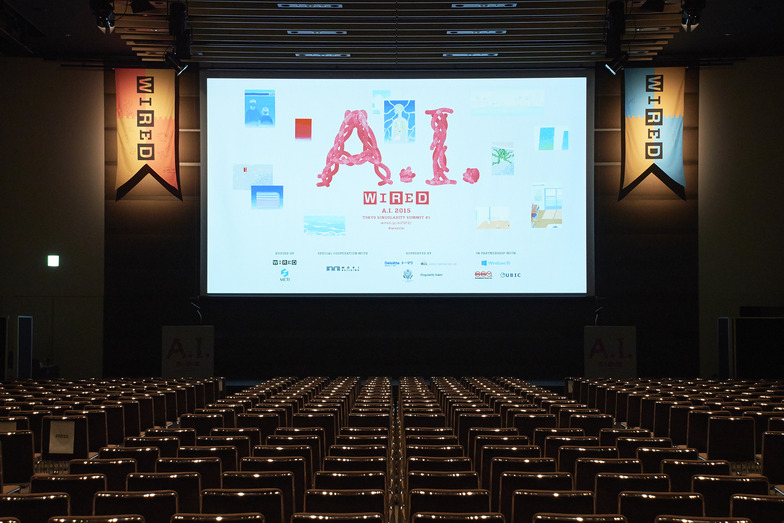
Continuing from last time, I report from "WIRED A.I. 2015 ~ TOKYO Singularity Summit #1".
"Human-Like AI: Inherent Risks and Safety" (Yuji Ichisugi, Artificial Intelligence Research Center, National Institute of Advanced Industrial Science and Technology)
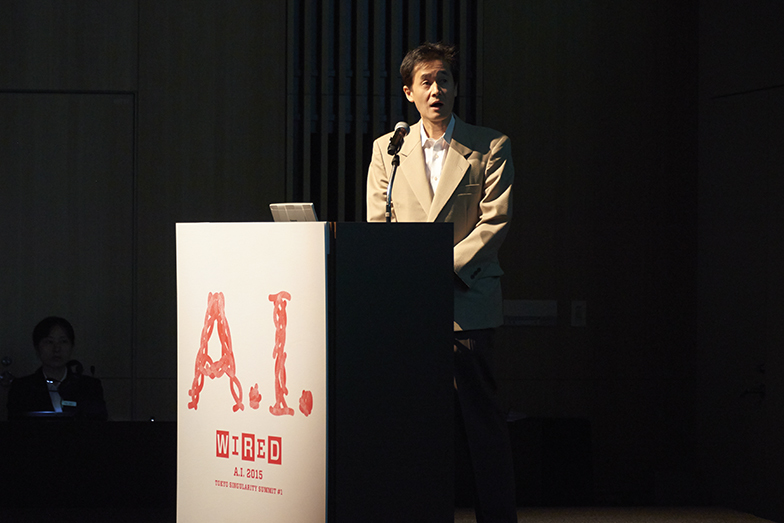
Dr. Ichisugi is a Principal Researcher in the Brain-inspired Artificial Intelligence Research Team at the National Institute of Advanced Industrial Science and Technology Artificial Intelligence Research Center (AIRC), which was also introduced in Dr. Matsuda's presentation.
AIRC, established this past May, aims to form a platform for AI research by gathering top-tier talent scattered across domestic and international universities and research institutions.
Participating as visiting researchers are Hiroshi Yamakawa of Dwango (previously introduced), Yutaka Matsuo of the University of Tokyo, and Ryutaro Ichise of the National Institute of Informatics.
As mentioned previously, the "SIG-AGI Founding Symposium" was held the following morning. Later that same afternoon, the "AIST Artificial Intelligence Research Center Founding Symposium" took place (venue: Nikkei Hall). These two days thus saw a concentration of major AI-related events.
Mr. Ichisugi's research goal is to create "human-like AI"—machines possessing human-like intelligence—by mimicking the brain through "brain reverse engineering" (reproducing the brain's mechanisms on a computer).
He explained that advances in computational neuroscience have significantly increased our understanding of the brain, and deep learning represents a successful engineering application of this knowledge.
Contrary to common misconceptions, the brain is a very ordinary information processing device. While more complex than organs like the heart, it is surprisingly simple. For example, the cerebral cortex, which governs various higher-order functions like perception, decision-making, motor control, thinking, reasoning, and language comprehension, is realized by a network of only about 50 distinct regions.
Based on the hypothesis that this cerebral cortex is a massive Bayesian network (a type of probabilistic inference model) sharing the same structure as deep learning, Professor Hitotsugi developed an algorithm called "BESOM."
Furthermore, regarding the societal impact when humanoid AI is realized, he stated that highly intelligent robots assisting labor would infinitely increase human labor productivity. If wealth redistribution is properly implemented and resource constraints are resolved, humanity could achieve infinite prosperity.
While human-like AI represents a research field that could bring immense benefits to humanity if realized, two challenges were identified: "unraveling the brain's algorithms" and "reducing computational costs."
Furthermore, as the theme indicates, AI carries risks that must be considered across short-, medium-, and long-term horizons.
In the short term, AI is merely a tool, so its extinction of humanity is inconceivable. However, risks exist from its misuse in AI weapons or crime. Furthermore, the risk lies not with AI itself but with humans using it as a tool, such as someone using AI to dominate the world.
In the medium term, as AI surpasses human intelligence, increased convenience comes with heightened potential dangers. Runaway AI could potentially disable all safety measures itself. Long-term discussions touched on whether AI could become humanity's successor after human degeneration or extinction. However, artificial entities lack the resilience of living organisms and are highly likely to perish. Since AI cannot be relied upon as a successor, humanity must continue to master and utilize AI.
"The Impact of Pre-Singularity" (PEZY Computing, Motoaki Saito)
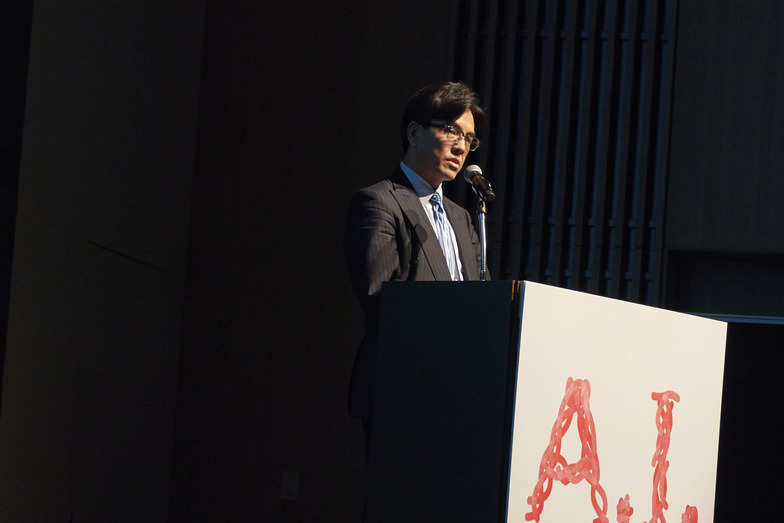
Mr. Saito develops supercomputers, and Mr. Matsuda places great expectations on them as hardware for Japan's "turning the tables."
According to Matsuda's introduction, astonishingly, PEZY Computing developed a supercomputer in just 11 months last year (the first unit in 7 months, the second in 4 months) and swept the top three spots on the Green500 ranking (which measures performance per watt, not absolute performance).
Furthermore, he stated that with sufficient funding, a computer 100 times faster than the "K computer" (exascale) could be built within five years (by 2020).
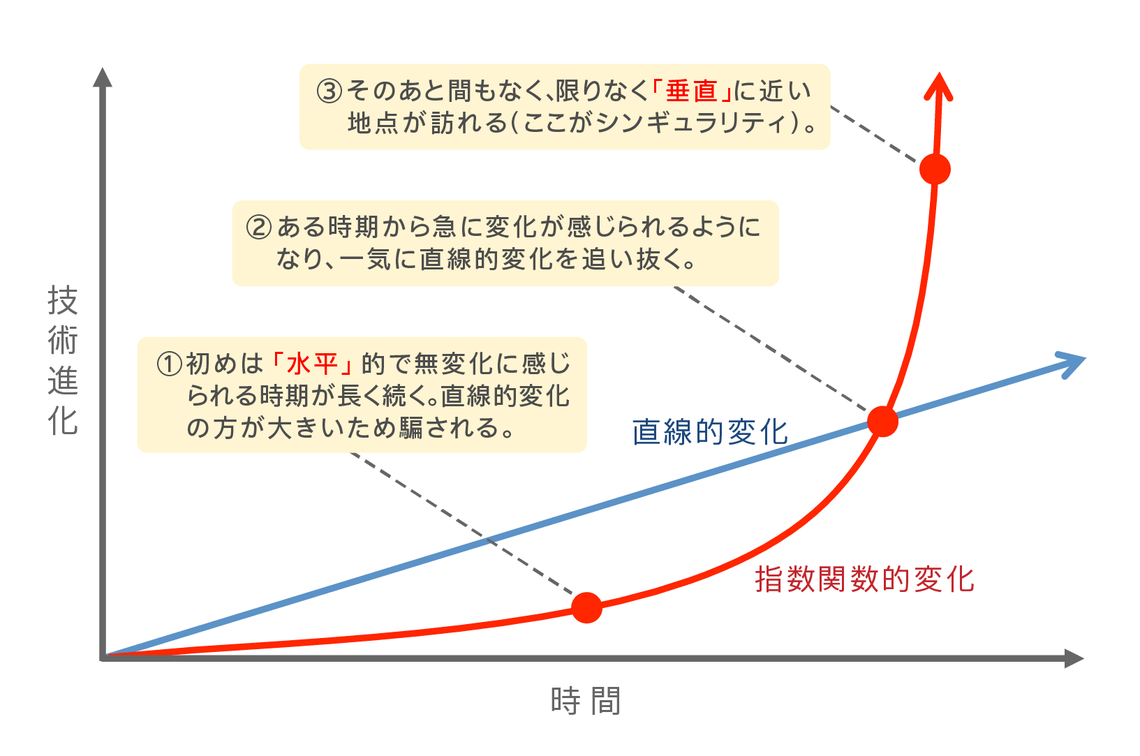
Mr. Saito began his career as a radiologist and has been involved in complex hardware development for 20 years. From this developer's perspective, he reaffirmed the "Law of Accelerating Returns" (mentioned earlier). He noted that compared to the world's first microprocessor in 1971 (the Intel 4004), performance had increased by a factor of one trillion by 2011. At this pace, it would reach a factor of 1,126 trillion by 2021.
Mr. Saito refers to the world that will emerge within the next decade, driven by next-generation supercomputers born from this evolution, as the "Pre-Singularity." He stated that, taken to the extreme, an era will arrive where "a nation's power equals the capability of its supercomputers."
He predicted that in this pre-singularity era, science, technology, and information technology would advance to their ultimate limits, productivity would increase infinitely, and medicine would evolve dramatically, liberating humans from all problems of living.
As a sign of this new world, he pointed to Artificial General Intelligence (AGI). Like next-generation supercomputers, AGI will be extremely powerful and versatile, making "national power = AGI performance."
If we define the capability of one human as "1H," the goal is to achieve 1H at the same scale (size) as a human. However, from the perspective of current computer technology, this represents an immense performance leap, requiring entirely new implementation techniques.
However, development is currently underway utilizing technologies such as "magnetic coupling" from Keio University's Kuroda Laboratory and "ultra-thin semiconductor wafer fabrication" from DISCO Corporation and Tokyo Institute of Technology's Oba Laboratory.
All technologies employed are Japanese-developed, enabling benefits from semiconductor scaling that significantly surpass Moore's Law.
Theoretically, it will be possible to pack the equivalent functionality of 1H-scale neurons and synapses into a volume of 800 cubic centimeters—smaller than a 10-centimeter cube.
Finally, they announced the launch of a new skunkworks project, "Project N.I." (N stands for New, Next, Nippon, Neuro, etc., and I stands for Intelligence), aimed at surpassing numerous leading Western projects through Japan's unique hardware and software development. They are now widely recruiting talented and conscientious developers.
"For Japan to Become an AI Advanced Nation" (Yutaka Matsuo, University of Tokyo, et al.)
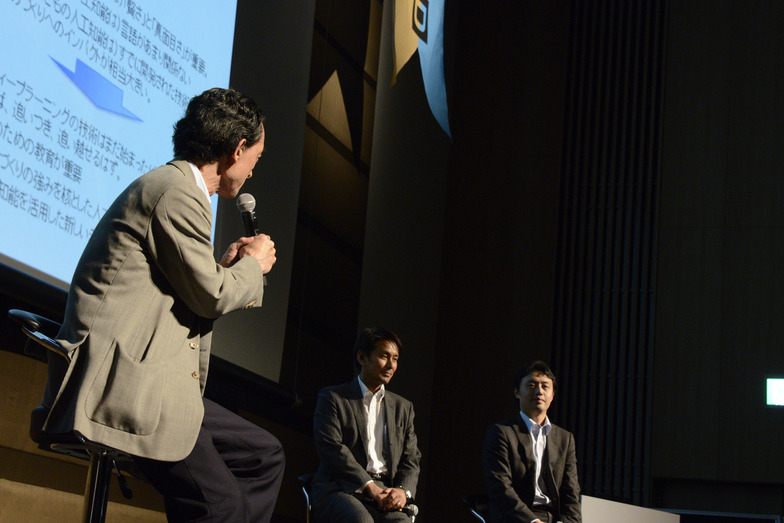
Although the order is reversed here, immediately before Mr. Saito's lecture, a session was held featuring editor Mr. Katsura Hattori, Mr. Hiroo Inoue from the Ministry of Economy, Trade and Industry, and Professor Yutaka Matsuo from the University of Tokyo.
As this session comprehensively discussed industrial approaches to AI, we summarize Matsuo's presentation as part of the seminar report.
Professor Matsuo, who currently gives lectures on deep learning in various formats, first noted the dramatic improvement in image recognition accuracy over the past few years.
As introduced by Mr. Yamakawa as "Moravec's Paradox," tasks that children can do are often the hardest for AI to perform, while tasks for adults or experts are relatively easier.
Amidst this context, image recognition is precisely such a simple task that even children can do, yet computers struggled with it for decades, showing little improvement in accuracy.
However, in February 2015, Microsoft achieved an error rate of 4.9% compared to humans' 5.1%, and in March, Google reached 4.8%, meaning computers surpassed humans in image recognition at least.
The next advancement is expected to be improvements in the motor skills of robots and machines. In May 2015, research was published at the University of California, Berkeley, showing that robots gradually become more skilled and proficient in their actions through trial and error.
The reason such improvements in motor skills weren't possible before, despite not requiring advanced intelligence, was due to an inability to correctly recognize situations. It is said that from now on, deep learning will enhance the motor skills of machines and robots.
According to Dr. Matsuo, it is better to distinguish between "adult AI" and "child AI."
"Adult AI" refers to systems that, when fed data and programmed by humans to process that data, can exhibit seemingly intelligent behavior. "Child AI" refers to systems that recognize images or improve their actions.
The distinction between the two stems from differing strategies. For "adult AI," data collection is crucial, making it a world where Google and Amazon hold strong positions, and Japan faces significant challenges in overtaking them.
On the other hand, he stated that "child AI" is well-suited for labor-intensive industries like manufacturing, construction, agriculture, and food processing, presenting opportunities for Japanese companies.
Looking at it by industry, "adult AI" is primarily used in sales, marketing, and advertising, with a market size of about 6 trillion yen in Japan and around 15 trillion yen in the US. However, "child AI" applied to "manufacturing" involves creating and selling products, moving money on a vastly larger scale. Therefore, enhancing the added value in this area is likely a bigger market.
Summary
Finally, after participating in events hosted by WIRED, the General-Purpose AI Research Association, and AIST over two days, I observed that references to advertising and marketing were scarce, and when mentioned, they were often within the context of U.S.-based platform companies.
Regarding advertising, while AI-driven innovation has already occurred, it is largely monopolized by US platform companies, leaving the advertising industry on the sidelines.
Furthermore, as mentioned in Dr. Matsuo's final lecture, while Japan's focus for AI application is shifting toward "manufacturing," is that truly sufficient?
I initially wrote that "the true threat of singularity might lie in the grandeur of the hypothesis and the strength of its verification power." It became clear that Japan's AI industry has already embarked on a significant journey toward the hypothesis of "whole-brain architecture."
In this context, perhaps Japan's advertising and media industries are in need of a grand hypothesis comparable to the Singularity or Whole Brain Architecture.

Was this article helpful?
Share this article


Newsletter registration is here
We select and publish important news every day
For inquiries about this article
Back Numbers
Author
Nitō Fumi
Dentsu Inc.
Business Development & Activation Division