Note: This website was automatically translated, so some terms or nuances may not be completely accurate.
 The Reality of Being 18 [5/5]
What kind of adults can today's youth trust?
With the voting age lowered to 18 and societal focus intensifying on youth centered around this age, a question arises: Is there a barrier of misunderstanding between "18-year-olds (young people)" and "adults and society"?
DENTSU SOKEN INC.'s 'Project18' conducted dialogues with high school students participating in 'My Project'*provided by the certified NPO Katariba, which conducts career education activities. Continuing from the previous installment, we delve into the real lives of high school students and explore the new values they hold.
*My Project is a project-based learning (PBL) program where high school students learn by launching and executing their own projects to solve issues in their immediate surroundings.
Project18 × High School Student: Kina's Case
The young person interviewed this time is Kina (female, pseudonym).
In My Project, she is leading an initiative primarily involving elementary, junior high, and high school students. Their goal is to revitalize the community of Hinase Town in Okayama Prefecture, where she was born and raised, and to promote intergenerational exchange. They are doing this by growing vegetables called "Ama Vege" using natural fertilizer made from local specialties: eelgrass (a type of seaweed) and oyster shells. Her project won the High School Student Special Award at the National High School My Project Awards.
Here, we introduce three clues discovered through our interview with Kina-san that connect to the "values of a new era."
Findings①
There's no need to limit yourself just because you're a high school student
When asked, "Why did you join My Project?", Kina answered:
"Seeing everyone around me working hard on club activities made me think, 'I want to do something too, but can I really do it?' Around that time, I talked to a friend I met through 'Life is Tech!'* in Tokyo. She said, 'Lots of high schoolers are participating in this thing called My Project, so why don't you give it a try, Kina?' I'd always had this desire to invigorate Nissei Town in the back of my mind, and now I'd found the framework of My Project, so I decided to go for it.
This might be a tangent, but honestly, since I was little, the question 'What do you want to be when you grow up?' has always been my least favorite. That's because I've always been the type who can handle most things reasonably well. So, if I'm placed somewhere, I'm confident I can enjoy it to the fullest. I think I can make the best use of myself when given a defined role."
※Life is Tech!: An IT camp and school for middle and high school students to learn programming, app development, design, game development, and more.
What's noteworthy is how she found a framework where she could thrive through advice from peers her own age. Building on the affirmation that "high schoolers can do all sorts of things," seeing other motivated teens her age succeeding pushed her beyond the self-imposed limits of "what high schoolers can do," allowing her to spread her wings.
Adults sometimes tend to think, "Let's prepare a framework where high school students can thrive." Indeed, as Kina herself stated, "It's okay for high schoolers to do this," she too carried the framework of "high school student." However, they need frameworks that allow them to engage more deeply with society at times and spread their wings even wider. It's crucial for adults not to define them, but to help expand their possibilities.
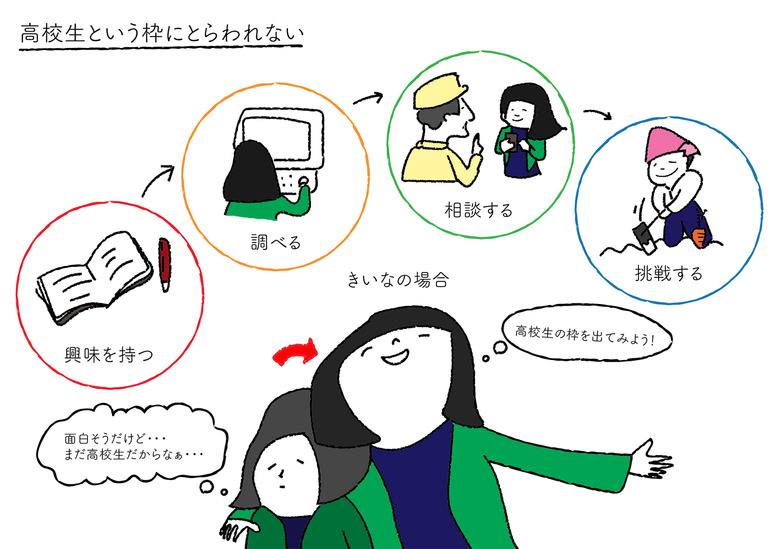
Illustration: Yohei Kawabe
Findings②
What's Needed Are Adults Who Offer "Opinions," Not "Rejection"
Many My Project initiatives involve adults who support the students. We asked, "What do you do when adults don't agree with your activities or reject them?"
"For my project, I needed to rent a field to grow vegetables. When I went with my mom to talk to a farmer, he initially didn't even look at me and just talked to my mom. I felt like he was dismissing me, thinking 'she's just a high schooler.' But when it was my turn to speak and I clearly explained my thoughts, it seemed to click for him. After that, we were able to rent the field smoothly.
Honestly, I actually like negative opinions. From my experience, people who just shower me with praise often haven't really looked at what I've done or the substance of my work. Even with negative opinions, I can tell whether someone is just being mean or if they've genuinely looked at the project and are giving me tough feedback. That's why I want to associate with people who give me good feedback, even if it's harsh."
News reports often say today's youth aren't used to being criticized or scolded. But they're actually very perceptive about whether adults' criticism or scolding comes from genuinely engaging with them. This is symbolized by Kina's words: "I felt like I was being looked down on, like 'You're just a high schooler anyway.'"
They dislike being dismissed not as individuals, but simply because they're "high schoolers." If criticism is directed sincerely at them as individuals, rather than at the label "high schooler," it becomes constructive feedback. They will sincerely engage with adults who offer opinions with their best interests in mind. Adults tend to lump them together as "high schoolers" or "young people," but it's crucial to remember that each person standing before you is a unique individual.
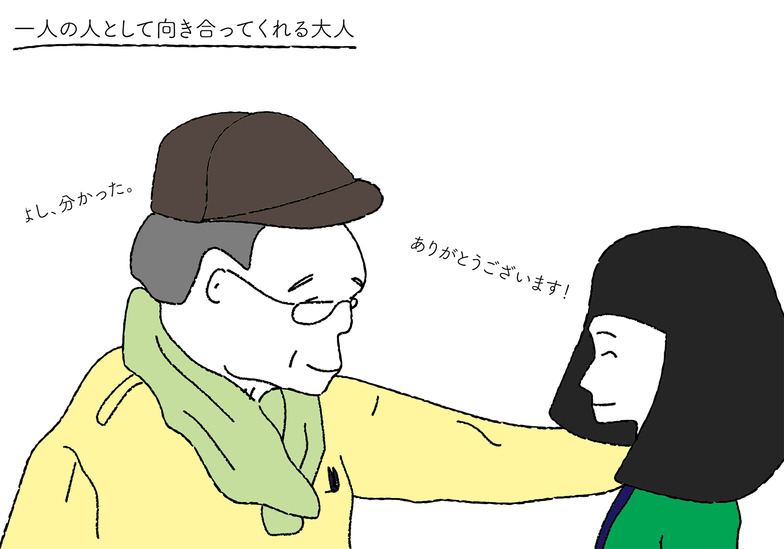
Illustration: Yohei Kawabe
Findings③
They prefer adults who genuinely enjoy things, not just for appearances
Kina also has a clear distinction between adults she finds cool and those she doesn't.
"The adult I respect is my mother. She told us, 'I don't have much education and only grew up in a small environment,' but she introduced us to all kinds of people and took us to all sorts of places. I respect my mother for her immense human strength, which sharpened my senses. Above all, she herself enjoys (daily life) the most.
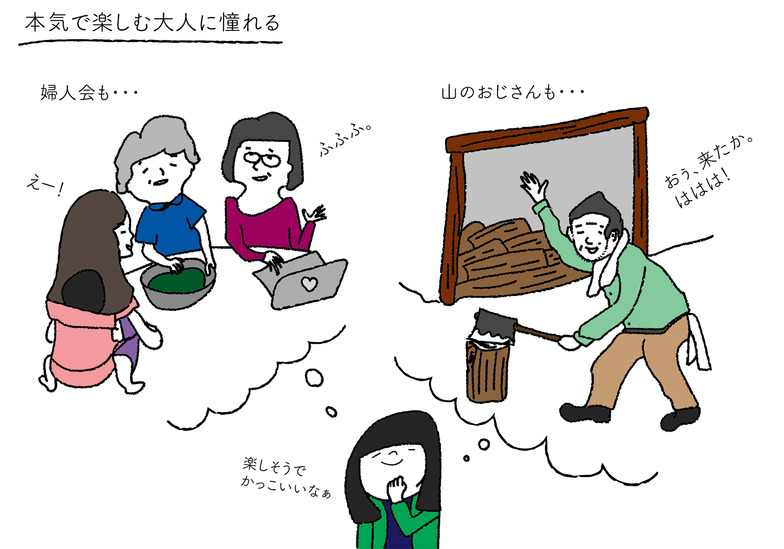
I think truly cool adults aren't defined by money or status, but by 'people who are enjoying themselves to the fullest wherever they are.' I've met people living rich lives in Tokyo, but I think the old man living in the mountains seems to be enjoying life more, and I think that's cool."
Kina-san attended her local women's association meetings with her grandmother from a young age. She even says her dream is "to join the women's association." That's because the people participating in the association seemed to be having fun. Having seen adults close to her genuinely enjoying their activities up close, she is naturally drawn to adults who are truly having fun. She also throws herself wholeheartedly into activities she wants to do and genuinely enjoys them.
How many adults are actually aware that children are watching them, observing whether they seem to be enjoying themselves? But it's clear she's been positively influenced by adults who live authentically and joyfully. Her perception that "people who are having the best time possible right where they are" are truly cool adults actually teaches us a lot. She reminds us of the importance of being someone children can look up to without shame.
Summary
We introduced three findings, but what became clear this time is "the emergence of new values that easily shatter underlying assumptions."
・They possess a lightness that allows them to overcome assumptions—almost like preconceptions—about how high schoolers "should" be, with just one remark from a peer.
・They don't simply react against negative comments; they can recognize that even if it's negative, if it's an opinion, it's something important to them.
・They can judge people based on the essence of "whether they are enjoying themselves," rather than the value that having money or status is what makes someone cool.
Her sensibilities can swiftly dismantle the various established theories and assumptions built by older generations and society, becoming a key to flexibly constructing forms suited to the coming era.
Eighteen-year-olds (young people) effortlessly transcend the sensibilities adults have become fixated on or forgotten. Engaging with "18-year-olds (young people)" not only helps us understand them but also offers adults valuable insights. Project18 will continue to delve into the realities of 18-year-olds (young people).
Was this article helpful?
Share this article


Newsletter registration is here
We select and publish important news every day
For inquiries about this article
Back Numbers
Author

Rei Nagi
Dentsu Inc.
Media Services / Radio,TV Division
Producer
Everything About WakamonA society where both people and pets are happy.The Reality of Being 18If you understand young people, you can see the future ~ Commemorative Series for the Release of "The Youth Divide" ~Get the U-turn candidates moving!"Flat Management"—What Management Thinking Do Future Leaders Need?