
Note: This website was automatically translated, so some terms or nuances may not be completely accurate.
 How Business Designers Create Breakthroughs [1/5]
Business Design for Creating a Future Worth Loving
Akihito Kunimi
Dentsu Inc.
Dentsu Inc. has launched a specialized organization within the company, "Dentsu Business Design Square," dedicated to creating innovation for client companies. In this series, members will explain "What Dentsu Inc. Considers Business Design to Be."
In the first installment, leader Akihito Kunimi discusses what Dentsu Business Design Square is and what value it can provide.
Table of Contents
▼Businesses Can't Survive by Doing the Same Things Over and Over
▼ Solving the challenge of "the disconnect between corporate purpose and society"
▼ Customized, meticulously designed approaches drive significant corporate growth
▼Dentsu Inc. Business Design Square's Seven Service Lines
▼Business design expertise and talent converge
Businesses can no longer survive by doing the same things they always have
The term "business design" is now heard everywhere. However, the concept of "business design" has existed since business first emerged in the world; it is neither new nor a passing trend.
So why has the term "Business Design" suddenly surged into prominence recently?
I believe it's because the era where simply spinning up existing systems at high speed ensured smooth business operations has ended, due to the impacts of digitalization and globalization. Doing the same things as before is no longer sustainable. Companies now need to fundamentally tune up their existing businesses, or even launch new businesses alongside their existing ones.
However, when companies raise the banner to launch new ventures, they often realize they haven't built the capacity to create new systems. This leads to unprecedented challenges: "We need to successfully launch new ventures that breathe fresh life into the company," "We must overhaul our employee training systems," or "We need to fundamentally transform how we manage the business." It's this proliferation of new challenges that has made "business design" a hot topic.
So, what exactly is "business design"?
I define "business design" as "identifying the essential challenges that need solving, using the appropriate methods to solve them, and bringing the solution to fruition."
↑Back to Table of Contents
Solving the Challenge of "The Disconnect Between a Company's Purpose and Society"
When you get down to it, the essence of business is its purpose within society. Restaurants exist because some people don't have the time or energy left to cook a delicious meal when they get home. Taxis exist because they allow you to move quickly when you think you'll be late for an appointment. However, businesses that lose their purpose within society may survive for a few years, but it becomes difficult to sustain them long-term.
Knowledge has become widely circulated in the business world, permeating companies with so-called expertise and know-how. This is wonderful. On the other hand, it's also true that we've become prone to being swept along by knowledge. Knowledge is the accumulation of wisdom, a shared asset, and often follows in someone else's footsteps. When considering corporate challenges, we often hear isolated statements like "we must enhance product strength" or "we must expand distribution channels." Certainly, such knowledge and thinking about the value chain are not entirely to be dismissed.
But what if, at a layer even higher than the value chain, the company's raison d'être is beginning to diverge from society? The challenge lies at a more fundamental level. The perspective is: What is the company's raison d'être, and what is hindering that raison d'être? Every business originates from a social raison d'être.
This is where my core thinking lies.
Where is the brand going? This is the very title of painter Gauguin's masterpiece, "Where Do We Come From? What Are We? Where Are We Going?" – a very simple question. When engaging with clients, I thoroughly consider these three points each time and design their future with my own clear "answer."
↑Back to Table of Contents
Only individually customized and thoroughly considered methods can significantly grow a company.
Whether redefining a company's raison d'être or creating new ventures, we always think about the "future." Generating profit or ensuring survival are merely means; the true purpose should be "creating a better future" and "bringing happiness to people." That's why we engage with clients, driven by the fundamental purpose of "creating a future worth loving."
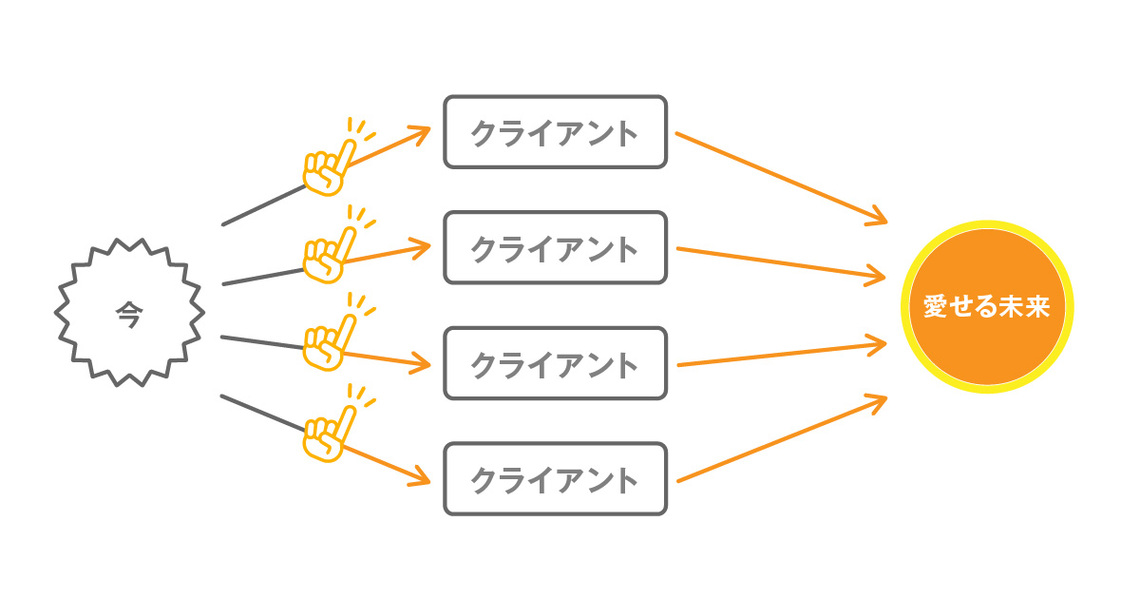
In business design, there is no one-size-fits-all approach suitable for every company. This is because, even within the same industry, each company's purpose within society is unique. That's why we often hear that simply replicating another company's success doesn't yield the same results. Only individually customized and thoroughly considered methods can significantly grow a company.
While entirely new thinking and ideas spark wild imaginings and swelling expectations, they also inevitably bring anxiety and perceived risk. This is precisely why we often settle for more realistic ideas, finding conclusions somewhere midway between the boldest concept and current reality. Consequently, we end up moving toward a future that remains within the bounds of our imagination.
The term "innovation dilemma" is often used. To avoid this, we must elevate the level of our ideas, acquire the skills to validate their validity, and develop ideas that overcome internal obstacles and build networks necessary for feasibility.
↑Back to Table of Contents
Dentsu Inc. Business Design Square's Seven Service Lines
Dentsu Inc. Business Design Square offers seven service lines.
1.VISIONEERING: Finding Your North Star
We redefine a company's raison d'être. This definition also extends to layers like new business creation. Whether for the company, its business, or internal reform, it becomes an essential process for ensuring lasting value in society. This is not merely defining a VISION in words. As the coined term VISION and ENGINEERING implies, we logically design it while calculating the impact the VISION will have.
2.OPPORTUNITY FINDING: Creating Innovative Opportunities
We concretely define the opportunities that can be gained when heading toward the set North Star. For example, if we redefine a company's raison d'être, we identify innovative opportunities to generate revenue while enhancing social value. This includes specific ideas for new businesses born from that new definition, perspectives for reevaluating current businesses, and other such ideas.
3.INTEGRATED DESIGN: Performing Integrated Design
This process concretizes how to develop the identified opportunities. For new ventures, we translate the core idea into a visible format—from product design or service design forming the business's core, to role definition within new channels and spatial design if those channels are involved.
4.BUSINESS FRAMING: Creating Launch and Growth Models
We translate the ideas—now integrated, designed, and elevated to a state where their potential is fully apparent—into a business model. We build a business model that is immediately launchable and capable of charting a growth curve, while strategically storytelling the elements requiring decision-making. This process demands advanced expertise in selecting elements, crafting the narrative, and choosing the model.
5.DEEP PROTOTYPE: Validating with Prototypes
We verify whether the designed business will truly be accepted by the market. By transforming the idea into a tangible or visible form, we test whether it can be made genuinely compelling. We also rigorously check how the idea will be evaluated in the market, continuing until we gain full confidence in it.
6.FUTURE ANALYSIS: Analyzing the Future
We verify how much revenue and profit the confirmed idea can generate. We clarify the business structure and quantify the idea based on calculations for various scenarios. This provides critical decision-making criteria for final management decisions.
7.SHERPARING: Supporting Execution
Even ideas that reach final decision often face unexpected hurdles before realization. SHERPARING is a term we coined from SHERPA. Like the Sherpas who carry heavy loads as unsung heroes and share the summit climb on Everest, we think alongside you, sweat alongside you, and accompany you right up to the final moment of realization.
↑Back to Table of Contents
Business Design Expertise and Talent Gathered
Dentsu Inc. Business Design Square brings together expertise and talent in business design from Dentsu Inc., the Dentsu Group, and companies with business partnerships with Dentsu Inc.
We deploy diverse professionals including strategists, business architects, product designers, graphic designers, copywriters, photographers, technologists, finance managers, decision managers, analysts, and project managers.
Our organization was born as a specialized unit that provides one-stop solutions for both Art (Creativity) and Science (Logic), serving as a place where these two elements converge.
Creativity alone leaves logic uncertain. Logic alone never materializes. Both are essential for management and business. We believe that only by continuously designing the social significance of a company or business from both creativity and logic can we open up a "future worth loving."
↑Back to Table of Contents
Was this article helpful?
Share this article


Newsletter registration is here
We select and publish important news every day
For inquiries about this article
Author
Akihito Kunimi
Dentsu Inc.
Dentsu Inc. Business Design Square
Executive Creative Director