Note: This website was automatically translated, so some terms or nuances may not be completely accurate.
 How Business Designers Create Breakthroughs [2/5]
Resolving Business Uncertainty Through Prototyping
Dentsu Inc. has launched 'Dentsu Business Design Square,' an organization dedicated to creating innovation for client companies. This series will have members explain "What Dentsu Inc. Considers Business Design to Be." In the second installment, business designer Masahiko Sakamaki discusses prototyping.
*Prototyping: A development method where a functional prototype is created early on. Users test its features and usability, and their feedback is incorporated into the development process.
【Table of Contents】
▼Products where functional differentiation is difficult and services with low barriers to entry require differentiation through experiential value
▼Avoiding "It was the best idea, but it's not interesting when actually built" through prototyping
▼Break down prototypes into three distinct components
▼Prototyping to generate entirely new outputs
▼Tackling the dilemma of business innovation and uncertainty through prototyping
Products and services need differentiation through experiential value
Hello, I'm Sakamaki, a business designer. I previously served as a department head overseeing product planning and design at an electronic musical instrument manufacturer. I joined Dentsu Inc. Business Design Square to leverage that expertise.
How can prototyping benefit today's businesses?
Products where functional differentiation is difficult and services with low barriers to entry require differentiation through experiential value. Prototyping expertise is essential for designing this experiential value.
In this article, I'll discuss the importance of prototyping based on my experience.
↑Back to Table of Contents
Avoiding "It was the best idea, but it's not interesting when actually made" with prototypes
I tend to worry a bit. Even when a brilliant idea emerges from my left and right brain working overtime, I doubt it, thinking, "Is this really a good idea?" and immediately want to prototype it. This stems from my unfortunate experience designing musical instruments: "It was the best idea, but when actually made, it wasn't fun." Why do ideas turn out disappointing? Because musical instruments are all about experiential value.
Products focused on functions and specs can succeed even if their experiential value, like "feel," is lacking, as long as they deliver the functional value needed to fulfill their purpose. But for instruments, the "feel" when playing is everything. If an instrument can't provide that experiential value of "feel," it simply doesn't work as a product.
For smooth product development, clearly defining specifications early is essential. This naturally shifts the focus to function value, which is easier to define logically, while the ambiguous, hard-to-articulate experiential value gets overlooked. The result is a product lacking the core experiential value that defines an instrument—leading to that "great idea that turned out boring when built" scenario.
To maximize experiential value while smoothly developing the electronic device, we must evaluate and improve it through repeated prototyping starting from the idea stage. Repeating this process has significantly elevated our prototyping skills.
↑Back to Table of Contents
Break Prototyping Down into Three Parts
Prototyping is a labor-intensive process. Striving for perfection can make it approach the real thing. But if you build the real thing, it's no longer a prototype. You must identify what needs verification and execute appropriately.
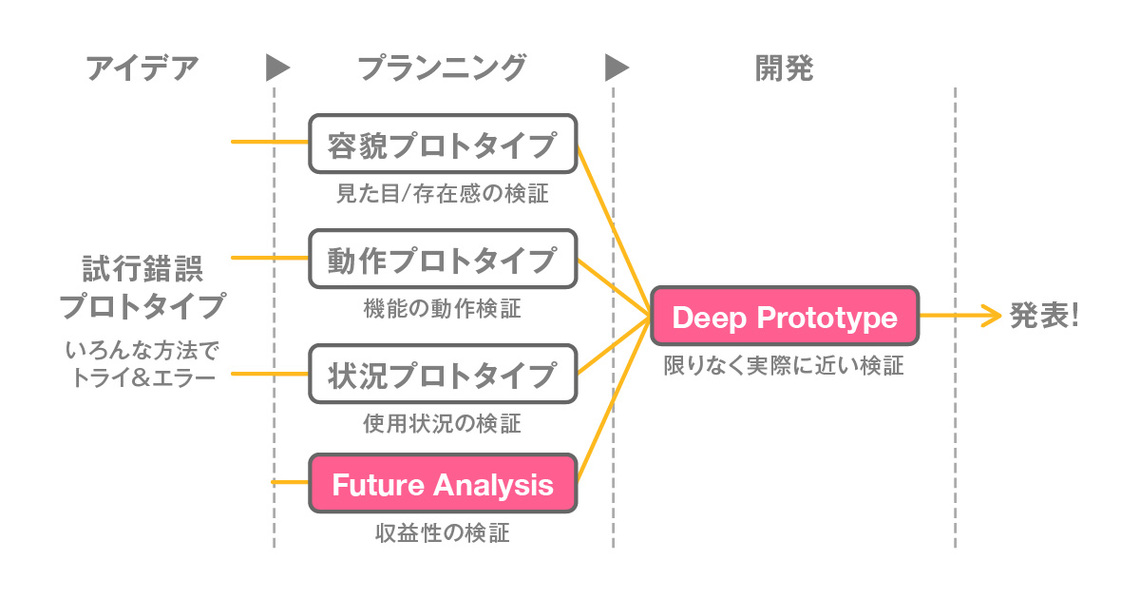
When the subject is a product/service, it is effective to break it down into the following three prototypes:
1. Appearance Prototype
2. Behavior Prototype
3. Situation Prototype Each is explained below.
1.Appearance Prototype
The Appearance Prototype is a prototype for verifying visual aspects. It is used to verify the presence and impact of the product/service when it becomes a reality. For simple evaluations, hand-drawn sketches may suffice. For more thorough verification, mockups using the same materials and finishes as the actual product can be created. For web services/applications, creating just a few key screens is often sufficient.
2.Functional Prototype
A functional prototype is used to verify how features operate. For products, this can be done virtually using software. Creating prototypes that closely mimic actual operation, which often involves electronic circuit design, has become considerably easier thanks to systems like "Arduino," which provide integrated hardware and software development environments. In web service/application development, creating paper prototypes of screen transitions also serves as a functional prototype. Moreover, powerful tools that can prototype both appearance and functionality simultaneously are readily available.
*Paper prototyping: Creating a simple mockup on paper of an app or website's screen transitions and layout.
3.Context Prototyping
Contextual prototyping is a method that recreates the usage context of a product or service. Role-playing techniques, where participants act as if using the product, can be easily conducted anytime, anywhere. Using prototypes that replicate appearance and functionality allows for verification in more realistic scenarios.
Any product or service can be broken down into appearance, behavior, and context. Decomposing these elements and clearly defining what needs to be verified for each enables appropriate and efficient prototyping. Dentsu Inc. Business Design Square utilizes prototyping not only for appearance, behavior, and context, but also for ideation and business purposes.
↑Back to Table of Contents
Prototyping to Generate Completely New Outputs
In my part-time design workshop at Chiba University, I conducted an experimental class applying prototyping. The approach was "Prototype first, before discovering the concept."
Typically, about half the time was spent finding a good concept, followed by designing a rough form and presenting it. Perhaps because it's a design department within an engineering faculty, students are skilled at building logic. However, many proposals felt like just adding a story to a simple idea—something you've heard before—and I was frustrated they rarely produced truly breakthrough outputs.
They're still young, and inevitably, their perspective is narrow, making it hard for them to find good concepts. In other words, they simply lack knowledge and experience. We used prototyping as a way to acquire that quickly.
Even if the concept seemed ordinary or uninteresting, I had them start with a prototype. Then, every week, I had them present the discoveries they made through that prototype in front of everyone.
What I repeatedly emphasized in every class was: "Through prototyping, I want you to make discoveries only you can make." By repeatedly prototyping around specific things, experience accumulates. Then, you start making discoveries you wouldn't have noticed initially. Building concepts based on those discoveries and translating them into products led to entirely new outputs.
Actually, this approach has its origins.
I got the idea during a conversation with Associate Professor Charlie Cannon, the head of the Industrial Design program, when I visited the Rhode Island School of Design, a traditional American design school, this past April.
"At the Rhode Island School of Design, we teach craft for innovation."
I was genuinely astonished to learn that this institution—dubbed "the Harvard of art schools," where Airbnb's founders studied and John Maeda called it "MIT's right brain"—teaches comprehensive craftsmanship covering both woodworking and metalworking for four hours a day, year-round. Honestly, I wondered why they felt the need to teach craftsmanship now.
Hearing Associate Professor Charlie Cannon explain it in detail made me truly understand the importance of craft. Craft is a continuous process of trial and error. Materials like wood and metal change shape with every cut, shave, or bend. Sometimes it turns out as expected; sometimes it doesn't. Craft is about rapidly repeating ideation and prototyping over and over.
"Future challenges lie before us like a sheet of metal. Do you see it as just a sheet of metal, or do you see it as something to create something new? That ability to think is the defining characteristic and strength of the students at the Rhode Island School of Design."
Learning to iterate through trial and error in craft, and gaining new insights empirically from that process, is the Rhode Island School of Design approach to craft education.
↑Back to Table of Contents
Tackling the Dilemma of Business Innovation and Uncertainty Through Prototyping
In today's world where identifying clear problems is difficult, an approach like Rhode Island School of Design's—finding problems and solutions through trial and error—is effective. Design thinking is the concept that broadens this approach for business application.
The more advanced the discovered challenge and the product/service solving it, the higher the uncertainty. Ideas innovative enough to surpass existing businesses inevitably carry significant uncertainty—this is the essence of the innovation dilemma.
What surprised me most upon joining Dentsu Inc. Business Design Square was their approach to tackling the dilemma of business advancement and uncertainty through prototyping. This represents a new form of prototyping that goes beyond creating tangible prototypes to include rigorous testing of intangible elements like revenue projections.
We validate and execute businesses built with Dentsu Inc.'s creativity and logic using the ultimate prototype. A new form of prototyping, worthy of the name "business design," is beginning.
↑Back to Table of Contents
Was this article helpful?
Share this article


Newsletter registration is here
We select and publish important news every day
For inquiries about this article
Author

Masahiko Sakamaki
Dentsu Inc.
Dentsu Inc. Business Design Square
Business Designer / Product Designer