Note: This website was automatically translated, so some terms or nuances may not be completely accurate.
 How Business Designers Create Breakthroughs [3/5]
The diverse array of business designers reflecting society's challenges
Dentsu Inc. has launched 'Business Design Square,' an organization dedicated to creating innovation for client companies. This series will explore "What Dentsu Inc. Envisions as Business Design" through its members. This installment features Business Designer Haru Ushikubo discussing the strengths of Dentsu Business Design Square, where diverse professionals converge.
[Table of Contents]
▼Dentsu Inc. Business Design Square as a Gathering Place
▼Synergy Emerges Through Developing Common Language Modules
▼The Era of Relying Solely on Logic or Intuition is Over
▼Simultaneous Right-Brain/Left-Brain Engagement as Dentsu Inc.'s Default Culture
Dentsu Inc. Business Design Square as a Gathering Place
Nice to meet you. I'm Haru Ushikubo, a business designer. This time, I'll talk about the people gathered at Dentsu Inc. Business Design Square.
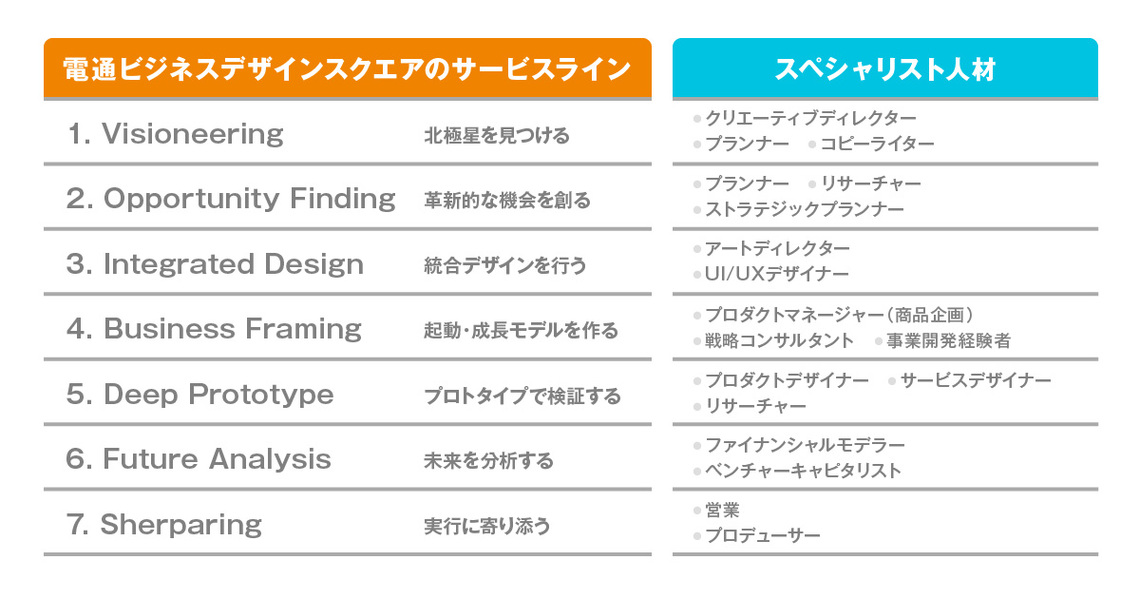
As you might sense from the background of Masahiko Sakamaki, who wrote the previous article, Dentsu Inc. Business Design Square is filled with many individuals possessing highly specialized skills and backgrounds, making it an organization akin to Liangshan Marsh. Alongside members who honed their expertise at Dentsu Inc. since joining as new graduates, the proportion of mid-career hires is relatively high. This blends well with Dentsu Inc.'s original culture, fostering a unique approach to business design.
The backgrounds of these mid-career hires are diverse: product designers, trading companies, investment funds, editors, writers, SIers (system integrators), securities firms, and more. Each has excelled in their respective industries and roles. I myself am a mid-career hire, having worked in content development (editing/writing), product planning at a manufacturer, strategic consulting, and then as a freelance planner.
↑Back to Table of Contents
Synergy Emerges Through Developing Common Language Modules
One might assume that an organization bringing together people from diverse backgrounds risks lacking a common language and becoming siloed. However, regarding the members of Dentsu Inc. Business Design Square, while each is an expert in a specific domain, they are also individuals seeking challenges in cross-functional, complex problems. This fosters a strong communication-oriented mindset among members and cultivates an organizational culture where synergy naturally occurs.
Furthermore, to prevent solutions born from synergy becoming one-off measures or tacit knowledge, resources are allocated to organizing and cataloging them as versatile modules and menus. Since these aren't simplistic templates, the process of creating them involves extensive discussion and insights, further deepening mutual understanding.
So, why are we gathering such members? And why do they gather? I'll explain that next.
↑Back to Table of Contents
The era of relying solely on logic or intuition is over
The reason highly specialized talent is gathering boils down to one thing: the increasing number of challenges requiring members with diverse specialized skills.
Society as a whole has largely harvested the easy, straightforward demand, and situations where challenges lie clearly exposed as challenges are becoming increasingly rare. Even when identifying challenges, we must first uncover blind spots and preconceptions, then observe from different, elevated perspectives.
Even when devising actual countermeasures, take service design for example: it requires a business logic underpinned by meticulous operational design, while simultaneously demanding UX design that appeals to the subtleties of user sensibilities on the front end.
Even in the cases brought daily to Dentsu Inc. Business Design Square, what initially appears to be a stiff, strategic consulting-type problem soon reveals deep-rooted barriers that logic alone cannot overcome... Each challenge is truly unique and structurally complex. Most cases now cannot be solved by logic alone, nor by intuition alone.
This prevalence of such cases is precisely what defines Dentsu Inc. Business Design Square.

↑Back to Table of Contents
Simultaneous right-brain and left-brain operation is the default at Dentsu Inc.
A recent industry trend involves strategic consultancies acquiring design consultancies or creative boutiques, or deepening collaborations with them. While this reflects the growing prevalence of complex challenges across society, the actual problems brought to these consultancies tend to lean more towards left-brain, management planning perspectives. This is perhaps inevitable, given that strategic consultancies inherently have a left-brain foundation.
In contrast, Dentsu Inc. has always had a business and culture that integrates both left-brain and right-brain thinking, or rather, Art (Sense) & Science (Logic). The company has a long-standing corporate culture where left-brain marketing analysis, represented by strategic planners, and right-brain advertising creativity, which handles expression design and implementation, have coexisted and delivered results.
And here's the most crucial point: because many clients understand this corporate culture and its track record, they feel comfortable reaching out to Dentsu Inc. when faced with problems where they themselves can't even define the core question – "What exactly is this project about?" The issues they bring up are consistently surprising, even to experienced business designers.
In response to rising expectations and increasingly broad challenges, Dentsu Inc. Business Design Square has naturally assembled a diverse team capable of covering any domain within client companies. We believe even more specialized members will join us going forward.
↑Back to Table of Contents
Was this article helpful?
Share this article


Newsletter registration is here
We select and publish important news every day
For inquiries about this article
Back Numbers
Author
Natsuki Ushikubo
Dentsu Inc.
Dentsu Inc. Business Design Square
Business Designer