
Note: This website was automatically translated, so some terms or nuances may not be completely accurate.
 Asian Women Today [2/6]
Analyzing Asian Women from My Own Unique Perspective! Indonesian Women: 38% Gyaru Level Healthy & Positive Women

Kano Juna
Dentsu Inc.
First up is Indonesia
The Asian market is gaining attention. Starting with the second installment, based on our exclusive interviews with Asian girls and the 'Comprehensive Quantitative Survey on Asian Girls', we'll take the liberty of analyzing how gal-like girls in each country are compared to Japanese gals, from our unique perspective.
Trends start at the mall!? Indonesia is one of the world's most mall-dense countries
According to JETRO, Indonesia's per capita GDP in 2009 was equivalent to Japan's level in 1970. It's safe to say the country is right in the midst of rapid economic development. Jakarta boasts a staggering 73 shopping malls concentrated in the city, so many that the provincial government has frozen new permits. With lagging transportation infrastructure and few public facilities, malls serve as gathering places for citizens. This holds true for gals as well. Students, office ladies, and people of all ages mix freely, making malls a hangout spot for every demographic.

In the interview, they immediately answered, "Usually, we go to the mall to chat with friends."
In Japan, girls with similar interests form tribes, gathering at their "bases" to create unique cultures—like the Harajuku style or Shibuya style.
Meanwhile, Indonesian girls all gather at the mall, so perhaps their goals are somewhat similar. When asked, it seems all girls above high school age want to become "adults" quickly.
While Japan prioritizes staying youthful and "gal-like" forever, Indonesia is the opposite. Indonesian girls seem to "grow up" about 10 years earlier than Japanese girls. And they seem to share the same admiration for the Western-style look that their older sisters aspire to. This might be because they have many opportunities to see these older sisters at the mall, and these older girls serve as a kind of fashion magazine for the Indonesian girls.
Indonesian girls are healthy & positive-minded
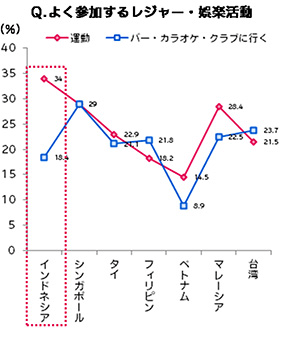
According to the survey, Indonesian girls have the highest life satisfaction and health consciousness among the Asian countries surveyed. The overwhelming majority exercised rather than going to clubs.
Indeed, the women interviewed agreed with these findings. "Absolutely! 'City folks' really care about it. My mom is super into beauty and always asks me to buy Japanese matcha for her. Japanese tea, Chinese tea, and Taiwanese tea are popular." Beauty comes from health. In Japan too, over the last two or three years, a healthy mindset focused on inner and outer beauty, fueled by the marathon boom, has spread beyond teens. This trend seems similar in Indonesia.
Analyzing Indonesian Girls' "Gal-ness"
We arbitrarily analyzed Indonesian girls' gal-ness using the three criteria defined by Gal Lab: LOVE (Heart), DECO (Technique), and GUTS (Body).
(This analysis references the criteria used by Japan's Gal Lab to distinguish "True Gals" from "Edge Gals".)
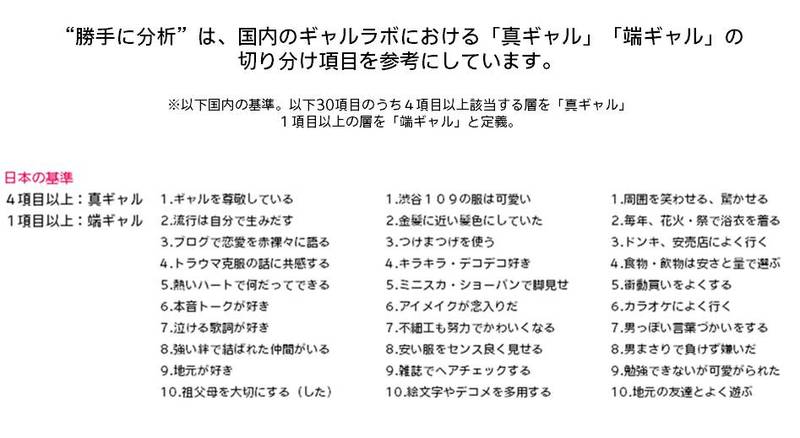
Indonesian Girls' Gal Level = 38% (with Japanese gal level set at 100%)
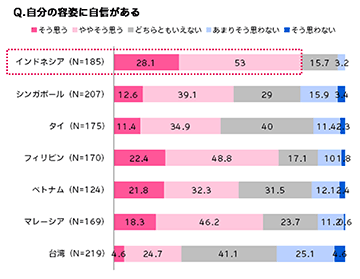
They possess LOVE ("desire to wear fashion that expresses themselves") and GUTS ("constant drive to improve their skills"), but DECO aspects like "wanting to dress to look attractive" or "accepting cosmetic surgery to enhance beauty" tend to be weaker.
Unlike Japanese gals who passionately pursue "bigger eyes at any cost!" or "a smaller face no matter what!" and makeup that rivals plastic surgery, Indonesian girls have a lower Japanese-style gal level. However, they seem to hold different values, leaning towards healthy and positive attitudes. Indonesian girls appear to have high satisfaction with their current selves, resulting in lower DECO enthusiasm.
Furthermore, even during interviews, it felt like the beauty they reference isn't Japanese "KAWAII" but Western-style beauty, creating a disconnect from Japanese gals.
The phrase "Japanese kawaii is cartoonish, while Indonesian kawaii is 'Sadako-esque'—straight black hair and 'beautiful' is the ideal"
This statement was particularly striking.

Olivia
However, I sense Japanese "KAWAII" could be accepted among high school students and younger. This is because idol groups like JKT48 are popular, and similar idol groups keep emerging. Like Japan's AKB48, these groups represent the reality of girls. They don't require plastic surgery-level makeup, which might have made them easier for Indonesian girls to accept.
Moreover, the girls interviewed actually showed "KAWAII" elements here and there, like in their phone cases or nails.
It seems likely that Indonesian girls' "gal" tendencies could increase in the future.
Was this article helpful?
Share this article


Newsletter registration is here
We select and publish important news every day
For inquiries about this article
Author
Kano Juna
Dentsu Inc.
Kansai Branch Office Marketing Design Bureau