Note: This website was automatically translated, so some terms or nuances may not be completely accurate.
 Dentsu Inc. B Team's Alternative Approach [9/10]
What if "Bound Tofu for Advanced Users" became popular among high school girls?

Throughout scientific history, behind every innovation lay the existence of an "absurd hypothesis."
This might sound like a grand statement, but Dentsu Inc. B Team developed a tool to rapidly generate an endless stream of "absurd hypotheses" and catalyze idea leaps. Its name?
"Foolish Idea Catapult"
. But before introducing it, let me briefly touch on the history of science.
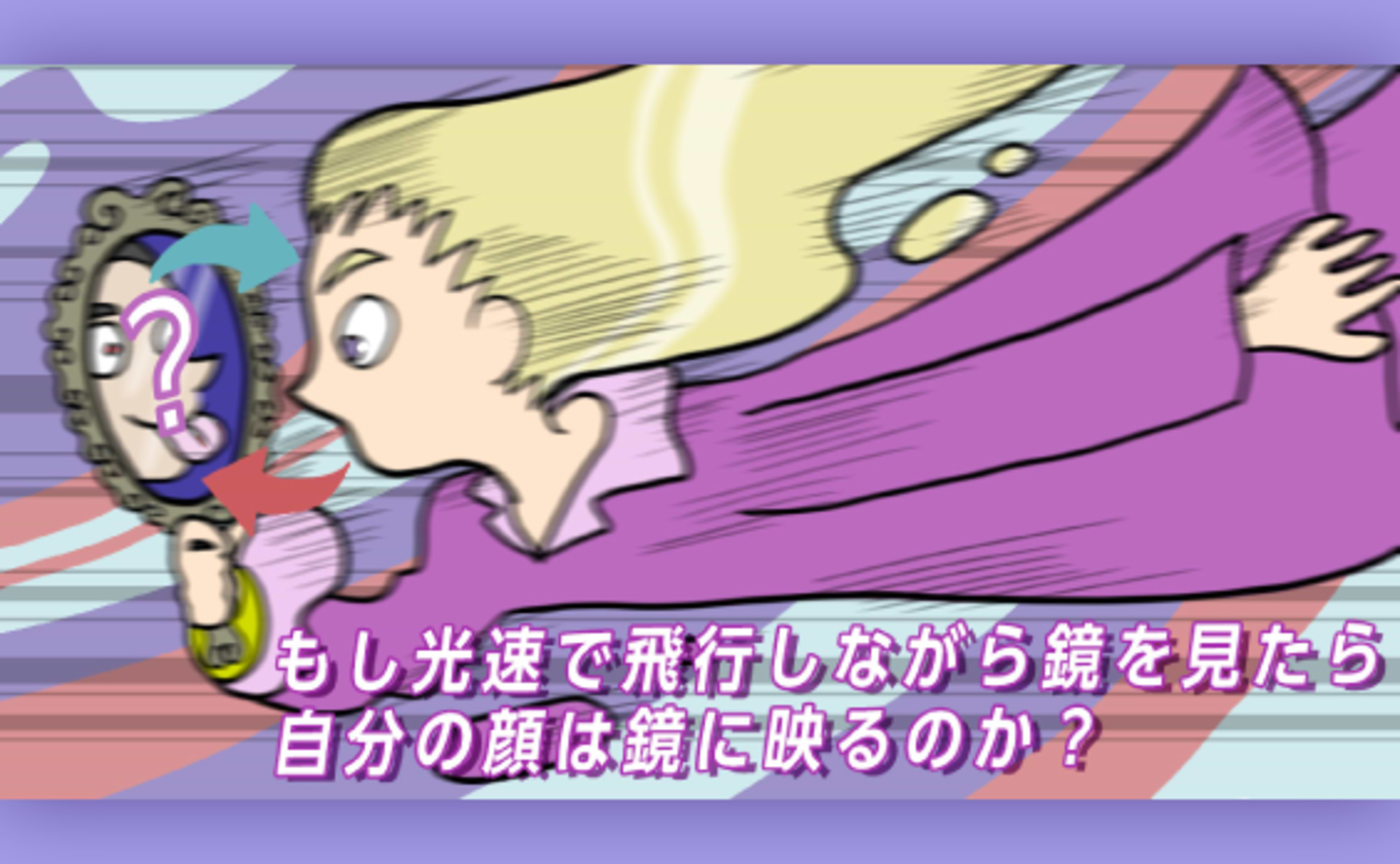
What happens if you look at a mirror while flying at the speed of light?
I'm Gousuke Fukuoka from Dentsu Inc. B Team. I majored in physics in college and serve as the "Science" researcher for B Team.
In fact, behind scientific discoveries lie countless "absurd hypotheses" like the one mentioned at the beginning.
Take Albert Einstein's "Principle of the Constancy of the Speed of Light." This principle states that "the speed of light is constant, regardless of the speed of the light source or the observer."
(Incidentally, a "principle" is a hypothesis that's so useful and likely correct that we accept it as true without needing to prove it.)
When Einstein was 16, he wondered:
he wondered what his face would look like reflected in a mirror if he were flying at the speed of light.
(Editor's note: The following discussion is quite complex, so skimming is recommended
(Editor's note: The following discussion is complex; skimming is recommended.)
Your face appears in the mirror because "light reflected off your face travels toward the mirror, reflects off it, and returns to your eyes." But what if you and the mirror were both flying in the same direction at the speed of light...
・Wouldn't the "light reflected off your face" fail to catch up to the mirror?
・If so, would the "light reflected off your face" appear stationary to you?

Through such thought experiments, he proposed that "the speed of light is constant for everyone, no matter where they are." And since it seemed "useful in many ways and correct," it became established as a "principle."
Setting aside the complex theory, there's one thing I want to convey here. Rather than Einstein arriving at this principle through accumulated experiments and logic, he first asked:
What if it were like this?
and then unraveled the world based on that hypothesis.
Another figure who proposed an equally absurd hypothesis was the 19th-century physicist James Clerk Maxwell. He wondered, "What if such a demon existed?" and questioned the laws of thermodynamics.
His idea was this:
(Editor's note: This is complex, so please skim without overthinking it)
Imagine a tiny demon sitting in the middle of a partitioned box, sorting fast-moving molecules to one side and slow-moving molecules to the other. The space containing the fast molecules would heat up, while the other space would cool down.
・If such a demon existed, it could create a temperature difference within the box without expending energy.
The idea of creating a temperature difference without expending energy contradicted the well-established scientific principle known as the Second Law of Thermodynamics, which is why it attracted so much attention. Maxwell was a great scientist, after all.
Of course, no such demon exists. Yet scholars followed Maxwell's lead, persistently pondering "What if it did?"
And now, it's been discovered that Maxwell's demon makes sense if you factor in the energy used to exchange "information about molecular velocity." In other words, information can be converted into energy! This led to the birth of a new field of study: "information thermodynamics."
Other seemingly absurd hypotheses, like Dirac's sea—the idea that vacuum is filled with negative energy—or string theory, which posits everything is made of one-dimensional strings, have also propelled science forward.
...While sharing such anecdotes with Team B members, it suddenly struck me: Couldn't the leaps of ideas needed to innovate products and services also spring from "outlandish hypotheses"?
Immediately, I teamed up with B Team's Kosuke Takahashi to develop a tool for generating an endless supply of "far-fetched hypotheses" in a short time.

The "Absurd Hypothesis Launcher" that propels ideas far into the distance
The resulting Absurd Hypothesis Launcher was developed as a web application running in a browser, enabling effortless idea generation for both individuals and groups.
The tool was developed in three stages: ① Hop, ② Step, and ③ Jump.
① Hop: Formulate hypotheses by adding modifiers like "big" or "small" to products or services
For example, suppose a company wants to develop "a completely new kind of tofu."
In this case
- "What if there was an incredibly large tofu?"
- "What if there was incredibly small tofu?"
By formulating hypotheses along the "size axis" like this, you can easily come up with new product ideas, right?

You can also prepare axes combining contrasting modifiers like "luxury/cheap" or "hard/soft," and by applying them one by one, ideas will flow continuously.
However, a single axis will only yield moderately innovative ideas. We further evolved our tool.
Step 2: Generate hypotheses by combining two axes—"vertical" and "horizontal"
We took the "opposite-meaning modifiers" from before and turned them into two axes, combining them to create a four-quadrant matrix.
For example, if the vertical axis is "Free/Restricted" and the horizontal axis is "Advanced/Beginner," combining them yields:
- "What if there was tofu that was advanced-level and free?"
- "What if there were beginner-friendly, constrained tofu?"
We generate ideas from these perspectives.

Combining these allows you to generate even more absurd ideas than before. We've prepared about 150 sets of randomly displayed "axes." At this point, theoretically, you can create over 40,000 variations of "○○ & △△ tofu."
The strength of the Absurd Hypothesis Launcher is its ability to generate massive output in minimal time. Don't hold back thinking "I need to come up with clever, good ideas." Just jot down and save every idea that pops into your head.
③ Jump: Push yourself further with the "Dig Deeper" button!
Once you've gathered a decent number of ideas, view them in "List View." You'll see a "Dig Deeper" button next to each idea.
Clicking this button will randomly display even more absurd questions—essentially "challenging prompts."
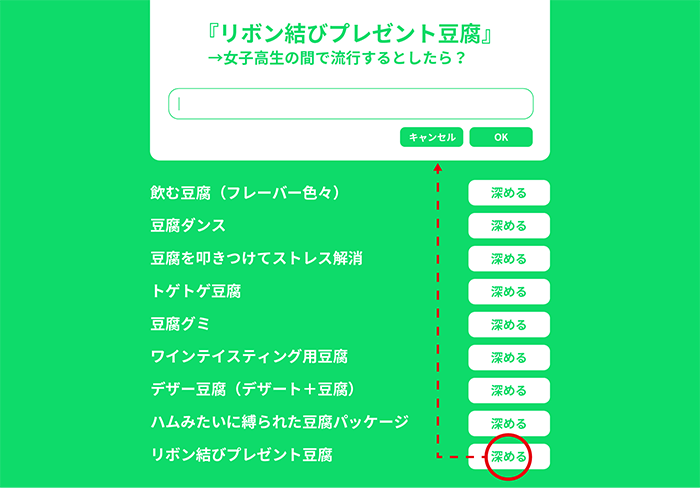
Prompt: "What if there was a tied-up & advanced-level tofu?"
→【Idea 1】 "Ribbon-Tied Gift Tofu"
→【Deepening】" What if it became a trend among high school girls?" ← Wild Card
→【Idea 2】" Commercialized as a tofu character that crumbles when the ribbon is untied"
Like this, clicking the "Deepen" button triggers unexpected jumps. And since the "Deepen" button's wild challenges can be switched with just one click, ideas get mass-produced at incredible speed.
- "What if it were on the ocean floor?"
- "What if you could do it in one second?"
- "What if President Trump used it?"
- "What if it were a hundred times bigger?"...
Once you let your imagination leap wildly, various angles emerge when refining ideas into something feasible. Examples include: "Create LINE stickers featuring a character made of tofu that crumbles instantly" or "Sell tofu at a pop-up store meticulously designed like a bubble tea shop, from interior to packaging."
Following tofu, we tried this with the theme "a new karaoke service."

Topic: "What if there was a prepaid karaoke service for young people?"
→【Idea 1】 "Karaoke Annual Pass" (Subscription)
→【Expand】 "What if you implanted it in your body?" ← Wild idea
→【Idea 2】Use piercings or accessories as authentication devices for the subscription
This time, just by spending 15 minutes with Takahashi-kun using the tool, we generated over 50 wildly absurd "new karaoke" ideas. While the quality varies, you wouldn't normally come up with this many out-there ideas in just 15 minutes.


Summary: Want to try a tool that generates massive amounts of ideas in a short time?
What makes this tool fascinating is that while generating outlandish hypotheses through the steps above, it simultaneously sparks ideas not just for new product development, but also for PR plans, integrated campaigns, and other communication strategies.
For example, with the "Deepen" button:
- "What if it were free?"
- "What if there were a million of them?"
...you might start thinking of some pretty outlandish PR campaigns. Like, "What if the budget were unlimited?"
This absurd hypothesis launcher has already been used in workshop formats by several companies. Some ideas are actually moving towards productization.
Team B will continue evolving the tool, such as periodically adding trending words to the randomly generated phrases. If you want to generate absurd hypotheses that lead to innovation, like Einstein or Maxwell, please contact Team B!
Dentsu Inc. B Team
https://bbbbb.team/

Was this article helpful?
Share this article


Newsletter registration is here
We select and publish important news every day
For inquiries about this article
Back Numbers


Author

Gosuke Fukuoka
Dentsu Inc.
Creative Planning Division 2
Copywriter / CM Planner