Note: This website was automatically translated, so some terms or nuances may not be completely accurate.
 CARTA and Dentsu Inc.'s Digital Navigation [2/3]
A Legendary Entrepreneur Speaks: The Journey of a Startup to Listing on the Tokyo Stock Exchange's First Section
CARTA HOLDINGS, INC (hereinafter referred to as CARTA) is expected to accelerate the digital transformation (DX) of the domestic Dentsu Group. Mr. Shinnosuke Usami, founder and CEO of VOYAGE GROUP, which handles a wide range of businesses from advertising to media operations, has been appointed as the company's Chairman.
This series interviews Mr. Usami to answer questions like: What kind of company is CARTA, newly added to the domestic Dentsu Group? And what kind of person is Mr. Usami?
In this second part, we focus on the secrets behind Mr. Usami's numerous successful new business ventures and his approach to taking a company public.
<Table of Contents>
▼What is the biggest advantage of "in-house development" for the technology department?
▼How did the organization become capable of continuously generating powerful new businesses?
▼At Career Crossroads, Choose the "More Challenging but More Interesting Path"
What is the biggest advantage of "in-house development" for the technology department?
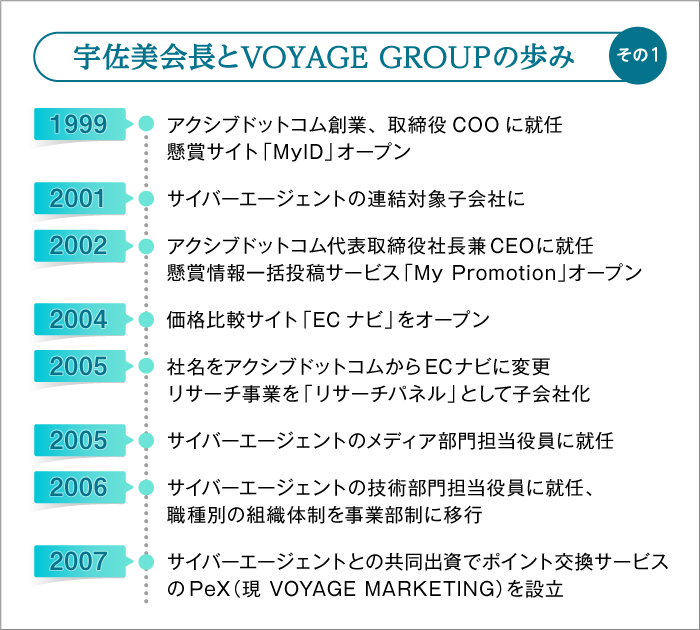
―Last time, we heard about Usami-san's Axiv.com, later VOYAGE GROUP, becoming a consolidated subsidiary of CyberAgent in 2001. Starting in 2005, Usami-san himself became involved in CyberAgent's management as an executive, correct?
Usami: Yes. Even after becoming a consolidated subsidiary, I remained focused on our own media business operations. However, Mr. Susumu Fujita, President of CyberAgent, approached me about working on the parent company's projects together. At that time, CyberAgent was in a phase of expanding its media business, and since there were areas I was personally interested in, I asked to be given the opportunity.
As the executive in charge of media at CyberAgent, I oversaw businesses like "comparison sites." These are platforms that allow users to compare services across companies in a specific field side-by-side. Since I had been running the price comparison site "EC Navi," I had the expertise.
―Was the expectation that Usami, who had built and nurtured media platforms like "MyID" and "EC Navi" from scratch, would help grow the media business by joining the management team?
Usami: That might have been part of it. I also think they hoped that bringing in an entrepreneur who joined the group through M&A—neither a regular employee nor a mid-career hire—would invigorate the management team. Serving as an executive for five years, learning how Mr. Fujita and others worked and thought was an incredibly valuable experience for me as a manager.
―You also took on the role of executive in charge of the technology division partway through, not just the media division.
Usami: At the time, CyberAgent outsourced the development of the "Ameba Blog" system. However, when dealing with rapidly evolving internet services, outsourcing inevitably led to a lack of speed. Therefore, the company decided to strengthen its in-house development capabilities and shift to in-house production. When considering who should drive this initiative, I was appointed, in a sense by process of elimination, as I was the executive with the most knowledge about systems at the time.
This was because, during my time at Tohmatsu Consulting after graduating, I had experience as a systems consultant. While I didn't do programming myself, I handled requirements definition and design. Building on that experience, I had also participated in the system design for our own EC Navi, so I suppose they felt I was the right fit.
As the responsible executive, I started by establishing CyberAgent's technology department and then built systems for measuring media effectiveness. Initially, I focused mainly on developing Ameba, but gradually, we shifted from external partners to in-house development within CyberAgent's advertising business domain as well.
—By the way, VOYAGE GROUP also handles service development primarily in-house, right? Did you have the mindset that if you're doing internet services, you should develop in-house?
Usami: I believe so. Having in-house engineers certainly speeds up development and improvements, but but the even greater advantage is that it makes it easier for the team to share a common vision of the goal and run in the same direction.
How did you become an organization capable of continuously launching powerful new ventures?
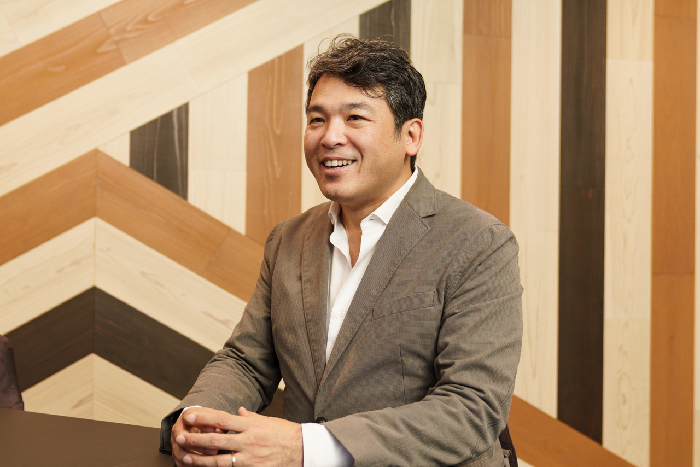
―When hearing about tech ventures, some companies struggle with integrating the engineering and business sides into one team. In that regard, VOYAGE GROUP seems to have fostered a culture without barriers between departments. What efforts have you made, Usami?
Usami: There are several things we keep in mind, but organizationally, adopting a "business division system" for each project was significant. Until 2006, the internal structure was organized by job type, like "Service Department" and "Development Department." It was the common structure where the Development Department handled "internal orders."
Instead, we started the business division system, aiming to integrate the development department, service/planning department, and sales department into one unified team. We gave each business division/subsidiary autonomy, allowing them to make significant decisions and drive initiatives independently. This approach fostered VOYAGE's unique culture where engineers and non-engineers collaborate seamlessly toward common goals. As a result, an atmosphere emerged where anyone could freely voice opinions, leading to the birth of numerous new ventures within the company.
―I believe the advertising platform business, specifically ad tech areas like DSP and SSP, has become a major pillar for VOYAGE GROUP in recent years. What led to focusing on this area?
Usami: It wasn't a case of us saying, "Let's get into ad tech now." Since the company's founding, we've always been in the digital media business. Maximizing "ad space sales," the core revenue source for media, was a constant pursuit. As a result, we accumulated significant in-house expertise in monetizing digital media, whether through banner ads, email ads, or other methods. The idea emerged internally that we could offer this accumulated know-how to competing media companies, which led to our advertising platform business.
―So you realized the know-how and technology used internally could be sold as a service to competitors.
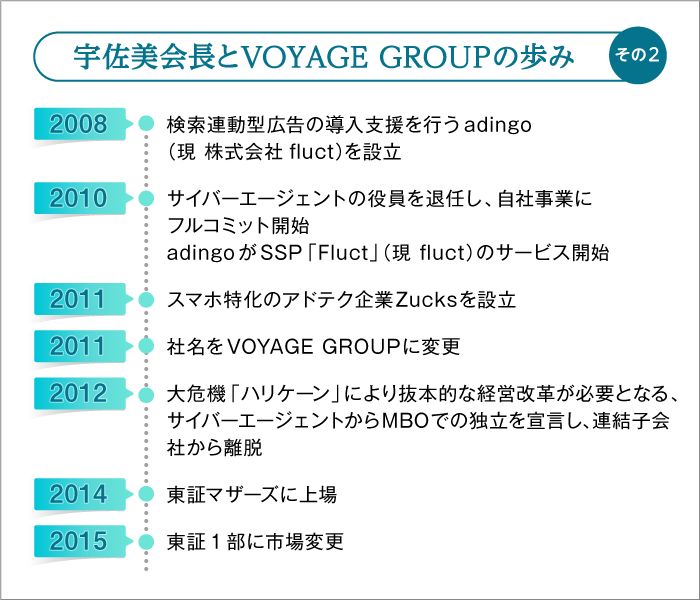
Usami: Yes. We first started this around 2008 with a product linked to "site search" on media sites. We embedded a customized site search engine into our customers' media sites. The agreement was that when search-linked ads appeared, we would share the revenue. Since the underlying search engine itself used another company's service, we called it a syndication business, and revenue grew steadily.
After serving as an executive at CyberAgent for five years, I stepped down in 2010 to focus on our own business, confident the tech department was sufficiently strengthened even without me. But then a major crisis hit the company. In the syndication business, the company providing the underlying search engine suddenly notified us that they would find it difficult to continue providing it. At that time, our operating profit was around 500 million yen, but losing this business meant we were looking at a potential loss of about 500 million yen. Internally, we called this crisis the "Hurricane."
―So a major pillar of your business was suddenly at risk of disappearing.
Usami: So we decided to build the next pillar and launched several new businesses simultaneously. One of these was "fluct,Inc.," an SSP business focused on "display ad optimization." This time, instead of relying on another company's platform, we aimed to build our own platform and support media in maximizing their advertising revenue. We already had relationships with various media outlets through our syndication business, so we began offering this service.
―So entrepreneurs really do face repeated crises... You must have experienced intense stress. What mindset helped you overcome those challenges?
Usami: It was like a runner's high (laughs). Also, even when facing a crisis where sales dropped by 500 million yen, we still had cash reserves of around 2 to 3 billion yen. That amount could sustain the company for about four years. I optimistically thought, "Looking back, we've hit the mark with a new business roughly once every three years, so four years should be fine." By that time, business ideas were already flowing steadily from within the company. So, within those four years, we planned to run several businesses and keep the ones that succeeded.
At career crossroads, choose the "harder but more interesting path"
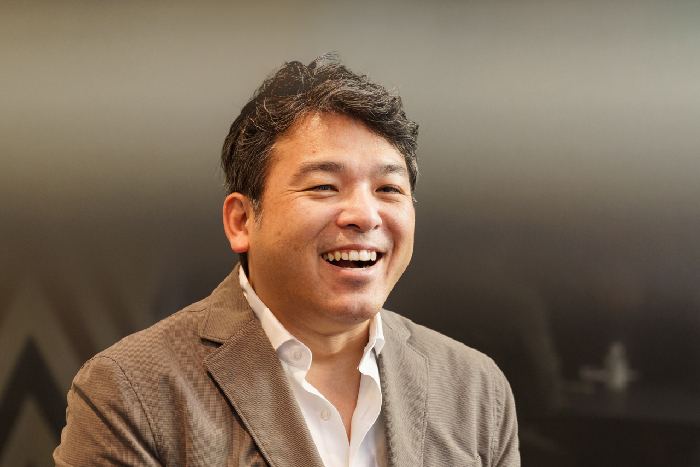
―As our own businesses grew larger and more numerous, we conducted an MBO(※) from CyberAgent in 2012. Had we already overcome the crisis by then?
※Management Buyout = Acquiring shares and management control from the parent company to become independent.
Usami: Not yet. It was still before dawn, so to speak (laughs). While we had various things in the works internally, including fluct,Inc., performance-wise it was the worst possible timing. We had a sense it might work, but we hadn't seen results from the new ventures we'd prepared yet.
―Why decide on an MBO at such a timing?
Usami: From the founding of Axiv.com, we always had the aspiration to "go public someday and grow the company to the next stage." I had mentioned to Mr. Fujita that we wanted to go public eventually. However, when sales and profits were growing, it was difficult to separate from the consolidated group.
However, performance had stalled at that exact moment. Mr. Fujita then suggested, "Right now, you could pursue an IPO by separating from the group. What do you want to do?" We deliberated, but ultimately decided to take the risk and challenge ourselves.
―I imagine the investment environment surrounding entrepreneurs was completely different from when you started in '99. Was raising funds for independence smooth?
Usami: The funding environment had deteriorated after the Lehman Shock (2008), but by that time, it had started to improve a bit. In our case, when we originally founded Axiv.com, we received investment from Tetsu Akaura of the venture capital firm Incubate Fund. Back then, we also worked hard alongside Mr. Akaura to secure funding. Ultimately, we gained support from a PE fund and created a mid-term management plan to increase profits by 500 million yen annually over three years.
―What was the journey like from the 2012 MBO to the 2014 listing on the Tokyo Stock Exchange Mothers market?
Usami: Our performance grew beyond expectations, leading to an earlier-than-planned listing. Looking back now, the process of aiming for the listing itself left a stronger impression than the listing event. We had to review our governance structure, establish regulations, and ensure compliance. In a way, creating an environment where we could reliably do what's expected of a listed company was more challenging than anticipated.
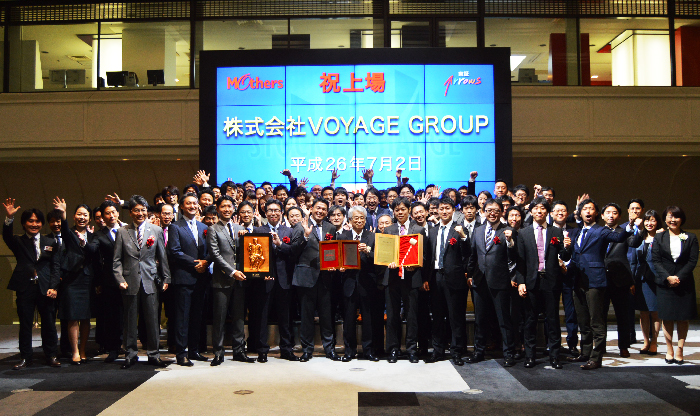
―As a milestone since founding the company, ringing the listing bell must have been deeply moving.
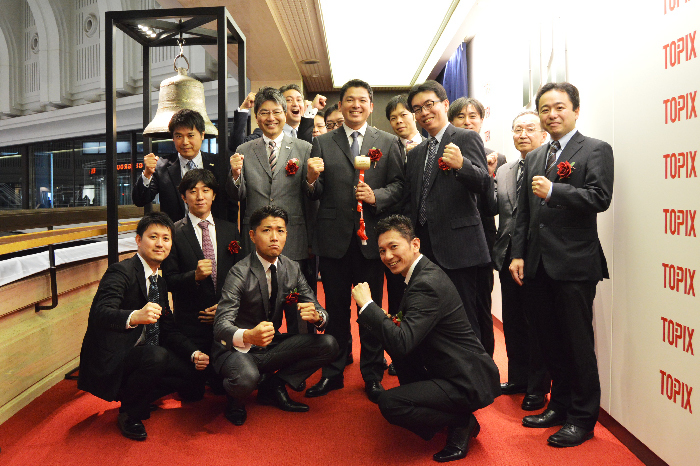
Usami: More than a goal, it was a milestone. Going public isn't the end goal. But personally, I was quite moved by the Mothers listing because I had such strong feelings about it. Later, when we moved to the TSE First Section, I felt, "We did what we had to do, and I'm glad we made it to the First Section."
―Did going public change your motivation?
Usami: Not at all. My core motivation has always been, "If we're going to do this, we should aim to do something truly world-changing." That hasn't wavered.
―I see. So whether it's going public or joining the domestic Dentsu Group, the core principle guiding your direction is always "Which path leads to greater impact?"
Usami: Exactly. We judge based on which path presents the greater challenge. Last year, we merged with Cyber Communications (CCI) and joined the domestic Dentsu Group. But if you ask whether VOYAGE GROUP couldn't have survived without this merger, that's absolutely not the case. We could have easily continued growing while maintaining our independence. However, I simply thought it would be more interesting to pursue a merger we'd never done before, opening up possibilities in areas we hadn't been able to reach.
―Was that the biggest factor in VOYAGE GROUP and CCI deciding to merge?
Usami: Originally, VOYAGE GROUP focused primarily on performance-based advertising, essentially advertising close to sales promotion. On the other hand, CCI and Dentsu Inc. are strong in brand advertising. Nowadays, advertisers are no longer clearly separating those two. They use the same programmatic advertising platform for both brand and performance. The meaning of treating them as separate entities is fading from the advertiser's perspective.
If advertisers are changing, then a platform capable of providing both is needed to meet that demand. That's why I see tremendous potential in VOYAGE GROUP, CCI, and the domestic Dentsu Group coming together.
―Finally, could you offer some advice for young business professionals or students who aspire to be entrepreneurs like you, to help them take on challenges in their future careers?
Usami: I'm not sure how helpful this will be, but I really feel like I've arrived at this point through a "grasshopper millionaire" kind of journey. What I mean is, I haven't always strategically chosen things. Instead, at various crossroads, I consistently chose the path that seemed "more challenging but more interesting." As a result, various possibilities opened up, and I formed many connections. I mentioned the metaphor of "rails" last time, but I don't think we live in an era where rails are already laid out anymore. If that's the case, carving your own path based on your own will is more satisfying and leads to greater growth.
Also, I think viewing things too cynically just makes life less interesting. Instead, if you focus on becoming actively involved yourself and on what you can accomplish in that role, I believe all sorts of possibilities will open up.
Was this article helpful?
Share this article


Newsletter registration is here
We select and publish important news every day
For inquiries about this article
Author
Shinji Usami
CARTA HOLDINGS, INC
Chairman and CEO