Note: This website was automatically translated, so some terms or nuances may not be completely accurate.
D&AD Collaborative Award Winner: "Get Back, Tohoku." The Brand Campaign Strategy Built by JR East and Dentsu Inc.
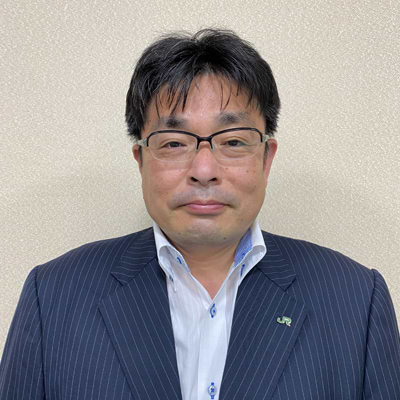
Yukatsu Mibu
East Japan Railway Company

Yoshihiro Yagi
dentsu Japan
The D&AD Collaborative Award, recognized as one of the world's most challenging design and advertising awards to win, honors the long-term relationship between client and agency.
JR East Japan and Dentsu Inc. were honored in the Creative Agency category for their decade-long collaboration and consistently high level of creativity.
※=D&AD
Founded in 1962 by the UK-based non-profit organization "D&AD (British Design & Art Direction)", the Collaborative Award recognizes outstanding partnerships between clients and agencies that have collaborated for three or more years, demonstrating sustained high creativity.
How did the 'Get Back, Tohoku.' campaign, the first in Asia to win this award, come to be and how was it executed?
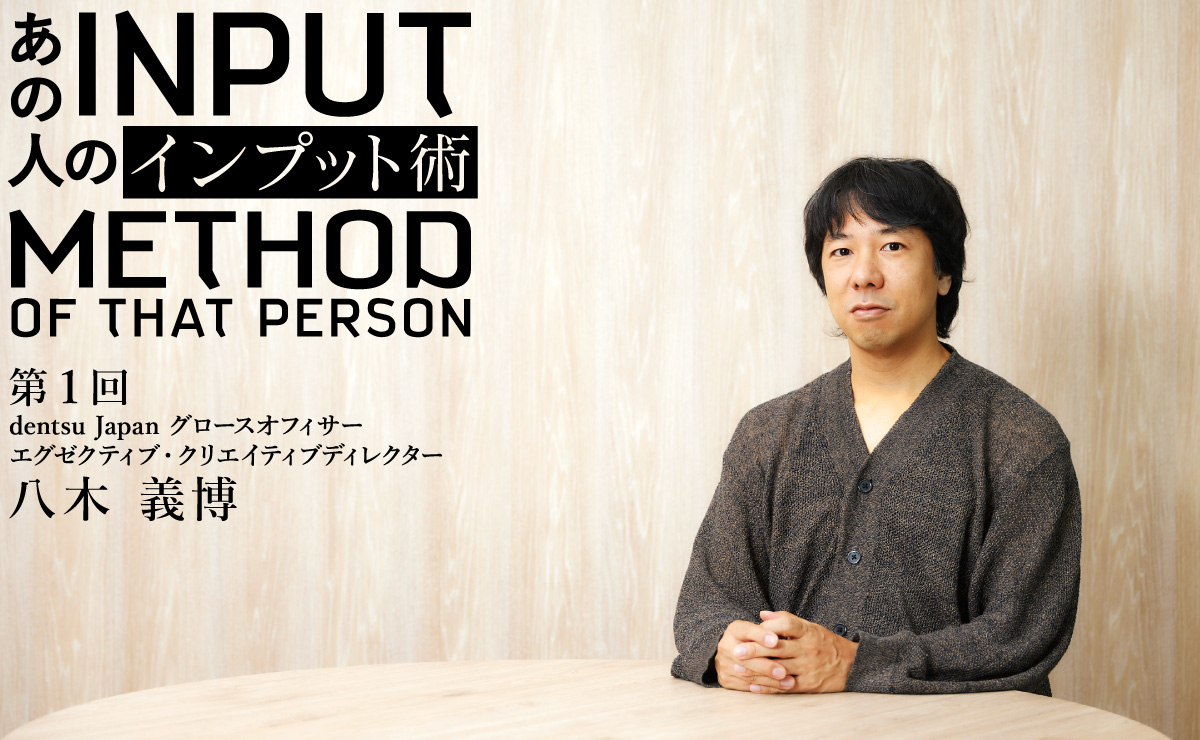
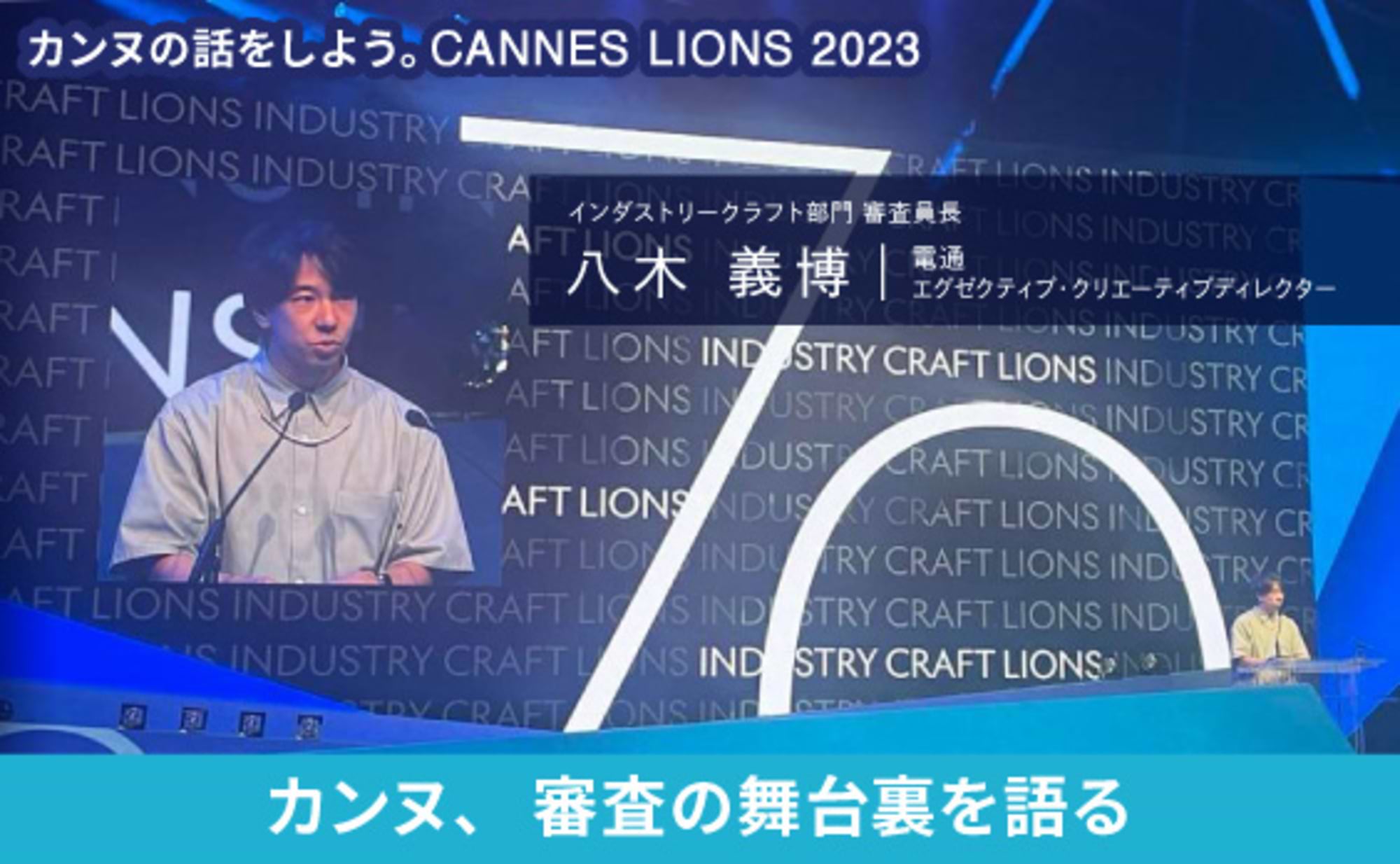
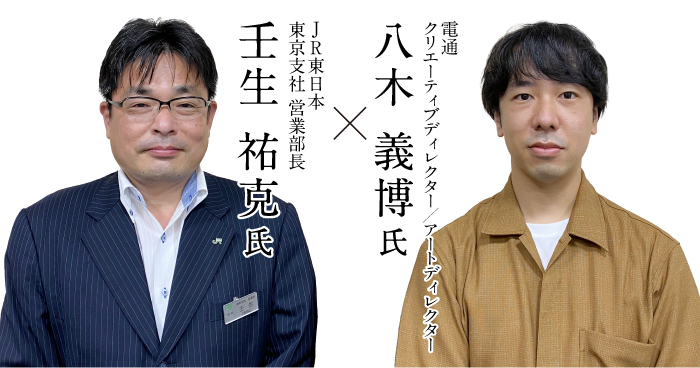
Yukaku Mibu, who served as JR East Japan's advertising leader at the campaign's launch, and Yoshihiro Yagi, Creative Director/Art Director at Dentsu Inc., discussed the secrets to building long-term relationships and the key points for a successful brand campaign.
We wanted to energize Tohoku immediately after the earthquake. Everyone's thoughts aligned, and the campaign took off.
Yagi: I started working on JR East projects with the "MY FIRST AOMORI" campaign for the Tohoku Shinkansen's new Aomori station opening in December 2010. But I began collaborating with Mr. Mibu a year later, starting with the "Get Back, Tohoku." campaign.
Mibu: Yes. It was after I took the position as leader of the Advertising Group in the Head Office Sales Department in 2011. Although I was assigned to a different group within the Sales Department during the conceptualization phase of the "Get Back, Tohoku." campaign, I observed the process from the sidelines, so I remember it well.
2011 was the year of the Great East Japan Earthquake. Our company manages the East Japan area, and our railways, particularly along the Pacific coast of the Tohoku region, suffered extensive damage. The Tohoku Shinkansen Shin-Aomori Station had opened in December 2010, and the new E5 series Shinkansen was introduced with the March timetable revision. With an Aomori tourism campaign scheduled to start in April, it was precisely the moment when we were saying, "Now we're going to promote Tohoku." The damage from the earthquake was therefore immense.
Amidst this, we saw the first anniversary of Shin-Aomori's opening as a potential turning point. We planned the campaign believing that using this anniversary as a catalyst would encourage customers to turn their attention to Tohoku and, crucially, to take action – to visit the region. We firmly believed that actual visits would be the most powerful force for disaster recovery.
Yagi: We felt that unless we used "expressions JR East had never used before," we wouldn't capture people's attention.Previous JR East posters typically featured visuals of tourist spots or local specialties. But the post-disaster landscape of Tohoku simply wasn't in that condition. So, we used a monochrome halftone Shinkansen as the visual, boldly employing the three colors symbolizing the Tohoku Shinkansen. We added the message: "Get Back, Tohoku." We developed this challenging visual and copy for the presentation, and initially, there were reactions like, "Are we really going this far?"
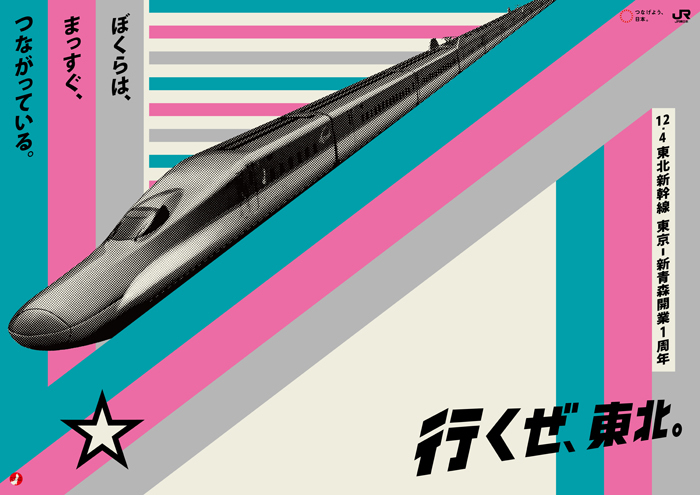
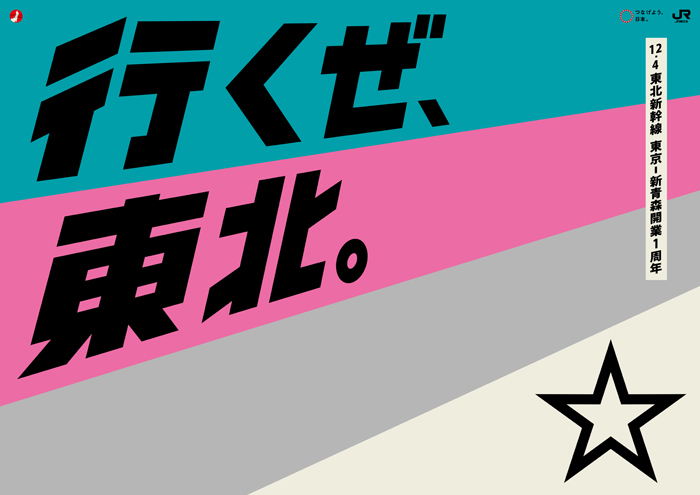
Mibu: Honestly, I thought it was pretty radical too. But when we actually tried it, while a message like "Let's do our best!" might feel a bit too earnest, the rallying cry "Get Back, Tohoku." just clicked instantly. I still remember thinking that this would really resonate with our customers.
Yagi: Honestly, I was worried about how much response we'd get from customers using posters as a medium. But people from Tohoku saw the posters and happily sent letters to JR East. We even got an email from a student deciding between Kyushu and Aomori/Sendai for university, saying, "After seeing this poster, I chose Hirosaki University" and sending it to Dentsu East Japan Inc. It taught me how much the world actually responds to posters.
Mibu: Even on social media, which wasn't as active back then, we heard customers say things like, "Just going there is a form of support, right?"
As a company responsible for public infrastructure like railways, we tend to have a serious, formal image.If we go too far, people might ask, "What are they doing?" Finding that balance is difficult, but this was a time when Tohoku needed a boost. The whole company was united in the desire to bring some brightness. That's precisely why executives could decide to go with this design and this copy. It was quite a bold decision, but what mattered most then was not our company's image, but that this campaign would draw society's attention to Tohoku. In that sense, I think we got off to a good start without losing sight of our purpose.
No matter how many times I got yelled at... The presentation was a "challenge."
Mibu: I worked with Yagi-san's team for three years until 2014, but I remember the second year being the most challenging.After the first year's "Get Back, Tohoku." we had intense debates about what to do next. JR East prioritized how to convey the current state of Tohoku to customers and how to direct their feelings toward it, while Dentsu Inc. focused on how to express that through advertising. Though we shared the same goal, we sometimes clashed precisely because we were each fulfilling our distinct roles.
Yagi: That's right. I was scolded the most during Mr. Mibu's time, so I was always nervous during presentations (laughs).
By 2012, the scenery visible immediately after the disaster began to change. We wanted to express the situation that only JR East, constantly watching over Tohoku, could convey – things like "The Tohoku Shinkansen has resumed operation" or "This line has been restored." So for the second year, we decided to send four photographers out into the field (laughs), not to create summer postcards from Tohoku, but with the concept of showing "This is what Tohoku looks like now."
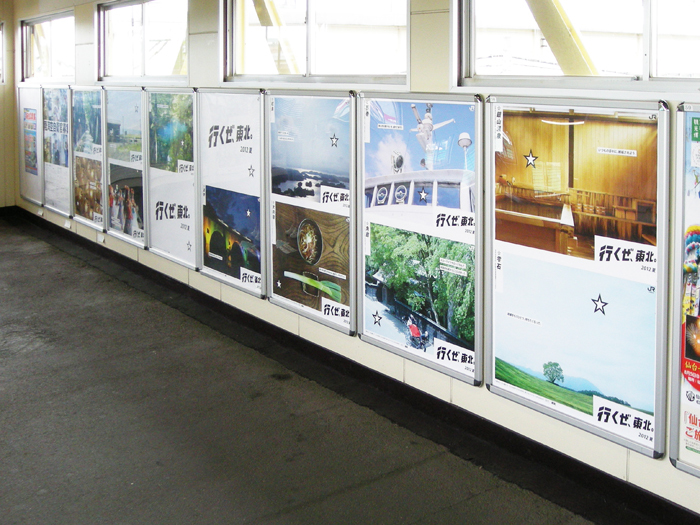
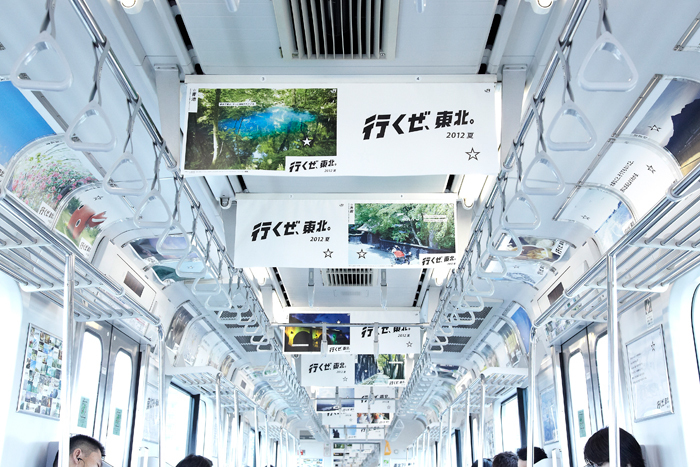
Mibu: Among the thousands of photos submitted, there weren't just the usual pretty landscape shots we'd seen before—there were also a lot of really unusual photos.
Yagi: We felt that if things suddenly returned to normal, it wouldn't attract any attention at all. The second year was really tough, figuring out how to keep the essence of "Get Back, Tohoku." in the design.
Since "Get Back, Tohoku." is based on the concept that actually visiting is recovery support, we focused on the real act of "traveling." Travel isn't just about visiting famous spots. We proposed photos that were just of the sky or mountains, themed around the various discoveries you make on a journey. We got yelled at sometimes, like "What the heck is this?"...
Mibu: Yeah, I think I did say "What is this?" a few times (laughs). Some were surprising, but seeing perspectives we hadn't considered was incredibly fresh. We gave Yagi's team many requests, but since we shared the goal of "what we wanted to achieve" and each had our roles, clashes of opinion were inevitable.
Yagi: Honestly, it was so tough I kept wondering when I should say, "Please take me off this project." But the clashes were incredibly constructive – "This is good," "This doesn't work for this reason." Through those repeated exchanges, I remember being able to rebuild myself.
It was a tough time, but Mibu-san's words left several lasting impressions. One was, "Isn't the train our origin?" We weren't using train visuals back then, but inspired by his words, we started incorporating train shots around the 2012 fall/winter season.
Mibu: During the earthquake, we ourselves were encouraged by the railways. At the time, the Shinkansen had suspended operations. When service resumed 49 days later, people along the tracks waved and spontaneously shouted "Welcome back!" It was the first time I realized that the mere act of a railway starting to move again becomes a source of power in itself.
That's why, in "Get Back, Tohoku." our campaign to support Tohoku through tourism, I thought including some element of railways would often resonate with our audience.
Yagi: But photographing trains is really tough. Since it's a safety-first railway that runs on schedule, you have to be extremely careful when shooting. It was a great lesson learning that safety is built on a continuous chain of many people performing their specific roles precisely.
What really stuck with me was taking a casual photo of a train at the maintenance yard in the snow. Mr. Mibu was directing operations right there in the snow, without even an umbrella.When I asked, "Could you move it a bit?" Mr. Mibu gave instructions, which then led to further instructions... and after several commands were relayed, the car finally moved. Just me asking someone to move something a little caused quite a commotion. Yet, he did it saying, "That's my job," and that really stuck with me. I thought it was kind of cool.
Mibu: I never heard you say that back then (laughs).
Yagi: I'd be too embarrassed to say something like that now (laughs).
Mibu: There was a moment, around the time of the "Red Demon" poster featuring a local Tohoku railway line, when I felt the rhythm between my group and Yagi-san's team really clicked, right?
Yagi: Actually, that "Red Demon" poster was my challenge to you, Mibu!
When we scouted the vehicle depot, the maintenance crew called the trains "Red Demon." Listening to them talk, they'd say things like, "The Red Demon's brakes start working X seconds after you step on them," or "This one's newer with less play, so it's this timing." It felt like they were talking about their own child with such affection. I thought, a local line in Tohoku with such a wonderful story might just make great content.We took on the challenge of making the local lines we casually ride every day the stars, presenting them in a cool and charming way.
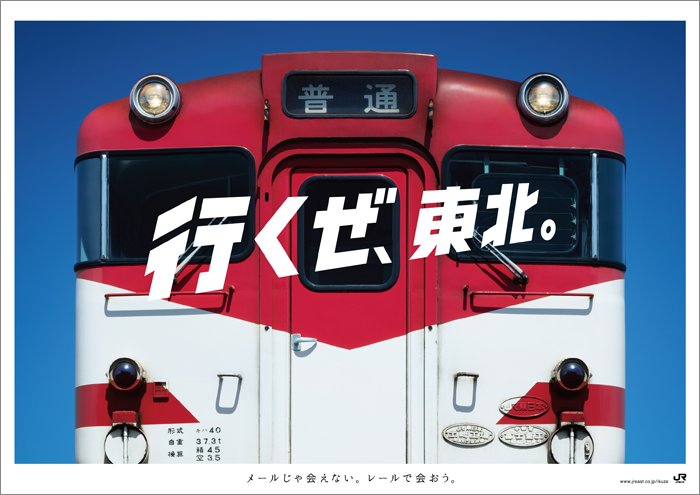
Mibu: Railway photography often follows classic patterns seen in magazines, but Yagi-san's perspective felt incredibly fresh. It struck me as something entirely different. We were thrilled by the perspective in his proposals.
The "Collaborative Award" made me reflect anew on the importance of "analog communication."
Yagi: The "Get Back, Tohoku." campaign has been running for 10 years. Often, when the person in charge changes, they think, "Let's just stop it!" So I feel this is almost a miracle. Hearing we won the Collaborative Award was truly moving.
Mibu: When I saw the news about the award, I honestly thought, "Yagi-chan, that's amazing!" Not only is it a very prestigious award, but the fact that it recognizes the relationship between client and agency makes it especially gratifying.
Advertising differs from art; the agency's role is fundamentally to respond to the client's objectives. Business-wise, it's a relationship between the client placing the order and the agency fulfilling it. This can sometimes create a situation where it's difficult to say things the client might find unpleasant. Or there's a risk of the agency just imposing its own ideas.We consciously strive to avoid that, aiming to be a team that collaboratively shapes our ideas. Receiving this award as an extension of that mindset feels truly wonderful.
Yagi: Thank you. I believe there is no greater honor in advertising work. This award specifically recognizes "collaboration," so it's a win achieved through the combined efforts of creatives, sales, promotion teams, and of course, the client.
These days, various technologies have advanced, changing how we communicate. However, I feel that what was truly important for building the essential relationship between client and agency wasn't the kind of connection you can build by leveraging remote environments in this digital world. It was the process of meeting face-to-face with people like Mibu-san and having those repeated, in-person exchanges. Because that is the essence of our work, our team believed it was something we absolutely must never lose.
Mibu: That's absolutely right. The reason we were able to build such a strong relationship with Dentsu Inc. is precisely because we layered analog communication, whether it was during the orientation or the presentations.
Within that relationship-building process, Yagi-san's design ideas certainly made a strong impression. But I also felt the immense impact of the account executives who worked tirelessly to facilitate smooth communication between the uniquely visionary creators and us, the clients, translating each other's thoughts. Ultimately, it reaffirmed that it really comes down to people connecting with people.
Yagi: As for the secret to building relationships... maybe it's about persistently proposing ideas no matter what you're told (laughs).
Mibu: Absolutely. What's great about Yagi-san is that he never gets unnecessarily defensive. Instead, with each meeting, he gets a better grasp of the key points and deepens his understanding. When there's depth or substance behind what he says, I gradually realized we had to take it seriously.
Yagi: Clients aren't necessarily trying to oppose things (laughs). When they say "no," there's always a clear reason behind it—whether it's compromising safety, misleading consumers, or something else. It can be hard to grasp that instantly, but I think the crucial thing is having the imagination to think, "How can I get Mibu-san to say 'yes'?"
Usually, when told "no," the whole team just gives up. We know it's not good. But through analog communication, we keep working together to find a way to make it happen. Then, sometimes, we get praised, or we can even go out for drinks together. That kind of relationship is incredibly rewarding. If it were a digital relationship, I don't think it would have lasted.
Mibu: That's right. Despite our many clashes, Mr. Yagi, who has observed JR East for ten years through the "Get Back, Tohoku." campaign, is a great supporter of our company. I'd be thrilled if he could leverage that understanding in various situations and become an advocate for us.
Yagi: That's very kind of you! I have plenty of things I want to do too. Having studied railways, I definitely want to challenge myself with new advertising expressions. But I'd also love to help connect advertising with JR East's travel products and services.
Was this article helpful?
Share this article


Newsletter registration is here
We select and publish important news every day
For inquiries about this article
Author
Yukatsu Mibu
East Japan Railway Company
Tokyo Branch Office
Sales Manager
Yoshihiro Yagi
dentsu Japan
Growth Officer / Executive Creative Director