
Note: This website was automatically translated, so some terms or nuances may not be completely accurate.
 Solving Future Challenges This Way by Future Creative Center [9/29]
What defines a store in the new normal era? The "AR Customer Service" born from 5G.
Dentsu Inc.'s cross-functional creative organization "Future Creative Center" (FCC) is a group of over 70 members supporting future-building domains with creativity, extending beyond the boundaries of advertising. In this series, center members discuss their upcoming initiatives under the theme "Future × Creativity."
This feature focuses on " GINZA 456 Created by KDDI," which KDDI opened on September 26. Located in Ginza's prime district, it was born as a concept shop where visitors can experience 5G. Creating an experience-focused store amid the pandemic presented numerous challenges. FCC members were involved in everything from the store's spatial design to PR, overcoming these hurdles through technology and creativity.
In this era dubbed the "new normal," what innovations are required for stores serving as the "touchpoints" between companies and people? Shinichi Sakamoto (Head of Brand Management, Advertising Department, Communication Division, and Strategic Group Leader, KDDI), Toshifumi Kato (Producer, Dentsu Inc.), and Ryusuke Nanki (FCC member, Dentsu Inc.) reflect on the experience.
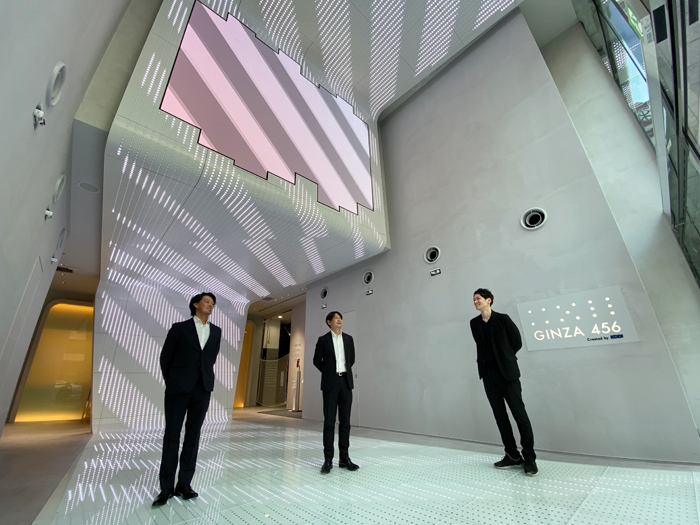
*This interview was conducted online.
How should stores operate amid restrictions on "viewing, touching, and gathering"?
Sakamoto: GINZA 456 Created by KDDI (hereafter GINZA 456) is a concept store where you can experience 5G. The name "456" originates from its address, 4-5-6 Ginza, Chuo-ku, Tokyo, while also symbolizing the transition from 4G to 5G and beyond. Located in Ginza, a cultural hub, we created a space distinct from other au shops. It's a special store bearing the KDDI name, not au.
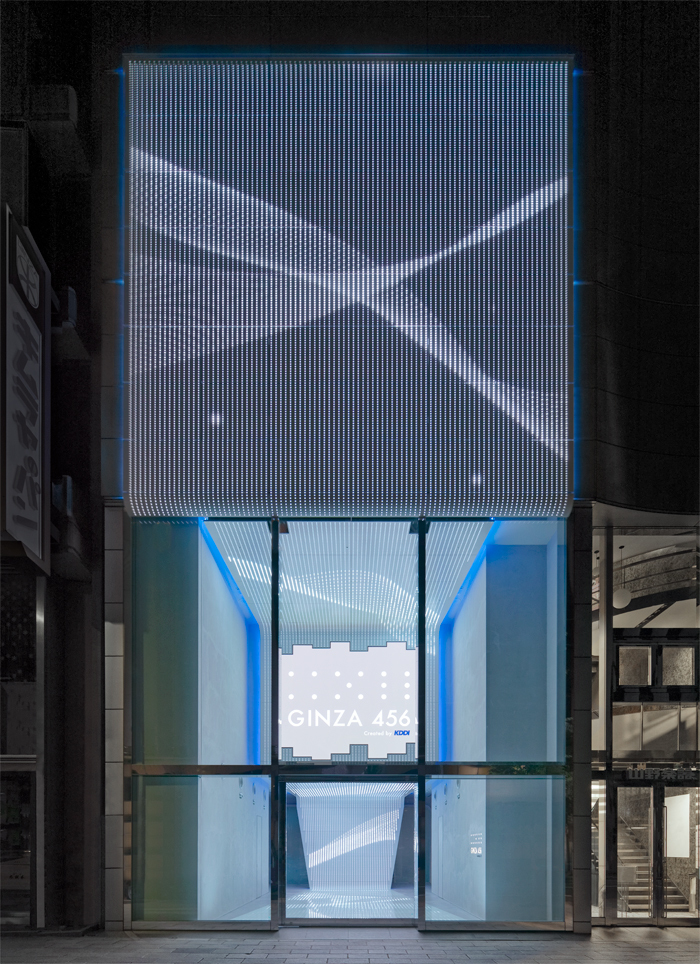
Kato: The B1F, 1F, and 2F of the building housing Yamano Music's flagship store are utilized. I've been in charge of KDDI's projects for several years now, overseeing the entire planning process from tenant negotiations and concept design to PR.
Nanki: I was responsible for the store design and its overall coordination. This encompassed everything from the store's planning and conceptualization to the interior spatial design, construction, and exterior. The B1F is an event floor where visitors can experience 5G. The 1F serves as the entrance showroom, and the 2F is the retail shop. This 2F space, as KDDI's flagship store, is also designed around the concept of providing the highest level of hospitality. That said, the real highlight of GINZA 456 is undoubtedly the B1F – the space where you can experience 5G.
Sakamoto: Yes. While 5G service has launched, I believe "experience" is crucial for its true adoption. For example, during 4G's early days, smartphones became widespread simultaneously. Consumers naturally adopted 4G when purchasing new smartphones. But now, smartphones are nearly ubiquitous. It's unlikely we can expect 5G to spread through device upgrades like 4G did. To make 5G catch on, the experiential value is crucial. We want people to "experience" 5G, which is still mostly just an "imagination" for many, and feel its appeal. As a result, more people will start using 5G. That's the kind of place we envisioned.
Kato: We spent considerable time debating what kind of experience to offer here, but then the COVID-19 situation worsened... Amidst the need to avoid crowds and contact, we faced significant challenges: what kind of experience would work, and what should the store even be like? The demands of the new normal often conflict with the very nature of in-store experiences.
Sakamoto: Exactly. With "seeing, touching, gathering" becoming difficult, we were like, "Okay, what do we do now?" What emerged from our relentless discussions was the "AR customer service" concept featuring talent Elaiza Ikeda. When the idea came up, we decided to make this the "customer service experience for the new normal era."
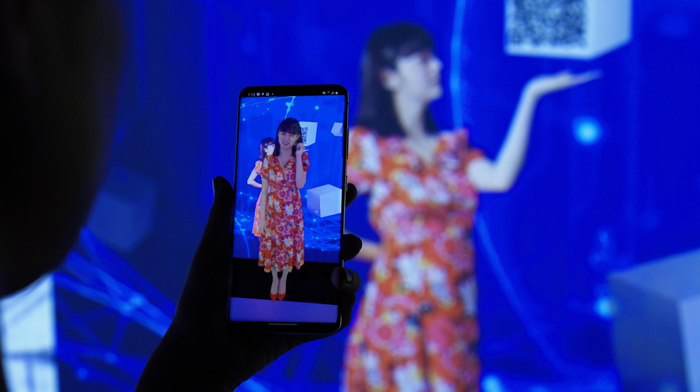
Kato: That's right. At GINZA 456, we lend 5G-enabled smartphones to customers with reservations at the entrance. When they enter the store, Eliza Ikeda appears via the smartphone's AR to guide them. It starts with her introducing herself: "I'm Eliza Ikeda, your guide at GINZA 456."
Sakamoto: I feel AR customer service is an idea with future potential. It was great that this new interface with customers emerged and became reality during our discussions about store operations during the pandemic.
Designing experiential content and exhibition spaces in light of the pandemic
Nanki: We designed all the experiential content on B1F to be viewed through the 5G smartphones customers hold. This includes "au XR Door," which lets you visit any place in the world, and "Virtual Hamasta," where you can walk around a virtual Yokohama Stadium.
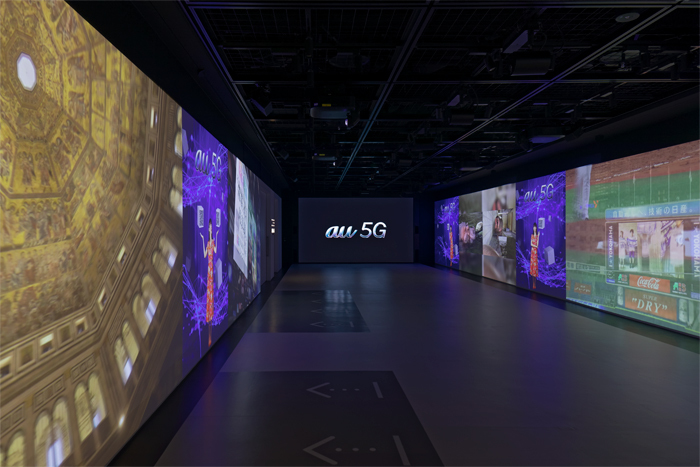
Kato: Given the current situation, gathering people for events is difficult, and physical exhibits carry risks from many people touching and congregating. So we decided to pivot decisively towards experiences customers could enjoy alone, viewing through their smartphones. We chose formats that minimized infection risk as much as possible. I remember these ideas gradually expanding as we discussed them together with KDDI.
Sakamoto: It was never just a formal discussion; we really brainstormed freely while chatting casually (laughs). Since we were working remotely, we took notes on the words and diagrams that appeared in PowerPoint. When envisioning future stores and services, there are many things that can't be easily put into words. If you try to discuss them formally in presentations or meetings, the substance tends to get blurred. Instead, I felt it was better to freely brainstorm whatever came to mind, building ideas layer by layer to clarify them.
Nanki: In terms of looking toward the future, the structure of B1F is also key, right? We made the entire wall a screen and installed movable walls. We also designed the ceiling so the projectors could be freely positioned. As a result, B1F has a "design that allows exhibits to be freely changed." This was something KDDI decided from the very beginning of the planning, right?
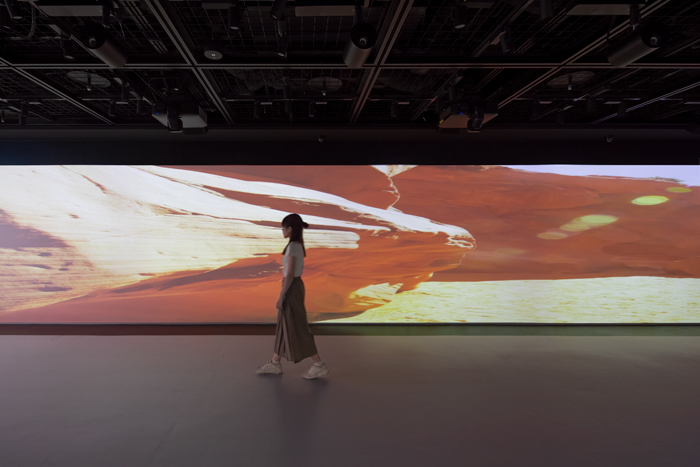
Sakamoto: Given our theme of future experiences, we anticipate countless unforeseeable changes ahead. Technologies and services we can't even imagine now might emerge. Moreover, in this unpredictable post-pandemic era, the flexibility of the hardware itself becomes crucial. We strongly wanted to create a spatial design capable of adapting to various futures.
The entrance facade signifying a gateway to the cyber world
Nagi: Beyond the basement design, KDDI consistently prioritized two key points from the project's inception: the store name "GINZA 456" and the presentation of the entrance. We installed a facade displaying LED video at the entrance. I was also responsible for this design. When selecting the LEDs, I even visited the factory to conduct experiments, temporarily assembling LEDs to verify their appearance. I strongly felt KDDI's commitment to detail.
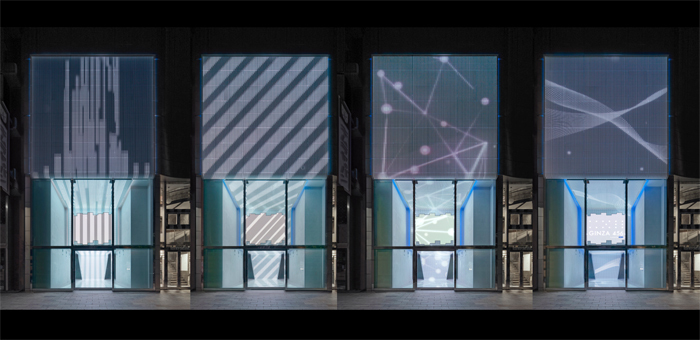
Sakamoto: 5G represents the evolution of the cyber world, and the entrance is precisely the gateway from the real to the cyber. It needed to express the worldview of that gate—where someone walking through Ginza's streets plunges into the cyber world. With experience being crucial for 5G adoption, the key was how effortlessly we could get people to cross that threshold.
Kato: The entrance's surreal quality acts as the gateway to the cyber world, right? Once inside, future content and spaces unfold. I think that turned out well as an experiential design.
Nanki: That's why we put a lot of thought into the façade design. While a large façade would create impact, the exterior wall area of the store is limited. So, we connected the façade from the exterior wall to the entrance and into the store, creating a sinuous flow to give it depth. I believe this created the impact seen from the outside.
Initially, we proposed creating an exhibition space on the side of the entrance. Given the size of the site, we didn't want to leave any space unused (laughs). However, KDDI stated, "We want the entrance to have a strong symbolic presence." They expressed a desire for a space stripped down to the bare essentials. That resolve, that unwavering stance, really left an impression.
As digitalization advances, "brand spaces" that create touchpoints become increasingly important
Nanki: I believe spaces that communicate a brand's intent, like this store, will become increasingly important. At FCC, we call these "brand spaces." Mr. Sakamoto, who has been involved in KDDI's brand strategy, what are your thoughts?
Sakamoto: I believe the role of physical spaces will only grow. The most crucial element in building a brand is creating touchpoints with customers—generating places and opportunities for communication. As digitalization advances, creating those touchpoints becomes harder. That's where the importance of the physical realm lies. The more the cyber world evolves, the more we need real spaces as touchpoints with customers. Within that, it's vital for them to experience the KDDI brand.
Nagi: What I learned from this design is that it creates a space where the "software"—the 5G experience content—and the "hardware"—the building itself—are deeply intertwined. The hardware is designed to maximize the potential of the software, and if either were different, this space wouldn't work. They're fused at a high level. Brand spaces are places that communicate the brand centered around the physical, but perhaps we'll see more spaces where software and hardware are integrated in the future.
Sakamoto: For us, the future holds infinite possibilities, so it's great we built a facility designed for change. While the current exhibition centers around 5G smartphones, we plan to continuously update it with content and experiences that go beyond just smartphones. Of course, we also want to explore experiential initiatives in collaboration with partner companies, not just our own. We aim to create a place where not only tech enthusiasts, but also people casually walking through Ginza can easily enjoy a glimpse of the near future.
Was this article helpful?
Share this article


Newsletter registration is here
We select and publish important news every day
For inquiries about this article
Back Numbers

Author
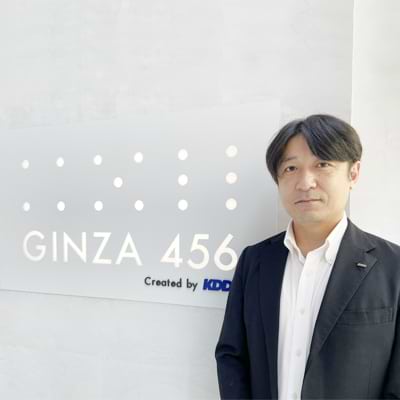
Shinichi Sakamoto
KDDI Corporation
Communications Headquarters Advertising Department
Head of Brand Management Office and Strategic Group Leader

Ryusuke Nanki
Dentsu Inc.
Future Creative Lead Office
Architect

Toshifumi Kato
Dentsu Inc.
Business Producers Division 6
Integrated Marketing Producer
