
Note: This website was automatically translated, so some terms or nuances may not be completely accurate.
 Solving Future Challenges This Way by Future Creative Center [10/29]
In this era of rapid change, what is branding that serves as the driving force for corporate growth?
Dentsu Inc.'s cross-functional creative organization, the "Future Creative Center" (FCC), is a group of over 70 members supporting future-building domains with creativity beyond the boundaries of advertising. In this series, centered on the theme "Future × Creativity," center members discuss their upcoming initiatives.
This installment focuses on an FCC member-led corporate branding project for the SKY Perfect JSAT Group. While the group is best known for its media services centered on the pay-TV service "SKY PerfecTV!", it also operates a space business within the group, which accounts for over half of its total profits. The challenge was to effectively reposition and communicate this unique business structure.
The key point was that this corporate branding also served as internal communication for employees and their families. In other words, it needed to connect the branding to the growth and sense of fulfillment of the company and its employees. Furthermore, the project progressed during the COVID-19 pandemic, yielding new discoveries along the way. We spoke with Dentsu FCC members Kentaro Mito and Seri Tanaka, along with Dentsu Inc. producer Kohei Kadota.
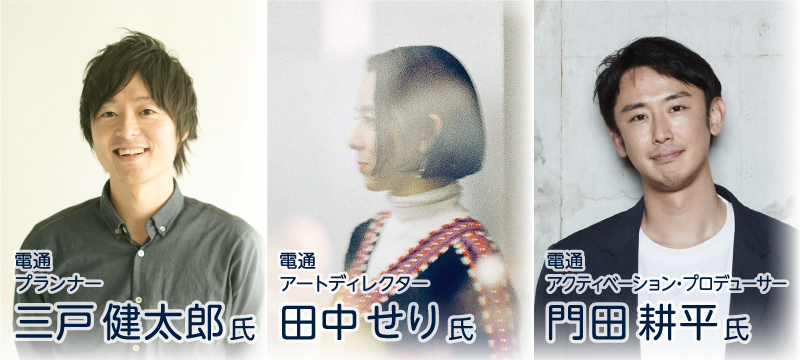
※This interview was conducted online.
Aiming for an expression that excites employees, like "Come join us!"
Mito: The SKY Perfect JSAT Group (SJ) engages not only in satellite broadcasting but also in space ventures. However, this aspect is not widely known. The corporate branding project began to clearly communicate that SJ is a unique company with two pillars: media and space ventures. Production started in March, and the first phase—a TV commercial, newspaper ads, and a website—launched in October. We plan to continue this corporate branding effort over the next three years.


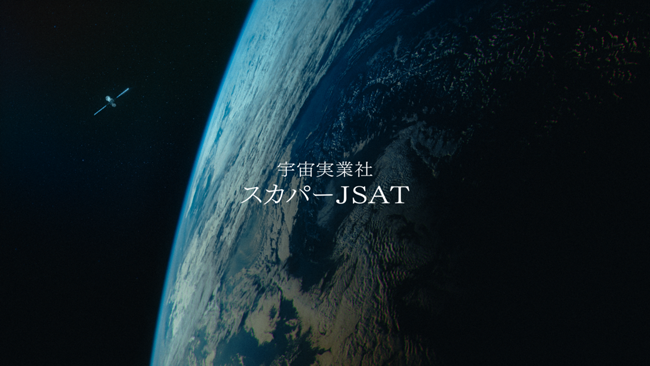
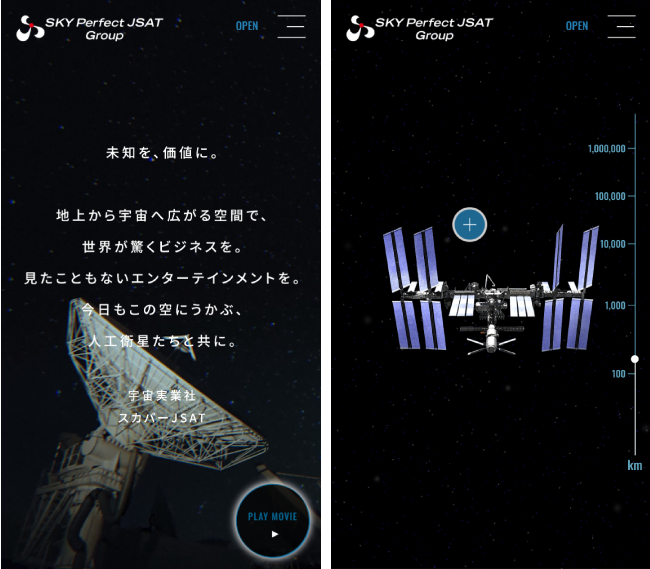
Kadota: I was originally in charge of SJ's sales operations, listening to client challenges. SJ's space business generates nearly double the profits of its media business. It was Japan's first private company to launch a communications satellite and still operates about 20 communications satellites. It's a rare company that doesn't just do research and development but actually conducts "business" in space.
Mito: Of course, effectively communicating this to the world was essential, but this time, conveying it to employees and their families—the company's internal stakeholders—was also a key point, right?
Kadota: Exactly. Competition in the media business is intensifying with more rivals entering the market. Meanwhile, despite being a pioneer in Japan's space sector, many people remain unaware of SJ's space operations. We wanted to empower employees to speak proudly about SJ's appeal. Furthermore, because the media and space businesses are so fundamentally different, there was little interaction between them. We aimed to break down those barriers. Alongside increasing public awareness, we needed corporate branding that would become a driving force for SJ's own growth.
Mito: I received that brief from Mr. Kadota at the beginning of this year. As the planner, I was tasked with developing the overall project strategy and concept. Mr. Tanaka, as the art director, handled the visual aspects. We brought in Chika Watanabe, who joined the company the same year as Mr. Tanaka and myself, as the copywriter, and proceeded with the project.
Tanaka: When developing concepts, we established a fundamental principle: "We won't create ads that merely explain what SJ is doing now."
Mito: Yes. While that approach could explain SJ to the outside world, it wouldn't easily inspire employees to feel excited about the company's future or boost their motivation and pride. After all, we know our own company best. Instead, we aimed for an expression that would make everyone feel happy and drawn to it, like a "come join us" kind of vibe.
Tanaka: The idea was to create a "guidepost" or "landmark" for the company and its employees to aim for, rather than just describing the current SJ.
Mito: To achieve that, we needed expressions that would really resonate with employees, messages that would strike a chord. So instead of us just unilaterally proposing ideas, we first created opportunities to hear directly from employees. We asked simple questions like, "Why did you join SJ?" and "What does space mean to you?"
Tanaka: Rather than us constantly proposing ideas, we worked together with employees, looking in the same direction. This is the "accompanying" approach to production that FCC values.
Mito: Exactly. Rather than just stating what we want to do or say, reflecting the employees' thoughts and feelings creates branding that resonates within the company.
We aimed for advertising that doesn't just convey information at a glance, but becomes a beacon and guide for the company.
Mito: That's how our brand slogan, "Turn the unknown into value," was born. What struck me during the interviews was the sheer passion and love for space among the employees. When I considered why they were so drawn to space, I realized it's because space itself is the ultimate unknown.

Brand Slogan: "Turn the unknown into value."
That thrill of the unknown is a universal human feeling, right? Space is full of the unknown, which is precisely why it's fascinating and fuels the passion of the employees. So, we decided to create a slogan focused on the unknown.
Tanaka: Earlier I mentioned "creating a landmark." Expressing a clear target or goal means it ends once you reach it. In such a rapidly changing environment, we should create an unchanging essence—a direction or landmark—rather than a specific target. This makes for a brand that endures through any era. In that sense, I think it fits the current situation well.
Mito: Another key point in this branding is redefining SJ as the "Space Enterprise Corporation." This also stems from employee feedback. One person described SJ as "a comprehensive trading company in space," and that phrase really stuck with me. Breaking it down, while there are institutions doing R&D in space, few companies actually conduct business operations there like SJ does. That's how copywriter Watanabe came up with the term "Space Enterprise Corporation."
Kadota: For this first phase of corporate branding, we created a TV commercial, newspaper ads, and a brand website. This serves as the "Declaration Phase," clearly stating, "This is what SKY Perfect JSAT is."
Mito: Since we had the phrase "Turning the unknown into value," the next step was ensuring our creative materials conveyed that effectively. For example, it wouldn't work to create overly explanatory materials while claiming to represent the unknown. For the TV commercial, we minimized explanations about SJ's actual business operations as much as possible.
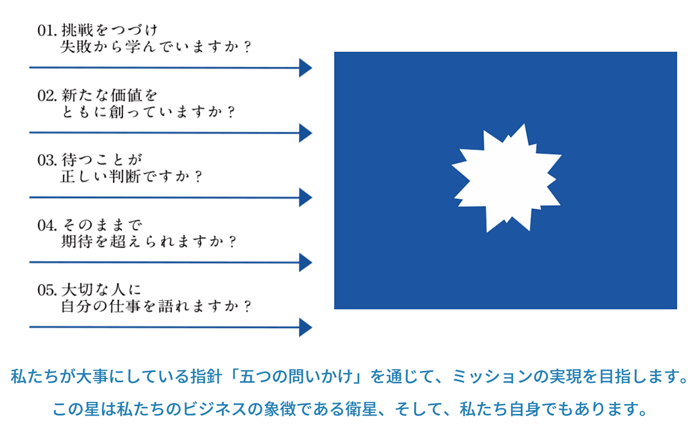
Tanaka: I designed the newspaper ad graphics. Since it serves as a marker and guidepost, simplicity was paramount. While photos of space or satellites would be easy to understand, that would make it an explanatory ad. Readers might overlook it as a familiar visual. So, we chose a bold yet simple visual.
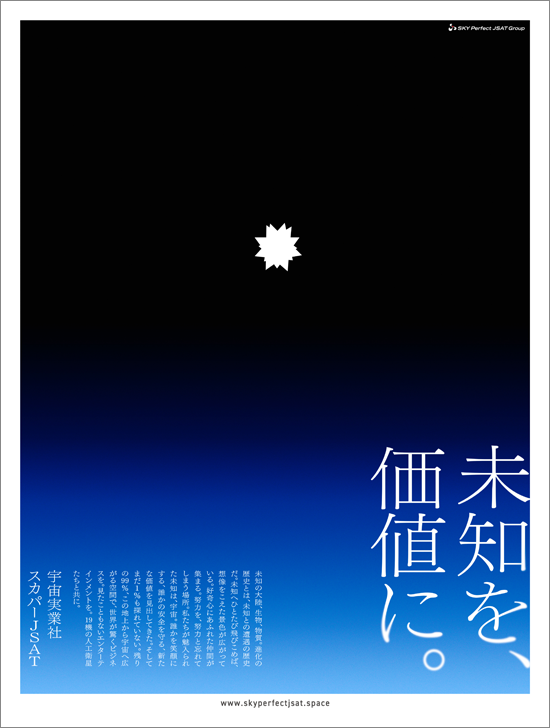
Mito: It takes a lot of courage to go this simple with a newspaper ad design, right? (laughs) I worked alongside everyone on SJ's cross-departmental branding project this time. Because we spent a long time discussing and sharing our thoughts, we could make this courageous decision quickly. I'm truly grateful for that.
Tanaka: That's right. But I believe ads aren't just for showing the company to the outside world; they're also for the employees who see them. If that's the case, rather than an explanatory ad where the information is complete just by looking at it, I wanted a visual that acts like a signpost – something that makes you want to follow this company, to see where it's headed next.
Specifically, we conceptualized the unknown as "white space," positioning the upper half as a "black void" and incorporating a signpost-like star design. We chose an abstract star over specific photos or images because we wanted it to symbolize both the satellite representing SJ's media business and the employees themselves who turn the unknown into value. The gradient from blue to black can be interpreted as the pre-dawn horizon or the horizon seen from space. We made it a visual open to the viewer's interpretation.
The "show it to your family" idea born from remote production
Mito: It was all remote production during the pandemic, but surprisingly, it worked out, didn't it? (laughs) We did the Los Angeles shoot remotely, and while making the commercial felt daunting, it turned out to be possible...
Kadota: When the commercial was scheduled for its first TV airing on October 1st, we also set up a way for employees and their families to watch it, right?
Mito: That's right. With the pandemic, many SJ members are working from home. We couldn't hold a company-wide meeting to present the finished commercial, so we agonized over how to share it with everyone. That said, internal communication is crucial for this corporate branding. So, after discussing with SJ, we had President Eiichi Yonekura (Representative Director and President, SKY Perfect JSAT Corporation) personally email all employees the day before the air date. Along with his thoughts on the project, he wrote, "Let's watch tomorrow's commercial on TV."
The idea of having family members watch it also stemmed from this background. We were conducting remote previews of the edited commercial, and the SJ team members showed it to their elementary and junior high school-aged sons and daughters, or their husbands, right then and there to get their opinions. There were moments where we refined the commercial while valuing the opinions of employees' family members, which made me think, "We really want family members to see this too."
Tanaka: What I felt through this project is that branding that drives corporate growth should reflect the feelings and direction of the company's employees. It's obvious, but the people who know the company best and have the deepest affection for it are its employees. That's precisely why it must express their sentiments. However, sometimes those inside don't notice, or they can't fully articulate those feelings. That's where we can help with our perspective and expression. I felt we should be that kind of presence.
Mito: It's crucial not to just suddenly present ideas like, "How about this expression?" but to create things collaboratively, accompanying the employees through dialogue, like we did this time. And another thing: to create branding that drives a company's growth, it's important not just to state the company's current value, but to focus on what it will do in the future, what kind of attitude excites people, and the "follow this lead" approach.
Moreover, right now, we don't know what the next few months will bring. In such times, rather than clearly pointing to a destination like "aim for this," I think it's more important to express the "unchanging essence" of the company, including its stance. Branding isn't a one-off thing; it's something that continues over the long term.
Kadota: SJ's corporate branding is also planned over a long-term period of about three years, right?
Mito: Yes. This time was the declaration phase, a classic branding initiative, but going forward, we'll take actual action. Back in March when we made the proposal, we also put forward the phrase "From SAY to DO." Moving forward, we'll build the brand through real actions, so please look forward to it.
Was this article helpful?
Share this article


Newsletter registration is here
We select and publish important news every day
For inquiries about this article
Back Numbers


Author

Kentaro Mito
Dentsu Inc.
第3CRプランニング局 フューチャークリエイティブ3B部長
クリエイティブディレクター



Tanaka Seri
Dentsu Inc.
Future Creative Center / Creative Planning Division 4
Art Director / Graphic Designer

Kōhei Kadota
Dentsu Inc.
Business Producers Division 5
Activation Producer