Note: This website was automatically translated, so some terms or nuances may not be completely accurate.
 Boost CX with AI-powered auto-generation tools! What is "CXAI"? [2/2]
In-House Creative Production with AI: Financial Industry Edition. Prepare for the Accelerating Growth of "Patterns"!
Four Dentsu Group companies jointly released the creative auto-generation AI solution "CXAI".
Introducing CXAI enables companies to bring creative production in-house. How does this process unfold, and what becomes possible? Takuya Kodama, who oversees Dentsu Inc.'s AI project " AI MIRAI," explains using the financial industry as an example.
<Table of Contents>
▼CXAI: Combining Various AI Modules to Enable In-House Creative Production
▼How to Handle the Accelerating Growth of Landing Page and Banner "Patterns"?
▼Can "CXAI" Save Mr. A, Who's Struggling with an Overwhelming Number of "Patterns"?
▼ "Automate only what can be automated" – even that alone delivers significant results!
▼CXAI Trial Partners Wanted
CXAI: Combining various AI modules to enable in-house creative production for businesses
It's been about two months since the release of "CXAI," an AI service supporting the in-house production of creative assets for digital marketing. We've received inquiries from clients across a wider range of industries and business types than we had anticipated.
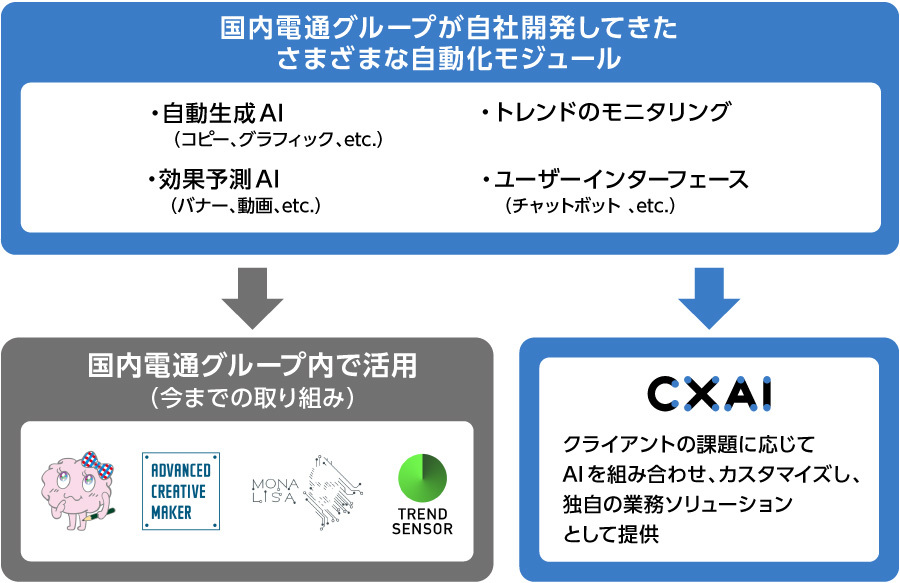
We are expanding our service offerings in response to inquiries not only from large corporations but also from startups and production companies.
Now, hearing suddenly about "supporting in-house creative production with AI" might make it hard to visualize how to proceed with implementation or what becomes possible.
Therefore, this time, we'd like to simulate how in-house creative production might progress using a hypothetical case study of an insurance company.
How to handle the accelerating increase in landing page and banner "patterns"?
"Even if they say it's possible now..."
Mr. A, responsible for new customer marketing at an insurance company, sat before his computer screen, troubled.
This company had quickly recognized the trend toward digital marketing and prepared its environment accordingly.
By accumulating data on site visitors' browsing patterns and product interests in its database, and leveraging marketing automation based on predefined scenarios, the company achieved the ability to dynamically switch landing pages and in-site banners according to each visitor.
The internal launch was spectacular, and the possibilities seemed limitless. Then, Mr. A's boss said this to him:
Starting next month, use this platform to test displaying different banner ads for recommended products by designing scenarios for each customer.
Of course, it's okay to fail. The important thing is to challenge as many possibilities as possible and run the PDCA cycle. This time, that has become possible.
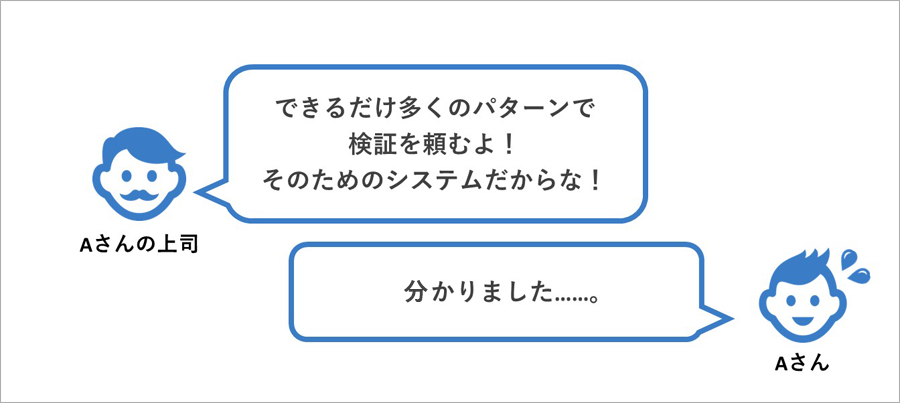
That said, these very words from his boss were the source of Mr. A's frustration.
After all, there are over 10 insurance products alone. We can also create numerous scenarios for which users to recommend them to.
Furthermore, even when we talk about product banners, there are over ten different customer experience channels—each with varying sizes and characteristics—such as websites, apps, mobile platforms, and email newsletters.
And when you factor in A/B testing for copy and graphics... it's mind-boggling.
Even a simple multiplication yields a staggering number of possible patterns.
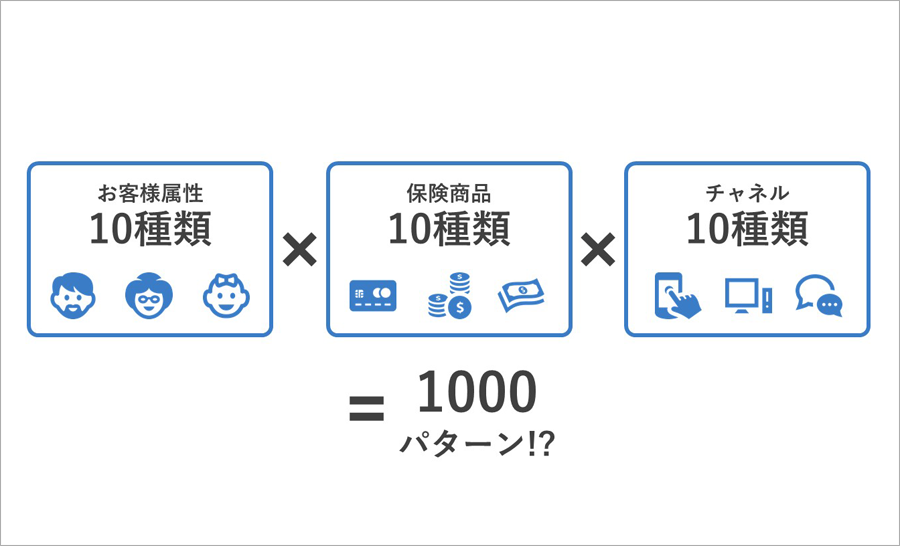
With a limited budget, how far can we really go?
We do have designers in-house. However, our in-house designers don't possess such advanced skills, and since they're in a different department, it feels awkward to ask them for minor adjustments or resizing.
It's not that we don't trust external production company creators, but as the number of patterns increases, so does the potential for rework and mistakes. Mistakes mean lost opportunities, plus the time it takes to replace them.
Mr. A's sigh only grows deeper.
Can CXAI save A, who's struggling with an overwhelming number of "patterns"?
So A considered utilizing CXAI's "Banner Generation and Resizing Module."
This module allows you to pre-register banner layout patterns. The AI then flexibly rearranges each element to modify the layout and resize it.

Humans handle the parts requiring "human touch," like scenario design and copywriting, while automating the most labor-intensive step—resizing—to advance in-house creative production.
As a result, we now only outsource the creation of "basic patterns" (15 types/month) to production companies. Beyond that, we can proceed with the work using CXAI and the capabilities of our in-house designers.
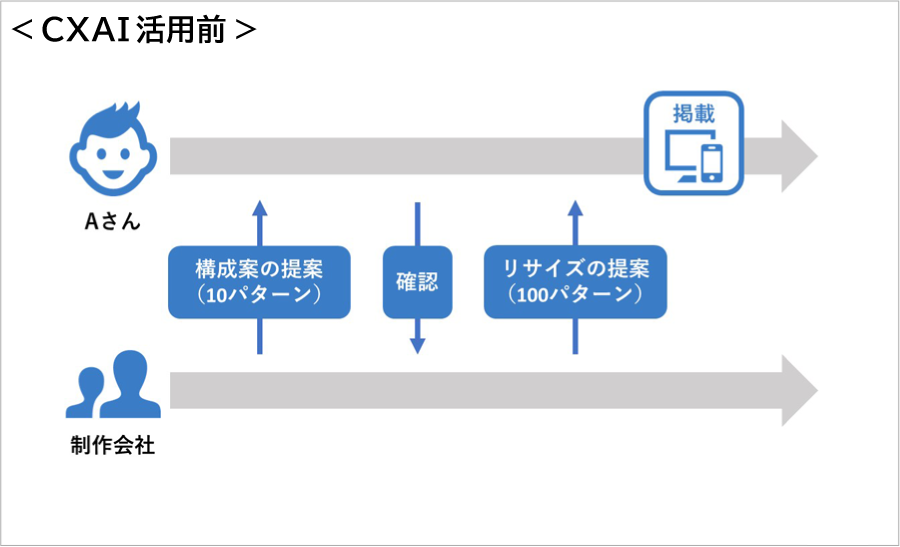
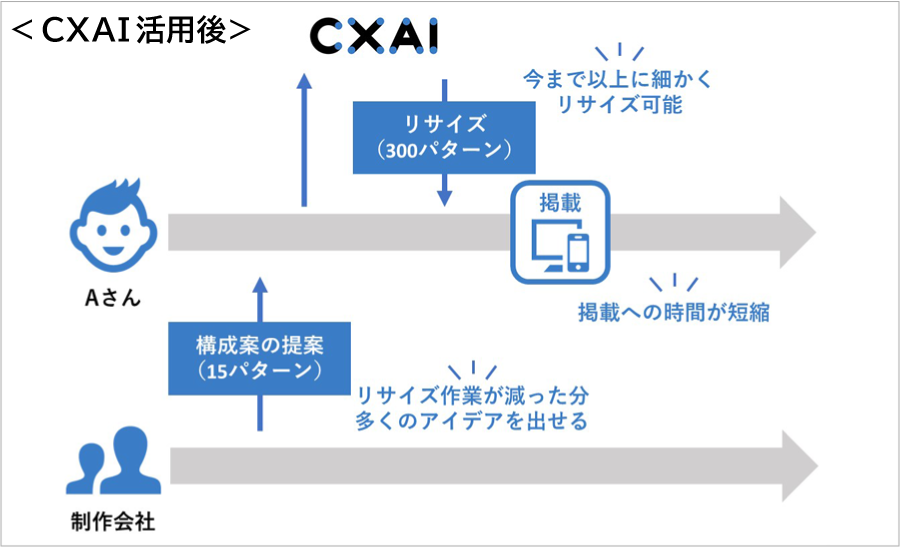
Viewed this way, the benefits extend beyond mere labor savings. Testing multiple layout patterns enables A/B testing, while production and revision speeds also increase.
Furthermore, even if Mr. A transfers to another department or the production company undergoes organizational changes, operations can continue without losing this know-how.
This allowed Mr. A to deploy more creative patterns than ever before, effectively delivering new product information to a larger user base.
"Automate only what can be automated"—even that alone yields significant results!
When people hear "in-house creative production," they might imagine having to hire in-house designers and creators and handle everything entirely within the company.
Similarly, "utilizing AI" can sound like completely disrupting existing workflows and replacing everything with machines.
However, as we saw in Mr. A's example, there's no need to in-house the entire creative production process, nor is there a need to entrust everything to AI.
Automating what can be automated with CXAI and "changing the division of roles between internal and external teams" is also a form of in-house production. And even that alone has the potential to yield significant benefits.
Next time, using a company in the retail and distribution industry as an example, I'd like to introduce a different approach to utilizing CXAI than the one discussed this time.
CXAI Trial Partners Wanted
CXAI is recruiting "Trial Partners." If you're interested in trying it out, please contact us at the email address below.
CXAI Secretariat Email: aimirai@dentsu.co.jp
Was this article helpful?
Share this article


Newsletter registration is here
We select and publish important news every day
For inquiries about this article
Back Numbers

Author

Kodama Takuya
Dentsu Group Inc. / dentsu Japan
Group AI Strategy Team / Chief AI Master
AI MIRAI's Vision for the Near Future of AI and WorkBoost CX with AI-powered auto-generation tools! What is "CXAI"?How Will Generative AI Transform Marketing?Dentsu Inc. × Creative × Technology. The Challenge of the Dentsu Prototyping Hub!"Coffee Shop: AI and Me" – Speaking Frankly About Generative AI