Note: This website was automatically translated, so some terms or nuances may not be completely accurate.
 Creating a Sustainable Era: Insights on Collaboration—Sustainable d Actions— [4/11]
What business opportunities will the "carbon border tax" bring?

Sustainable Actions Webinar Report
Last year, Dentsu Inc. Japan Network's Sustainability Promotion Office and Dentsu Inc. Team SDGs hosted a webinar titled "Europe's Advancing Carbon Border Tax: Global Trends and Required Corporate Responses."
To achieve "carbon neutrality" (net-zero greenhouse gas/CO2 emissions), a goal gaining global attention, the EU has announced it will introduce the "Carbon Border Adjustment Mechanism" (CBAM), commonly known as the "border carbon tax," starting in 2026.
This webinar explored the impacts and business opportunities the border carbon tax will bring to industry, featuring discussions with experts.
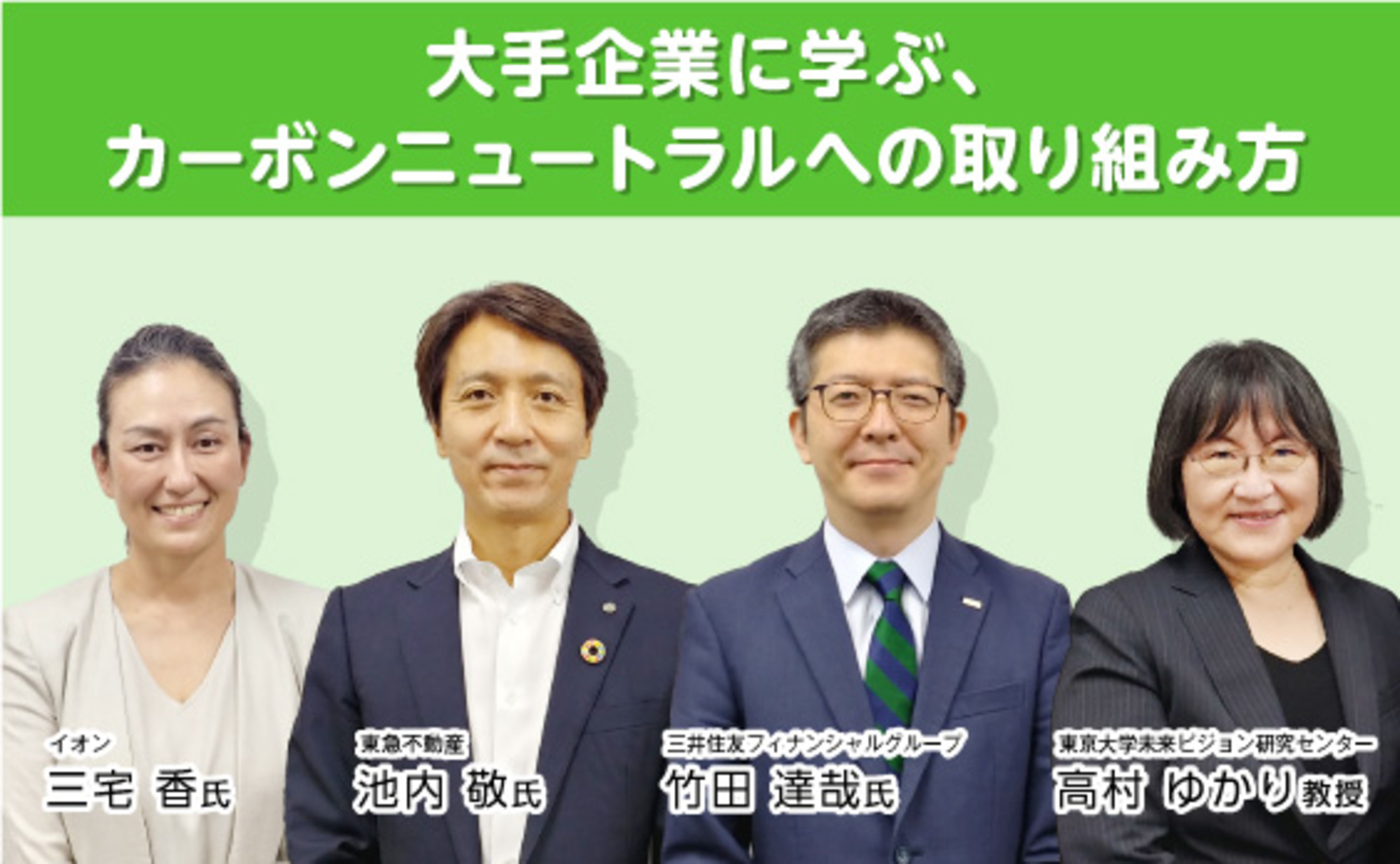
Speakers included Professor Yukari Takamura from the University of Tokyo's Center for Future Vision Research and Rie Takeshima from Dentsu Inc. Team SDGs. The session primarily featured a discussion between these two speakers.
Past webinar reports are available here
・ "Carbon Neutrality" Can Be a Catalyst for Enhancing Corporate Value
・Learning from Three Major Companies: Approaches to Achieving Carbon Neutrality

What is the "Border Carbon Tax" that could significantly impact global business?
Globally, efforts to achieve carbon neutrality are intensifying. Over 140 countries (as of late 2021) have set targets for net-zero greenhouse gas and CO2 emissions by 2050, including the EU. Japan also declared its "2050 Carbon Neutrality" goal in 2020. Reflecting this trend, more Japanese companies are setting carbon neutrality targets for 2050.
Furthermore, countries are focusing on raising their 2030 targets and formulating related policies. The EU announced its "Fit for 55" package in July 2021, amending a series of climate and energy laws. Among the various new legislative proposals, the Carbon Border Adjustment Mechanism (CBAM), scheduled to start in 2026 after a trial period beginning in 2023, is expected to have a particularly significant impact on industry.
This mechanism requires EU-based businesses handling imports from outside the EU in five sectors—steel, cement, aluminum, fertilizers, and electricity—to pay a price equivalent to the carbon price that would be paid within the EU if the same product were manufactured locally. Importers must declare the volume of imported goods and their associated carbon emissions, then purchase "CBAM certificates" equivalent to the emissions of the imported goods to pay the carbon price.
This system, referred to as a "border carbon tax" in Japanese media, is described by Professor Takamura of the University of Tokyo as follows: "Currently, the direct impact on Japanese industry is considered relatively small. However, the EU is continuing to consider expanding the scope of covered products. Additionally, there could be impacts when exporting products manufactured at production sites outside Japan into the EU, or when manufacturing products using covered goods like steel imported into EU production sites. We must continue to closely monitor future developments."
In an era where tracking emissions throughout the manufacturing process is essential
So, how will the border carbon tax impact industry going forward, and what risks and business opportunities does it present? Here, we present a talk session between Mr. Takamura and Rie Takeshima of Dentsu Inc. Team SDGs.
Takashima: First, could you explain the background behind why the EU decided to introduce a border carbon tax?
Takamura: It's closely tied to raising the 2030 target. By significantly increasing the goal from "at least a 40% reduction compared to 1990 levels" to "at least a 55% reduction," they've created a situation where they must strengthen emission reduction measures. On the other hand, for European companies exposed to international competition, unless measures are strengthened not only within the EU but also outside it, they will be at a competitive disadvantage.
Takashima: I see. So, it's not just about the noble cause of climate change response; there's also an intention to properly protect European industry. How is the US responding to these EU moves?
Takamura: In the U.S., measures like a border carbon tax have been discussed and proposed since the 2000s. However, due to the slow progress in raising domestic mitigation standards, there hasn't been much movement toward implementation. Yet, under the Biden administration that took office in January 2021, a major goal of "50-52% reduction compared to 2005 levels" was set, reigniting interest in a border carbon tax.
Takeshima: Compared to these developments in Europe and the United States, Japan seems to be lagging behind considerably.
Takamura: In Japan, there has been discussion about putting a price on carbon, but concrete measures have been slow to materialize. However, the "Green Growth Strategy for Carbon Neutrality by 2050" announced in 2020 indicates a direction to "proceed without hesitation with carbon pricing that contributes to growth, leading to enhanced industrial competitiveness, innovation, and investment promotion."
The issue I see is that, while many companies feel they are paying a fair amount in relation to energy, for example, Japan is seen from outside the country as not paying much for carbon. The problem is that payments are not necessarily proportional to carbon emissions and are not sufficiently visible as a "price for carbon."
Takashima: So, the key point is how to visualize the carbon price for businesses and products, and as a prerequisite, measuring and visualizing emissions becomes a major key point.
Takamura: Yes. With a border carbon tax, the payment amount is determined based on reporting how much carbon is emitted during a product's manufacturing process. Therefore, accurately grasping the emissions of the products your company manufactures will become more important than ever before.
Considering the potential future expansion beyond the initial five sectors—steel, cement, aluminum, fertilizers, and electricity—it will become truly vital to also grasp emissions within the supply chain, known as "Scope 3".
※ When calculating greenhouse gas emissions related to business activities, emissions are categorized and calculated as Scope 1, Scope 2, and Scope 3. Scope 1: Direct greenhouse gas emissions from the company itself (fuel combustion, industrial processes). Scope 2: Indirect emissions associated with the use of electricity, heat, or steam supplied by others. Scope 3: Indirect emissions other than Scope 1 and Scope 2 (emissions from other companies related to the company's activities).
Border Carbon Tax Brings Business Opportunities to Each Industry
Takashima: As border carbon taxes are introduced going forward, could you tell us about the risks Japanese companies should be prepared to face?
Takamura: For the five sectors currently targeted, direct exports from Japan to the EU are either zero or very limited. However, there are likely cases where production takes place overseas and exports to the EU occur. Therefore, it will be necessary to assess the impact and risks to the business, including such scenarios. Particularly for the five targeted sectors, estimation and reporting of emissions will begin in 2023, so prompt action is essential.
Takashima: I see. What risks should industries outside these five sectors anticipate?
Takamura: The European Parliament has consistently advocated for including as many products as possible under the border carbon adjustment mechanism. Given the mechanism's purpose as a climate change countermeasure—reducing emissions outside the EU associated with products imported into the EU—sectors with significant supply chain emissions, such as automobiles and electrical/electronic products, are likely candidates for inclusion.
Takashima: On the other hand, if we view the border carbon adjustment as a business opportunity, what possibilities might arise?
Takamura: Once the border carbon tax is implemented, products with reduced manufacturing emissions will undoubtedly be valued by the market and gain cost competitiveness. Consequently, I expect businesses supporting industries' carbon neutrality efforts to expand. For example, there will be significant demand for products and services that provide solutions to decarbonization requirements. This includes energy businesses that can supply low-carbon or decarbonized energy needed for manufacturing, as well as equipment and devices that can reduce emissions in the logistics sector, encompassing manufacturing processes and transportation.
Takashima: Considering the emerging demand for facilities enabling low-carbon and decarbonized operations, opportunities seem to be expanding for real estate and municipalities attracting businesses.
Takamura: Exactly. The question is how to reduce emissions across the entire supply chain, including the manufacturing process. One beverage manufacturer decided that building a new, decarbonized factory would lower overall emissions from the manufacturing process and boldly constructed new production facilities.
Takashima: So it's crucial to look not just at risks, but also at business opportunities.
Takamura: I believe how companies track their Scope 3 supply chain emissions will likely become a major challenge going forward. If digital technology and information systems can help alleviate this burden, then products and services supporting emissions tracking and estimation represent significant business opportunities for the IT industry as well.
Takashima: I now clearly understand that border carbon taxes are a topic affecting various industries. Are there any trends companies should particularly watch going forward?
Takamura: I believe it's crucial to closely monitor policy developments related to border carbon taxes, not just in the EU but also in places like the US. As I mentioned earlier, managing Scope 3 emissions will be a key challenge going forward. Furthermore, companies will face stronger demands not only to track emissions but also to understand and appropriately manage their supply chains from the perspective of workers' human rights and social considerations.
Takashima: Thank you. Finally, this is a big question, but what kind of action is needed from Japan as a whole regarding border carbon taxes going forward?
Takamura: Understanding supply chain emissions is not just a challenge for large corporations. We must create mechanisms that enable thorough tracking of emissions and lead to reductions, encompassing the small and medium-sized enterprises (SMEs) that support the supply chain. As a nation, I believe we need to establish systems and environments that support such efforts.
Furthermore, as I mentioned earlier, Japan's current system makes the price of carbon difficult to see from the outside. This also hinders consumers in choosing products with lower emissions. I believe we should create a system where everyone can easily grasp and recognize the emissions associated with products.
Takashima: So, including national systems, it's about the entire supply chain working together, not just individual companies, to address this. Thank you for today.

Was this article helpful?
Share this article


Newsletter registration is here
We select and publish important news every day
For inquiries about this article