
Note: This website was automatically translated, so some terms or nuances may not be completely accurate.
 With Shopify Plus, e-commerce site development is no longer daunting! [2/2]
How Do You Define Requirements for an E-Commerce Site Built with Shopify Plus? ~ Dentsu Digital Inc.'s Requirements Definition Framework ~

In our previous article, we introduced Shopify Plus, its features, and its scalability.
While Shopify Plus provides many mechanisms to quickly launch an e-commerce site, what distinguishes an e-commerce site from a regular website is the need to integrate with tools and systems that support marketing initiatives—such as warehouses, external systems, existing members, and sales channels—and sometimes even build new systems from scratch, as we mentioned last time.
The critical phase during e-commerce site launch is "requirements definition," where we identify each of these elements and determine how to address and manage them.
In Part 2, we'll introduce the approach and process for requirements definition when using Shopify Plus, following Dentsu Digital Inc.'s framework.
Why Requirement Definition is Critical in E-Commerce Site Development
"Requirement definition" is an indispensable process in system development.
Specifically, it involves defining the system's direction, the features to be implemented on the site, and the specific development approach based on the company's business strategy, internal organizational structure and operations, marketing initiatives, goals, objectives, and the requirements needed to achieve them.
Furthermore, it is the phase where both the company and the vendor reach mutual agreement on whether the defined requirements can be met and whether the proposed approach is acceptable.
E-commerce sites, in particular, require more than just displaying content on the site.
- front-end functions like member registration, purchasing, and recommendations
- back-office functions like product management, member management, and order management
- integration with external systems and tools
These complex, e-commerce-specific functions are intertwined, making it no exaggeration to call it a web application rather than just a website. Additionally, consideration is needed from both the user experience perspective—such as the purchase flow and information architecture—and the operational perspective—such as how e-commerce operations will be managed.
Precisely because e-commerce sites are complex, carefully and meticulously advancing the requirements definition phase—understanding and clarifying what is needed from the system from both user and development perspectives—enables the subsequent development phase to proceed smoothly.
From a project management perspective, thoroughly defining requirements during this phase also helps prevent schedule delays, budget overruns, and reduced system quality.
Dentsu Digital Inc. 's "7 Key Points" Framework for Requirement Definition in Shopify Plus E-Commerce Site Development
Here, we introduce Dentsu Digital Inc.'s unique "7 Key Points" approach used during the requirements definition phase. These "7 Key Points" can also be applied to requirements definition for e-commerce platforms other than Shopify Plus, so please use them as a reference.
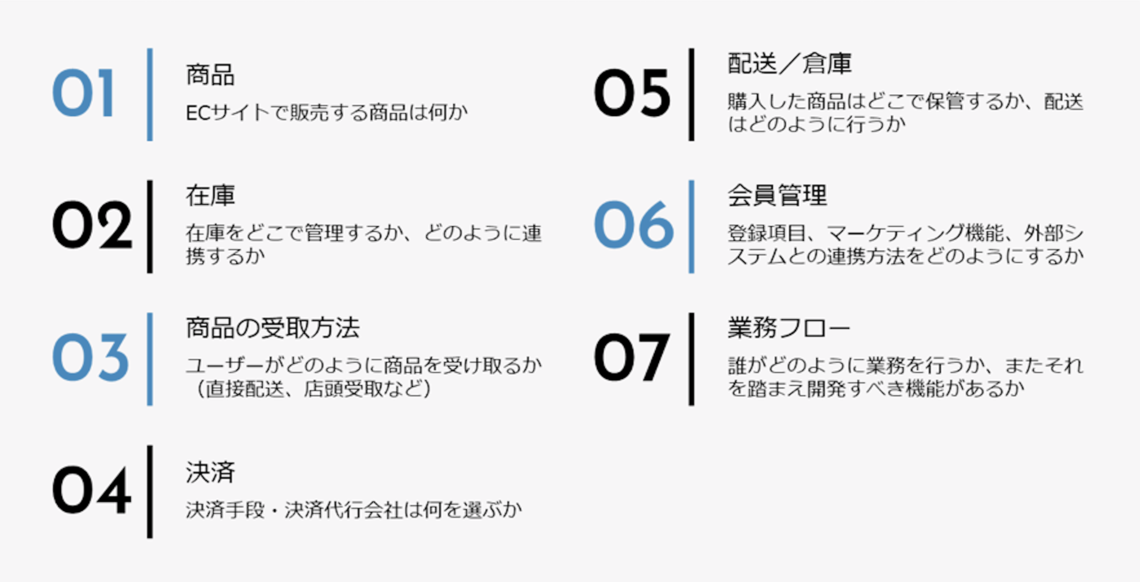
1. Products
Products are the most crucial element within an e-commerce site. Therefore, they are organized first during the e-commerce site development requirements definition.
・Product Type / Number of Products / Price Range
During the requirements definition phase, we organize the product overview information: "Product Type / Number of Products / Price Range." Therefore, defining detailed product information for the product page or creating a product master is unnecessary at this stage.
The number of products is organized as it impacts front-end design and usability. However, if the product count is enormous, additional consideration is needed regarding "how product information will be registered." In some cases, developing tools for product registration may be necessary, which can affect the overall project schedule. Therefore, it is recommended to organize this as early as possible.
・Product Categories / Search Axes
Once product types, quantities, and prices are organized, the next consideration is product categories/search criteria. Search criteria refer to search conditions beyond product categories, such as brand, color, or price range. For e-commerce sites, "how easily users can search for and find products" is key, making the information architecture for product categories/search criteria critically important.
Shopify/Shopify Plus has a limitation where product categories (called Collections on Shopify) cannot be set up with multiple levels, requiring careful planning for category design. Additionally, for search criteria, functional considerations are necessary regarding how to implement them within the constraints of Shopify/Shopify Plus's limitations.
2. Inventory
Inventory management is another critical consideration alongside products. Managing inventory on an e-commerce site is highly complex. Incorrect inventory management methods can lead to overselling or missed sales, resulting in customer complaints and lost opportunities, necessitating careful planning.
・Where to manage inventory counts for each product
First, Shopify/Shopify Plus requires registering inventory quantities for each product listed in the admin panel. Since this is a core inventory management function, managing inventory within Shopify/Shopify Plus is a viable option for those seeking minimalist e-commerce site development.
On the other hand, if you already manage inventory using an external system like a core system or OMS (Order Management System), you can continue using that system. In that case, you'll need to consider how to synchronize inventory levels between the external system and Shopify/Shopify Plus, as discussed later.
Additionally, inventory management may not be necessary when selling digital content.
・When managing inventory via an external system: How to integrate it with the e-commerce site
If inventory is managed in an external system like an ERP or OMS, you will need to consider or develop a system to reflect that inventory in Shopify/Shopify Plus.
Specific integration methods include automated integration using APIs or manual integration using CSV files, etc. Since inventory is constantly changing, it is best to choose a method that minimizes the burden on your company's operations staff.
Additionally, services like OMS that offer inventory management highly compatible with Shopify/Shopify Plus exist, so considering their implementation might be worthwhile.
3. Product Receipt Methods
The typical flow from purchase to product receipt on e-commerce sites has mostly been "purchase on the e-commerce site and have it delivered to your home."
- However, this has changed due to: * Increasing demand for online purchases of diverse products across various price points
- and businesses' desire to reduce the ever-rising shipping costs as much as possible.
- and the diversification of shopping experiences that seamlessly blend online and offline channels
have led to the adoption of various delivery methods.
The main options include direct delivery, in-store pickup, and in-store pickup/payment. The choice of method may require different settings in the management interface and, in some cases, additional development.
Additionally, since businesses may want to change or add pickup methods as they evolve, it's essential to plan for future functionality.
It's reassuring to know that Shopify and Shopify Plus can handle direct shipping, in-store pickup, and in-store pickup/payment methods using core features and official apps.
4. Payment Processing
Payment processing is a core feature unique to e-commerce sites. Shopify and Shopify Plus offer a limited selection of payment processors and methods, requiring you to choose from these options. There are two main points to consider when selecting:
・Payment methods suited to your products and target audience
The payment methods you should implement vary depending on your products and target audience. For example: "High-priced items often require credit cards," or "Products targeting younger demographics may need to include post-payment options." If end users don't find their preferred payment method, it can lead to cart abandonment, so careful consideration is essential.
・Payment processing fees / Sales commissions
Payment processing fees and sales commissions directly impact an e-commerce site's profitability. Processing fees vary by payment method across different payment processors. Additionally, using Shopify's proprietary payment solution, Shopify Payments, can eliminate transaction fees. Therefore, a comprehensive evaluation is essential.
5. Shipping/Warehousing
While terms like "shipping" and "warehousing" may seem straightforward, the scope of considerations is vast. As these represent ongoing operational costs for running an e-commerce site, it's important to explore options, including leveraging existing systems and infrastructure.
・Shipping Costs
Shipping costs are determined not only by the fees paid to carriers but also by warehouse storage fees, distribution labor costs, and other factors. While free shipping has become the norm recently, packaging materials and shipping costs are also rising, necessitating careful consideration.
・Warehousing
In e-commerce, deciding where to store products for sale is crucial. Options range from owning your own warehouse to outsourcing storage to third parties.
Warehouses typically use a WMS (Warehouse Management System) to manage shipping operations. For Shopify/Shopify Plus, there are several compatible services and WMS systems available. Selecting one of these can help reduce development and implementation costs.
・Fulfillment
Fulfillment refers to all operations occurring from when a customer places an order until the product reaches them. This includes shipping operations like receiving, inspection, packing, and shipping, as well as call center functions. When starting an e-commerce business, it is necessary to consider and define who will handle these tasks and how.
6. Member Management
While e-commerce sites handle various types of information, member information is crucial for implementing marketing strategies. There are three main points to consider regarding member information.
・New Member Registration Fields
Considering the input fields during new member registration is crucial for understanding user characteristics. However, excessive registration fields can lead to site abandonment or purchase abandonment. Therefore, it must be balanced between the registration barrier and the importance of data acquisition.
• Availability of member-related marketing features
Various marketing strategies exist for members, such as guest checkout functions that bypass registration, introductory coupons to boost new registrations, and membership tiers based on purchase frequency or amount. The extent of functionality required to implement these strategies must be identified during the requirements definition phase.
・Integration with existing member management systems (enabling single sign-on)
If member management is already handled on sites or services outside the e-commerce platform, users can log into the Shopify/Shopify Plus-powered e-commerce site using the ID/password from that system. This is Single Sign-On.
Implementing single sign-on requires the use of the Multi-Path API, which is only available with Shopify Plus. Therefore, if this requirement exists, you must select the Shopify Plus plan.
Integration with existing member management systems requires consideration not only from the system side but also from the perspective of user flows such as member registration, member information changes, and member cancellation.
7. Operational Workflow
E-commerce operational tasks can be broadly divided into the following two categories:
・Front-end Operations
Content creation, product photography, promotion/marketing
・Backend Operations
Product procurement, order management, shipping, inquiry handling, returns/exchanges, sales management
A business flow is a flowchart that organizes these operations from the perspective of "who, which system, in what order, and whether manual/automated."
Creating a business flow enables you to visualize operations from an objective perspective. From an e-commerce site development standpoint, it also helps identify functions that Shopify/Shopify Plus cannot fully support, revealing where customization is necessary.
Therefore, we recommend creating a business flow diagram, even a simple one, during the requirements definition phase if possible.
To Smoothly Advance Requirements Definition
This article introduced the importance of requirements definition for building an e-commerce site using Shopify Plus and presented "7 Key Points" to utilize when proceeding concretely. However, these are fundamental concepts only. The scope of development will vary based on your company's specific requirements, and additional elements beyond what was covered here may need to be defined. Please customize accordingly based on your project's scale and characteristics.
When defining requirements, it's crucial to communicate effectively with your vendor. This involves not only understanding Shopify/Shopify Plus's capabilities and what it can achieve, but also accurately conveying your company's needs and enabling the vendor to identify challenges based on those requirements.
Successfully guiding the project requires not only discussing the project's goals, objectives, and desired outcomes, but also thoroughly discussing what is sometimes unachievable. We strongly encourage you to focus on communication during your requirements definition process.

Was this article helpful?
Share this article


Newsletter registration is here
We select and publish important news every day
For inquiries about this article

Author

Tamie Kanemoto
Dentsu Digital Inc.
Commerce Division Commerce Direction Business Unit
System Consultant
