Note: This website was automatically translated, so some terms or nuances may not be completely accurate.
 Signs of Seniors Unlocking the Potential of the "100-Year Life Era" [2/3]
Contributing to Japan in the 100-Year Life Era? The Potential of the "Senior Pro Bono Segment"
This series, presented by Tamami Koga of Dentsu Inc. Senior Lab, explores the attitudes and intentions of seniors through quantitative and qualitative research. It introduces the real needs, trends, and future business possibilities revealed by these findings.
Part 2 presents the characteristics of the "Senior Pro Bono (Social Contribution) Segment" revealed by Dentsu Inc. Senior Lab's "Senior Trends Survey 2022," along with challenges and necessary solutions highlighted by interviews with "Pro Bono Reserve Force" members—students enrolled in Waseda University's Life Redesign College.
About Dentsu Inc. Senior Lab:
An internal cross-functional project at Dentsu Inc. focused on developing insights and solutions through research on seniors, with the theme of "Solving Social Issues in a Super-Aged Society."
Website: https://www.projects.dentsu.jp/seniorlab/
About Waseda University Life Redesign College (Waseda LRC)
A program that creates new university value—Life Redesign—by providing learning opportunities and communities for meaningful living and continued social engagement in later life, under the concept of "The University for the 100-Year Life."
Website: https://lrc.waseda.jp/
<Table of Contents>
▼What is Pro Bono? The Potential of "Senior Pro Bono"
▼Highly Motivated to Learn and Eager to Connect with Others.
Introducing the Characteristics of the "Senior Social Contributors"
▼Asking Waseda LRC Students: "How to Live in the Second Half of Life"
▼Considering Necessary Support and Solutions with Waseda LRC Students
What is Pro Bono? The Potential of "Senior Pro Bono"
Have you heard the term "pro bono"?
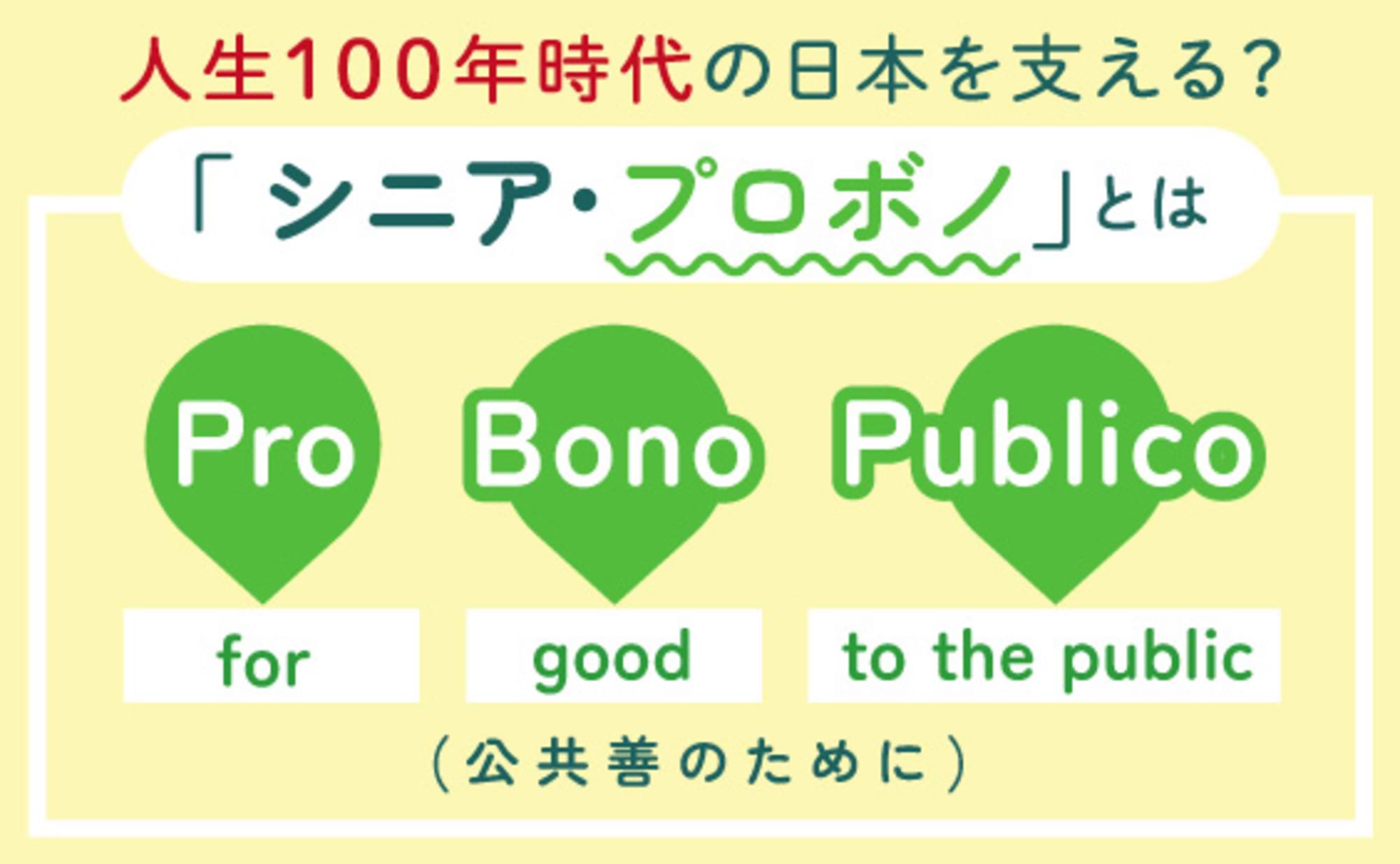
Derived from the Latin phrase "Pro Bono Publico" (for the public good), it refers to "volunteer activities where individuals provide skills and knowledge cultivated through their profession for social or public purposes." (Source: "Pro Bono: New Social Contribution, New Ways of Working" by Sagamaru)
Within volunteer activities, it specifically aims to contribute to solving social and public challenges. It involves voluntarily and without compensation utilizing skills and knowledge that would otherwise be compensated professionally if performed within a company or similar setting. Regarding compensation, "paid volunteering," where only travel expenses and actual costs are covered to make the activity sustainable, has also become more common in recent years.
This led Dentsu Inc. Senior Lab to consider whether "senior pro bono" could play a significant role in the coming era.
The "2025 Problem," where 8 million baby boomers turn 75 or older, and the "2040 Problem," where the junior baby boomer generation reaches 65 or older, often frame the increase in elderly populations as a "factor" contributing to rising social security costs and labor shortages.
However, looking at it another way, this also means that people who have spent years acquiring skills and knowledge valuable enough to earn professional compensation in companies and other organizations now have a certain amount of time available. Couldn't "senior pro bono" become the driving force for improving society going forward?
Results from the screening survey (N=9825) of the "Senior Trends Survey 2022" conducted by Dentsu Inc. Senior Lab (※1) revealed 291 pro bono practitioners (3%) and 866 volunteer practitioners (including pro bono) (9%). When asked about future intentions, 580 respondents (6%) expressed interest in pro bono work, and 1,365 (14%) expressed interest in volunteering, including pro bono. This indicates that more people are interested in participating in the future than are currently practicing.
※1 = The options in the survey indicated the following:
Pro Bono: Volunteer activities utilizing existing knowledge and experience
Volunteer: Regular community activities or volunteer work, and one-time volunteer activities done irregularly
In the open-ended responses about activities pro bono-interested individuals wish to pursue, many enthusiastic comments were seen, such as: "I want to utilize my financial planner qualification to promote asset management," "I want to teach children using my 40 years of experience as an educator," "Having worked in international departments for many years and having overseas assignment experience, I want to convey an international perspective to young people."
Highly motivated to learn and eager to connect with others. Introducing the characteristics of the "Senior Social Contributors"
What kind of people are seniors who practice social contribution? We introduce their characteristics based on the results of the questions "About Life and Lifestyle" and "About Hobbies and Learning" from the "Senior Trends Survey 2022".
In this survey (N=800), only 22 individuals met the criteria for "Senior Pro Bono." Therefore, we examined the characteristics of a total of 95 individuals, including volunteer practitioners, as the "Senior Social Contributors." (Figure 1)
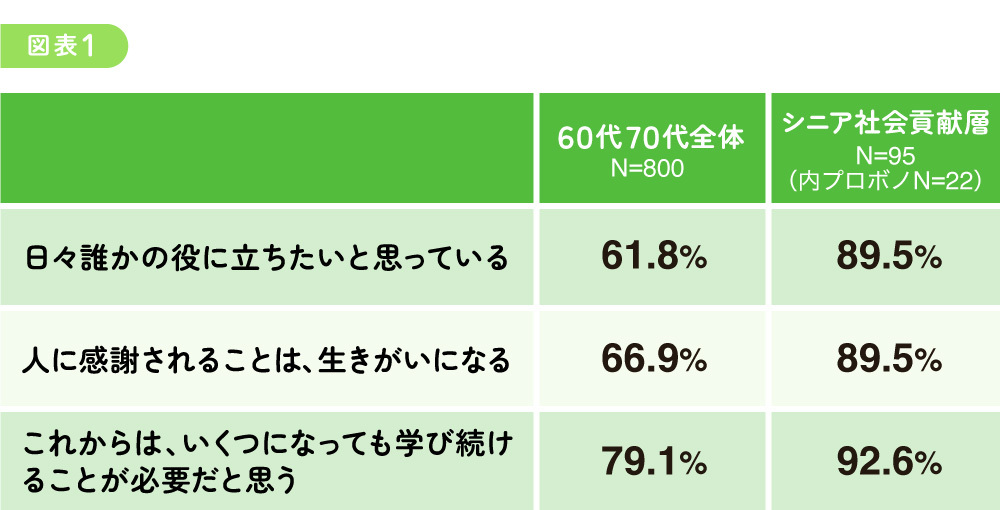
Alongside the mindset of "wanting to be of help to someone" and "finding purpose in being appreciated by others," the desire to continue learning is also high, at around 90%.
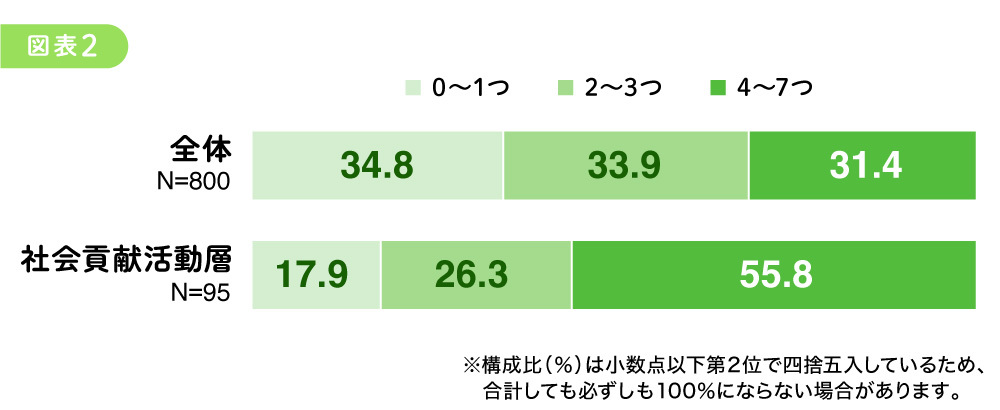
Moreover, they have broad social networks, with over half belonging to four or more communities. (Figure 2)
*Seven communities presented in the survey (people currently interacting with or building relationships):
1. Family/relatives, 2. Neighbors/community, 3. Friends from youth, 4. Work colleagues, 5. Hobby groups, 6. Volunteer groups, 7. Healthcare/caregivers
Looking at "Products/Services of Interest" (Figure 3), items reflecting health care, such as "brain age or hearing age measurement apps" and "easy-to-use home exercise equipment," and those reflecting a desire for learning, like "high-quality trips that combine thorough learning with enjoyment," ranked highly.
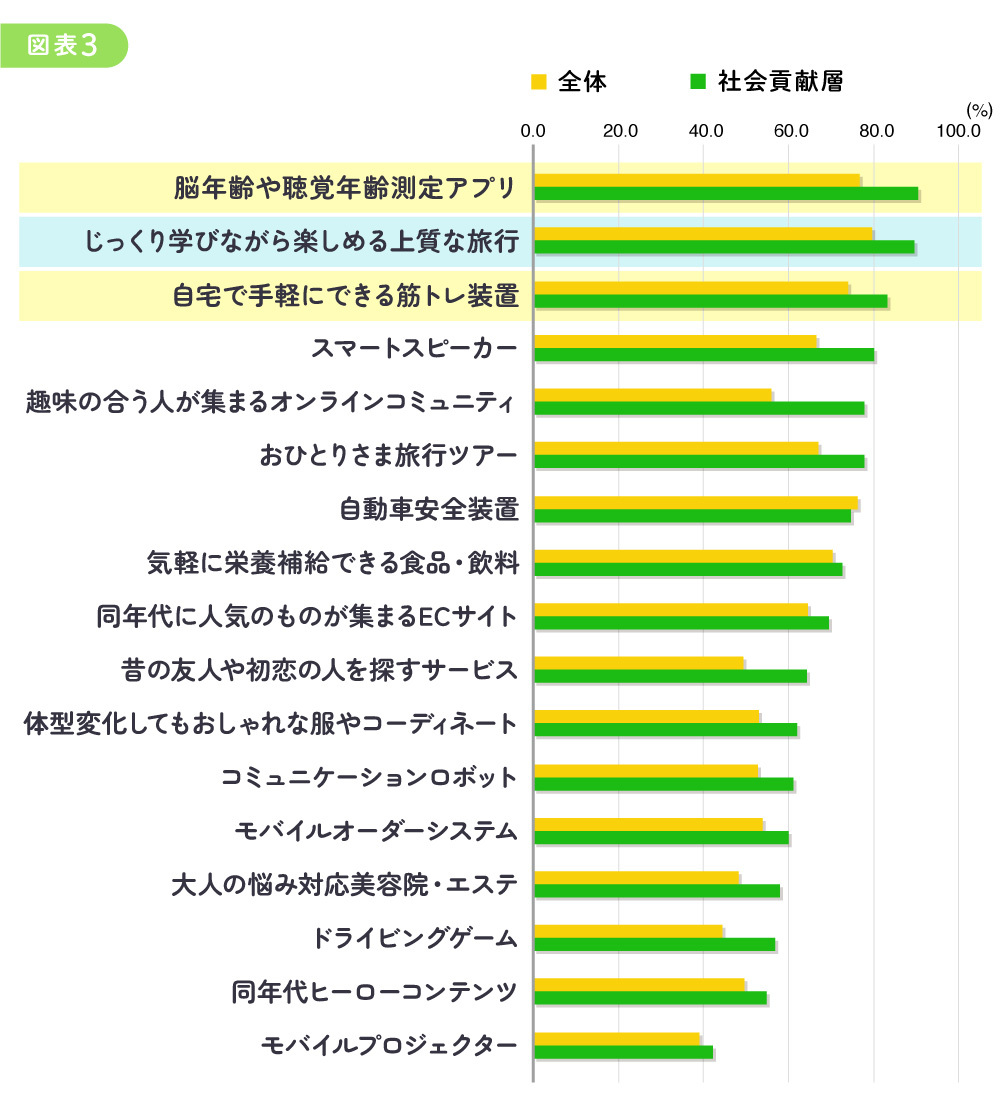
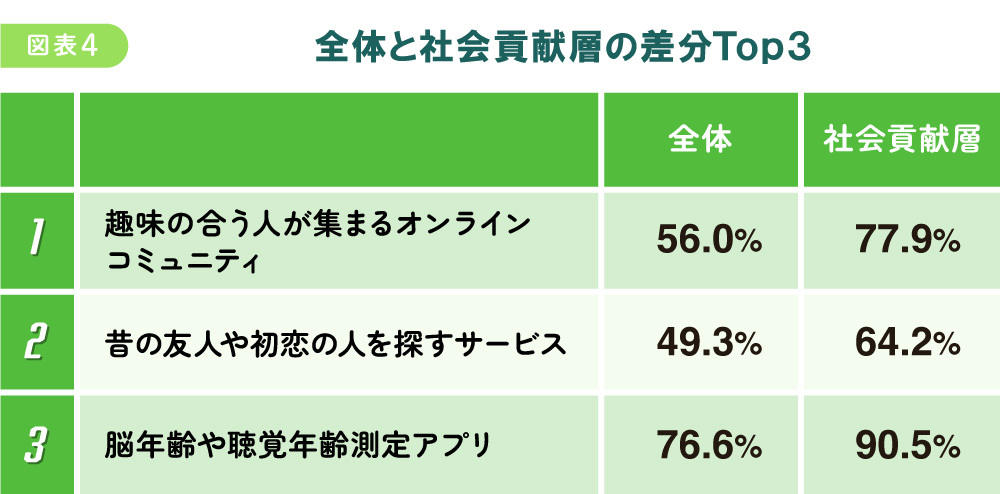
Comparing seniors aged 60-70 overall with the senior social contribution group (Figure 4), while differences in interest are significant across the board, "online communities gathering people with shared hobbies" ranked highest. These results suggest the senior social contribution group particularly seeks human connection. But why is that?
To uncover the underlying motivations of these individuals, we interviewed Waseda LRC students—who could be considered a "pro bono reserve force"—at .
Waseda LRC Students on "Living in the Second Half of Life"
Waseda LRC students are individuals motivated to contribute to Japan's future society and solve social issues. They aim to achieve fulfilling lives in the latter half of the 100-year lifespan era and reconnect the significant power of pre-seniors and seniors back into society. They learn about social issues, NPOs, and pro bono work in lectures, positioning them as "pro bono reserves" who could serve as role models leading the future image of seniors.
We conducted group interviews with six men and women in their late 50s to early 70s who provided particularly concrete answers about social contribution under "Areas I Want to Focus On" in a survey of all participants (N=33).
Participants included:
- A: With teaching experience, self-taught English, and aiming for international volunteer work
- B, who is pursuing a dual degree to become a certified librarian
- C, who wants to earn some income while solving social issues
- D, who wants to improve local food self-sufficiency based on experience in the food industry
- E, who wants to support disabled employment, including finding purpose, by leveraging experience working at a subsidiary for people with disabilities before retirement
- F, who aims to create spaces for shared laughter by leveraging overseas assignment experience, parenting experience, and a passion for comedy
These six individuals possess rich skills and experience that can be applied to solving social issues.
Hearing them speak, their motivation is high and their visions are clear. They applied to Waseda LRC specifically to prepare for this, aiming to relearn skills and build connections, and all seemed ready to start activities immediately.
However, as they learned, while their goals became clearer, challenges and hurdles also emerged. The main challenges can be summarized into the following three points.
- Hesitation in decision-making stemming from a strong sense of responsibility
Many organizations are working to solve the very problems they focus on. On one hand, it's hard to know if it's the right fit or if their skills will truly be useful until they try. On the other hand, once they decide to commit, they don't want to easily give up. This hesitation arises precisely because of their strong sense of responsibility.
- Anxiety about being tied to an organization
Working for an NPO constantly short-staffed brings satisfaction from being relied upon, yet creates conflict with the desire to freely use the personal time I've finally gained.
- Hesitation to take action on your own
Gathering information both on and off the job, thinking independently, recruiting peers, and initiating activities all require energy. Yet, pushing oneself as hard as in youth is no longer feasible. Trial and error also demands energy, leading to hesitation born from a desire to avoid failure as much as possible.
Support and Solutions Needed: Discussions with Waseda LRC Students
In the latter half of the group interview, we discussed what kind of support is needed to realize aspirations and solutions to overcome challenges.
Summarizing the results, the following three types of support were identified as necessary:
- Providing opportunities and venues for life career consulting
While respondents in the "Senior Signs Survey 2022" also expressed concerns about whether their skills would be useful, we found that even among individuals with the skills and experience of Waseda LRC students, some lack confidence in whether their skills are actually applicable or in demand. This may be influenced by the fact that while working within an organization allowed for objective assessment of value through evaluation and compensation, this sense of value becomes harder to grasp after retirement. There appears to be a need for opportunities and spaces to take stock of one's skills, reflect on how one wishes to live going forward, and consider what themes one would like to contribute to.
- Matching and Community Building
After taking stock of one's skills, the next step is connecting them with societal needs. While services exist to match pro bono volunteers with NPOs and similar organizations, senior pro bono volunteers face the risk of not finding such services. Furthermore, according to Waseda LRC participants, peers provide encouragement, support, and inspiration. Meeting like-minded individuals with shared aspirations could also serve as a catalyst for action.
- Creating Internship Opportunities for Senior Pro Bono
Responsible senior pro bono volunteers are unlikely to think lightly of quitting if things don't work out. Therefore, a trial period, such as a limited-time internship, where they can test whether the activity is manageable and fulfilling, would make it easier to try. This could also alleviate the concerns of the receiving organization and help align mutual expectations.
Waseda LRC participants are currently concretizing their individual goals through seminar activities. Waseda University and Dentsu Inc. will continue supporting the realization of these activities.
[Contact] Dentsu Inc. Senior Lab: senior-lab@dentsu.co.jp Contact: Koiso / Koga
[Survey Overview]
"Senior Trends Survey 2022"
Target Population & Sample Size: Men and women aged 60-70 nationwide; Screening: 9,825 respondents, Main Survey: 800 respondents
Eligibility: Individuals owning and using smartphones, PCs, or tablets at least once daily
Survey Method: Internet survey
Survey Period: July 2022
Survey Management: Dentsu Inc. Senior Lab
"Waseda LRC Student Questionnaire"
Target Population and Sample Size: 33 Waseda LRC Students
Survey Method: Online Survey
Survey Period: August 2022
Conducted by: Waseda LRC Office
"Waseda LRC Student Group Interview"
Participants and Sample Size: 6 groups of Waseda LRC students
Survey Venue: Waseda LRC Nihonbashi Campus, Classroom 1
Survey Dates: Session 1: August 30, 16:30-18:00; Session 2: September 6, 16:30-18:00

Was this article helpful?
Share this article


Newsletter registration is here
We select and publish important news every day
For inquiries about this article
Back Numbers
Author
Tamami Koga
Dentsu Inc.
First Integrated Solutions Bureau
Solution Director