Note: This website was automatically translated, so some terms or nuances may not be completely accurate.
 Urban Future Design Unit: Pursuing Happiness in the City [2/12]
Beyond just smart—the future of a "happy city"
The "Urban Future Design Unit" is a specialized team within Dentsu Inc., spanning domestic group companies, dedicated to supporting the creation of future cities and regions with high happiness levels ( see here for unit details ).
But what exactly is a "high-happiness city"?
We define it as "a city where residents and workers experience high satisfaction, and where a sense of hope and great potential for the future is palpable."
Amidst trends where "city development keywords" like smart cities, sustainability, urban OS, and DX transformation take center stage, we ask: "Is this change truly desired?" and "Will people feel happiness in this future?" We want to support the process of overlaying the future desired by residents with the future of urban and regional evolution, valuing subjective factors like "satisfaction" and "hope."
As one example of our efforts, we present the "High Happiness City Survey," which reexamines the future of desirable cities from the resident's perspective ( survey overview here ).
<Table of Contents>
▼Reimagining the "Future of the City" from the Resident's Perspective
▼The Future of Cities Where People Own Their Own Lives
▼Making Every "Connection" Deeper
▼Bringing "Positive Surprises" to Community Development
Rethinking the Future of Our Towns from the Resident's Perspective
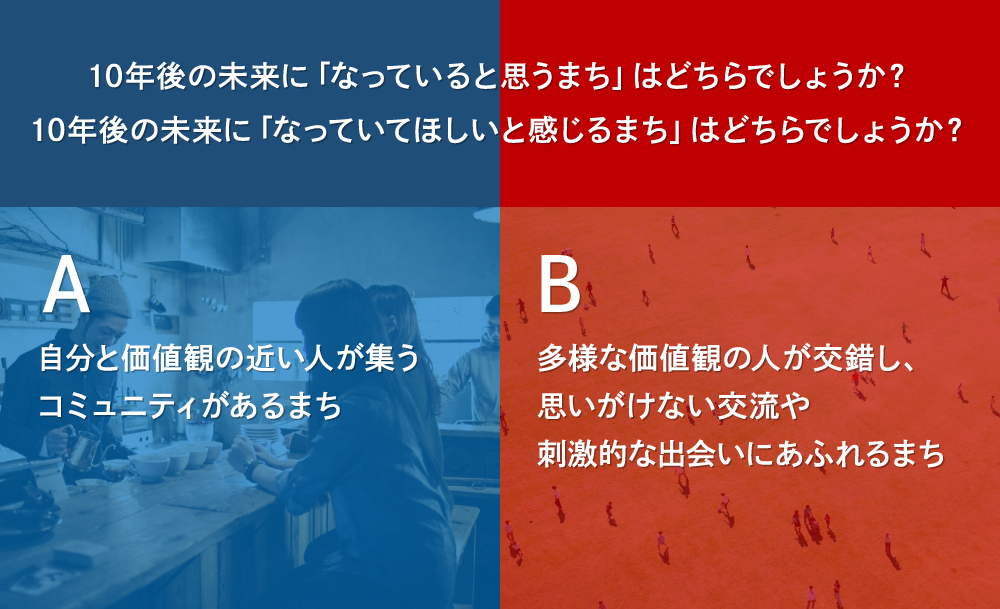
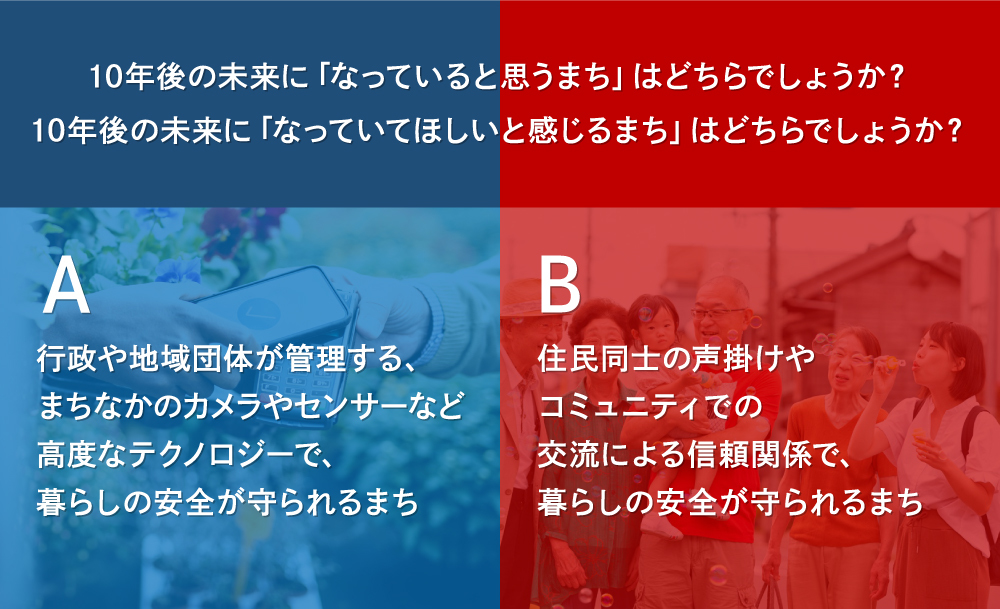
This survey compares two different cityscapes, asking respondents to identify "the city they believe will become the future" and "the city they hope will become the future." It aims to gather insights from residents' perspectives on what constitutes a happy future city.
By separately asking about perceived future predictions and desired future hopes, we aim to uncover deeper resident insights—such as the gap between stated opinions and true feelings often overlooked in conventional surveys—to serve as a catalyst for incorporating these perspectives into community development.
The Future of Cities Where People Own Their Own Lives
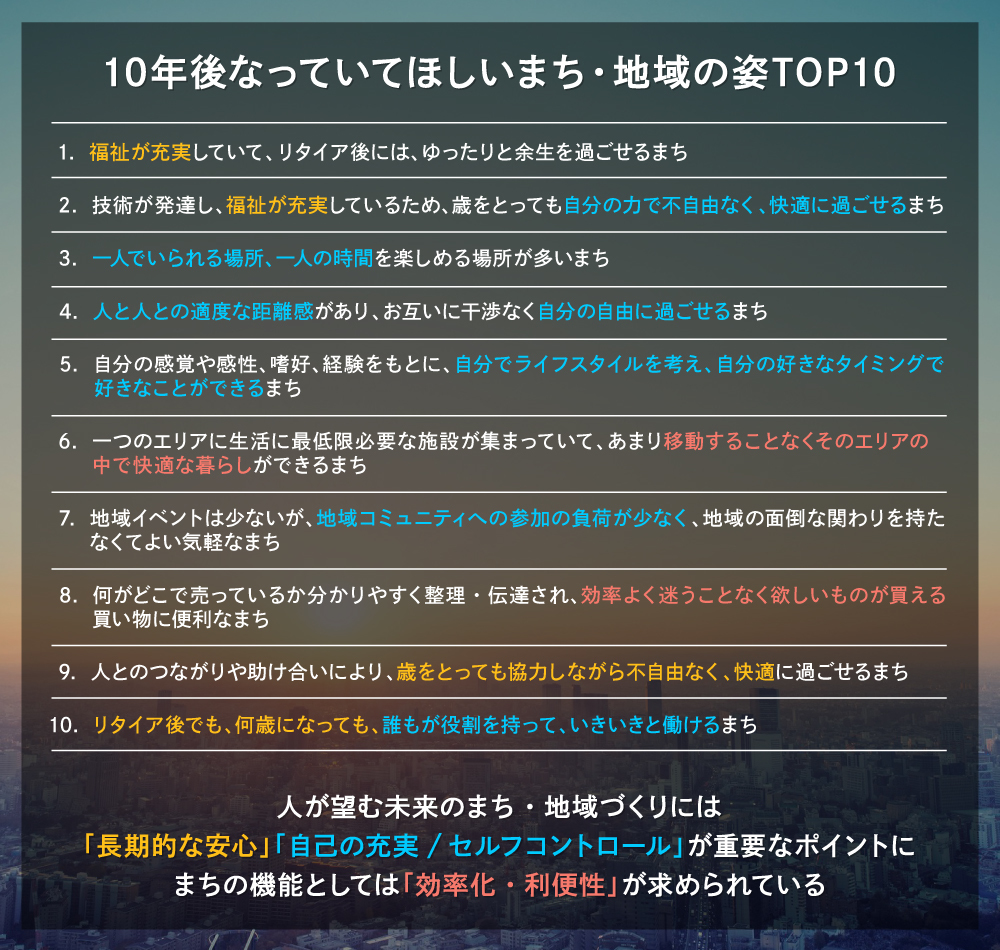
First, we present the top 10 desired city features.
Three major trends emerge: "Long-term security," "Ownership of one's life," and "Efficiency and convenience." What's interesting is the clear demand for maintaining ownership of one's life – the desire to "decide for oneself and remain free."
Recommendation technology and AI are making society increasingly "mistake-proof." Yet, when viewed from the perspective of people living fulfilling lives, it becomes clear that designing the future of cities must also recognize the value of each individual determining their own path and defining their own answers.
For example,
- DX should not provide answers, but rather support individuals in choosing their own right answers.
- Social support that enables people to maintain a rich range of self-determination even in old age
- Individuals who don't want to make mistakes, yet simultaneously refuse to relinquish ownership of their own lives
- Designing experiences that encompass not just achieving goals, but the journey to get there
Don't you think that just having these perspectives could change community development a little?
Even a single "connection" can be deeper
"Community connections matter"
"Digital mechanisms to create human connections"
I believe "connection" is one of the most frequently used keywords in community development. National surveys show that a higher percentage of Japanese people feel lonely compared to people in other countries, and proposals like "strengthen community connections to alleviate isolation and loneliness" are seen everywhere.
However, looking at real life around us, parents don't gather in parks as much as they used to, actively trying to make friends, and many people seem to want to avoid local events and activities as much as possible. What lies between this "I hate loneliness, but connection feels a bit burdensome"?
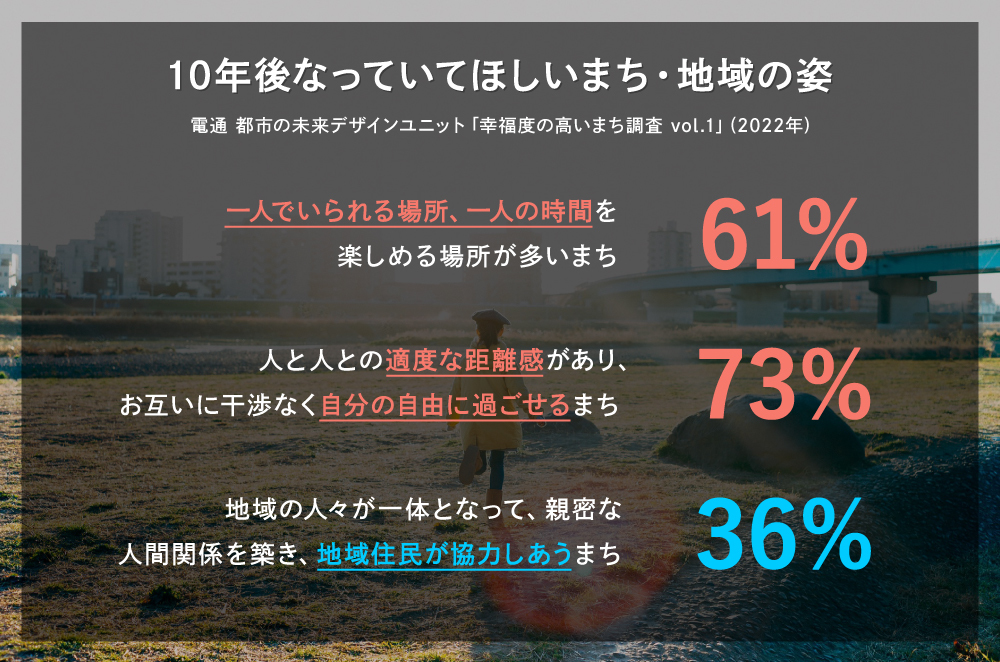
In fact, our recent survey showed that while 73% of respondents desired a "town with a comfortable distance between people," only 36% hoped for a "town where residents cooperate with each other."
So, do people not seek community connections?
It seems too simplistic to jump to that conclusion. Let's dig deeper into the survey results. What kind of connections are desirable? This question explored that perspective.
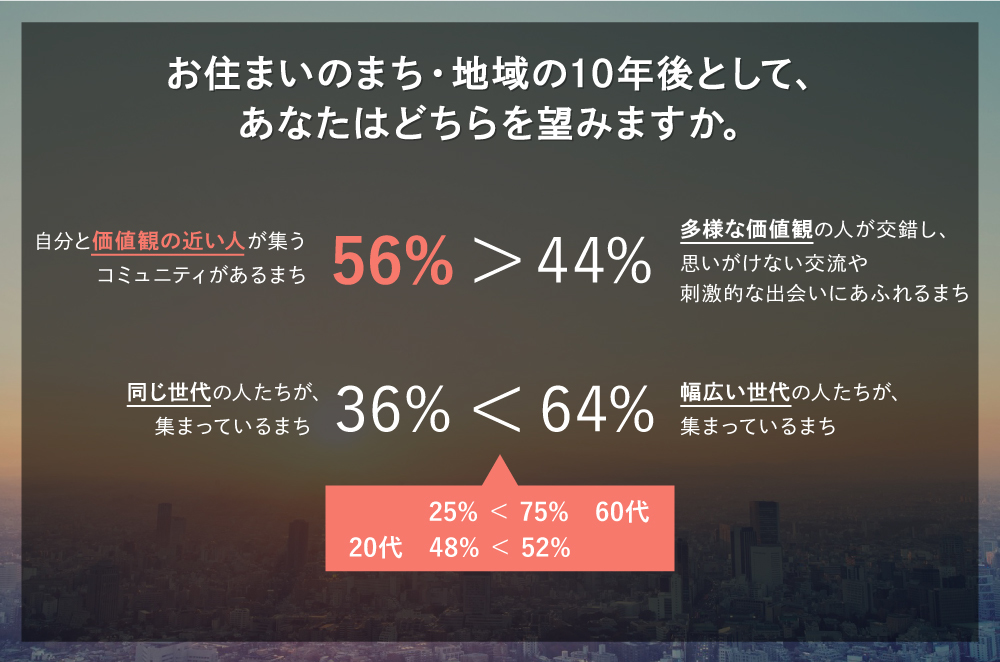
A significant 56% desire a "town where people with similar values gather." This figure is notably higher compared to the 36% who wanted a town where residents cooperate. Furthermore, differences in desired connections by generation are apparent: while many younger people seek gatherings with peers, older residents often desire interaction across a wider age range.
What this survey reveals is likely a "rejection of externally imposed connections" and a demand for "new ways of connecting" tailored to values and life stages.
It's not just about connecting; "designing comfortable ways to connect" is crucial.
For example,
- Connecting local residents through diverse sports teams × digital technology
- Neighborhood associations that allow remote participation anytime, anywhere, free from time and location constraints
- A municipality-led skill bank where residents safely help each other using their unique abilities
Through such initiatives, we may be able to offer proactive connections based on shared values and new, low-burden ways of connecting.
Leveraging digital technology has made it possible to design more flexible and diverse ways of connecting across regions and generations. As people's relationships with their homes also change—through remote work, relocation, and other shifts—there is significant value in reexamining connections themselves more deeply and realistically from the perspective of residents.
Bringing "Positive Surprises" to Community Development
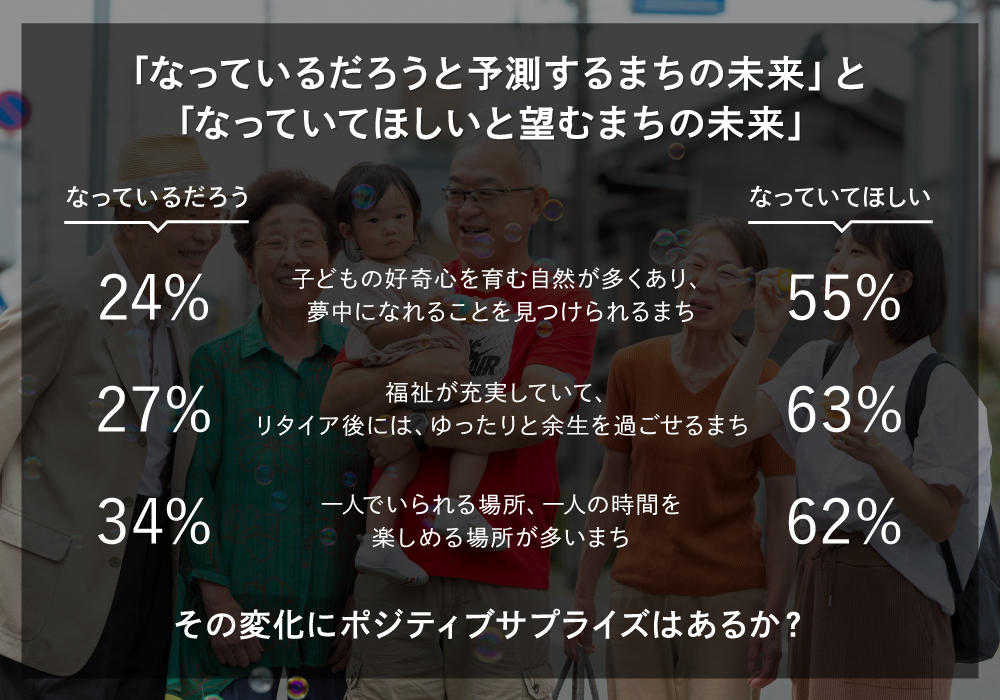
Finally, I'd like to focus on the gap between "the future of the city we predict will happen" and "the future of the city we hope will happen," a key feature of this survey.
The three townscapes introduced in the figure above highlight examples where the gap is particularly large for the item "We hope it will become this way, but we don't think it will." In each case, there is a difference of about 30% between "We hope it will become this way" and "We think it will become this way."
People desire these outcomes, but deep down, they've given up hope. Put another way, these are "future scenarios that would bring positive surprises to residents if realized."
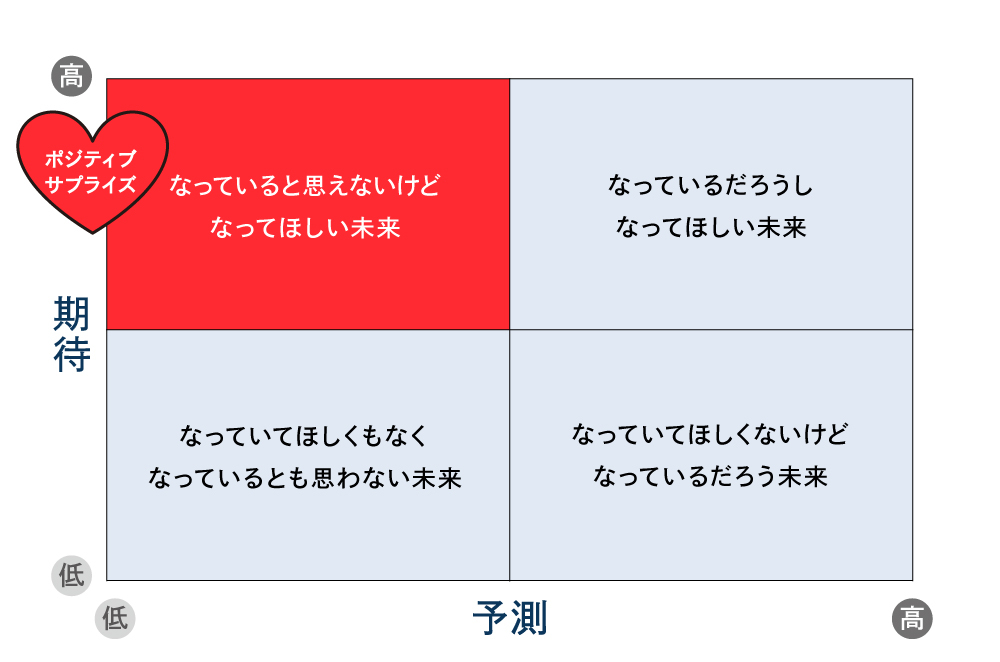
For example, incorporating the gap between residents' "expectations" and "predictions" as a perspective into urban development priorities. Re-examining city planning from the residents' viewpoint, focusing more on future changes that would be positive surprises for them, rather than changes that are simply expected to happen.
By focusing planning on changes that bring greater joy, we might achieve higher levels of happiness in our communities, even with the same amount of change.
What do you think?
When you look at urban development from a "people"-centered perspective, don't you find different insights?
Through unique research perspectives and deep societal insights, we continuously capture the evolving insights of residents and reflect them into creating happier communities. The Urban Future Design Unit will continue providing urban development information from our distinctive viewpoint. If you are considering urban or community development, please feel free to contact us.
[Contact for Inquiries]
Urban Future Design Unit
Website: https://www.dentsu.co.jp/labo/futuredesign_unit/index.html
Email: futuredesign-unit@dentsu.co.jp
【Survey Overview】
Survey Name: "High Happiness Town Survey vol.1"
Target Area: Kanto Region (Tokyo Metropolis/Kanagawa Prefecture/Chiba Prefecture/Saitama Prefecture/Gunma Prefecture/Tochigi Prefecture/Ibaraki Prefecture)
Respondent Criteria: Men and women aged 20–69
Sample Size: Total of 3,500 individuals
Survey Method: Online survey
Survey Period: October 29, 2022 - November 2, 2022
Research Agency: Dentsu Macromill Insight, Inc.

Was this article helpful?
Share this article


Newsletter registration is here
We select and publish important news every day
For inquiries about this article
Author

Kikuchi Sōzō
Dentsu Inc.
Business Transformation Division 1, Transformation Partner Division 5
Planner