Note: This website was automatically translated, so some terms or nuances may not be completely accurate.
 DENTSU DESIRE DESIGN's Approach to Marketing Reconstruction Based on "Theory of Desire" [22/40]
Considering the "Curse of Liking" ~ Decoding the Reality of "Liking" and Happiness Through Numbers
Dentsu Inc. Desire Design (DDD) is an organization that develops various solutions and disseminates information based on the relationship between consumption and desire.
Starting with the 21st installment, we analyze the " Heart-Moving Consumption Survey " conducted by DDD in May 2025, sharing insights and findings derived from the survey results.
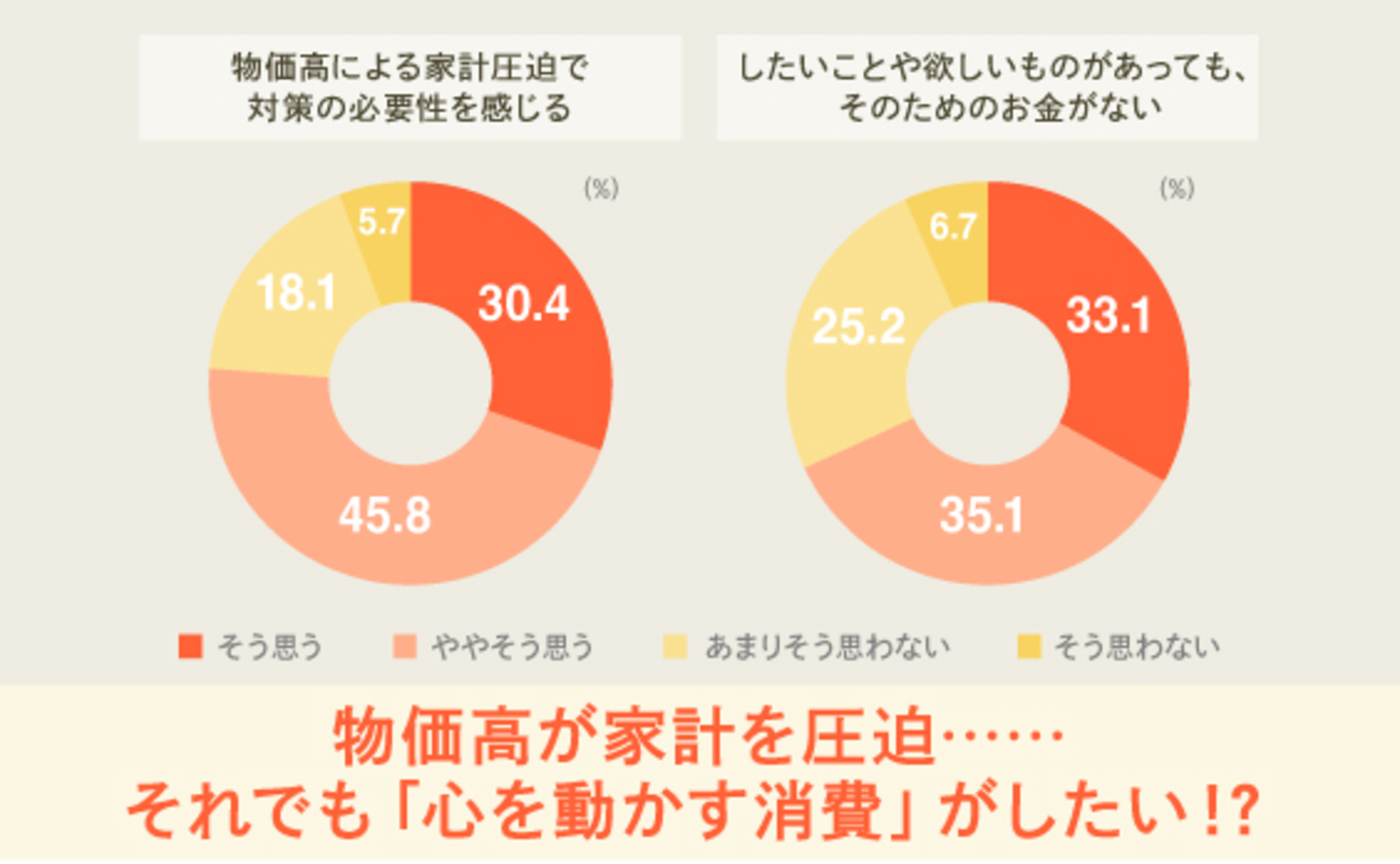
The previous article revealed that, compounded by rising prices, many people feel they lack the money to pursue their desires or buy what they want. This time, we shift our perspective to deliver an analysis focusing on people's feelings of "I like ○○."
"Turn your passion into your job," "Live for what you love." While these positive phrases abound, many people might feel trapped by a lifestyle or work style that prioritizes "liking" things. Are there really that many adults who can afford to spend time on their passions? Conversely, might those who haven't found their passion feel marginalized? Overall, how are people connected to their "likes" right now?
DDD's Akane Yamada posits a hypothesis about this "curse" stemming from "liking" and examines survey data from May 2025.
What is the "Hypothesis: The Curse of Passion"?
As seen in the term "fan activity fatigue," this idea suggests that even when people have something they love, they feel stressed by their inability to fully engage with that passion due to time constraints or mental limitations. Alternatively, amid booming "favorite" (people or things) trends, some worry about "not having anything they love." This raises the question: Could "favorite people or things" actually be restricting people's actions and thoughts?
Adults who prioritize time for their passions
I obtained a national career consultant certification as a hobby and now work in the field. In career counseling, I frequently hear people say, "I want to turn my passion into a job." Search engines even suggest "job hunting passion" as a top prediction when you search for "job hunting."
Furthermore, social media is filled with voices from people who have actually turned their passions into careers. The increasing number of related books published and survey results among younger generations also clearly show a growing demand for lifestyles and work approaches centered around keywords like "passion," "what you want to do," and "self-realization."
When asked whether they prioritize time spent on their passions, a remarkable 63.8% of all age groups responded that they "prioritize time spent on their passions."
Among 15-19 year-olds, 78.2% of males and 80.3% of females prioritized it, while for 70-74 year-olds, 72.5% of males and 74.8% of females did so. While the high rates among younger and older age groups might be less surprising if attributed to having less time consumed by school, work, or childcare, it's interesting to note that there's little gap among those in their prime working years. Even among 30-49 year-olds, around 60% maintain this priority.
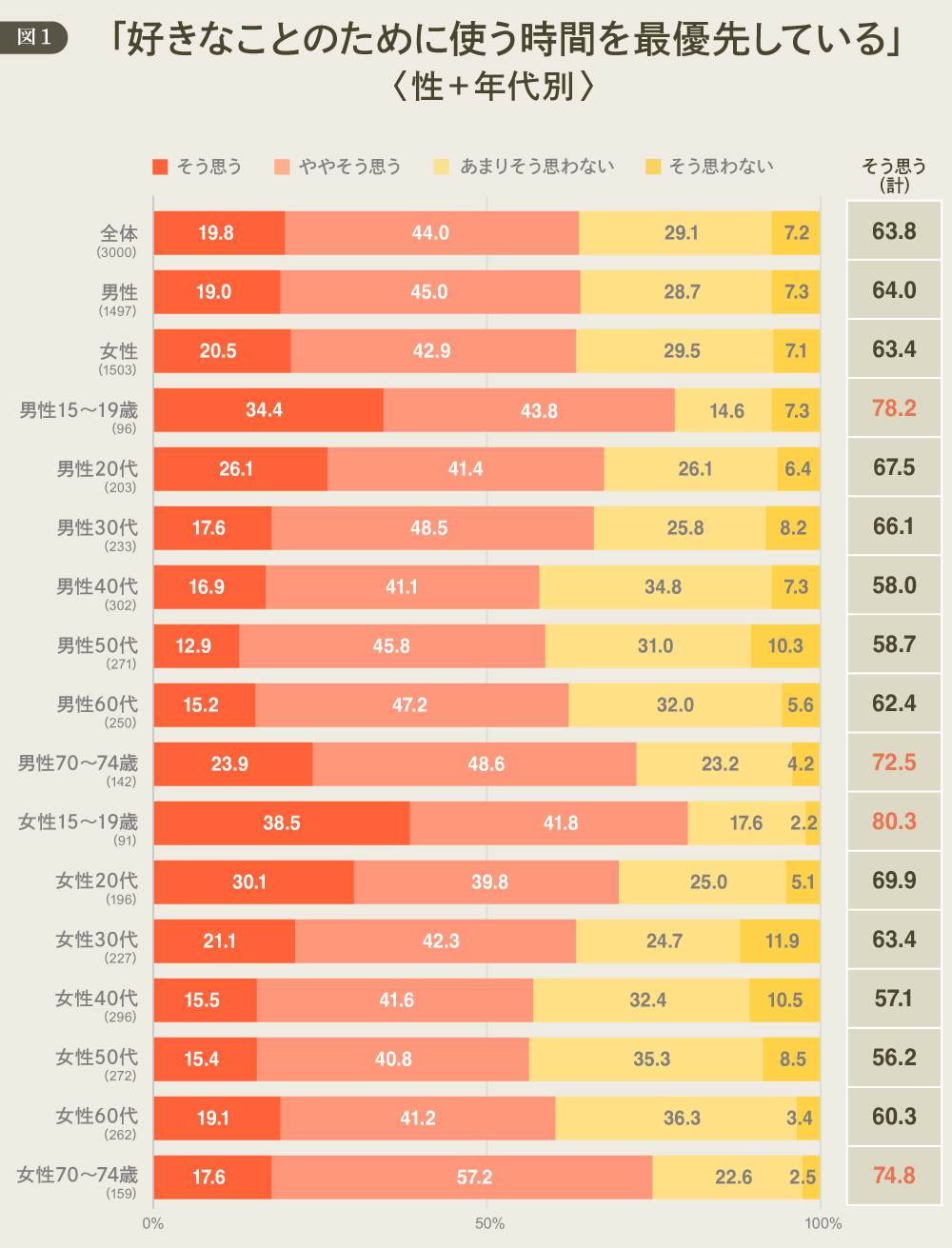
This means that even among those who should be devoting most of their time to work, housework, and childcare, over half still prioritize time for their favorite things above all else. This suggests that the recent focus on time efficiency and the culture of short digital content may be enabling this.
Watching just one video of your favorite creator on your phone to unwind, spending five minutes late at night browsing DIY accounts... As ways to enjoy favorite content in small pockets of time have evolved, people no longer use busyness as an excuse to neglect their passions.
This survey (May 2025) notably showed a significant increase in the "desire to test one's skills," driven by curiosity and creative ambition. This suggests even busy individuals are increasingly making time to engage with their passions.
Does prioritizing "what you love" affect happiness?
Next, we examined the differences between those who "prioritize time spent on their passions above all else" and those who do not, to understand their respective characteristics.
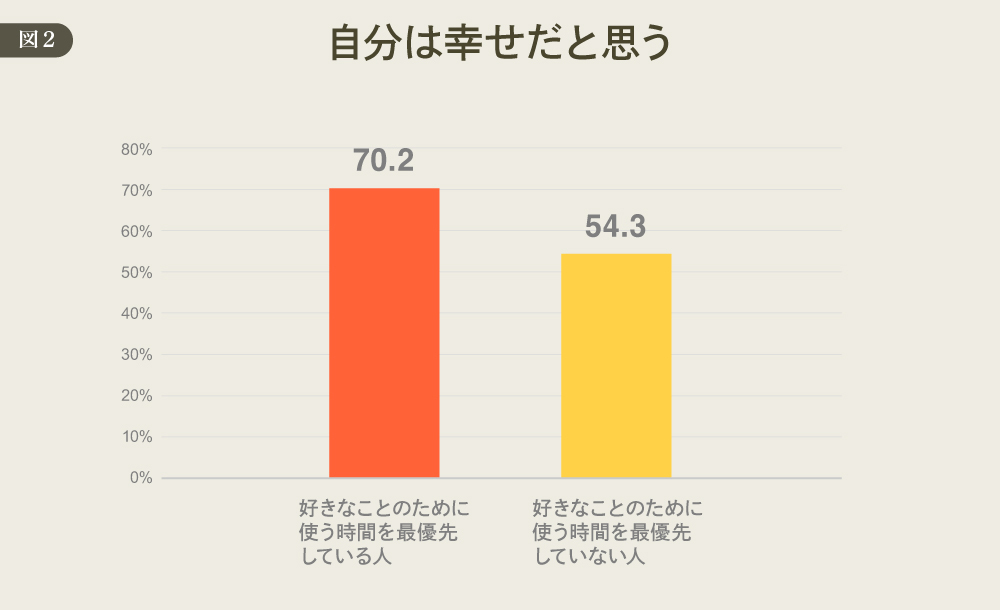
A particularly interesting difference emerged in responses to the question "Do you consider yourself happy?" While 70.2% of those prioritizing time for their passions answered "Yes," only 54.3% of those not prioritizing such time agreed, a gap of about 16 percentage points. This suggests that not being able to prioritize personal passions in daily life may be a factor lowering people's sense of happiness.
The anxiety of not having "likes"
This raised another question: Why do people who cannot secure time for "things they like" have lower happiness levels?
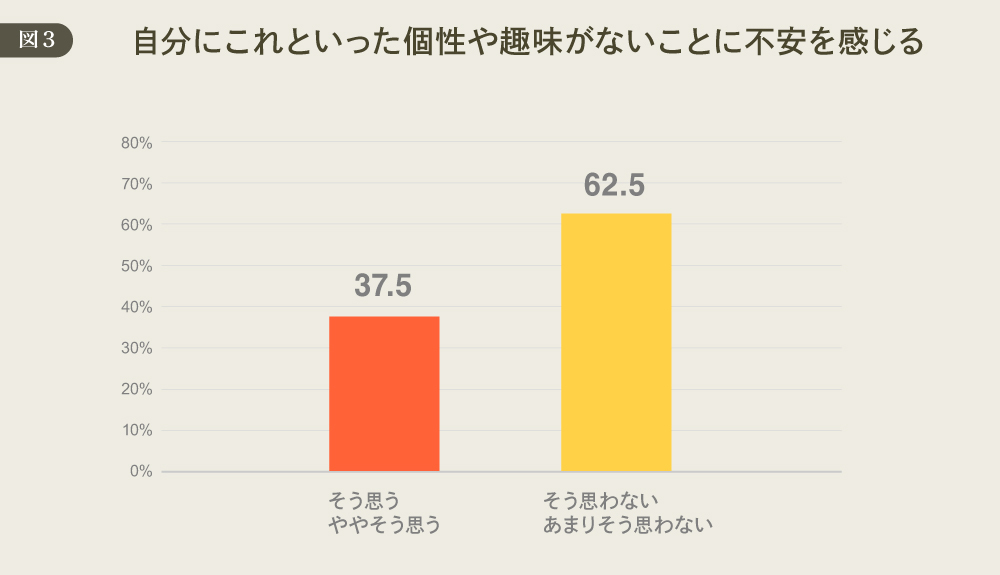
The key may lie in the very presence or absence of "likes." To explore this question, we examined the next survey item. 37.5% of respondents answered "agree" or "somewhat agree" to the statement "I feel anxious about not having any particular personality traits or hobbies." This means over 60% feel "it's okay not to have hobbies."
While those unable to prioritize "likes" time tend to have lower happiness levels, the majority are people who are fine without "likes." To understand the reason for this gap, we compared the characteristics of those who "feel anxious about not having any particular personality traits or hobbies" with those who "don't feel anxious about not having any particular personality traits or hobbies." We examined how their responses differed across the survey questions.
A particularly notable difference emerged: the tendency to conform to others to avoid criticism.
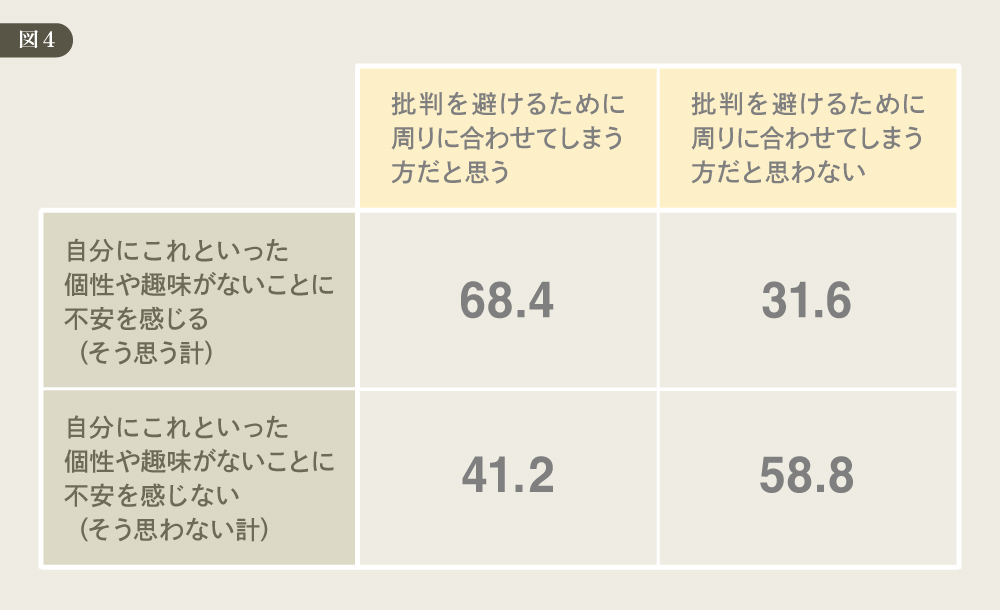
Among those who "feel anxious about not having any particular personality traits or hobbies," 68.4% answered that they "tend to conform to others to avoid criticism." In contrast, only 41.2% of those who "don't feel anxious about not having any particular personality traits or hobbies" answered similarly, a difference of 27 percentage points.
This result suggests that those anxious about lacking interests strongly desire to "avoid standing out" or "not feel out of place," making them more sensitive to peer pressure.
For this group, it may not be that they can't make time for their "likes," but rather that they don't have any "likes" or don't know what they like, so they aren't trying to make time. However, it's worth pausing to confirm whether they truly have no "likes." Sometimes, their tendency to conform raises the bar for what they consider a "like" or suppresses their interests.
Prioritize even things at the "maybe I like this" level. Consciously make time for them. If it doesn't feel right after trying, switch. If it resonates, nurture it a little. These small, consistent steps can break the cycle of "I don't have time because I don't have hobbies." As a result, there's ample room to narrow the happiness gap with those who prioritize time for their passions. The key seems less about the "depth" of feeling for something, and more about whether you "make time for it."
The "blessings of liking" outweigh the "shackles of liking"
Over 60% prioritize time spent on their passions, and three out of four of them report feeling happier.
This data shows a clear trend: those who secure time for their passions tend to have higher happiness levels, visualizing the happiness gap with the minority who cannot prioritize their passion time.
Interestingly, the proportion of people who feel anxious about not having a passion was unexpectedly low. While recent marketing trends often focus on exploring the behaviors of those with passions—like fandom activities or hobby communities—these results suggest it might be equally fascinating to examine the actual behaviors of people who "don't have a passion but don't feel anxious about it."
Furthermore, the "curse of passion" might not be the absence of passion itself, as initially hypothesized, but rather the belief that "passion must be this way." The size and form of passion vary from person to person. Even small passions, when prioritized by those who possess them during spare moments, could increase the number of people who feel happiness.
Is it true that only a limited number of adults can afford to spend time on their "likes"? Conversely, might those who can't find something they like feel marginalized? Analyzing data based on these hypotheses revealed that the "curse of liking" is an illusion; time spent on things you like does indeed lead to greater happiness. In other words, the benefits of liking something outweigh the perceived curse.
[10th "Heart-Moving Consumption Survey" Overview]
・Target Area: Nationwide Japan
・Subject Criteria: Men and women aged 15–74
・Sample Size: 3,000 total samples (allocated according to population ratios across 7 age groups: 15-19, 20s-60s, 70-74, and 2 gender groups)
・Survey Method: Internet survey
・Survey Period: Tuesday, May 13, 2025 – Friday, May 16, 2025
・Survey Sponsor: Dentsu Inc. DENTSU DESIRE DESIGN
Survey Agency: Dentsu Macromill Insight, Inc.

Was this article helpful?
Share this article


Newsletter registration is here
We select and publish important news every day
For inquiries about this article
Back Numbers
Author

Akane Yamada
Dentsu Inc.
Marketing Division 4
The future isn't something you "wait" for—it's something you "create"! Transforming Japan's career education through future-oriented thinkingDENTSU DESIRE DESIGN's Approach to Marketing Reconstruction Based on "Theory of Desire"Building the future begins with visualizing the will of the future.Book Publication Commemoration! How to Envision a Post-SDGs Future