Japan's space startup ispace launched the private lunar exploration program "HAKUTO-R" in September 2018. Its "Mission 2" concluded in June 2025.
This mission aimed to attempt a lunar landing again and deploy a micro-rover (small lunar exploration vehicle) developed by the company to conduct lunar exploration and collect lunar regolith (lunar sand). Unfortunately, the landing attempt was unsuccessful.
Dentsu Inc. began collaborating on business development and marketing with the program as early as 2015, when it was still known as "HAKUTO." Furthermore, Dentsu Inc. developed and supported a partnership program connecting ispace with corporate partners.
The 'HAKUTO-R' program became a milestone for the expansion of private space ventures in Japan. As major corporations worldwide show increasing interest in space development, what is the domestic context, the passion invested in this program, and the significance Dentsu Inc. —serving as a bridge between companies and space ventures—found in this challenge?
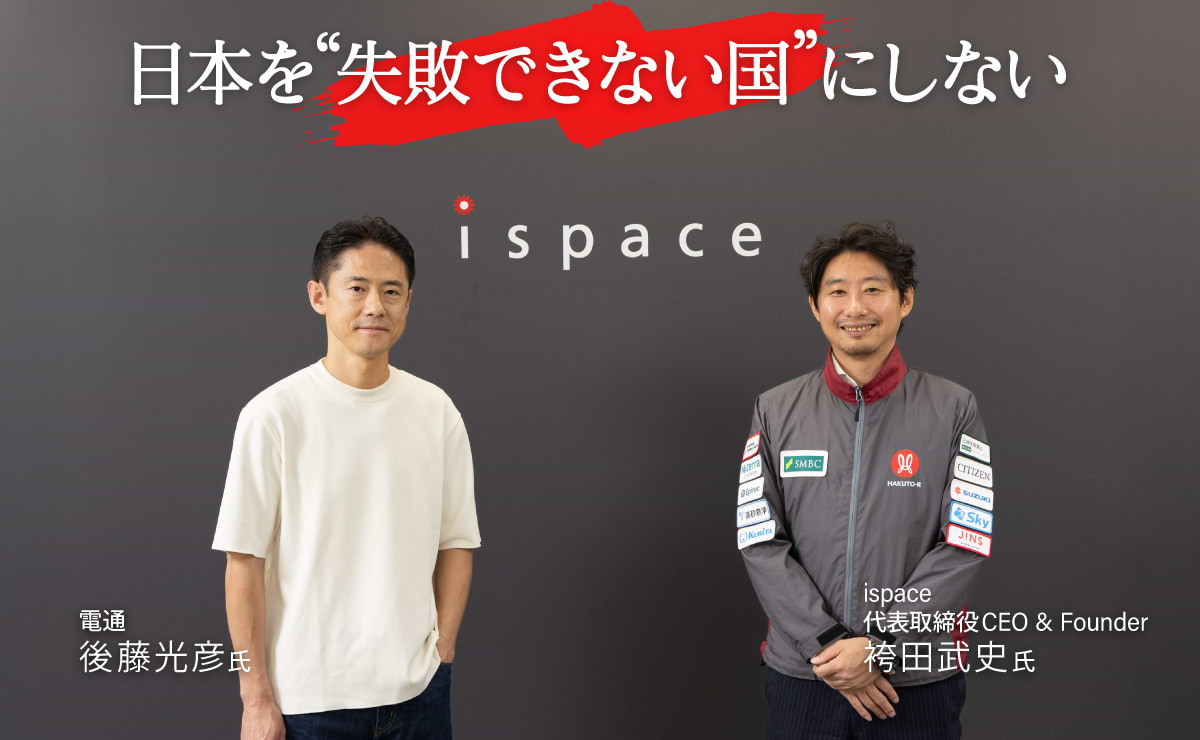
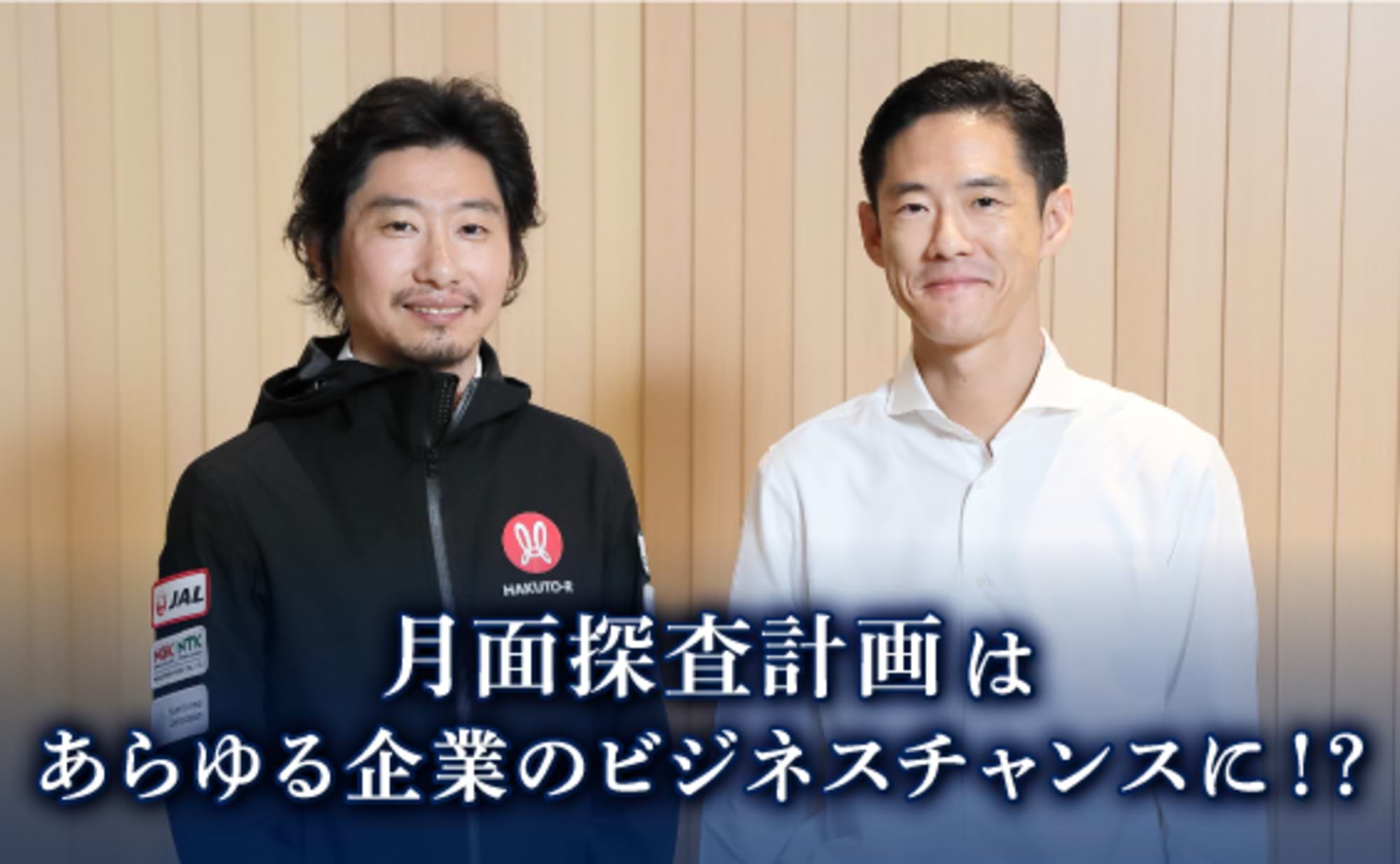
Takashi Hakamada, CEO & Founder of ispace, and Mitsuhiko Goto, Director of Dentsu Inc.'s Marketing Division 6, reflect on their nearly decade-long collaboration.
From left: Dentsu Inc.'s Mitsuhiko Goto, ispace CEO Takeshi Hakamada
"Keeping Small Promises." Hakamada's Integrity Convinced Us of Private Space Business's Feasibility, Leading Us to Begin Support
――First, please introduce yourselves.
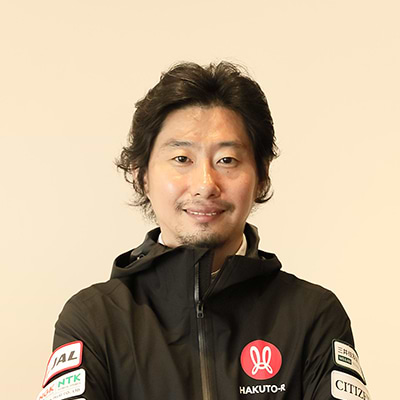
Hakamada: I serve as CEO of ispace, aiming to create a "sustainable world utilizing space resources." Since 2010, I participated in the private lunar exploration race "Google Lunar XPRIZE," leading the Japanese team "HAKUTO."
Later that same year, in September, I launched White Label Space Japan (ispace's predecessor), and established ispace in 2013. Since 2018, while leading the private lunar exploration program "HAKUTO-R," I have been promoting private space business primarily focused on lunar transportation.
Goto: I work in Dentsu Inc.'s marketing division, primarily receiving works and proposals from content holders. I support the design, proposal, and execution of marketing strategies tailored to client companies' needs. My goal is to create mechanisms for mutual success between content and companies, contributing to solving client challenges.
――Please tell us about how you two met.
Hakamada: For the "Google Lunar XPRIZE," we competed as Team HAKUTO with the help of many volunteers. Among them was an employee from Dentsu Inc., who introduced me to Mr. Goto. That was the start. It's been 14 years since then.
Goto:Back then, Mr. Hakamada was working tirelessly to secure funding for the Google Lunar XPRIZE. A Dentsu Inc. member volunteering with us approached me, suggesting we treat "HAKUTO" as a kind of "content" and explore sponsorship opportunities. Honestly, the theme of a lunar landing felt incredibly ambitious, and being a startup, the hurdles seemed high... I remember inwardly thinking about how best to decline.
――So what ultimately led to you teaming up?
Goto: The turning point came when I handed Mr. Hakamada a flyer for an event organized by Dentsu Inc. as the lead sponsor in April 2015, and he attended with his employees.
From experience, even when people say "I'll come" to such events, their busy schedules often make actual attendance difficult. But in Mr. Hakamada's case, I sensed his sincerity and character in keeping that "small promise." I felt, "This person might actually achieve a lunar landing." That moment was when I resolved to seriously engage with ispace's challenge as a business venture myself.
To realize a world like Star Wars. The 10-Year Journey of the "HAKUTO" and "HAKUTO-R" Programs
――Let's now look back on the journey over these 10 years. Could you share again what initially inspired you, Mr. Hakamada, to start lunar exploration by a "private company"?
Hakamada: At the core was my desire to create a world where private companies drive space development. Japan's space program is primarily government-led. This was especially true around 2010 when the Google Lunar XPRIZE began. However, around that time in the US, a shift was starting to occur from government-led to private sector-led initiatives.
When the government handles space development, budget constraints inevitably create financial limits. If private companies can participate and foster sustainable economic growth, perpetual space development becomes possible. Conversely, without economic rationality, realizing a world like Star Wars, with multiple spacecraft flying around, is difficult. That's why I believed an era was coming where private companies would lead space development.
My own personal journey began when I took that first step to participate in the "Google Lunar XPRIZE," which started as an international race.
――Please tell us about the challenges undertaken by the "HAKUTO-R" program and how you feel it has impacted Japan's space development efforts.
Hakamada: "HAKUTO-R" launched Japan's first privately-led lander (lunar lander) in 2022 as Mission 1, aiming for a lunar landing. In the subsequent Mission 2 conducted in 2025, we aimed for a lunar landing alongside lunar exploration using the onboard micro-rover.
First, Mission 1 succeeded in reaching a point just short of landing on the lunar surface. I feel this dispelled the skepticism many held about whether startups could truly realize the space industry. It changed the perception around us – people realized, "They've come this close."
In the subsequent Mission 2, we completed "Success 8" out of the 10 defined milestones, just as in Mission 1. However, we did not achieve "Success 9," the lunar landing. We take this fact very seriously. For both Mission 1 and Mission 2, we received support aimed at the major goal of landing on the moon. Therefore, the strong desire to show everyone the moment of landing remains.
Mission 2 Milestones (Image provided by ispace)
Goto: For Mission 2, communication was lost at an altitude of 192 meters above the lunar surface. Mr. Hakamada likely feels it was "just 192 meters away," but I believe reaching that point in only two attempts was a remarkable achievement.
The very creation of ispace—a space industry startup with bases in Japan, the US, and Europe—is itself a major achievement in Japan's space sector.ispace consistently discloses clear business continuity plans. These plans demonstrate high feasibility and credibility. Furthermore, Mr. Hakamada's unwavering commitment to lunar exploration, evident in his words and actions, conveys a passion bordering on obsession. It is precisely because this strong conviction spread to all stakeholders that everyone could unite to overcome various obstacles.
Hakamada: While we didn't achieve a landing, I'm deeply grateful that, thanks to everyone's support, we were able to complete a mission carrying the hopes of so many people. We believe that new challenges in space development don't succeed after just one or two attempts; success is built upon repeated failures.
Rather than entering the field only after other private companies succeed in lunar landing, we believe that boldly challenging it beforehand is what contributes. We recognize that failure is a necessary process for future success. In that sense, attempting the same mission twice in space development and maintaining continuity was groundbreaking.
――Mr. Goto, from your position supporting this challenge as a liaison with partner companies, how do you perceive its significance?
Goto: For Dentsu Inc., the profound significance lies in realizing an entirely new mechanism: "supporting space development through sponsorship." Traditionally, sponsorship focused on sports, entertainment, and large-scale events. Globally, there were almost no precedents for a mechanism enabling corporate sponsorship involvement in the unknown frontier of space. Creating an opportunity to enter the growing space industry through this program holds immense meaning.
The impetus for creating this sponsorship mechanism came from my own realization during the "HAKUTO" project: the absolute prerequisite for securing the funding needed to achieve a successful lunar landing was obtaining "sincere support" from at least ten major corporations.
Back then, a startup aiming for a lunar landing faced even greater challenges than today, and I anticipated extremely high hurdles in gathering supporters. However, once we actually began moving forward, we were given opportunities to present to many companies both domestically and internationally. Furthermore, executives listened to us seriously. Some actively asked questions, and others even extended meeting times beyond the scheduled duration.
"HAKUTO" and "HAKUTO-R" were featured in media worldwide, sparking widespread public discussion. The micro-rover bearing partner logos was exhibited at the Smithsonian Museum in the US and featured in school textbooks, demonstrating significant societal impact. Ultimately, "HAKUTO-R" secured support from 21 companies.
The connection between major private companies and ispace began to reveal a path forward for Japan's space industry.
――What motivated Dentsu Inc. to continue supporting this program?
Goto: There are three reasons. The first is the realization of Mr. Hakamada's "Moon Valley Initiative," which aims to build a city on the lunar surface where 1,000 people can live permanently by 2040. I understand this cannot be achieved by space-related companies alone; synergy with non-space companies in areas like technology utilization is crucial. Dentsu Inc. possesses a network spanning diverse industries, making us a well-suited partner for realizing this vision.
List of all "HAKUTO-R" participating partners, including Official Partners, Corporate Partners, Media Partners, and Supporting Companies (Image provided by ispace). Each leveraged their expertise to support the project.
Goto: The second reason is our expectations for the space industry itself. Space-related technology is already indispensable as social infrastructure, and its growth is expected to continue. We believe that companies' involvement in space will lead to both social development and their own growth.
The third reason is to address the structural challenges facing Japan's space industry. Currently, there are not many individuals in Japan who can promote space development with their personal assets, such as Elon Musk and Jeff Bezos. Therefore, we believe that it is essential for private companies to collaborate and enter the space industry in order to achieve sustainable growth. For these reasons, we believe that Dentsu Inc.'s involvement is extremely meaningful and have continued to provide our support.
Hakamada: Dentsu Inc.'s cooperation has greatly expanded the scope of what we can do. Especially during the HAKUTO era, we were just a startup with only a few members, so access to Dentsu Inc.'s resources enabled us to expand the scale of our operations, not only in terms of sales to sponsoring companies but also in terms of event implementation.
The same applies to the creative side.We ourselves were constantly thinking about how to communicate effectively to the world to gain support for "HAKUTO" and "HAKUTO-R." Therefore, we understood the importance of design and visual presentation in media like and made our own efforts in that regard. In this aspect, leveraging Dentsu Inc.'s expertise allowed us to smoothly achieve what we couldn't do ourselves: creating a "presentation style that resonates well with clients." We truly feel this enabled us to reach a much wider audience.
The challenge never ends. What is the next space development project private companies are aiming for?
――Finally, please tell us about your future endeavors and outlook.
Hakamada: ispace has missions planned through number 7. We are currently developing for Missions 3 and 4.
Mission 3 is scheduled to launch a lunar lander from the US in 2027, and Mission 4 from Japan in 2028 (*). We are not only planning to go to the moon, but also to deploy a communications satellite into lunar orbit. We are also advancing new technological developments, such as using cameras alongside sensors to confirm terrain information during landing.Mission 2 encountered an issue where the altitude sensor did not function as planned. Therefore, we are aiming for a lunar lander that is more technically reliable, not solely dependent on that sensor.
(*) The launch date is a plan as of 2025 and is subject to change. Furthermore, the project implementation period for the SBIR (Small Business Innovation Research) program theme "Development and Operational Demonstration of a Lunar Lander," under which ispace was selected as a subsidized project, is set in principle for fiscal year 2027.Mission 4, eligible for SBIR-based subsidies, was initially agreed upon with the Ministry of Economy, Trade and Industry (METI) and the SBIR Secretariat for launch within 2027. However, as of October 2025, ispace's internal development plan anticipates a launch within 2028. This change is currently under coordination with relevant ministries and the SBIR Secretariat, and will ultimately require formal approval of the plan revision by METI.
Mission Flow Chart from Mission 1 to Mission 7. ※The above is merely an illustration. ※The above represents the currently anticipated missions and launch schedule and is subject to change. (1) For details regarding this matter, please refer to the briefing materials disclosed by ispace on June 24, 2025, and the timely disclosures. (2) While initially agreed with the Ministry of Economy, Trade and Industry (METI) and the SBIR Secretariat for a launch within 2027, ispace's internal development plan as of October 2025 anticipates a launch within 2028. This change is currently under coordination with relevant ministries and the SBIR Secretariat. The plan change will be formally approved upon receiving final authorization from the Minister of Economy, Trade and Industry. (3) Assumptions as of November 2025. Provisional names subject to change. The lander design in the image may also change.
Hakamada: Space ventures are shifting significantly from national to private-sector leadership. To reiterate, within this trend, we believe "continuous challenge" is what drives business growth.
Regarding our challenge of lunar transportation, the technology is already proven. Our first step is to ensure a successful lunar landing and then continuously challenge ourselves with each mission. By repeating this dozens, even hundreds of times, we aim to make lunar landings a routine capability.
Goto: Our daily lives are increasingly becoming dependent on the existence of space. The space industry is gaining attention as a growth sector alongside AI, and the Japanese government has positioned it as a core industry, advancing large-scale investments.
Personally, I witnessed the launch of Mission 1 in Florida and saw firsthand how deeply embedded the space industry is in everyday American life. Conversely, upon returning to Japan, I realized many people still don't feel a personal connection to space discussions. Moving forward, I hope to contribute, even in a small way, to building a movement that grows the space industry into a true core industry, leveraging the experience gained by the ispace team and us on the ground.
Born in 1979. After earning a Master's degree in Aerospace Engineering from the Georgia Institute of Technology, he worked at a management consulting firm before founding ispace. He is currently advancing private space ventures utilizing space robotics technology to build a world where humanity establishes a habitat in space and Earth and space coexist. He competed in the Google Lunar XPRIZE as "HAKUTO" starting in 2010 and now leads "HAKUTO-R," the world's first private lunar exploration program.
Mitsuhiko Goto
Dentsu Inc.
Marketing Division 6
Director of Content Solutions
Born in Tokyo. Spent childhood in Paris, Seoul, Manila, Taipei, Belgrade, and other cities. After working in sales for an automaker, engaged in planning utilizing content such as films, anime, games, and events at CDC, MCP Agency, and Solution Development Center. Leverages diverse IP as corporate solutions to maximize the value of both content and clients. Recipient of numerous awards, including a Cannes Lions Gold Award.