The creative power and brand strength cultivated by publishers through magazine and book production are now gaining significant attention. This series introduces the assets and content creation capabilities of publishers in today's era across various themes, offering insights for marketers looking to leverage the publishing industry.
This installment focuses on Shueisha's "digital manga." How did the manga magazine app "Shonen Jump+," boasting cumulative downloads of 30 million (as of January 2025), and the global distribution app "MANGA Plus by SHUEISHA" (hereafter "MANGA Plus"), with cumulative worldwide downloads of 40 million (as of October 2025), begin and expand?
Shuhei Hosono, who spearheaded the launch of both apps and currently serves as Editor-in-Chief of 'MANGA Plus,' and Mai Okawa, who works in Shueisha's Media Business Department handling manga IP tie-in projects, were interviewed by Hisashi Iwanami of Dentsu Inc.'s Publishing Business Development Division. They delve into Shueisha's content strategy and global expansion plans.
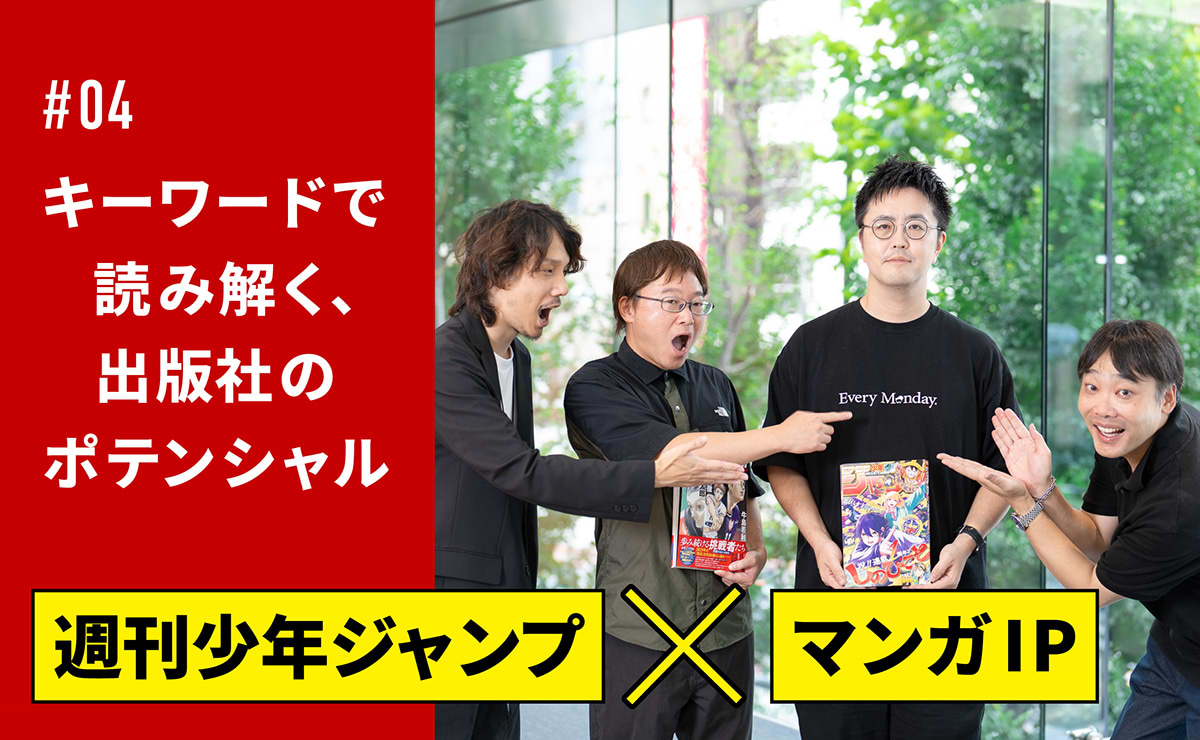
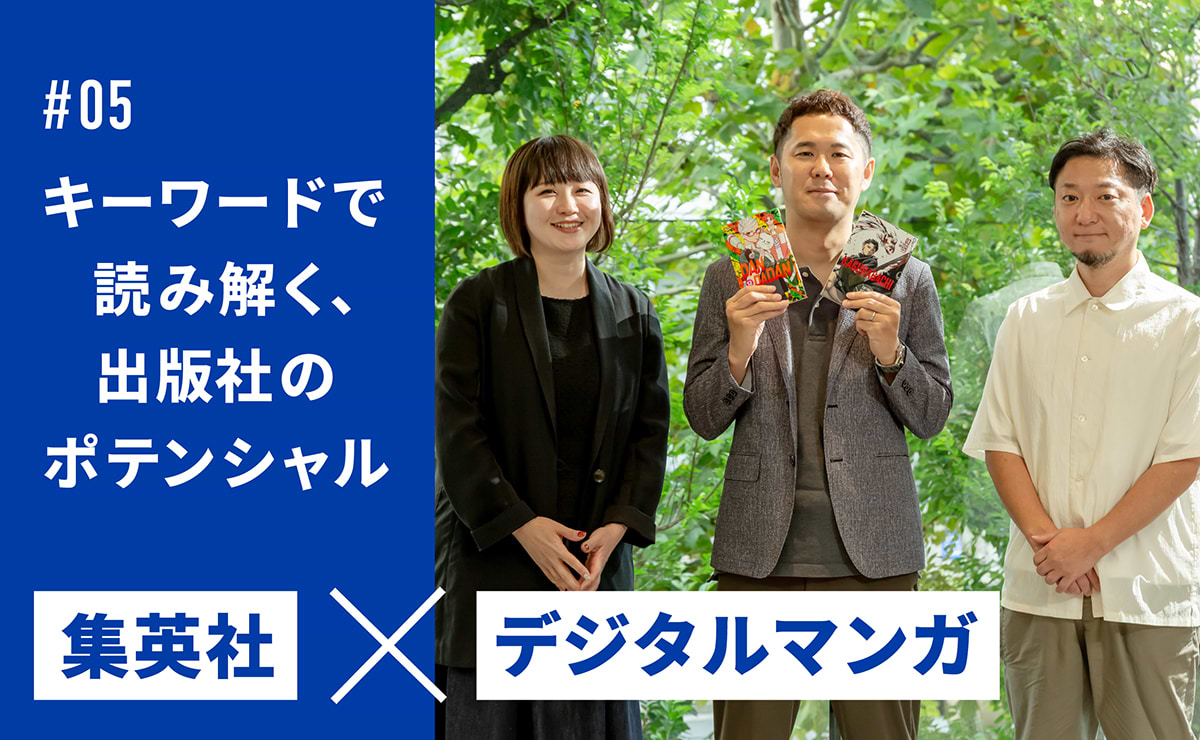
From left: Mai Okawa, Media Business Department, Shueisha; Shuhei Hosono, Editor-in-Chief, MANGA Plus by SHUEISHA; Hisaki Iwanami, Publishing Business Development Division, Dentsu Inc.
The editorial policy is "anything goes"! "Shonen Jump+" launched with the cooperation of Shueisha's "Manga Editorial Department Alliance"
Iwanami: First, please tell us about your involvement in launching "Shonen Jump+". Mr. Hosono, you were Deputy Editor-in-Chief of "Weekly Shonen Jump" at the time. How did you perceive market needs and user challenges for digital expansion when starting "Shonen Jump+"?
Hosono: As Deputy Editor-in-Chief of Weekly Shonen Jump, I shared responsibilities across the entire publication, including "budget," "page layout planning (work order and page settings)," and "media adaptation" tasks. I was assigned to handle "digital." However, when I took the role in 2012, the digital sector had very little presence. We were basically just confirming works to be supplied to web-focused e-bookstores. So, it wasn't really a case of starting with a clear grasp of market needs or user challenges(laughs).
Later that same year, prompted by the Digital Business Division, we started operating the app for Shueisha's own e-bookstore, "Jump BOOK STORE!". That's when we realized, "Digital actually sells pretty well." So, we decided to challenge ourselves by publishing original works, leading to the launch of "Jump LIVE" in 2013. Gradually, we started to feel more positive results. Wanting to introduce more original works seriously and gauge reader reactions, we then launched "Shonen Jump+".
Iwanami: How long after launching did you start seeing tangible results, like "users are increasing"?
Hosono: Honestly, the user growth was incredibly fast. We aimed for 1 million app downloads in a year, but achieved it in just 19 days. The biggest reason was implementing simultaneous release—publishing print and digital editions at the same time—for Weekly Shonen Jump, a title with high print circulation, something we hadn't done much before.
That's precisely why "Shonen Jump+" gained recognition and acceptance from readers so quickly. On the other hand, when talking about "Shonen Jump+," even though it has original works, people kept saying "You mean the simultaneous release, right?" for years. While I understood it was inevitable, it was frustrating.
Iwanami: Now, original works like SPY×FAMILY and Dandadan, known to many people, have emerged from it. Is there a reason why hit works unique to "Shonen Jump+" are born, or a unique editing method?
Hosono: If I had to name one editorial principle for "Shonen Jump+," it's "anything goes." At launch, we had few titles and barely managed daily serializations. So we reached out to various editorial departments across the company seeking diverse works to publish.
We started with just five editorial staff members. The editor-in-chief was handling multiple roles, and I could only manage about two series myself. We were severely understaffed. So, we invited editors from various other departments to join us – Weekly Shonen Jump, shoujo manga magazines, JUMP j BOOKS, Weekly Playboy, and more. For me, it felt like we were building Shonen Jump+ together with the diverse editorial teams across Shueisha.
At the time, "Shonen Jump+" wasn't a well-established platform, so while some manga artists found it difficult to suddenly be asked for a serialized work, others said they could draw a one-shot.For the editorial department, it was easier to publish ambitious one-shots, and there was a momentum to do so. The diverse one-shots published there—stories involving gender, sisterhood themes, core sci-fi works—significantly broadened the scope of "Shonen Jump+". As a result, creators began to think, "Maybe my work could get published too," and readers gradually recognized it as "a platform that features various genres."
Aiming for long-term "fan building" over short-term app-only profits
Ōkawa: When do you feel the distinct "Shonen Jump+" identity began to emerge?
Hosono: 'Body Search', which was recently adapted into a live-action film, was an early hit. Starting around 2016 with titles like 'Fire Punch' and 'The End of the World Harem', that 'anything goes' atmosphere really took hold. 'SPY×FAMILY' and 'Kaiju 8' seemed to fit perfectly at a time when the reader base was gradually expanding and there was a growing demand for more mainstream, classic-feeling works.
Iwanami: You mentioned this was a challenge before the publishing industry fully embraced digital expansion. How would you position this initiative within the publishing industry?
Hosono: When "Shonen Jump+" launched, there were only apps like "Manga Box" and "comico" (an app for webtoons produced in Japan), so I think it was a pioneering effort.
Simultaneously, its uniqueness lies in not pursuing standalone app revenue like other digital platforms. Since 2019, serialized works have offered the first full volume free after app download, and all latest chapters remain free. While many apps prioritize sales, we believed fostering readers and fans who follow the series would ultimately generate profits more effectively than short-term revenue.
Taiga: "Shonen Jump+" has fixed serialization schedules by day of the week, and many readers tune in at the 12:00 AM release time. Because it's free and instantly accessible, the buzz and excitement after the latest chapter goes live also generates a lot of buzz. What was innovative from an advertising perspective was that 50% of the ad revenue generated after a reader finishes a chapter is returned to the author. Rather than just focusing on generating revenue for the app itself, aiming to create a service where readers can enjoy manga daily while also giving back to the creators was a new approach.
Hosono: Yuta Momiyama, who co-created "Shonen Jump+" and now serves as its Digital Editor-in-Chief, described this medium as "something like television." The media itself gains momentum as readers (viewers) come, and the featured works grow larger and larger. It would be great to create that kind of dynamic in manga too.
An overseas app targeting the "90% print: 10% digital" market. Two developments only possible because it's directly operated by Shueisha
Iwanami: Next, let's hear about "MANGA Plus," which Mr. Hosono currently oversees as editor-in-chief. This web service (with an app) provides multilingual translations of the latest chapters from works serialized in Weekly Shonen Jump and Shonen Jump+, releasing them globally outside Japan, China, and Korea simultaneously with their Japanese release. What prompted the shift toward targeting overseas markets?
Hosono: "MANGA Plus" launched in January 2019. Around 2017, webtoons were gaining popularity overseas, and we felt a sense of crisis that Japanese manga's presence was diminishing. The discussion began with the idea that we should launch a direct service overseas to counter this.
Simultaneously, pirate sites featuring Japanese manga were proliferating overseas. This demand, we reasoned, meant that if we released official versions globally at the same time as Japan, we could capture those readers.
Ōkawa: It's currently available in 9 languages (English, French, Spanish, Portuguese, German, Thai, Indonesian, Russian, Vietnamese* as of October 2025).
Hosono: Overseas, the sales ratio between print and digital is roughly 9:1 overall, with print overwhelmingly dominating. Digital sales are lowest in Europe, while Asia is around 10% and growing. North America is actively trying to increase its share. Thankfully, since the pandemic, print sales have increased about fivefold. Despite the huge population difference, North America and France have similar print sales volumes.
Iwanami: France has subsidies like the "Culture Pass" (a program supporting youth cultural activities), and children sometimes buy manga with money provided by the government, right? How much variation is there in MANGA Plus user numbers by country?
Hosono: North America has the most "MANGA Plus" users, followed by Indonesia. Brazil is growing rapidly lately, then Thailand, India, and France. Brazil has passionate fans of titles like 'BORUTO―ボルト― 1―TWO BLUE VORTEX―' and 'Kagurabachi', and I personally find it an interesting market to expand into.
Iwanami: How are you positioning the uniqueness of "MANGA Plus" for overseas markets, in terms of content strength and service differentiation?
Hosono: Honestly, I feel we're still halfway there. I think simply offering "simulcast manga reading" is a bit weak. The greatest strength of "MANGA Plus" is that it's directly operated by Shueisha's editorial department. Leveraging that, I hope we can convey the atmosphere of Japanese editorial teams and creators through two main approaches.
One is sharing the atmosphere of Japan's manga industry and messages from creators and editors beyond the distributed works. This is something only direct editorial management can achieve, and I believe it absolutely adds value. Along similar lines, the other is building a unique community, hoping the "MANGA Plus" platform itself can become a meaningful space for overseas fans.
Considering tie-ins that leverage the unique creativity of "manga"
Iwanami: How are you approaching overseas promotion strategies? Are you considering country-specific plan adjustments?
Hosono: Realistically, we're stretched just choosing which countries to promote in; making detailed adjustments per country is difficult. Currently, we're focusing particularly on North America, Indonesia, and India. Indonesia has enthusiastic readers, and people are starting to pay for the app, so I think it's a well-balanced market. India offers surprisingly visible results at low cost, and with its sheer population, we want to grow there.
Iwanami: Are there any advertising or tie-up methods Mr. Hosono or Mr. Okawa would like to try?
Hosono: Since this is a platform run by a Japanese editorial team, I think it would be great if we could collaborate with domestic companies expanding overseas. That way, both sides could benefit and gain momentum. Of course, tie-ups with local companies in each country would also be interesting, and we'd be thrilled if various companies got on board.
Ōkawa: Absolutely. When delivering Japanese content overseas, it would be exciting to create tie-in projects featuring original artwork, like what we achieved with "Shonen Jump+." We definitely want to pursue that.
"Shonen Jump+" features many titles like "Marriage Toxin" and "Kindergarten WARS" that are popular within the app with high view counts, yet aren't widely recognized yet because they're still in preparation for anime adaptations. Partnering such works with major companies could potentially boost not only the products themselves but also the value of the works and their creators. Fans of the works would be delighted too. We aim to establish projects that benefit readers, advertisers, and creators alike.
For example, in Japan, we've featured a tie-in with Panasonic promoting their men's body trimmer on "Shonen Jump+". By having manga characters introduce the product within the story, the appeal of the item becomes easier to understand. Even if readers aren't deeply familiar with the product's specifics, it can spark curiosity – making them think "What is this?" or "I want to try it" – and contribute to piquing their interest.
・Check out the Marriage Toxin tie-in manga here ・Check out the 'Kindergarten WARS' tie-in manga here
Iwanami: There was also an advertising project featuring original artwork by multiple artists, right? It was an interesting project showcasing each artist's unique personality and worldview. When pursuing tie-ups, are there any particular points you pay attention to?
Ōkawa: Regarding that point, since artists are unique creators, it's difficult to have them draw exactly as the advertiser requests. Conversely, doing so would eliminate the very appeal of a manga tie-in.
When the advertising company understands the unique creative nature of "manga," it leads to excellent projects. So, when pursuing tie-ups, we communicate to the company beforehand: "Please leave the content and worldview to the artist as much as possible" and "Please avoid adding text boxes whenever possible." We often proceed after having them confirm only factual accuracy and proper use of proper nouns at the "name" stage—the rough storyboard where the narrative flow is outlined.
Aiming for a "win-win-win" collaboration through "agile execution" and "media power"
Iwanami: Regarding advertising projects, are there unique advantages to "Shonen Jump+" being distributed via both app and web?
Hosono: In terms of being web-only, I think we have greater freedom in page allocation. For example, when publishing a one-shot tie-in manga, print requires coordination with various departments. With "Shonen Jump+," we can basically publish whenever and however many pages we want without such coordination. We can even schedule releases at specific times, even if it's not the regular update day for the tied-in series. We can also embed links to video ads for playback. In that sense, it's easier to execute tie-ins flexibly.
Ōkawa: During the pandemic in 2022, the manufacturer of the VR headset "Meta Quest" (formerly Oculus Quest) approached us. They couldn't let consumers try it at retail stores, so they wanted to "show what VR can do using manga and video." At the time, 'Dandadan' was only around its third chapter release, so we realized a project where the author, Mr. Ryū Yukishin, drew the protagonist, Okarun, within a VR space.It's hard to imagine now that he's become even busier since the anime adaptation, but Mr. Ryu practiced drawing in VR for about half a year to prepare. His kindness shone through during filming, making me an even bigger fan.
・Check out the Meta Quest × 'Dandadan' tie-up video here
Iwanami: Indeed, experiential campaigns like this effectively convey both the work's appeal and the product's appeal simultaneously.
Taiga: What's unique to "Shonen Jump+" is that we prioritize being a service that gets "read by many people." For advertisers, how much exposure they get is crucial."Shonen Jump+" publicly discloses view counts, and those numbers are substantial, demonstrating its media strength. Seeing the view counts and comments for tie-up projects gives advertisers tangible proof of interest, leading to many cases where they become repeat clients or give high ratings. This "win-win-win" approach to tie-ups is what makes "Shonen Jump+" great.
Iwanami: Companies with a Japanese market can partner with Shonen Jump+ and then translate their content directly into various languages, expanding overseas through the MANGA Plus platform. I believe manga tie-ins are a highly effective new marketing solution.
Within this, it's our job as advertising professionals to help client companies understand the current key points. When collaborating with overseas companies, I always refer to the creators not as "authors" but as "artists." I make sure to convey: "Please understand you're working with genius 'artists' who can draw manga (illustrations) and craft stories."It's challenging due to cultural differences, but I believe there's significant potential for overseas recognition through collaborations with "MANGA Plus."
Hosono: It seems like a promising new direction for overseas appeal, doesn't it?
We want to spread original hit works globally and deliver the diverse appeal of Japanese manga.
Iwanami: Finally, through "MANGA Plus," how do you envision expanding manga culture? Also, from the perspective of how you want to connect with the world through manga, could you share your vision as Editor-in-Chief, Hosono-san?
Hosono: Currently, we publish Japanese works as-is, so popularity in Japan directly translates to popularity on "MANGA Plus." However, since cultures and sensibilities differ by country, it's also possible for a work to gain popularity overseas first through "MANGA Plus," then spark popularity back in Japan. We want to create new hits in this way, originating from "MANGA Plus."
Simultaneously, we want to expand beyond just Japanese works to include original overseas creations. We have a site called "MANGA Plus Creators by SHUEISHA" where overseas creators can submit work, and we hold a monthly manga contest. It would be exciting if new works born here became hits, and that's what we're aiming for.
Iwanami: It seems "original hit works" will indeed be the key.
Hosono: While we have that expectation, honestly, there's also a sense of urgency. Currently, some Japanese anime are achieving explosive hits overseas. Manga hasn't yet caught up to the elevated status of "Japan Anime." Just like in Japan, manga and anime need to form a mutually complementary relationship overseas, and that's where we come in.
Personally, I also feel a strong desire for "the world to understand the depth of manga." I recall an overseas interviewer once saying, "Webtoons are great because they have so many different variations, unlike manga." Hearing that was a real shock and made me feel frustrated...
I firmly believe Japanese manga possesses far greater breadth and depth. Yet some overseas audiences seem to think Japanese manga is only the so-called "mainstream" shonen manga. I hope we can create a world where people everywhere can more deeply appreciate the diverse charms of Japanese manga and enjoy it in richer ways.
Deputy Editor-in-Chief, Editorial Department 3 Editor-in-Chief, Shonen Jump+ Editorial Department / MANGA Plus by SHUEISHA Manager, Overseas Business Division 1
Deputy Editor-in-Chief, Third Editorial Department; Editor-in-Chief, MANGA Plus by SHUEISHA (Shonen Jump+ Editorial Department); and Manager, Overseas Business Division 1. Joined Shueisha in 2000. Assigned to Monthly Shonen Jump, building his career as a manga editor. Subsequently worked at Jump SQ. (Square), then joined Weekly Shonen Jump in 2012.In 2014, he was involved in launching the manga magazine app "Shonen Jump+," serving as its Editor-in-Chief from 2017 to 2024. He currently serves as Editor-in-Chief of the overseas manga magazine app "MANGA Plus by SHUEISHA."
Mai Okawa
Shueisha Inc.
Media Business Division, IP Planning & Promotion Section, Section Chief Concurrently serving as Rights IP Management Section, Rights Business Division
Media Business Department, IP Planning & Promotion Section, Section Chief, concurrently serving in the Rights Business Department, Rights IP Management Section. After gaining experience in sales and operations at an advertising agency from 2012, joined Shueisha in 2017. Responsible for advertising planning utilizing manga IP and app monetization within the Media Business Department. Also concurrently serves in the Rights Business Department, working to expand IP business.
Hirooki Iwanami
Dentsu Inc.
Publishing Business Development Division, Content Account Division 1
Planner
Planner, Publishing Business Development Division. Content Account Division 1. After graduating from Rikkyo University, studied fashion design and marketing in New York, graduating from FIT. Upon returning to Japan, worked at Dentsu Inc. Magazine Bureau handling clients including Shueisha, Kodansha, Shogakukan, and Magazine House. Gained experience in sales for foreign fashion brands at The Goal Inc. Currently involved in global business for publishers, working on the global expansion of manga and anime.

 Unlocking a Publisher's Potential Through Keywords [5/6]