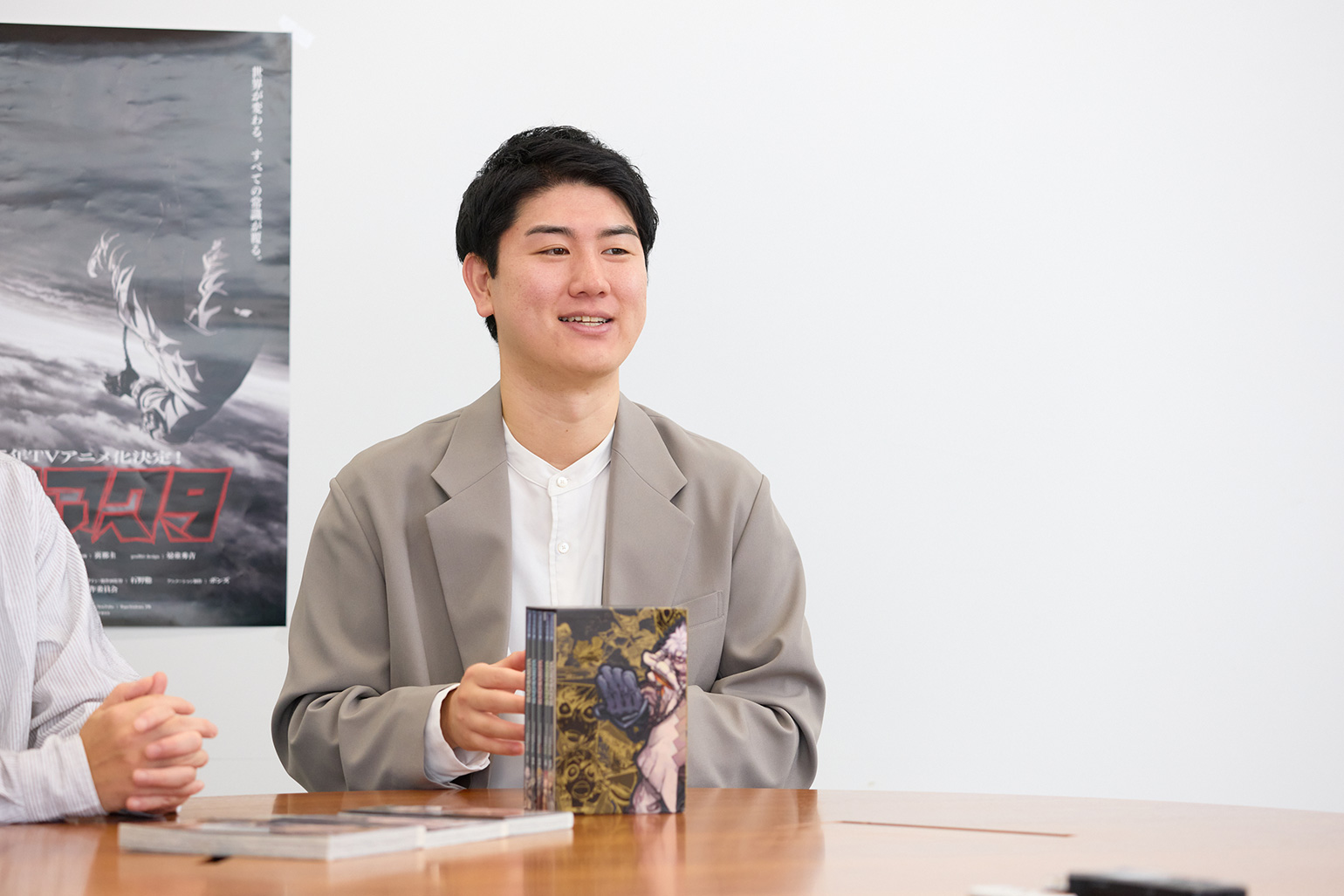
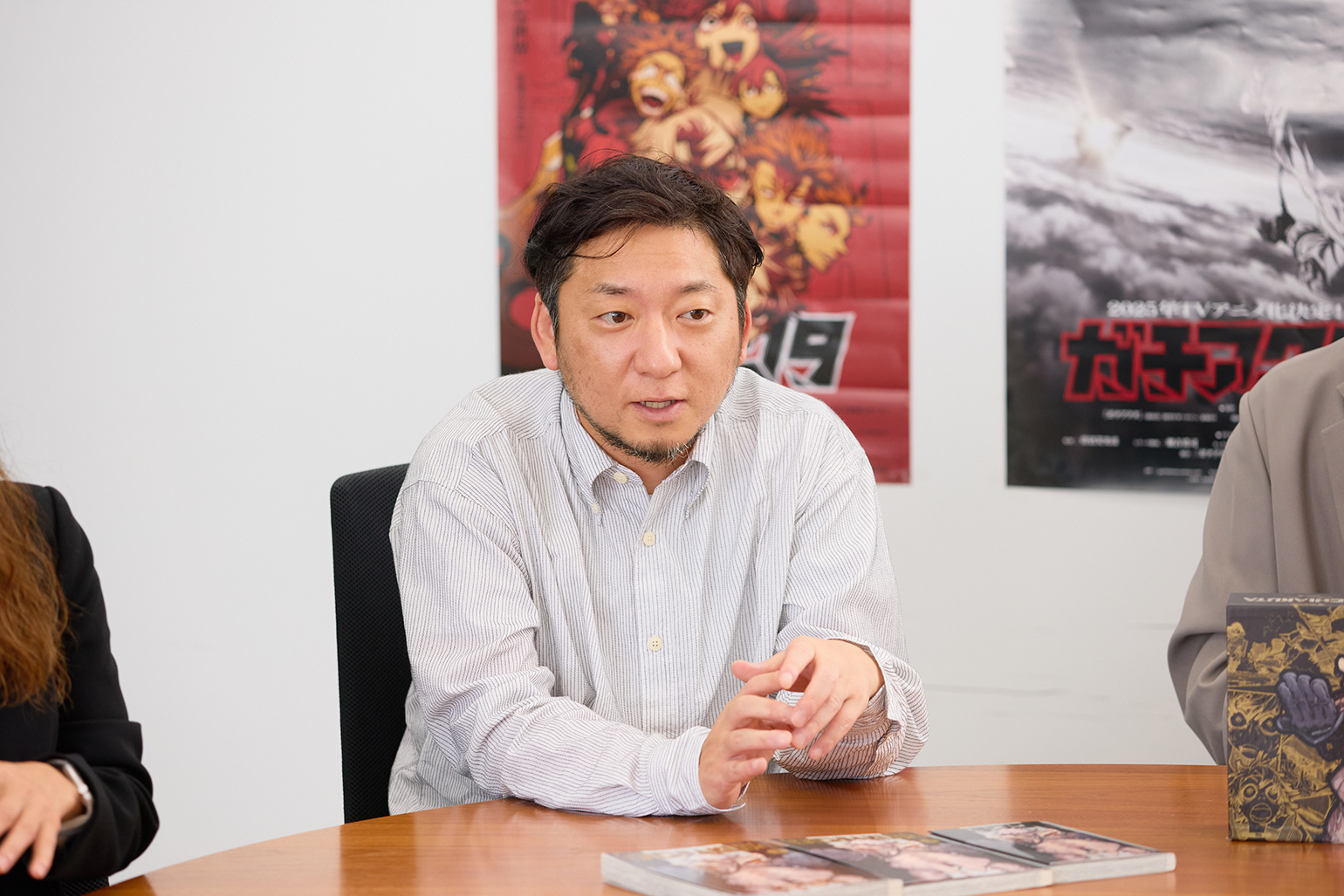
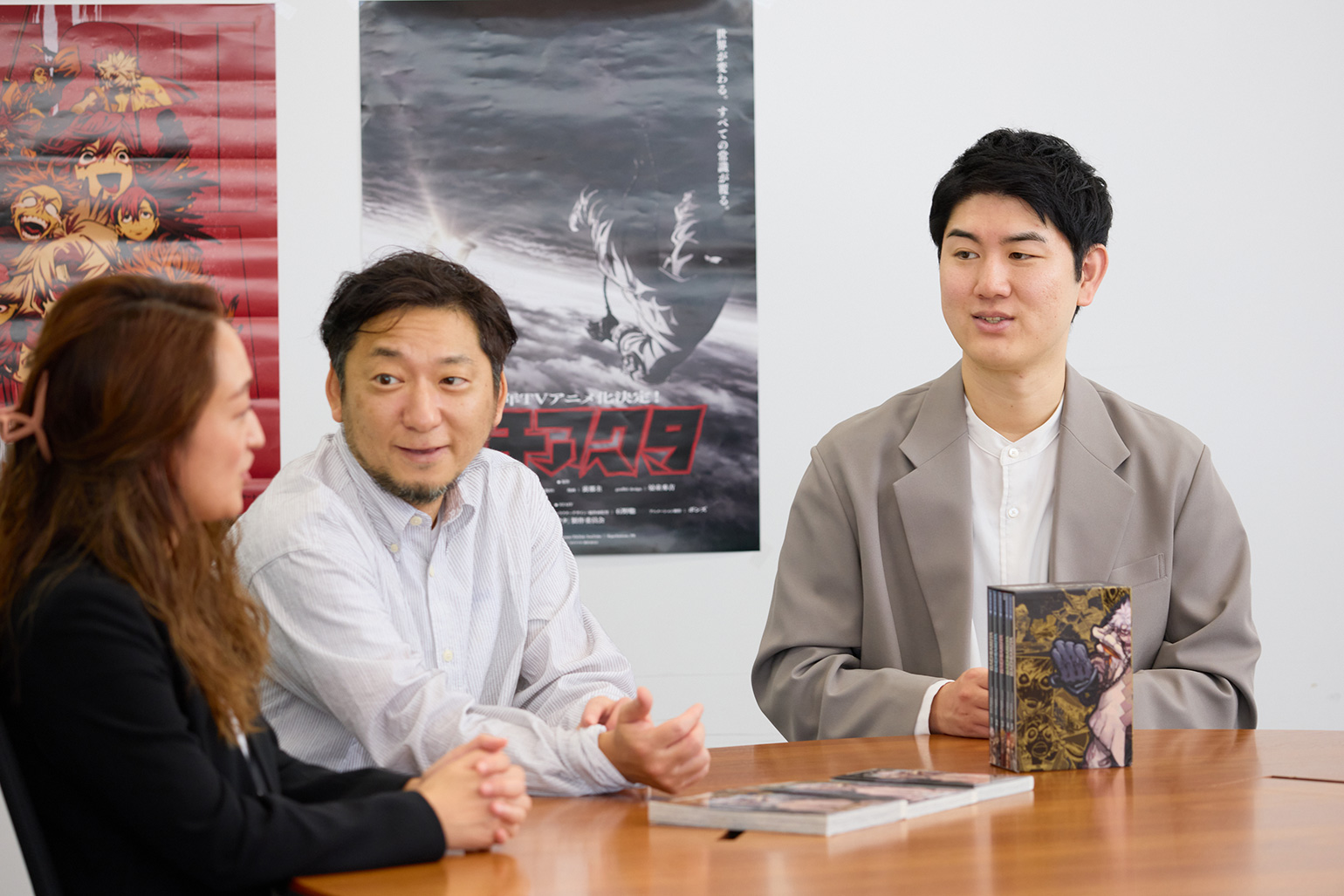
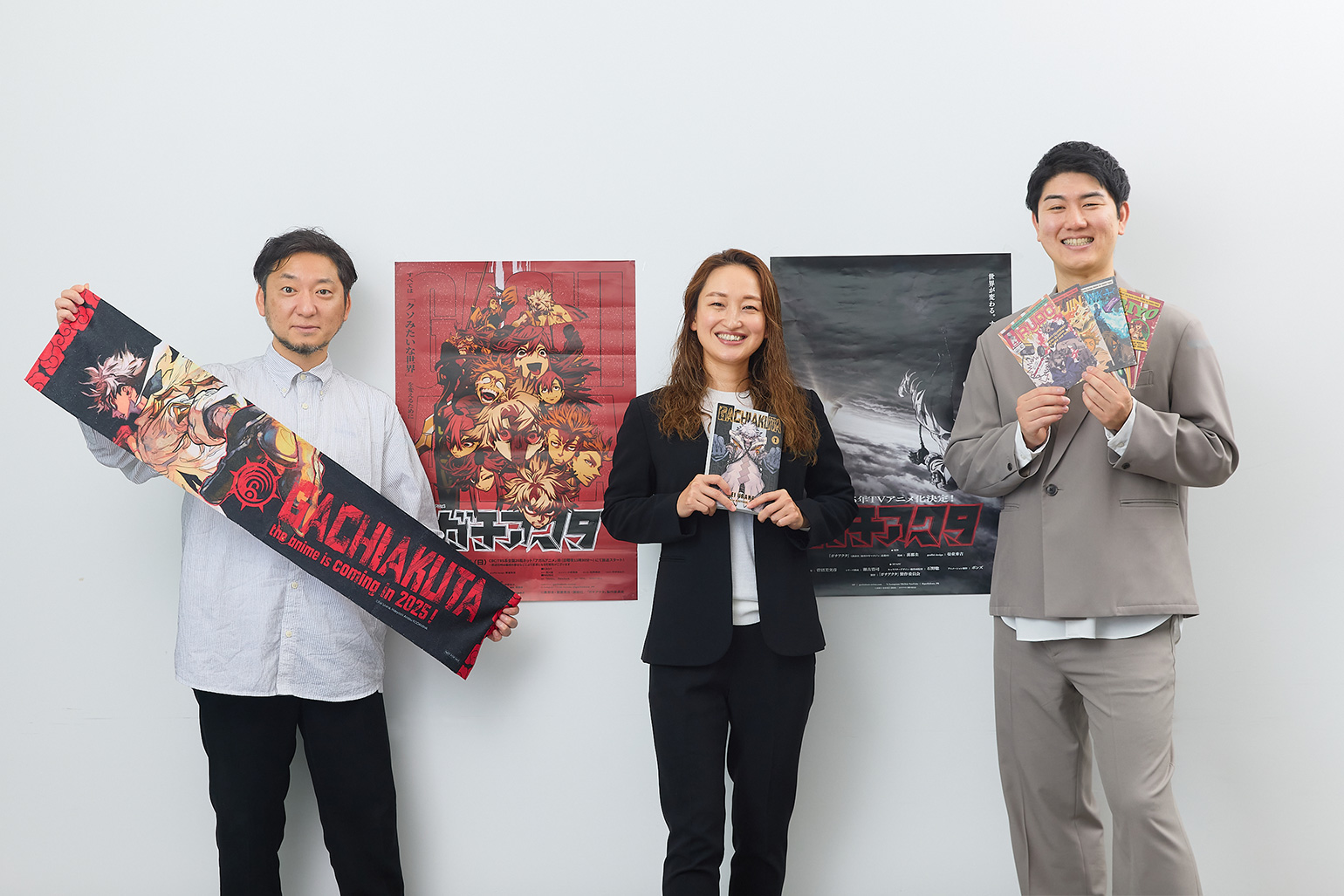
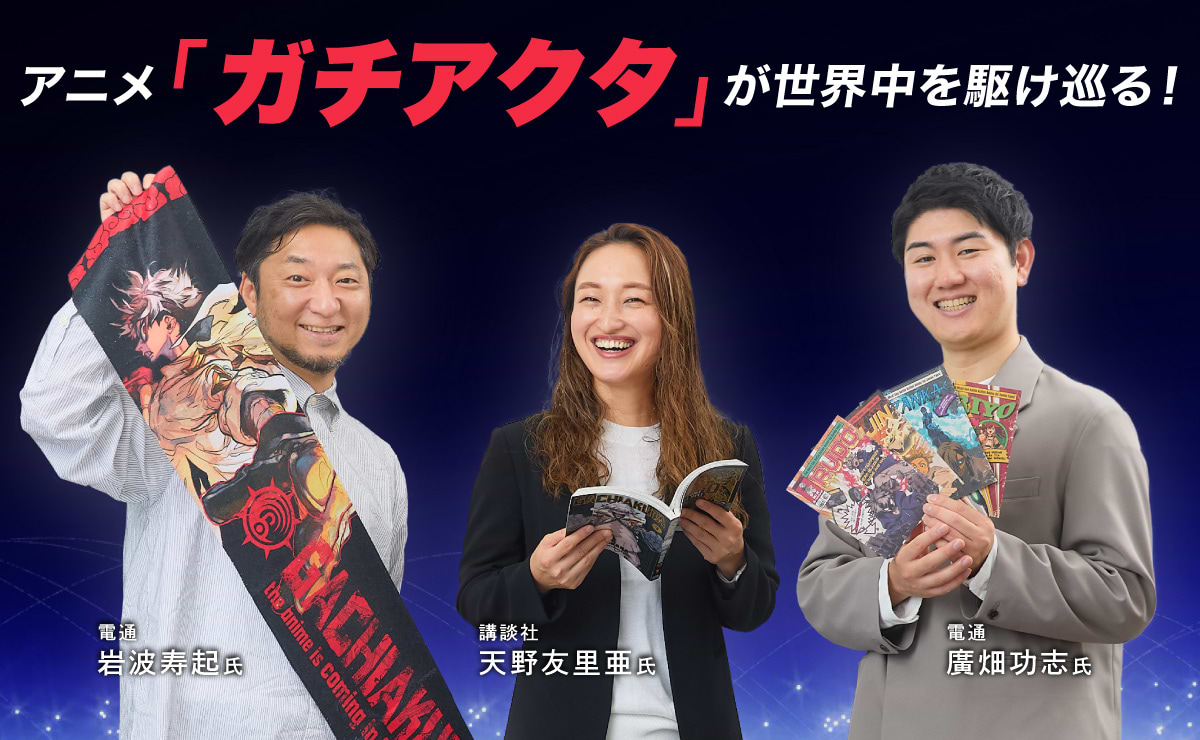
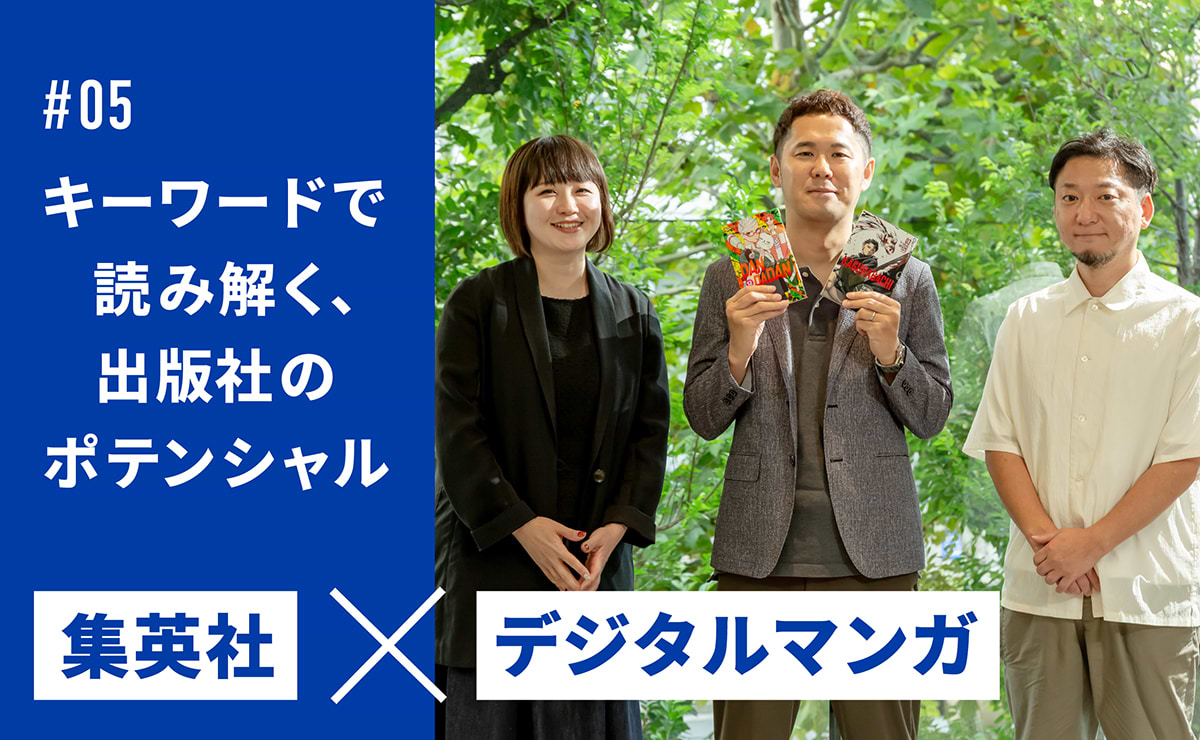
From left: Hirooki Iwanami (Dentsu Inc.), Yuria Amano (Kodansha), Koji Hirohata (Dentsu Inc.)
Japanese IP content such as anime and manga is expanding its market globally. Within this trend, the global communication campaign for the anime "Gachiakuta" generated significant worldwide buzz.
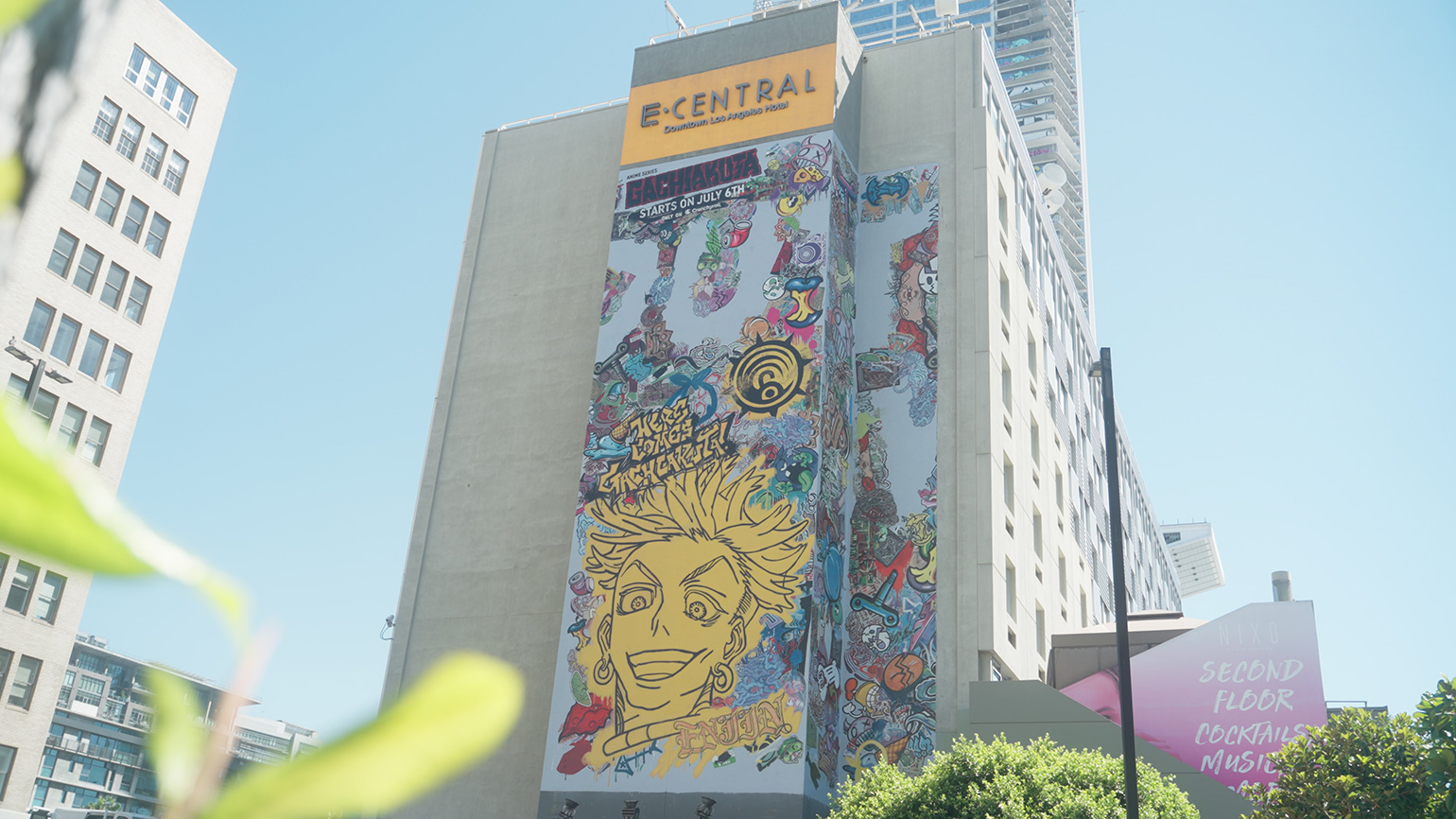
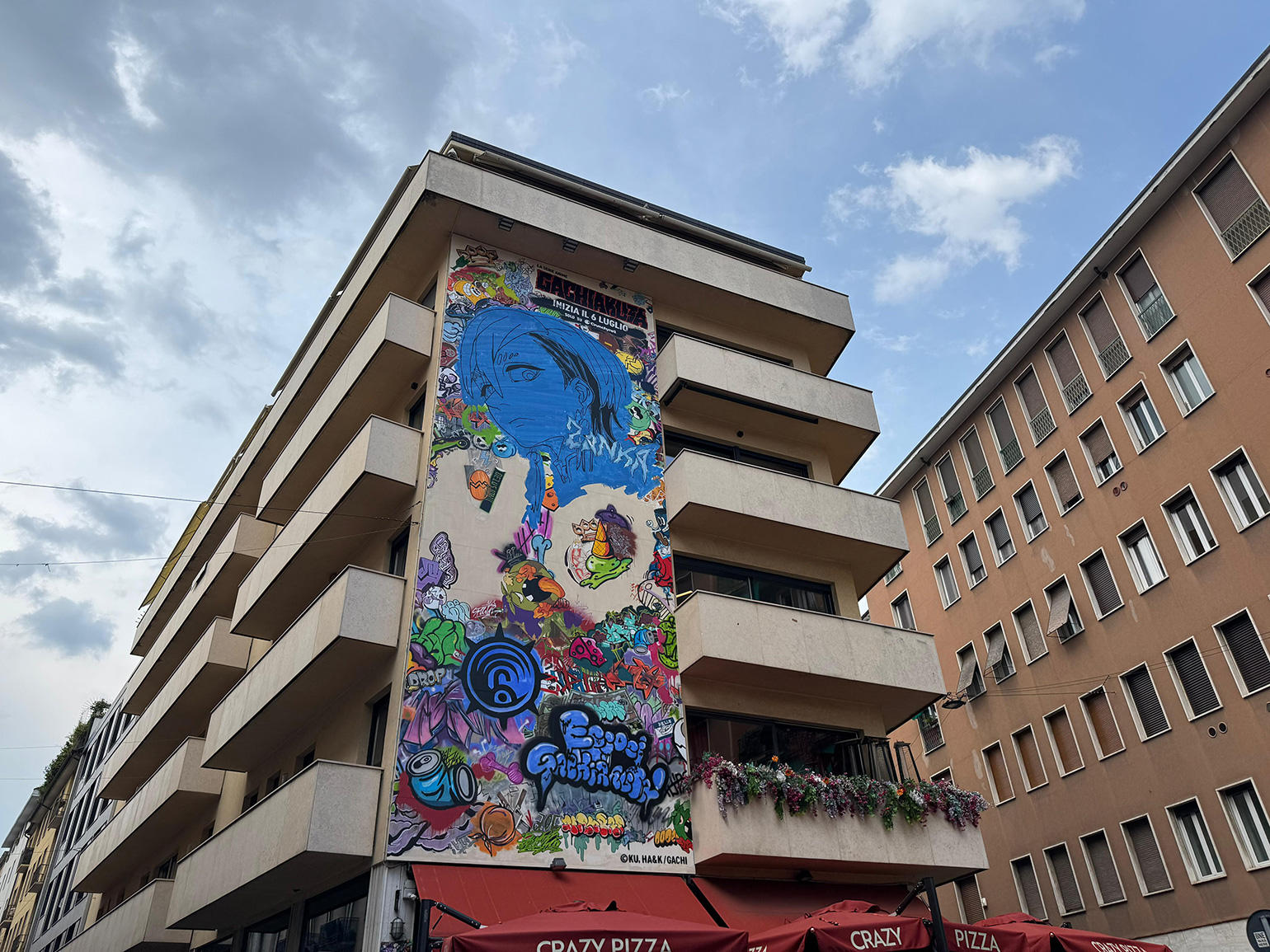
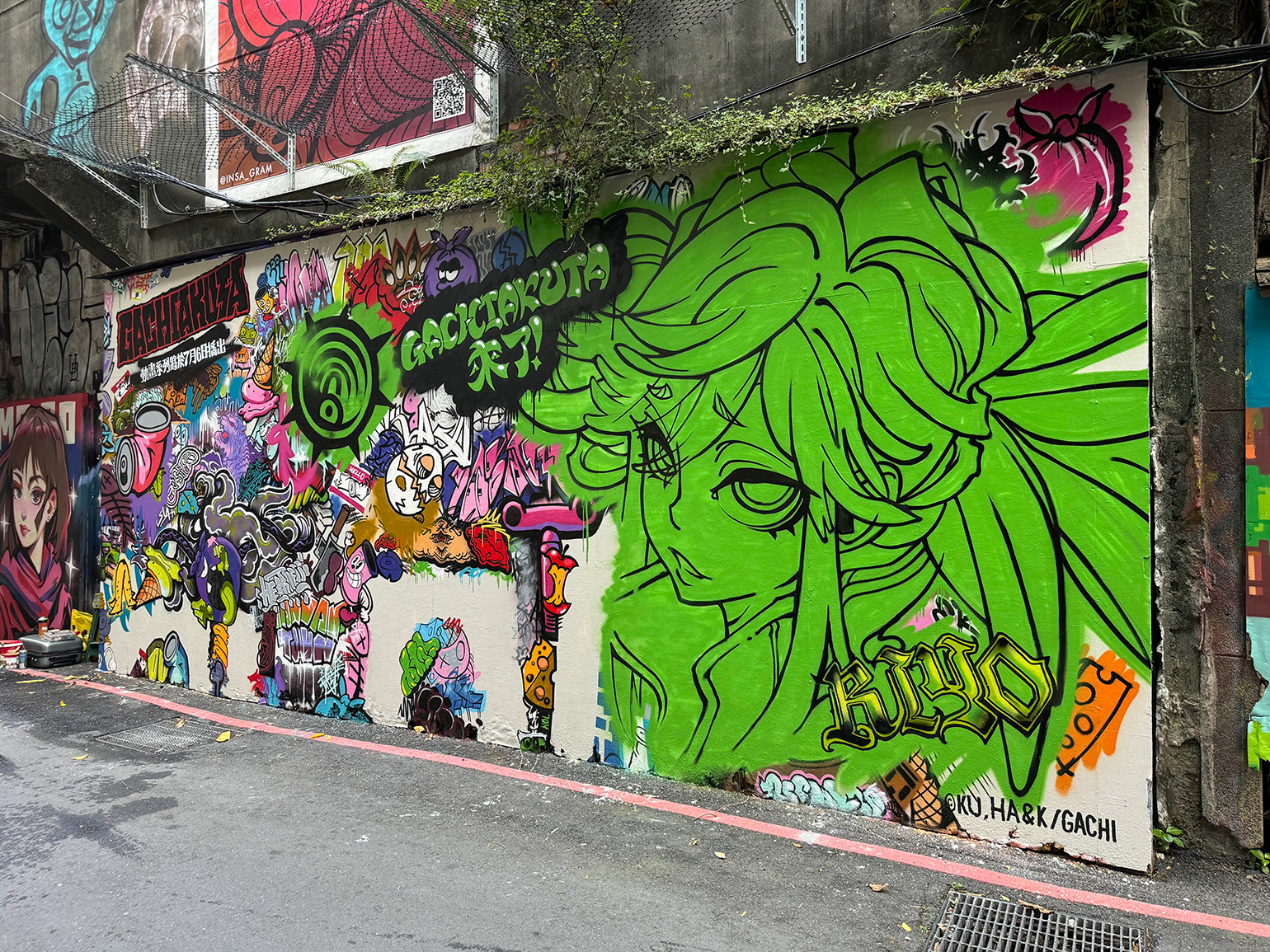
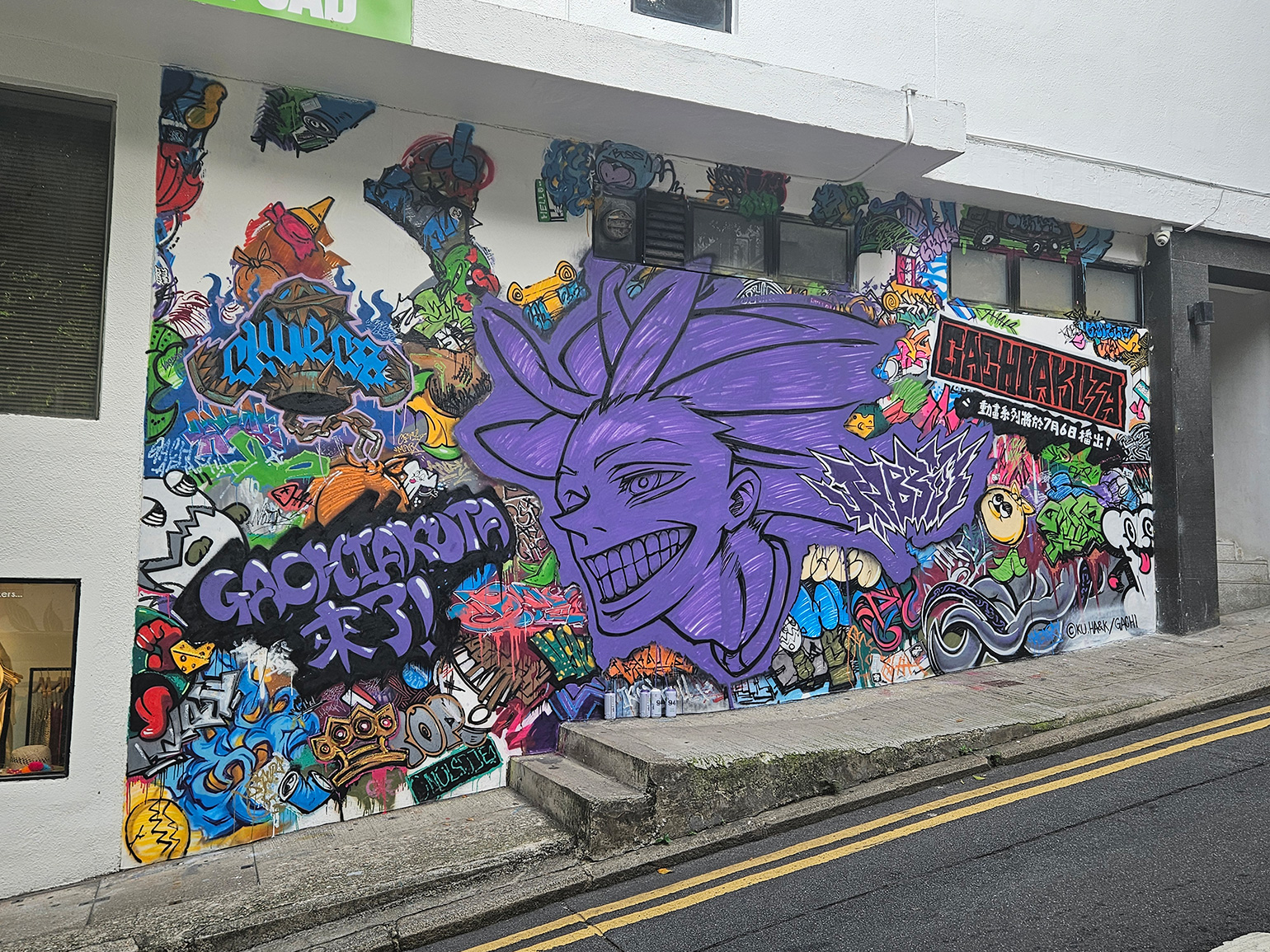
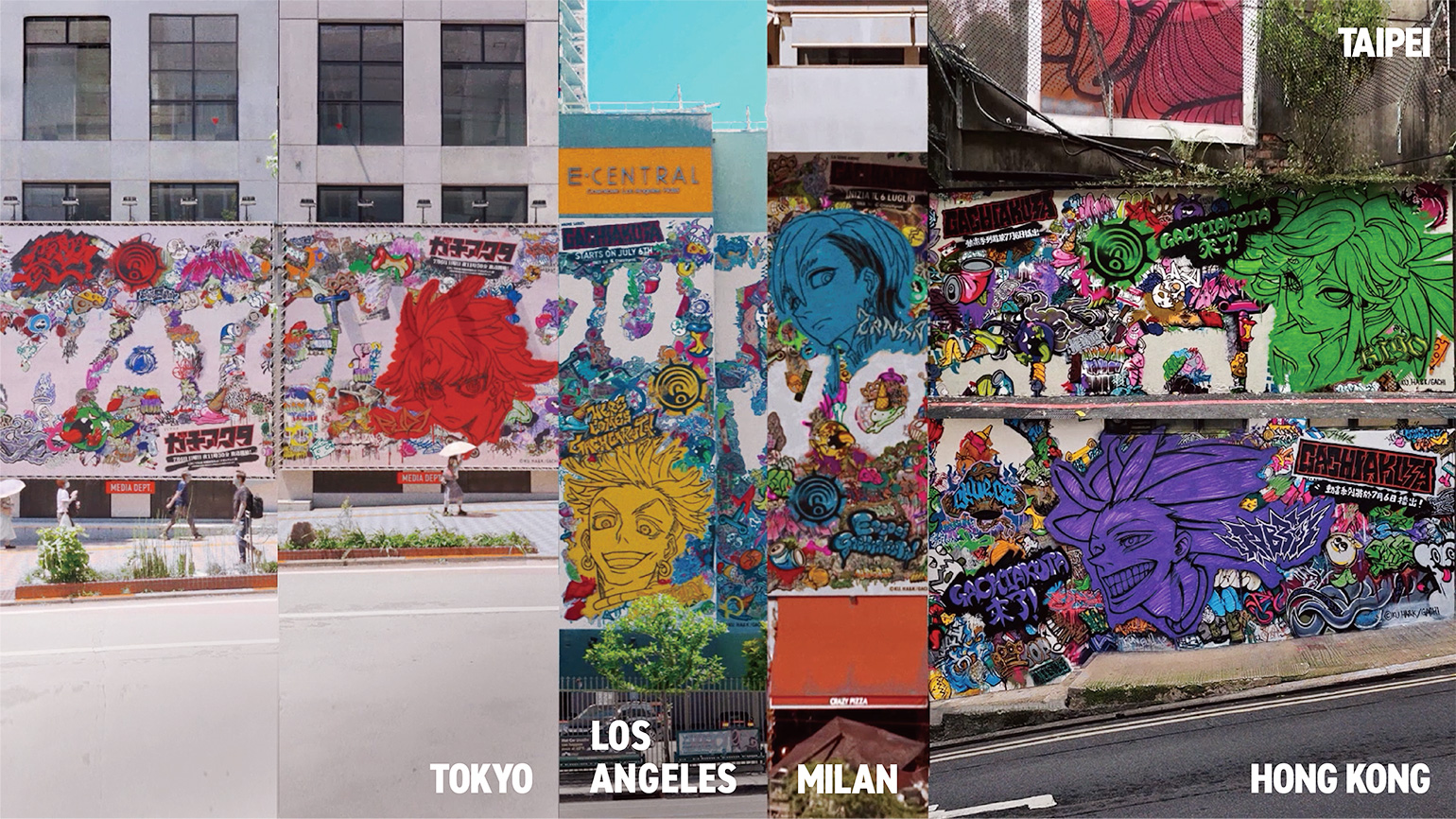
Under the concept "Gachiakuta World Takeover," a global SNS and website were launched. Furthermore, graffiti visuals connecting on a global scale were deployed, and world premieres (advance screenings) were held in various locations worldwide. These efforts successfully ignited enthusiasm among overseas fans.
When the first episode aired, it achieved an unprecedented surge for a new anime, ranking #1 in the average viewership rankings for July season anime on Crunchyroll, one of the world's leading anime platforms.
This article explores how the work "Gachiakuta" was delivered to the world. We invited Yuria Amano, who handles overseas rights for Kodansha, and spoke with her, along with Hirooki Iwanami and Koji Hirohata from Dentsu Inc., about the successful global communication strategy.
What is "Gachiakuta"?
A battle action story centered on Lud, a boy living in a slum inhabited by descendants of criminals. Set in a world overflowing with garbage, it depicts the struggles of individuals with special abilities, known as "Givers," against "conventional wisdom," "power," and "discrimination and prejudice."
The original manga, created by manga artist Kei Urana and graffiti designer Hideyoshi Andou, began serialization in the December 2022 issue of Weekly Shonen Magazine. It won the Global Special Award in the Comics category at the Next Manga Awards 2022. The TV anime began airing in July 2025 and has been generating buzz.
Iwanami: For about 17 years since joining Dentsu Inc., I've been involved in business with publishers. On the overseas promotion team for the anime "Gachiakuta", I mainly handle coordination between the production committee (※), including Kodansha, and overseas licensees. I primarily deal with overseas licensees like Crunchyroll and Medialink.
※Production Committee... An organizational structure where companies from different industries invest and share responsibilities to produce works like anime or films. In anime production committees, participants like the original work publisher, music label, animation studio, game company, broadcaster, and advertising agency collaborate, leveraging each company's strengths to grow the project.
Hirohata: My usual role involves advertising creative work and overseeing the growth of manga and anime. For the overseas promotion team of the anime "Gachiakuta", I'm contributing as Creative Director, leveraging my past experience promoting IP content to oversee all creative aspects. Beyond strategy development, I primarily handle planning, production, and direction for outputs like video content and social media campaigns.
Amano: I belong to Kodansha's Anime & Game Business Division. My job is licensing anime broadcast rights overseas. For this project, I primarily oversee the entire strategy as the licensor.
──Before we talk about "Gachiakuta", could you tell us about the current landscape surrounding Japanese anime and manga content?
Amano: The proliferation of video subscription services, followed by the "stay-at-home demand" during the COVID-19 pandemic, led to a tremendous global surge in demand for anime and manga. While things have calmed down somewhat post-pandemic, growth continues even compared to pre-pandemic levels. Particularly for anime, its reach has broadened significantly. In many overseas regions, watching Japanese anime is no longer a rare hobby.
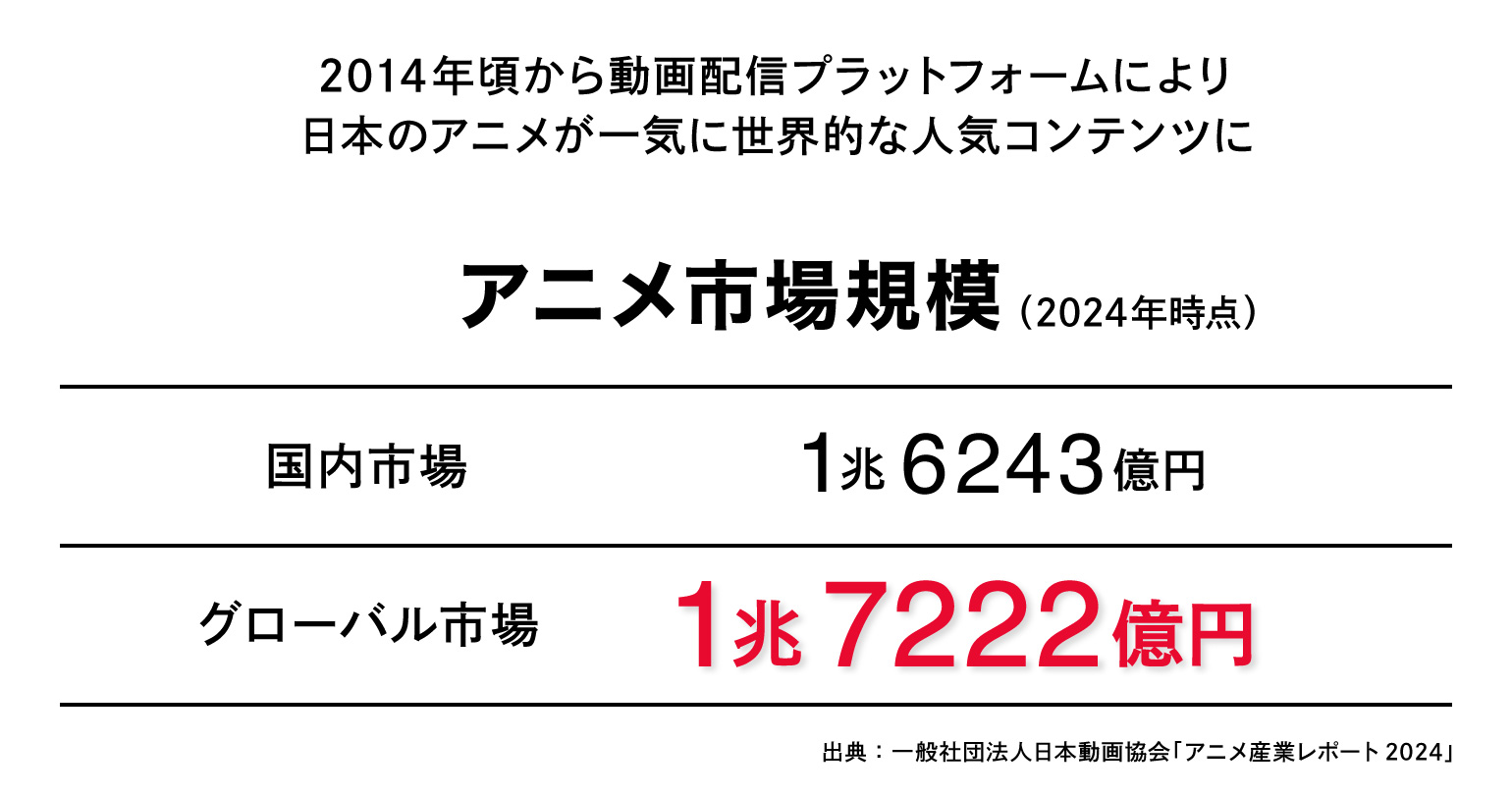
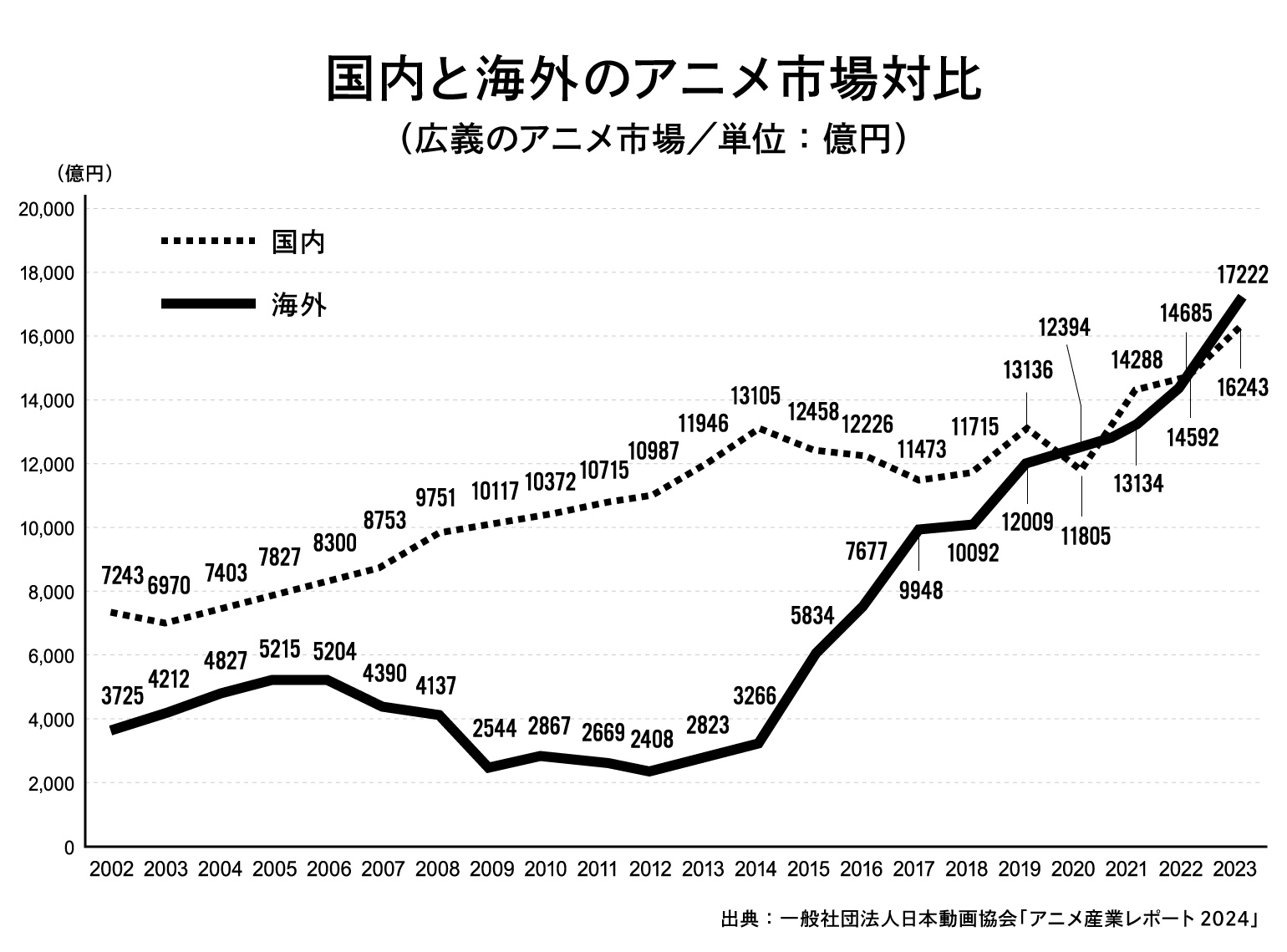
Japanese anime has become a 3 trillion yen industry. Overseas markets began to surge around 2014, when video subscription services started to gain traction. Overseas sales have now overtaken the Japanese market.
──This time, an unusually large-scale overseas promotion for a new anime was conducted, something quite rare for Japanese anime. Among the many works available, why was "Gachiakuta" chosen?
Amano: First, overseas publishers showed significant interest in the original "Gachiakuta" manga. When discussing it with colleagues in the comic licensing department, they said, "This work is amazing." While this isn't always the case anymore, foreign-language original manga licenses still sometimes move faster than anime licenses. Armed with that information, when we pitched the anime license, the response was distinctly different from other works. I thought, "This will work overseas. We have to go for it."
"Gachiakuta" is a collaborative work by manga artist Kei Urana and graffiti designer Hideyoshi Andou, both possessing unforgettable, impactful artistry. The characters, battle scenes, and graffiti are all incredibly cool.The story is also said to have a structure relatively accessible to Western cultures. Honestly, I think everyone is initially drawn in by the art, but upon reading, there are lines and story elements that stick with you. I felt that achieving both of these is precisely why it already has such broad support, and I sensed long-term potential.
On the other hand, Kodansha had long faced challenges promoting its own IP overseas. Since this work has global potential, we felt we needed to try something different from our past approaches.
──What kind of challenges were you facing?
Amano: It's more about anime than IP as a whole. I think it stems from our team's lack of resources and experience relative to the infinite possibilities. There are mainly two challenges we feel. One is that after granting rights, the development is almost entirely left to the local partners in each region. The business model of the anime production committee, which is structured and planned with the Japanese market as the main focus, might also be partly related.
The second is insufficient coordination. This coordination was lacking both between Japan and the licensees, and also among the overseas licensees themselves. We wanted to achieve more seamless coordination and create synergistic effects. Furthermore, as the original rights holder, even when focusing solely on overseas markets, we handle foreign-language versions of the original works, merchandising, and games. Ideally, our strength should lie in coordinating all these rights effectively, yet we still haven't achieved satisfactory coordination.
Therefore, this time, we asked Dentsu Inc. to serve as the promotional liaison with our overseas licensees and to develop global promotional plans aimed at achieving worldwide hits, free from regional or rights-based divisions.
Iwanami: Dentsu Inc.'s Entertainment Business Center (EBC), which handles content like anime, invested in the "Gachiakuta" anime and is also part of its production committee. Through EBC, my division, the Publishing Business Development Division, was approached with the request to "form an overseas promotion team."
So, we brought in Hirohata, who has handled communications for various IPs and has lived overseas, as Creative Director, and launched the team.
Hirohata: This time, after conducting interviews with Kodansha, we began researching the SNS, websites, videos, and advertising strategies of anime particularly popular overseas. Following that, we thoroughly researched the appeal of the "Gachiakuta" project and proposed concepts and communication methods to the production committee.
However, what made this different from our usual client work was that, as Iwanami mentioned earlier, Dentsu Inc. is also part of the "Gachiakuta" production committee. Once it was decided that Dentsu Inc. would handle the overseas promotion, it felt less like a simple client-agency relationship and more like we were all working together desperately with everyone on the committee, including Kodansha.
Not straightforward? To steer the project toward a unified direction
Dentsu Inc.: Mr.Koji Hirohata
──Once it was decided that Dentsu Inc. would handle overseas promotion, how did you approach the communication planning?
Hirohata: Given the unprecedented global scale, we were essentially feeling our way forward. We focused on two key points. First, "creating a face that shows this is a work aimed at overseas audiences." This was a point Ms.Amano particularly emphasized in our discussions. We consciously aimed for a communication approach that told fans in every country, "This work is for you."
The other crucial point was "ensuring the work itself points in one unified direction." We couldn't execute global initiatives solely with our own resources. Only through solid collaboration with overseas publishers and licensees could we achieve high-quality execution down to the finest details. Therefore, we also needed to design coordination with local teams—the representatives in each region around the world.
Iwanami: In an anime's communication plan, "how to generate excitement at the very beginning (the premiere of Episode 1)" is crucial. That's why, even when we took on overseas promotion, we were committed to a "vertical launch." After all, the key lies in how many people can see Episode 1 and how much buzz we can generate at that point.
However, during discussions with overseas licensees, we noticed a gap between the Japanese production committee/overseas promotion team and them. Unlike us, who prioritize vertical launch, overseas licensees typically wait until the anime airs and gauge fan reaction before gradually ramping up communication. This made negotiations difficult, requiring numerous meetings to bridge the gap.
Amano: We really talked that point over extensively. It might have been a major turning point.
──You mentioned the importance of aligning in one direction. How was the "concept" for Gachiakuta's overseas promotion decided?
Hirohata: We wanted to effectively elevate the underground worldview of "Gachiakuta", its bold visual style, and the protagonist's inherent "rebellious spirit" into the core concept for overseas promotion. That's when we focused on the "graffiti" culture, a crucial element in the original work.
Graffiti is about imprinting your thoughts onto the world through words and images. We saw it as a way to leave a mark, a testament to one's existence. Using graffiti, we believed we could raise the signal fire for "Gachiakuta" to announce itself to the world.
Thus, we established the concept "Gachiakuta World Takeover"—embodying the determination to paint the world in Gachiakuta colors—and devised a promotional strategy that fully leveraged graffiti expression.
Amano: Having Mr.Hirohata clearly define the overall concept this time led overseas licensees to tell us, "We've built a complementary relationship with the production committee." Previously, each region promoted using what they thought were optimal strategies, but it was unavoidable that initiatives ended up fragmented across licensees and regions.
However, with the flagship initiative "World Connecting Graffiti," we were able to execute it globally with everyone facing the same direction, connecting horizontally between licensees. We achieved something that would normally be impossible, and I am truly grateful.
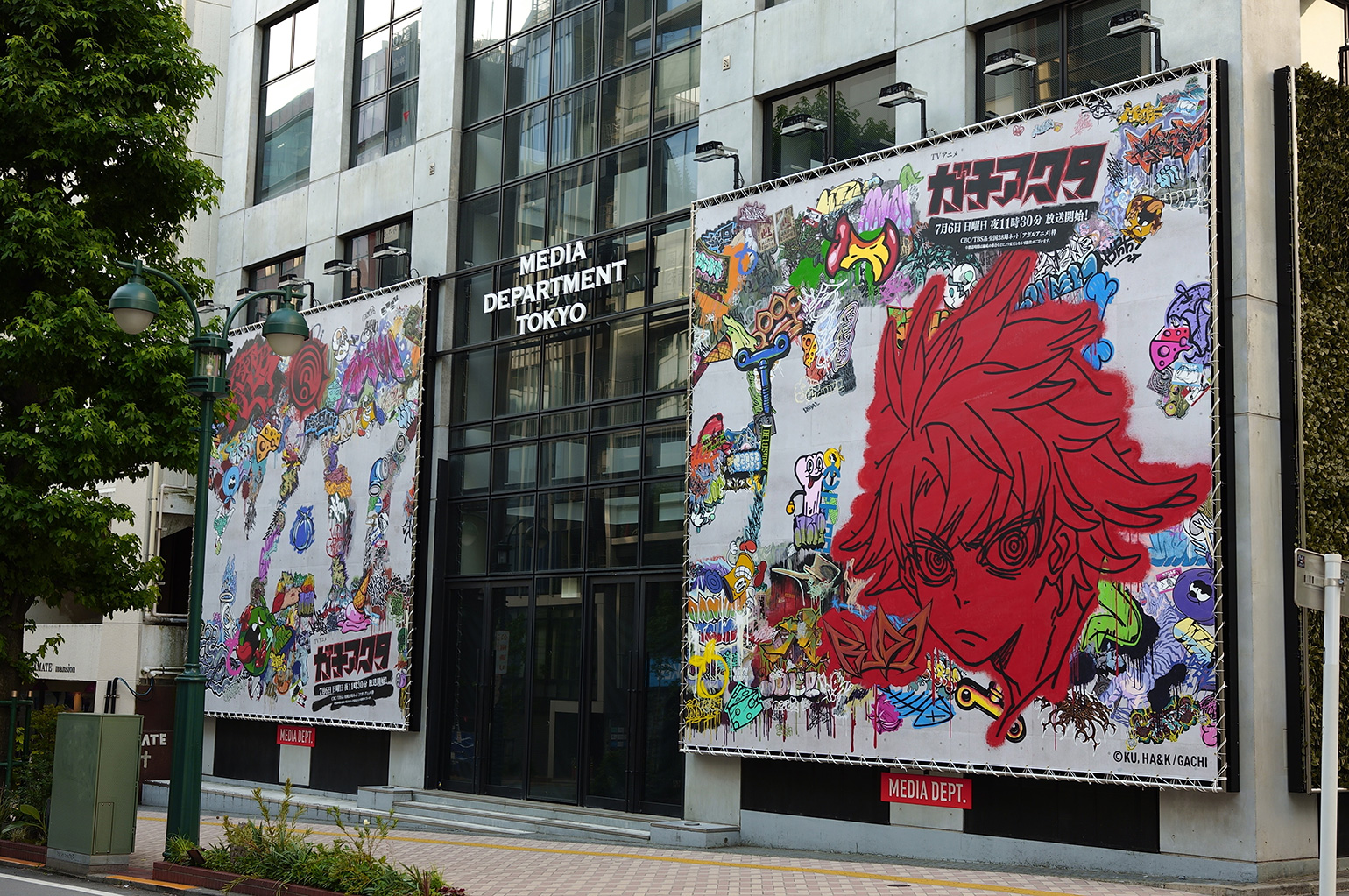
World Connecting Graffiti simultaneously took over symbolic areas in Tokyo, Los Angeles, Milan, Taipei, and Hong Kong. It also generated significant buzz on social media.
──"World Connecting Graffiti" and global social media campaigns generated huge responses in each country. Could you share the background behind deciding on each initiative?
Hirohata: When we were seeking a flagship initiative to embody the "Gachiakuta World Takeover" concept, we conceived the idea of massive interconnected outdoor graffiti advertisements. We proposed a plan synchronized across five global cities. When connected, the graffiti revealed the message "Watch Out World!"—a pre-broadcast message directed at fans worldwide.
This outdoor ad was realized through meticulous effort: we designed it ourselves, focusing on character visuals and graffiti created by Mr.Andou, then painters in each country hand-painted the final pieces. With tremendous cooperation from local partners and mobilizing resources like Dentsu Inc.'s Global Business Center (GBC), we made it happen.
Amano: I also really like it. This "Connecting Graffiti Visual" was one of the deciding factors in accepting Dentsu Inc.'s proposal.
Hirohata: Thank you. Actually, it was my top recommendation too (laughs). We're also tackling global SNS and a global website. After discussing how establishing a proper information hub led by the production committee would express the project's stance of "reaching people worldwide," we decided to launch it.
The global website consolidates all "Gachiakuta" information for overseas audiences. We wanted an official hub where fans could find everything without missing anything. By featuring the latest updates and anime event report videos, it also becomes a place where "Gachiakuta" worldwide can see the movement happening near them, thinking, "Wow, it's this exciting in my area too!"
Amano: At Kodansha, we genuinely want to spread our works worldwide. We value not just North America, but also South America, Europe, Asia, and every other region. That's why we asked Dentsu Inc.—as Mr.Hirohata mentioned earlier—to create campaigns where fans in every region feel like the promotion is specifically for them.
Iwanami: That's why we're also focusing on multilingual support for our global SNS. We've made an effort to translate important posts into up to seven languages so fans feel like we're speaking directly to them. While our overseas licensees also have channels and share content, we still wanted to send authentic information from Japan itself to the world.
The "incredible passion" felt at the World Premiere and Anime Expo
Dentsu Inc.'s Hirooki Iwanami
──You also held a world premiere (preview screenings in various regions), which is rare for a Japanese anime. What was the goal behind that?
Amano: The primary goal was to generate massive, simultaneous excitement worldwide right at the anime's broadcast launch. During discussions, we got really excited, thinking, "If we do this, it'll definitely create buzz!" and everyone agreed, "We have to make this happen somehow."
Iwanami: I remember that was the most heated discussion at the production committee meeting. Should we take the risk and do the world premiere, or play it safe? The 20 to 30 people at that meeting debated this single issue intensely. At that moment, I felt a real sense of unity, knowing everyone on the production committee was genuinely committed to making this project a success.
Amano: The situation differs between Japan and overseas, so holding an overseas premiere carries different risks than doing it domestically. Production committees, including ours, have traditionally prioritized the Japanese market. Some voiced concerns: was it really necessary to take the risk of an overseas premiere?
However, in this era, to genuinely pursue global expansion for a work, you absolutely must take risks. I believe it's precisely because we took that risk that this work is succeeding now. Compared to when we had those discussions, I feel the production committee members' perspectives and attitudes toward overseas markets have shifted.
──In addition to the world premiere, you also had a booth and participated in panels at Anime Expo, the largest anime event in the US. Could you share what you observed about overseas fans and how they differ from Japanese fans?
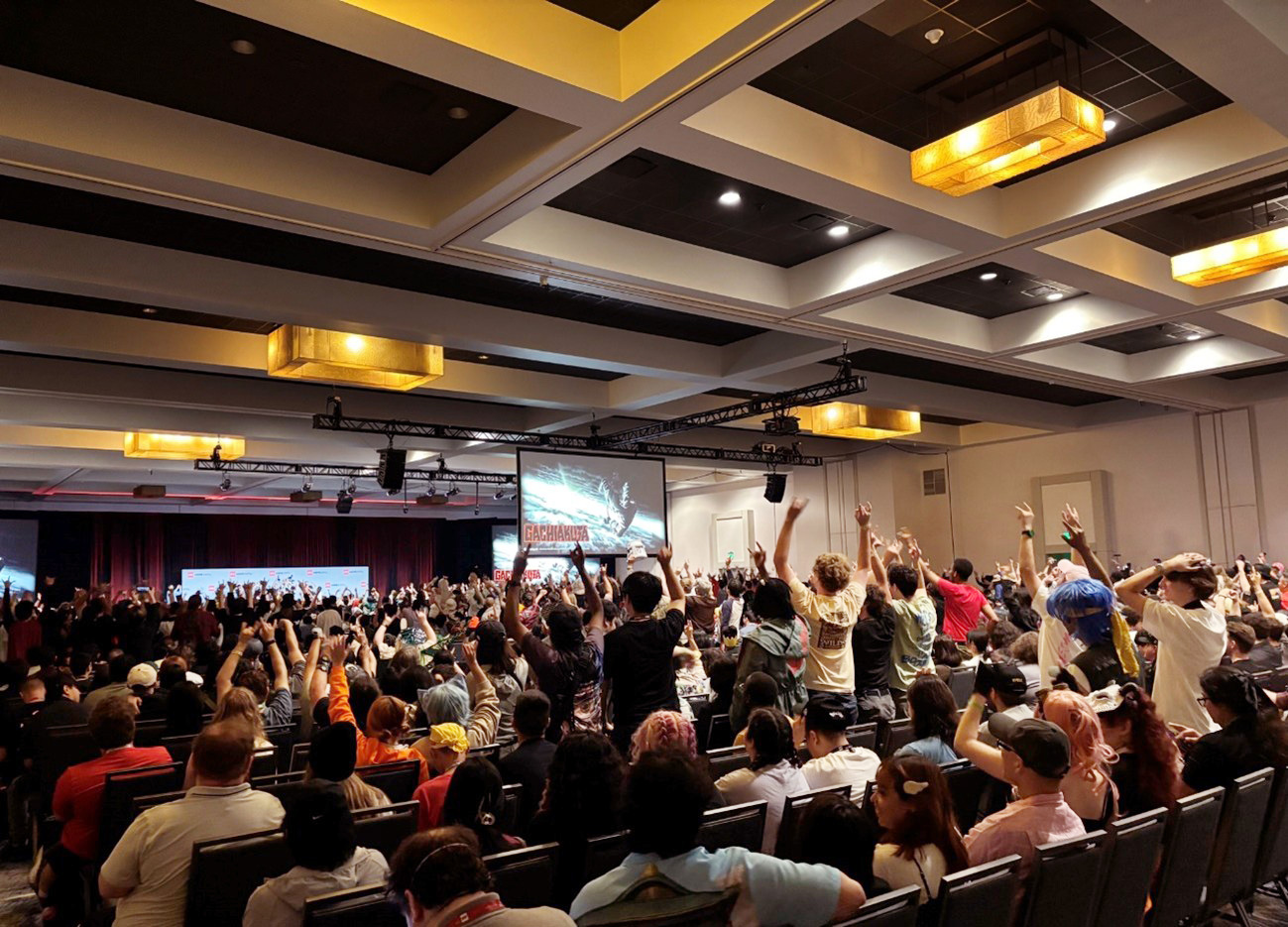
Many anime fans flocked to the world premiere and the live painting event by the original author.
Iwanami: Wherever I went, I was struck by just how incredibly passionate fans are about manga and anime. Another major difference from Japan is that far more people overseas are interested in behind-the-scenes content. It was impressive to see them listening intently and with genuine interest to the author's or producer's remarks.
Hirohata: The values surrounding cosplay were also distinctive. In Japan, the typical dynamic involves cosplayers wearing meticulously crafted costumes and spectators enjoying the sight. Overseas, however, it's embraced as a more accessible culture. People cosplay more with the mindset of simply embodying their favorite world, prioritizing that over high quality. That's why I felt cosplay popularity is relatively higher than in Japan.
I also felt the high energy at the venue. During panel discussions, whenever new information or footage was revealed, the audience would literally gasp. Even we, who knew about the reveals beforehand, were genuinely surprised by the reaction.
Iwanami: Getting that kind of positive reaction is really motivating, isn't it? The response at Anime Expo in LA was fantastic, and the panelists were genuinely excited.
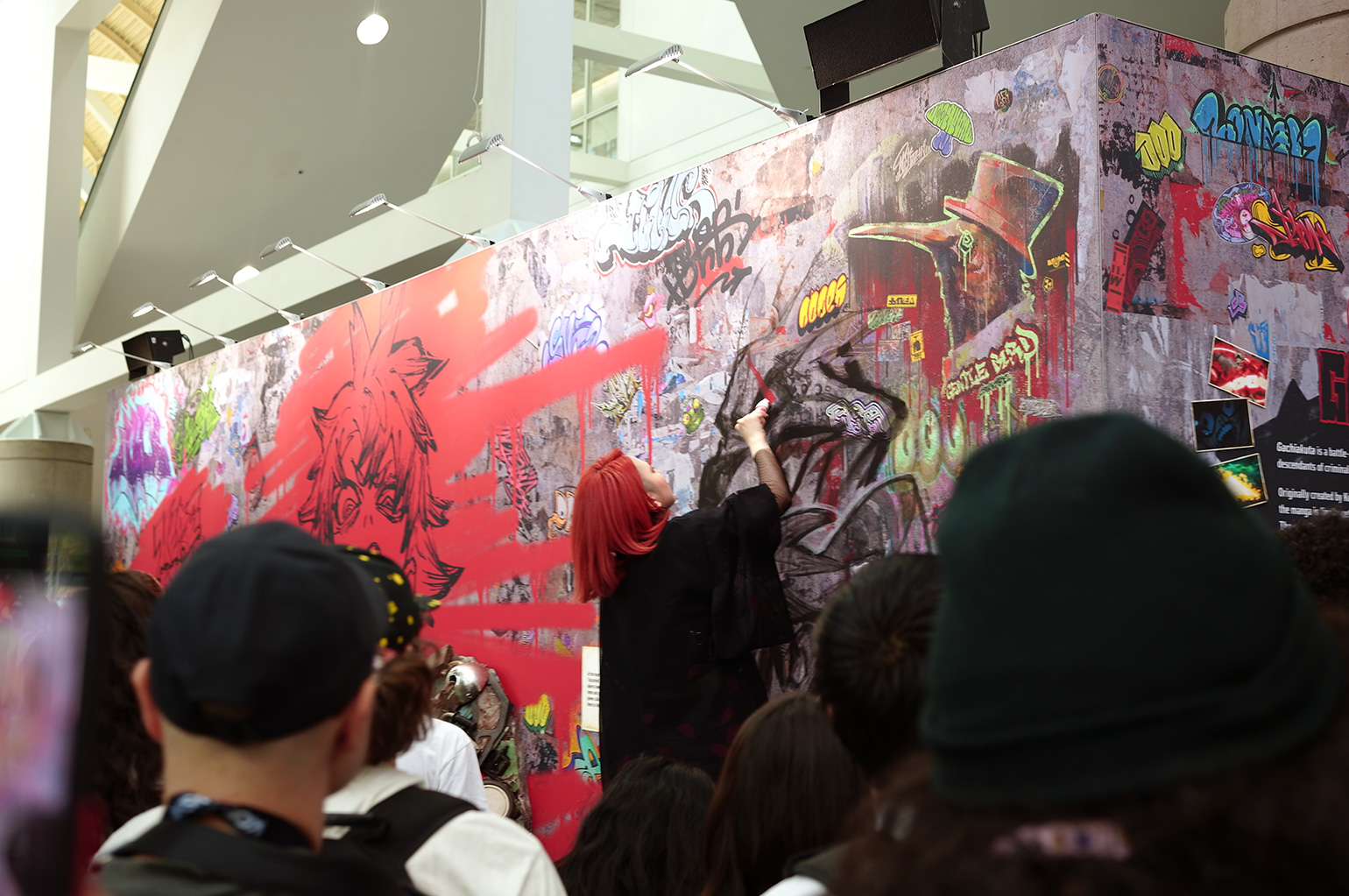
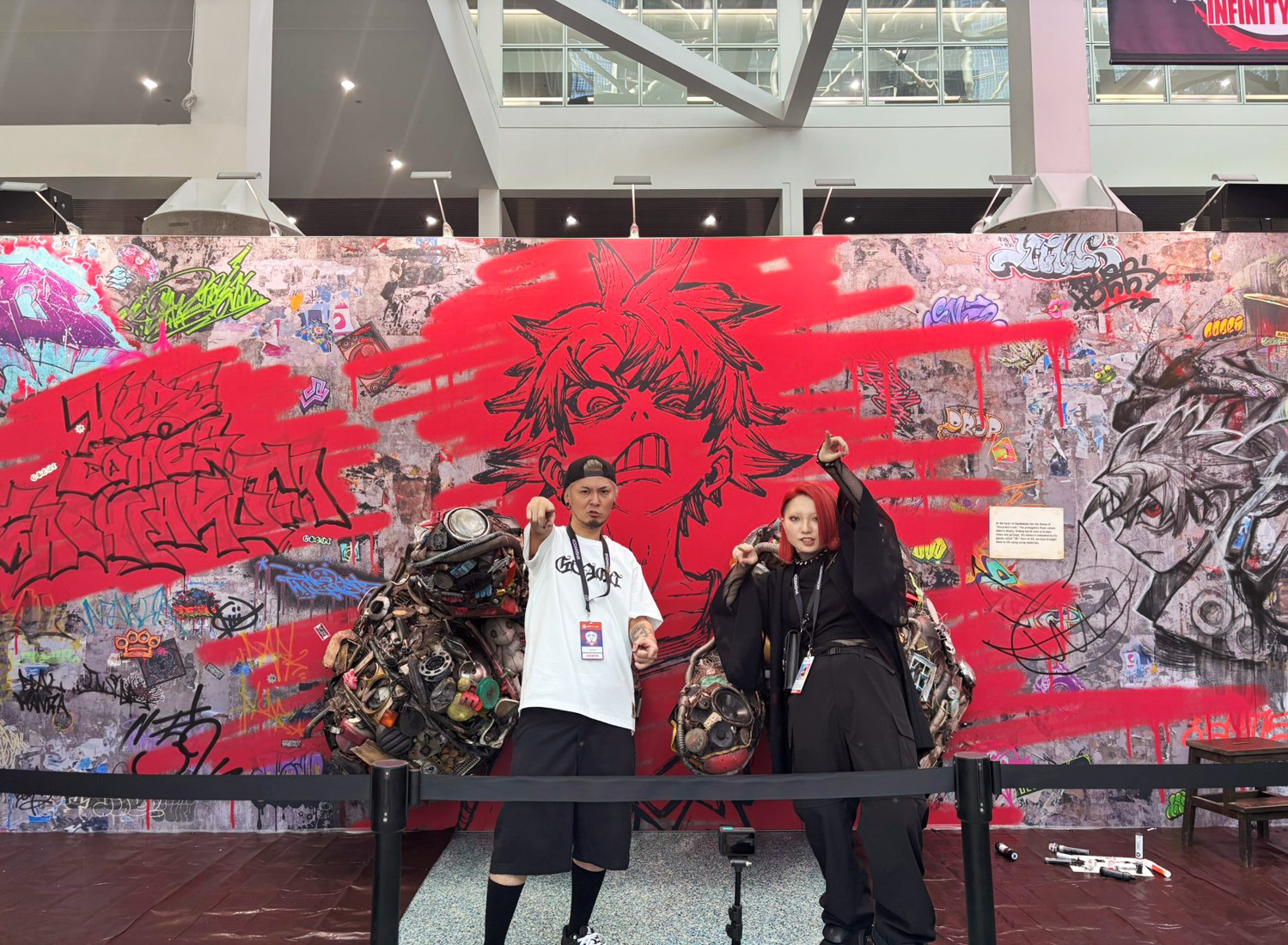
Hirohata: I think the key to fan communication for IP content is creating moments where that "passion" resonates. So at Anime Expo, we had booths in three locations and participated in two talk sessions. We also arranged a live painting event featuring Urana-san and Andou-san.
Throughout the event, we created a situation where fans would see "Gachiakuta" and hear their names everywhere they went, letting them physically feel the excitement. As a result, the local fans showed even more enthusiasm than we expected.
Urana and Andou performed live painting on a wall beside a massive art installation made from scrap materials. Their booth drew such attention it became a crowd magnet.
The possibilities are endless! The "inventions" to spread Japanese IPs worldwide continue.
──So, what are the key points in designing communication that overseas fans will enjoy?
Hirohata: It's hard to sum up in one word, but I think it's about pinpointing the essence of the work—understanding what fans find interesting about it. On top of that, grasping the characteristics of fans in each region.
For example, with "Gachiakuta", preserving its gritty, underground tone and feel is fundamental. To gain traction in North America, we focused on major events like Anime Expo. In Asia, there's a stronger culture of promoting individual characters. Identifying these regional fan characteristics, then determining what kind of initiatives would work best for this specific work—this multiplication effect—and translating it into a promotional strategy is crucial for global communication.
──As an IP holder managing many outstanding manga, what do you consider most important when expanding Japanese IP content globally?
Amano: Of course, the brilliance of the IP itself is fundamental.Works that gain global popularity inherently possess a universality that transcends borders. What we can do on the business side afterward is to listen carefully. And to observe closely, I believe. I'm still very much in the learning phase myself and have many areas for reflection, but it's about observing the market. Listening to fan opinions. And working collaboratively with licensees toward the same goal. Furthermore, to meet overseas demand, I think it's equally important to listen to the opinions of the production committee members and the authors themselves, and to serve as a bridge between them and the licensees.
──Finally, could you share your outlook on the future of "Japanese IP × Overseas Expansion"?
Amano: After the pandemic, anime became accessible on diverse platforms worldwide. It feels like people who hadn't previously encountered anime can now finally enjoy it casually. The Japanese anime market is predicted to expand further for at least the next few years. However, there's still so much untapped potential in the overseas anime market – so much that should be possible. The possibilities are enormous. I believe we'll be able to create even broader, more exciting projects going forward.
Iwanami: I agree! Through this project, we've seen that the promotional know-how we've cultivated domestically also works overseas. For example, the effectiveness of "vertical launches" is one such thing.
On the other hand, there are still gaps. Even when conveying the same concept, I strongly feel the importance of localization. This means we need to gain deeper local insights and build networks. This project was only possible thanks to the cooperation of licensees like Crunchyroll and Medialink. Moving forward, to globalize IP content, I believe the key lies in digging deeper into local insights and accumulating that knowledge.
Additionally, while collaborations like anime and convenience store promotions are commonplace in Japan, I believe such communications can also be executed globally. Launching new business ventures derived from anime and manga is an area where Dentsu Inc. excels, so I want to attractively "expand" IP content in various forms.
Hirohata: Yes, I believe Dentsu Inc. is expected to "invent" new methodologies and expressions. This time, we challenged ourselves to "invent" overseas promotional methods like outdoor advertising, SNS, and websites while pinpointing fan insights in each specific area. Yet, there are still untapped areas remaining. That's precisely why it's such a rewarding field where we can discover the "firsts."
Moving forward, I want to explore untapped areas like promotions that incorporate the voices of overseas fans, and I'm eager to "invent" many more things together with everyone.
After graduating from a UK graduate school, joined Kodansha. Worked in advertising-related departments for approximately three years. Subsequently transferred to the International Rights Business Department, handling overseas licensing for comics and anime merchandising. Currently oversees the Anime Overseas Licensing Team in the Anime & Game Business Department. When not working, devotes time to wine, travel, rugby, and admiring Shiba Inu dogs.
Hirooki Iwanami
Dentsu Inc.
Publishing Business Development Division, Content Account Division 1
Planner
Planner, Publishing Business Development Division. Content Account Division 1. After graduating from Rikkyo University, studied fashion design and marketing in New York, graduating from FIT. Upon returning to Japan, worked at Dentsu Inc. Magazine Bureau handling clients including Shueisha, Kodansha, Shogakukan, and Magazine House. Gained experience in sales for foreign fashion brands at The Goal Inc. Currently involved in global business for publishers, working on the global expansion of manga and anime.
Born in Kanagawa Prefecture, spent childhood in the United States. Graduated from the Graduate School of Engineering, University of Tokyo. A planner specializing in fan communication and buzz-building strategies for IP content, creating playful experiences using digital and technology, and global expansion. Hobbies include manga, comedy, idols, puzzle-solving, and basketball. Skilled at being a board game master.