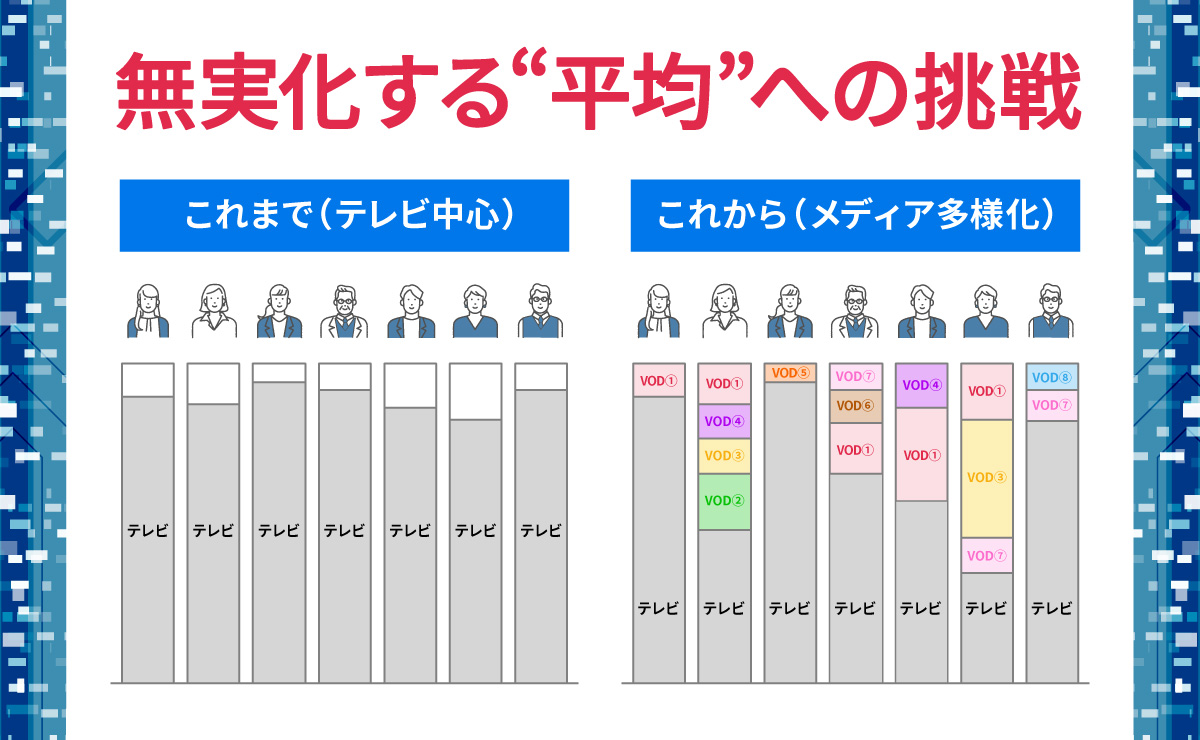
Television commercials used to face challenges such as "time-consuming from order to air" and "limited effectiveness measurement." Now, services that overcome these challenges and update advertising on television media are increasing.
This series introduces new services related to the increasingly sophisticated television media and examples of advertisers who have used these services. We will explain how to effectively utilize TV commercials based on advertisers' KPIs and challenges.
This time, we introduce the case of Coca-Cola Japan (hereinafter Coca-Cola), which achieved results by challenging the initiative of "purchasing additional commercial slots at the last minute using 'Sugree,' a service that predicts reach and conducts online transactions for advertising slots."
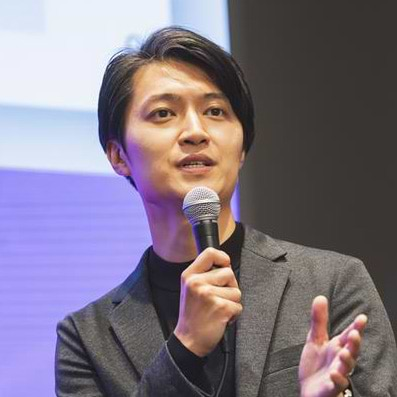
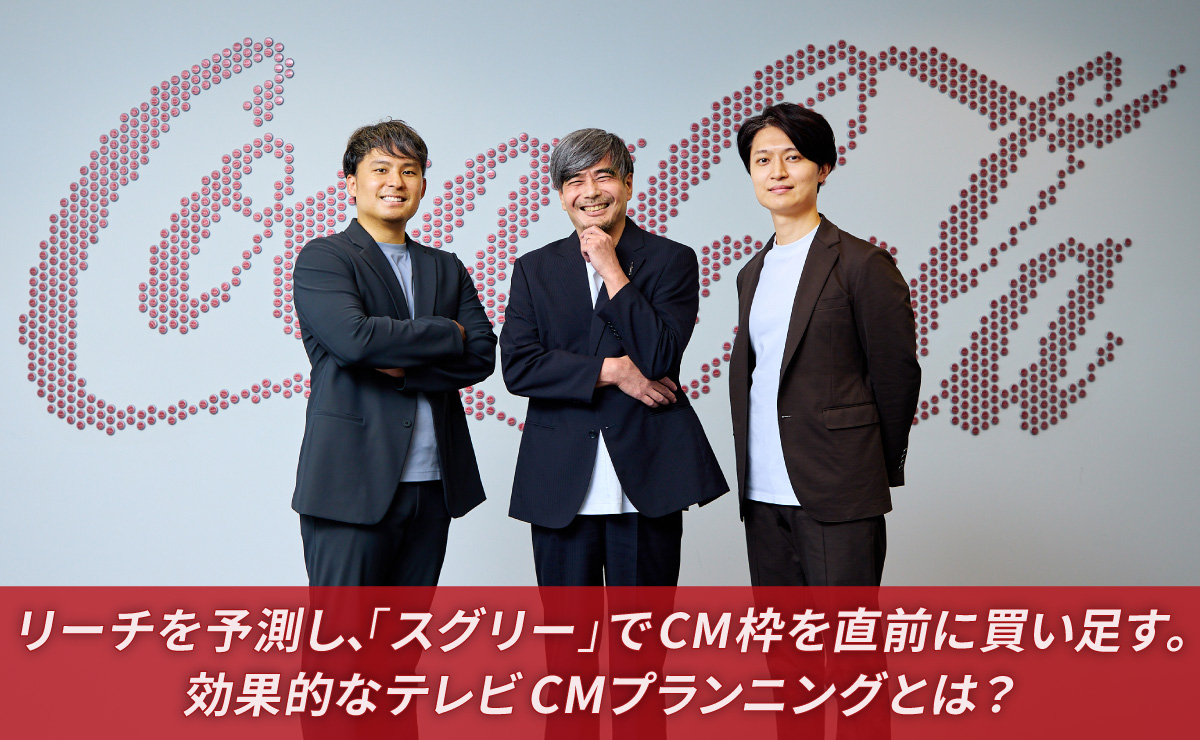
Tetsuya Ikeda from Coca-Cola's Marketing Division, Yusuke Takei from Nippon Television who was involved in developing "Sugree," and Yuta Takigawa from Dentsu Inc.'s Radio,TV Business Produce Division discussed the case.
(From left) Yuta Takigawa, Dentsu Inc. Radio,TV Business Produce Division; Tetsuya Ikeda, Senior Director, Marketing Division, Coca-Cola Japan; Yusuke Takei, Deputy General Manager, Advertising Strategy Center, Sales Division, Nippon Television
Buying slots effective for gaining unique reach with SHAREST Reach Planner and Sgree
──First, please introduce yourself.
Ikeda: After working in media planning at several advertising agencies, I joined Coca-Cola. I am currently part of the Marketing Division and am in charge of media planning.
Takei: After joining Nippon Television, I was involved in selling TV commercial spots, including forming digital media alliances. At that time, I was greatly surprised by the difference between how digital and TV advertising are sold...This prompted me to aim for the realization of "TV commercials that can be operated like digital ads." I led the planning and development of the "Ad Reach Max Platform," which enables the digitization of TV advertising by connecting to broadcasters' broadcasting equipment, and "Sugree," a service for online trading of digitized advertising slots.
Takigawa: After joining Dentsu Inc., I worked in sales before transferring to the Radio,TV Business Produce Division. Using data and AI, I plan and implement measures to efficiently utilize TV commercials in collaboration with broadcasters, utilizing predicted viewership ratings and other data. In this initiative, we supported the campaign by adding additional commercial slots purchased through Sgree to the TV spot slots already purchased, thereby increasing the overall unique reach efficiency of the campaign.
──This initiative focused on improving the efficiency of TV commercial reach. What challenges had you faced with regard to reach up until now?
Ikeda: The main purpose of using TV commercials is to raise awareness of the campaign. However, as TV viewing habits gradually change, we felt that it was difficult to achieve the expected reach with conventional planning and TV advertising.
Takei: Recently, I've noticed more advertisers adopting the stance that "we don't need TV commercials; digital is sufficient" in media planning. I proposed the Ad Reach MAX initiative internally during the COVID-19 pandemic in 2021, a time when the world had shifted entirely toward digital. Ad Reach MAX emerged from re-evaluating television within the digital context and determining how it should be positioned.
──What specific measures did you take in this initiative to improve the efficiency of reach acquisition?
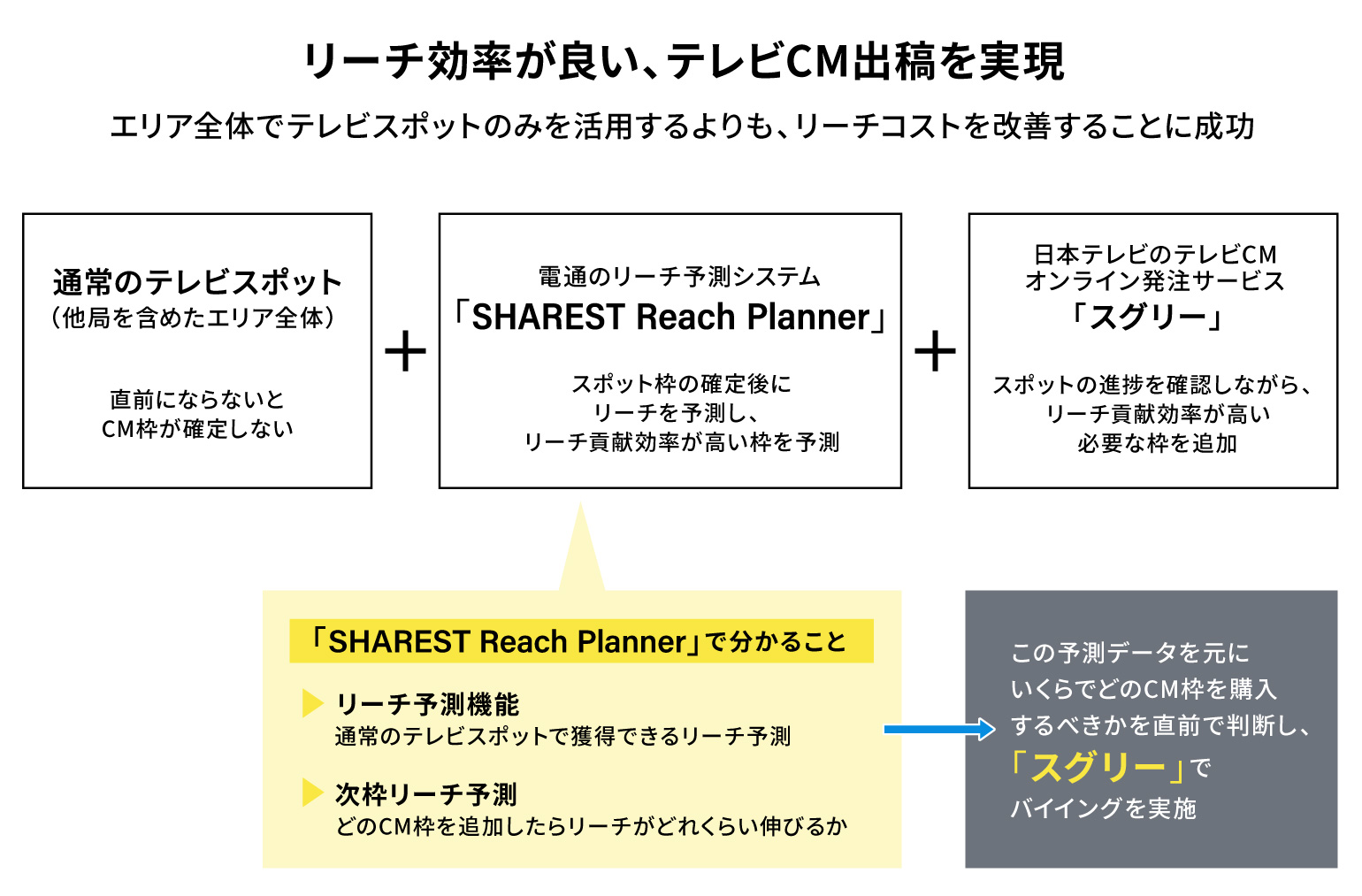
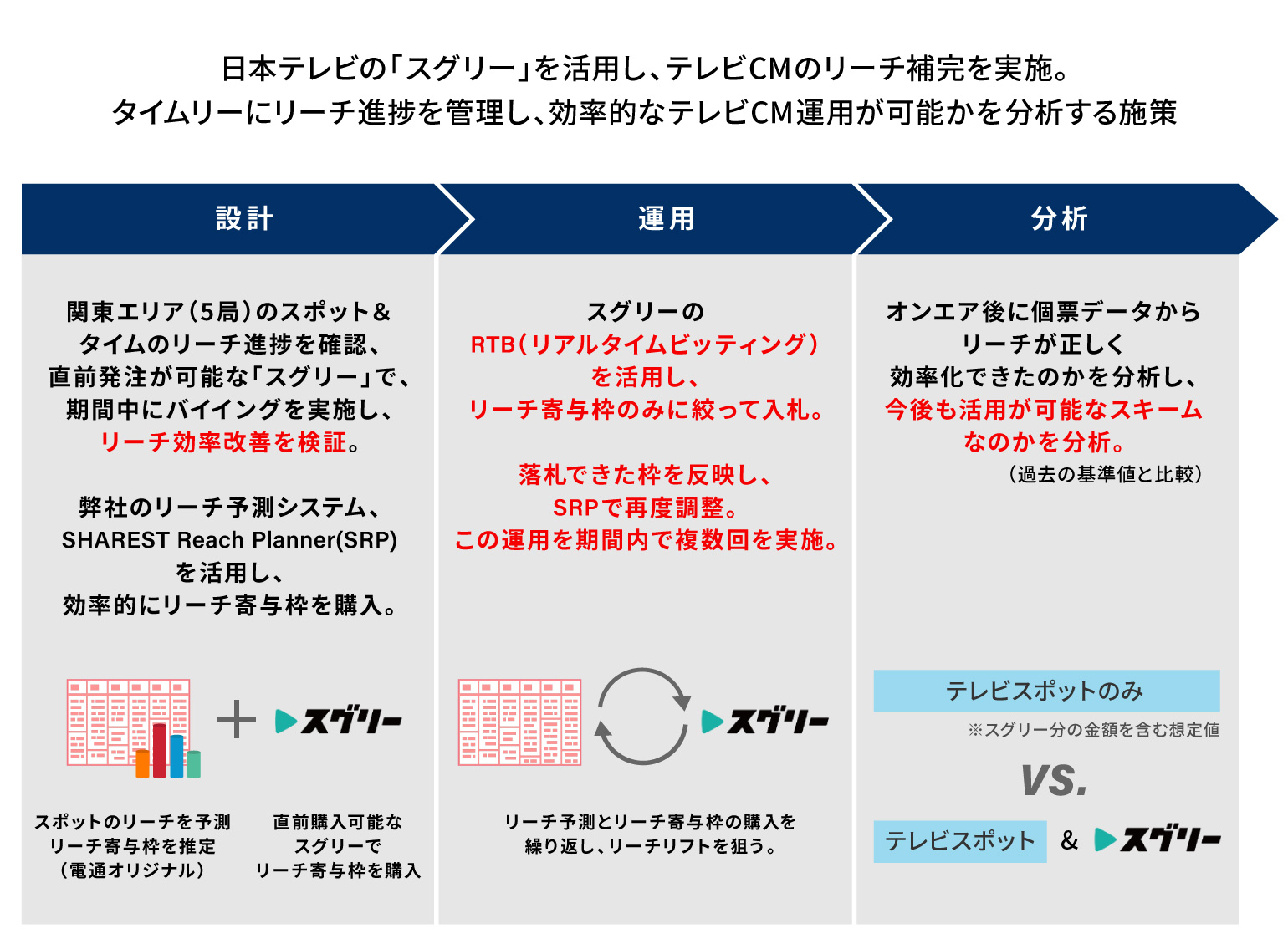
Takigawa: As usual, we purchased TV commercial slots. Then, using Dentsu Inc.'s reach prediction system, SHAREST Reach Planner, we identified the commercial slots that would contribute to reach and made additional purchases on Greer. Greer allows you to set bid costs, so we purchased at prices that would maximize efficiency, taking into account past reach acquisition costs.
──What kind of system is SHAREST Reach Planner?
Takigawa: It's a system that enables unique reach prediction based on predicted viewership calculated using AI from various data, such as past ratings, and predictions of viewer overlap between programs. It has two main functions.
The first is the unique reach prediction function. It predicts how much unique reach can be gained from a single spot campaign, taking into account that the same person may be exposed to the same advertisement multiple times.
The second is the search function for additional commercial slots. After predicting the reach score that can be achieved with spot campaigns alone, it can determine which slots on which stations should be purchased to increase reach most efficiently.
In our recent project with Coca-Cola, we identified additional slots to purchase from among those available on Greer and bought them one by one. We set a baseline value based on past spot campaign results and compared it with the predicted reach score for this campaign to determine how much additional commercial slots we could purchase to efficiently and cost-effectively increase reach, and then set the bidding conditions. As a result, we were able to improve reach efficiency.
──Next, Mr. Takei, please explain about Sgree.
Takei: Sugree is one of the user interfaces of Nippon Television's advertising slot trading platform, Ad Reach MAX, and was launched in April 2025. Sugree has two functions.
One is impression reservation. You decide your budget, period, target, and number of impressions in advance. After that, commercial slots are automatically managed to achieve the contracted number of impressions. The biggest difference from existing TV spots is that the impressions set at the time of ordering are guaranteed. Because it is automatically managed by the system, you cannot check in advance when the commercial will air.
The other is automatic bidding auctions. This involves competing for specific slots in an auction format. For example, if you specify that you want to buy the one-hour slot from 5:00 p.m. to 5:59 p.m. on September 8th because it is valuable, we will bid precisely for that slot. Of course, since it is a bidding system, there is a possibility that you may not win the bid. In that case, you can recover by bidding for another one-hour slot or the following day, allowing you to minimize lead time.
──Which feature did you use for this initiative?
Takei: The automatic bidding auction. We thought this would be a challenging product. However, once we started operating it, demand for the automatic bidding auction grew. In April, impression reservations were about 60-70%, with the automatic bidding auction at around 30%. By September, over half were automatic bidding auctions.
Takigawa: Why is the demand for automated bidding auctions increasing?
Takei: I think it's because it can be adapted to a wide range of KPIs.Even among customers who value reach, the metrics they emphasize in marketing vary. Until now, I think television has been forced into the KPI of GRP (Gross Rating Point: total audience rating). However, by using Greer, it has become possible to purchase commercial slots with KPIs that are more in line with marketing plans. As a result, I feel from talking to various people that automated bidding auctions have a wider range of uses and purposes and are easier to use.
Purchased six commercial slots with Greer and increased reach
──Please tell us your impressions of this initiative, which combined SHAREST Reach Planner and Greer.
Takigawa: After the spot campaign slots were more or less decided, we were able to select and purchase additional slots that contributed to our reach, which I thought was a good fit.
Ikeda: The approach of maximizing effectiveness by purchasing additional commercial slots on top of normal buying matches the media efficiency and business contribution we are always seeking, and I think it's great that you recognized this point.
Takei: I believe that using SHAREST Reach Planner this time solved two issues that Nippon Television had.
One is that Greer can only be used to purchase Nippon TV slots. Therefore, when purchasing a wide range of commercial slots, including those on other stations, as Coca-Cola does, I think it is inefficient to use Greer only for our station and conventional spot slots for other stations.However, this time, we were able to use Greer as an additional option, purchasing the base portion with conventional spot slots and supplementing the shortfall with Greer. I believe this use of Greer solved the problem that currently only Nippon Television's commercial slots can be purchased with Greer.
Another issue is that many people don't know how to use Sgree. This time, as the name "Sgree: Instant Reach" suggests, we were able to propose using Sgree to gain reach, which I felt was an idea that made it easy to convey the appropriate usage to our advertising clients.
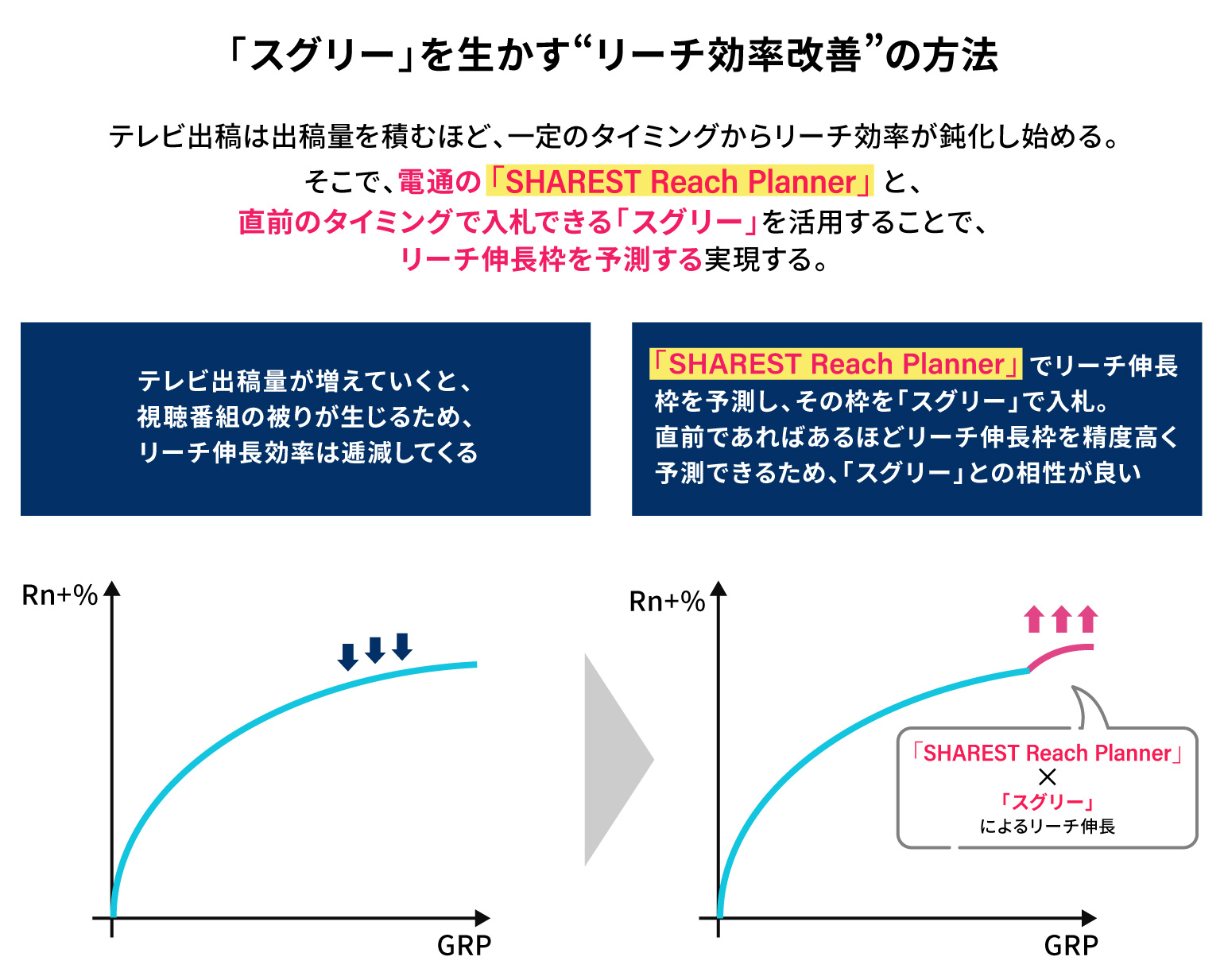
Takigawa: Spot slots have the disadvantage that you don't know where they will be aired until the last minute. From the perspective of acquiring unique reach, it is important to avoid wasting impressions.I think the advantage of "Sugree," which can be purchased at the last minute, is that it allows us to achieve effective frequency while avoiding excessive exposure to the same people, meaning we can effectively reach people who haven't seen the commercial. It's not just a matter of buying additional commercial slots. We were able to predict which commercial slots would contribute to reach and bid below the standard value based on past performance, so I think we were able to make a good proposal.
──Please tell us the results of this initiative.
Takigawa: We purchased six commercial slots with Sugu-Greer and were able to efficiently increase our reach compared to past results.
Ikeda: Regarding the results of this initiative, the internal response was that it has enabled us to further improve the efficiency of television media.
Takigawa: As a result, all the slots purchased on Sgree contributed significantly to our reach, which I think is great. There are opinions within the company that we want to spread this kind of utilization, and we have received inquiries about it.
Takei: Since this initiative was implemented in May 2025, just two months after the service launched, it attracted a lot of attention within Nippon Television. The positive results led to internal discussions about how to utilize Greer.
Delivering the most effective advertising to the world through AI utilization and cross-platform integration
──Please tell us about your future outlook.
Ikeda: I think it would be great if we could adjust the volume of commercials based on the temperature. For example, looking at the data for our product Aquarius, we see that it tends to sell better on days when the temperature exceeds a certain value or when it is a certain number of degrees higher than the previous day. We tried to see if we could increase sales by increasing media exposure when those conditions were met. It was easy to do digitally, but we found it difficult with traditional television. I think it would be great if we could use it that way for TV commercials in the future.
Takei: Actually, we recently released a temperature-linked feature for Greer. For example, you can set it to run ads only when the temperature exceeds 35 degrees Celsius and stop when it drops below that. We also plan to release a feature that automatically adjusts ad placement based on weather settings, such as running ads only when it's sunny or snowing.
Takigawa: If Sugree's temperature-linked function develops further, it will be possible to create advertising appeals connected to real life, such as telling people that on days when Coca-Cola commercials are running, it's a hot day with a risk of heatstroke, so they should drink plenty of fluids. I think this would be beneficial for consumers. It would be wonderful if such initiatives could be implemented in the future, and I feel it would bring advertising closer to how it should be.Also, since details about TV programs are often released at the last minute, if we can combine AI to measure which commercials will be most effective in which program slots, we can leverage the advantage of being able to buy advertising space right before it airs.
Takei: That's right. Times and moods change moment by moment, and I think advertising will be more accepted if it fits with the trends of the world. It would be great to be able to use Sgree to run ads in real time, and I think we need to evolve it further because the era of AI will require even greater speed in the future.
Ikeda: This time, we were able to confirm the effect of increasing the amount of unique reach. In the future, I think the significance of using Sgree will increase even more if we can also see the quality of the slots purchased with Sgree.
As a manufacturer, we want our ads to reach consumers through any medium, but excessive exposure to the same ad across various media is counterproductive for companies. Therefore, we believe the ideal situation is to be able to control the volume of messages delivered across media platforms. I feel that Sgree, which allows TV commercials to be used like digital ads, has the potential to lead to that ideal. For that reason, we want to continue using it and expect it to continue evolving.
Japan & South Korea Operating Unit Marketing Division IMX Media Strategy & Operations
Senior Director
Joined I&S BBDO in 1995. Handled TV stations, media planning, and underwent training in the UK. Moved to GroupM Japan in 2006, managing various foreign clients. From 2016, led numerous brand campaigns at Coca-Cola Japan, also involved in developing the Tokyo 2020 Olympics and Shibuya Coke Vision.
Yusuke Takei
Nippon Television Network Corporation
Sales Division, Sales Strategy Center
Deputy General Manager, Adreach Max Division
Business manager for the Ad Reach Max Project, which makes TV advertising easier to use. Leads the marketing utilization and industry standardization of Sgree, an advertising space trading platform that integrates TV and digital.
Yuta Takigawa
Dentsu Inc.
Radio,TV Business Produce Division, Television Market Development Department
Producer
As a business producer, I handle client operations. Since 2022, I have been part of the Radio,TV Business Produce Division, responsible for developing and operating television solutions utilizing AI and data, driving the advancement and efficiency of next-generation television advertising.

 Advanced TV Lab: Evolving Planning and Effectiveness Measurement Systems [4/6]