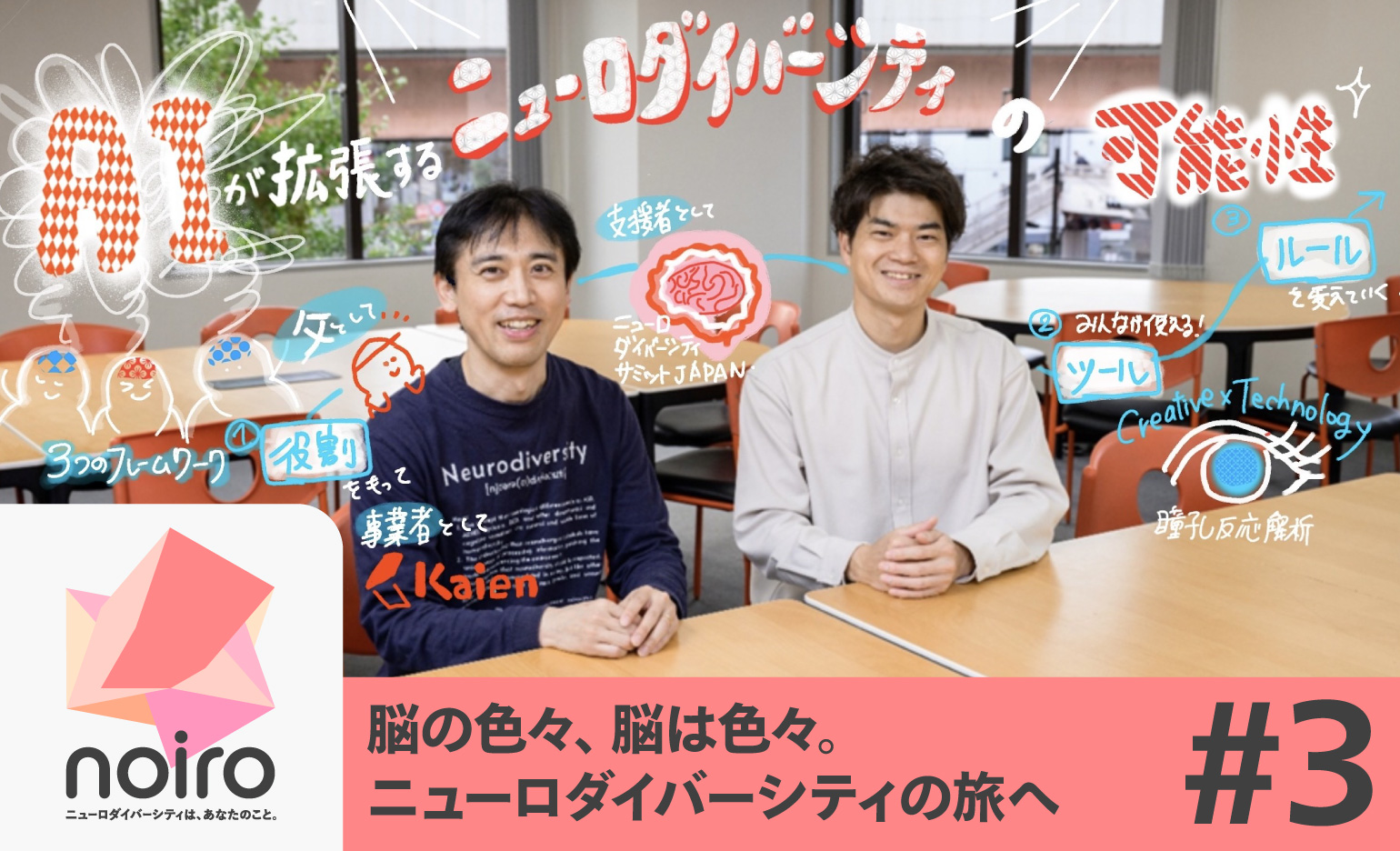
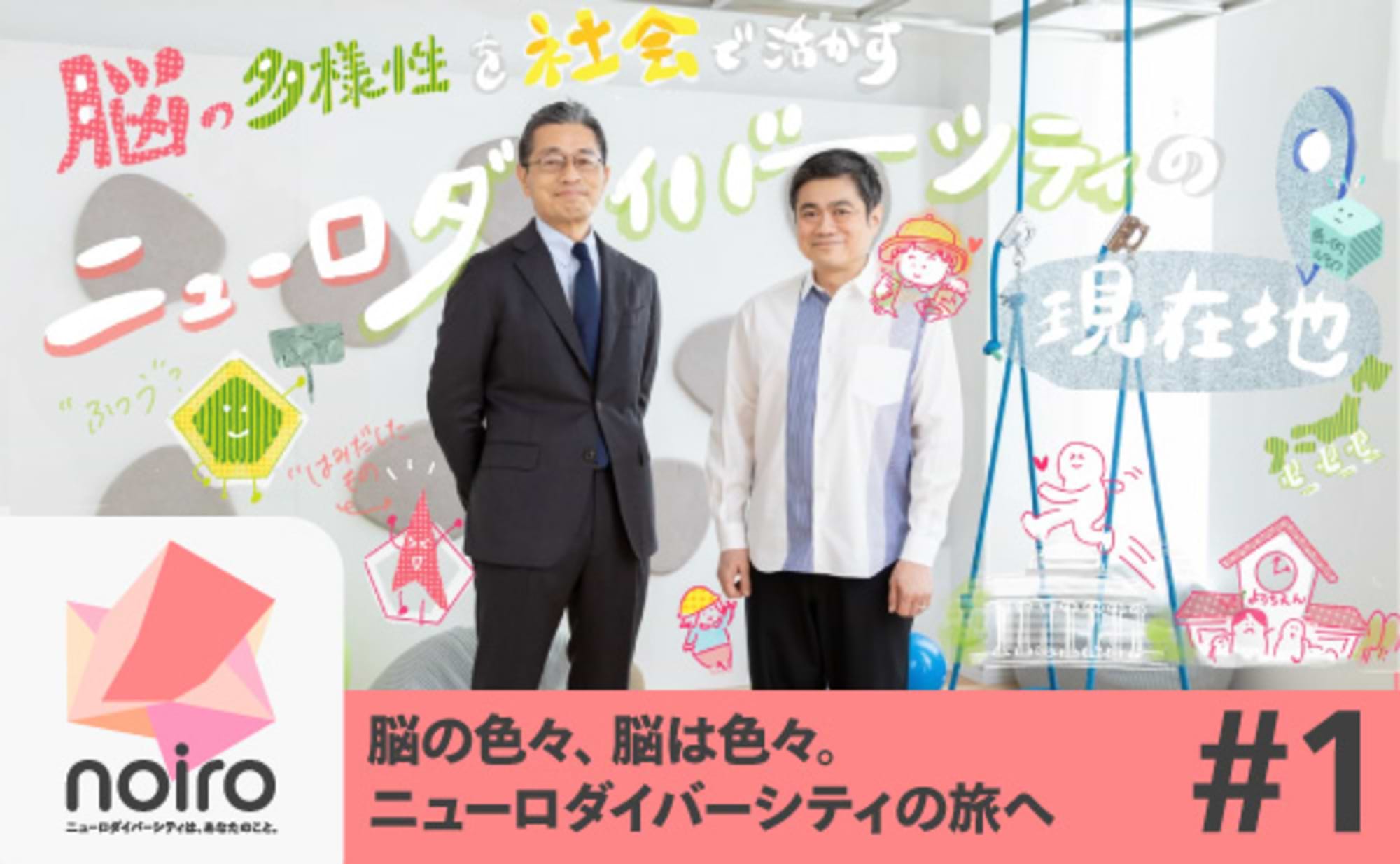
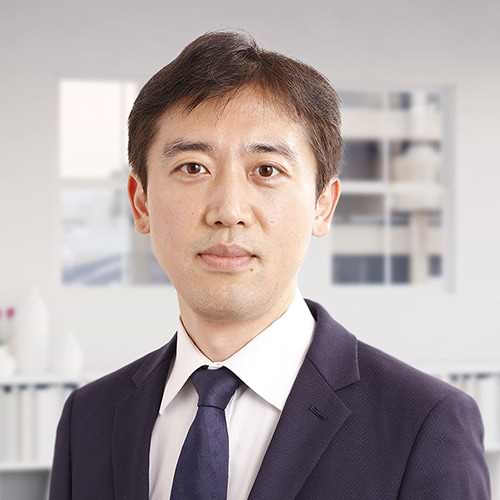
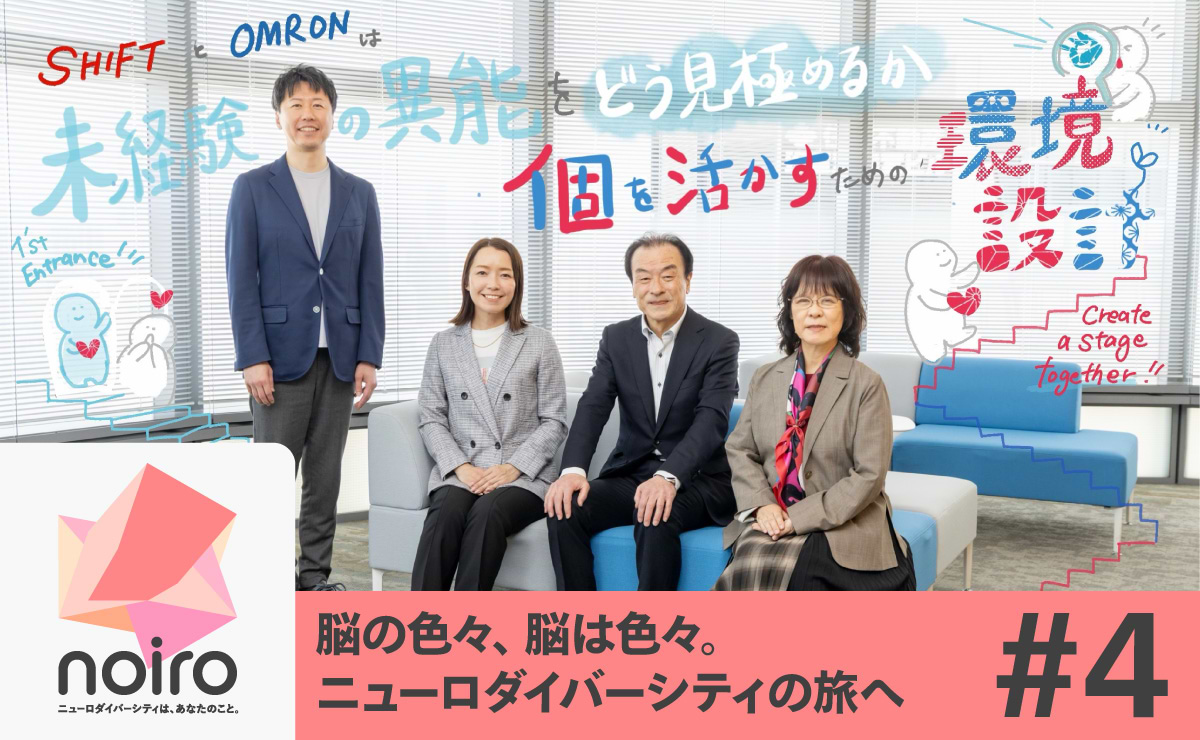
From left in the photo: Keita Suzuki, Representative Director of Kaien; Takeshi Iida, DENTSU SOKEN INC. Taken at the Kaien Akihabara Satellite Office. Photo-scribing: Chiharu Kai ( Representative, Dentsu Graphic Recording Institute )
Neurodiversity is a philosophy that views diverse developmental characteristics—including ASD (Autism Spectrum Disorder) and ADHD (Attention-Deficit/Hyperactivity Disorder)—as “differences in brain characteristics” and “individuality,” and seeks to harness them for the benefit of society.Focusing on this concept, the Neurodiversity Project [noiro] was launched in 2021 by a group of volunteers from Dentsu Inc. and DENTSU SOKEN INC. In this series, members of noiro will explore the current state and future of neurodiversity through dialogues with experts and individuals living with these conditions.
For this third installment of the series, we invited Keita Suzuki from Kaien, a noiro alliance partner that provides employment and educational support to people with developmental and mental disabilities. Joined by noiro member Takeshi Iida (DENTSU SOKEN INC.) and moderated by noiro member Hidemitsu Kitamoto (Dentsu), they discussed the theme “AI and Neurodiversity.”
*What is Neurodiversity?* A term combining “neuro” (brain/nerves) and “diversity.”It is a concept that views differences in the brain, nervous system, and the various individual characteristics stemming from them as forms of diversity, encourages mutual respect, and aims to leverage those differences within society. It regards neurodivergent development—such as autism spectrum disorder (ASD) and attention-deficit/hyperactivity disorder (ADHD)—as natural differences among individuals, rather than as disabilities, lack of ability, or a matter of superiority or inferiority.This concept applies not only to neurodivergent individuals but to everyone. It was proposed in the 1990s by Australian sociologist Judy Singer, and since the 2010s, initiatives—primarily among overseas IT companies—have spread to leverage the characteristics exhibited by people with neurodivergent traits, such as high levels of concentration and creative thinking.
Two days before moving to the U.S., my son was diagnosed with a developmental disability. I earned an MBA and founded Kaien
Kitamoto: Today’s theme is “AI and Neurodiversity.” I’d like to discuss how technology—including AI—can enhance neurodiversity and transform the world. First, could our guests, Mr. Suzuki and Mr. Iida from DENTSU SOKEN INC., please introduce themselves?
Suzuki: My name is Suzuki, and I’m the CEO of Kaien, a company that provides employment and educational support for people with developmental disabilities.
I used to work as an announcer at NHK. In August 2007, I was set to study abroad in the U.S. to earn my MBA, but two days before my departure, my son was diagnosed with a developmental disability. Looking back, I realized that my child is a separate individual from me, and that it was wrong for me to grieve on his behalf—but at the time, I was so shocked that I remember I couldn’t stop crying.
After that, with the mindset that “I just have to keep moving forward,” I went to the U.S. and, while pursuing my MBA, began exploring the intersection of developmental disabilities and business. As I learned and exchanged ideas with talented MBA students of my own generation, I became inspired to start a business aimed at supporting people with developmental disabilities. After many twists and turns, I founded Kaien.
So, I am a father, a supporter, and a business owner. I’m involved with developmental disabilities and neurodiversity from these three roles and perspectives.
Iida: At DENTSU SOKEN INC., I’m involved in business development for solutions that utilize technologies such as pupillary response analysis, as well as creative tools that can be applied in workplaces where people with disabilities are employed. Currently, in addition to noiro, I’m also working on DENTSU SOKEN INC.’s Neurodiversity Project.
If I look back on my past just a little bit… I have an experience from my school days where “even though I was terrible at baseball, I served as captain of the baseball team for a long time.” Precisely because I was bad at it, rather than leading with strong authority, I remember constantly engaging in dialogue with each person on their level— —while being mindful of fairness and aiming for individualized optimization on that foundation. I believe that approach to human interaction—facing each person as an individual—and those values are still very much alive today as I work on neurodiversity initiatives.
My Introduction to Neurodiversity
Kitamoto: I think the term “neurodiversity” is still not very common or well-known in Japan. Against this backdrop, you, Mr. Suzuki, were quick to pick up on the term and have been actively sharing information about it. Around when, and under what circumstances, did you first encounter the term “neurodiversity”?
Suzuki: I wasn’t familiar with it when I first started my business. I don’t remember exactly when I first heard it, but I think it was probably around 2015…
Neurodiversity isn’t a concept that categorizes individual developmental traits or disabilities—such as ASD or ADHD—but rather a way of thinking that acknowledges, “Everyone’s brain is different, isn’t it?” and “That’s just part of our individuality—it’s only natural.”As a parent myself, I felt that “there’s no need to make a clear distinction,” and I thought it felt more natural to be told, “It’s simply a ‘fact’ of brain diversity,” rather than being forcibly labeled as “You have ASD.” So, in many ways, I found it to be a very useful and accessible term.
Later, in 2020, I learned that Stanford University School of Medicine was hosting a Neurodiversity Summit. I thought, “This sounds interesting,” so I signed up without hesitation and participated online. The content was incredibly inspiring. While seminars and events like this often feature presentations by experts such as researchers and doctors, this one was different: neurodivergent individuals (people with developmental characteristics) themselves—speaking from their own perspectives—powerfully shared information about the challenges they face and the initiatives they’re undertaking.
I was deeply moved and immediately contacted Stanford University, asking, “Please let us host the Neurodiversity Summit JAPAN!” They graciously agreed, and in 2022, our company took on the planning and operation—essentially using the name—and held the first edition.
Companies have varying perspectives on neurodiversity. What are the three key perspectives necessary for smooth acceptance?
Kitamoto: I think there are many instances in the corporate world where discussions about neurodiversity are tied to the employment of people with disabilities. In 2024, the mandatory employment rate for people with disabilities at companies of a certain size was raised to 2.5%. However, the reality is that only 46% of companies have actually met this target.There’s also the so-called “2027 Cliff”—the challenge of an IT talent shortage in a rapidly digitizing society. There’s a growing trend suggesting that neurodiversity could contribute to solving this issue by leveraging people with developmental characteristics suited to that field, so neurodiversity itself is viewed in various ways. Mr. Suzuki, how do you perceive this situation through your business?
Suzuki: We have a client who has commissioned us under the project name “Neurodiversity.” That company understands that everyone has elements of neurodiversity and that each person is truly unique. However, I sense that in many companies, the term is still primarily used in the context of hiring people with disabilities or those with specific developmental disabilities.
Kitamoto: Even regarding the employment of people with disabilities, while some see hope that neurodiversity could become a critical strategy for meeting statutory employment quotas, others view it as just another new buzzword in the realm of DEI. Amid this, it seems many companies are struggling with how to implement this concept within their own organizations.
At noiro, we have identified three key components—① “Role,” ② “Rule,” and ③ “Tool”—as a framework for advancing neurodiversity. First, we firmly establish “Roles,” which encompass positions and responsibilities, including those of management. Second, to support this, we change the company’s systems and HR policies—the “Rules.”Furthermore, we develop and implement “Tools”—such as physical environments and technologies tailored to individual characteristics—that are easy for everyone to use. This is our approach, built on these three pillars. While today’s discussion will focus primarily on “Tools,” I believe that for companies to truly embrace a diverse workforce, they need to make comprehensive and dynamic changes across all three areas.
Suzuki: Based on these three principles, I think it’s quite difficult to change the “rules” without a top-down approach.As for “roles,” I think they can be adjusted to some extent even at the “department” or “section” level within an organization, so I feel that the staff members in our company responsible for hiring people with disabilities and diversity initiatives are at a level where they can make changes here. And as for “tools,” isn’t the current reality that they can be implemented by individuals or at the workplace level? That said, from the perspective of fostering inclusion, it’s probably necessary to change the company’s structure—the “rules”—at some level.
How do technology and AI support neurodiversity?
Kitamoto: I also attended the fourth Neurodiversity Summit JAPAN 2025, held this past September. Speakers included doctors, executives from technology companies, corporate HR managers responsible for hiring people with disabilities, and individuals with disabilities themselves—a truly diverse range of perspectives—resulting in a rich and varied program. In particular, this year’s event featured a wide array of topics related to AI and technology.
I’d like to move on to our main topic: “AI and Neurodiversity.” This primarily falls under the “Tools” category of the “Roles,” “Rules,” and “Tools” framework we discussed earlier. First, could Mr. Iida—who is working at the forefront of technology to support neurodiversity—tell us about the “Technology × Neurodiversity” initiatives you’re currently involved in?
Iida: We’re working on various projects, but the one that stands out to me is the proof-of-concept experiment we conducted with Kaien in 2023. At a workplace for people with developmental disabilities, we had employees wear head-mounted displays and use virtual reality (a computer-generated virtual space; hereinafter “VR”) to create a work environment that was more comfortable for each individual.
Until then, creating an environment tailored to each individual in an office required physical investments—such as installing partitions or setting up multiple monitors. In contrast, with a VR environment, you can build your own personalized space simply by putting on a head-mounted display. You can display an unlimited number of monitors, play your favorite music, and easily create an environment where you don’t feel self-conscious about others’ gazes. You can customize your work environment to your own preferences.
In the pilot experiment, we used these tools to see if they actually made it easier to work. The results—while based on subjective evaluations—showed that concentration levels increased and drowsiness improved. On the other hand, we found that the effectiveness of relaxation content intended to serve as an alternative to “calm-down spaces” (*) was quite limited, and we were able to identify challenges and areas for improvement.
*Calm-down space = A place where people who are prone to feeling unwell or experiencing panic due to stimuli such as sound or light can temporarily calm themselves down
Kitamoto: I was also present for this pilot experiment, and while incorporating technology into a neurodiversity setting might seem like it would place a burden on the workplace, I was reminded once again that they are actually a very good fit and hold great potential.
I believe VR also holds a wide range of possibilities. Furthermore, from a technological perspective, generative AI has certainly been gaining prominence in recent years. One talk that left a lasting impression on me at the summit I attended was the idea that AI brings three major benefits to humans: “compensating for weaknesses,” “expanding strengths,” and “creating opportunities.” All of these align very well with neurodiversity. I feel that AI has the potential to significantly expand the possibilities of neurodiversity.Mr. Suzuki, what are your thoughts on technology and AI?
Suzuki: It’s an extremely convenient tool, but on the other hand, there are various challenges, such as dependency and hallucinations. However, just like social media, now that it’s here, I think everyone will eventually start using it, so my take is that rather than trying to avoid it, we just have to use it (laughs).
In November 2025, you co-authored a book with psychiatrist Dr. Yusuke Masuda titled *An Introduction to AI Mental Health Care: As Taught by a Psychiatrist* (Shōeisha). The first thing that comes to mind is AI-powered self-counseling.It’s accessible 24 hours a day, provides immediate responses, and since it doesn’t involve a human, there’s no need for unnecessary social niceties. It’s also effective to use AI to help plan out the steps and schedule for achieving goals you’ve set for yourself.
Many neurodivergent people struggle with planning. They often find it difficult to read the room or make sense of a situation, and they tend to get overwhelmed by various things, thinking, “I don’t know what to do or how to do it!” In such cases, I believe it would be a huge relief to have AI support them as a personal counselor or coach.
AI is a tool that takes established norms and common values, customizes them for you, and explains them in an easy-to-understand way. That’s why I feel it can be particularly useful for communication and cross-cultural interactions.If I were to study abroad in the U.S. right now, I’d probably use AI like crazy. I’d be asking it nonstop: “I got invited to this party—how should I respond?” or “What should I bring?” (laughs). I think it can be a great help to many neurodivergent people by providing general answers and average guidelines.
Kitamoto: That’s true—it’s useful because it clearly highlights the “subtle discrepancies in conversation and values” that neurodivergent people often face. Plus, it’s great that you can ask anything. Even things you might find a little awkward to ask someone else… you can ask them 24 hours a day without any hesitation.
Iida: I get it. I’ve been trying to use AI to change the way I communicate myself. It seems I have a tendency to speak in abstract terms…I’ve always struggled to explain projects in a way that’s easy to understand and concrete. So I consulted the AI over and over again about how to speak in a way that my colleagues—system engineers and consultants—could understand, and I finally managed to get my point across. It was precisely because of generative AI that I was able to communicate effectively with others, which boosted my self-esteem and sense of self-efficacy. AI also seems useful in other situations where how you convey your message matters, like writing emails and business documents.
Speaking of technology in general, when it comes to work styles, I feel it’s useful for creating environments and systems; specifically regarding AI, I find it helpful as a communication hub and for organizing my thoughts.
The AI adoption rate among neurodivergent individuals is approximately 77%. How should we approach AI dependence?
Kitamoto: During the Neurodiversity Summit JAPAN 2025, there were discussions about how AI is actually being used to support communication, mental health care, and task management for neurodiverse individuals.
On the other hand, I’m concerned about the issue of dependency that Mr. Suzuki briefly mentioned earlier. According to a survey by Professor Ginga Sasaki of the University of Tsukuba, 76.8% of neurodivergent individuals (many of whom work in IT) have experience using generative AI. When such a high percentage of people are using something this convenient, I can’t help but wonder if the level of dependency is also high…
Suzuki: I think it’s practically inevitable that people will come to rely on a “jack-of-all-trades” that thoroughly supports those in the minority. AI, in particular, lacks physicality—unlike humans. It behaves like a human, but it isn’t human on the inside; it doesn’t feel pain, get sleepy, get tired, or get hungry. Because it’s that kind of entity, there’s a risk of becoming overly dependent on it. That said, we can’t very well choose not to use a technology that’s this convenient and has already entered our world.
That’s why I think the nature of our dependence is crucial. Rather than relying on a single AI, I hope people will rely on multiple AIs—and not just AIs, but multiple human beings as well. To avoid becoming one-sided or getting stuck in a single way of thinking, I hope people will diversify their sources of support as much as possible.
This is something often emphasized in the fields of psychiatry and mental health care. I don’t think it matters much whether we categorize our dependence as “because it’s AI,” “because it’s a human,” or “because it’s social media.” Precisely because it’s so easy to become immersed, I believe it’s important to maintain connections with a diverse range of tools and people.
Neurodiversity Is Both a Fact and an Operating System
Kitamoto: I’ve often heard people say that the tech sector is a good fit for individuals with developmental disabilities, and that there are many neurodivergent people working in Silicon Valley. While tech-related roles are garnering attention for their compatibility and track record, in Japan—where the declining birthrate and aging population are reducing the working-age population—I feel that neurodivergent individuals are likely to thrive not only in tech but across a much broader range of fields.
Finally, could you share your thoughts on how Japanese companies perceive neurodiversity, as well as the current situation and future prospects?
Suzuki: As I mentioned in my introduction, neurodiversity is the idea that “everyone’s brain has its own unique characteristics” and that “differences are natural—they are part of our individuality.”To put it another way, it’s also a value system that recognizes: “Everyone shares certain traits common to those with developmental disabilities,” and “Regardless of whether or not someone has a diagnosis, we all naturally have our own unique experiences—such as being sensitive to sounds or experiencing physical discomfort in the stomach.” A small but growing number of companies are beginning to understand this and strive to effectively support a wide range of employees, regardless of their diagnoses. However, the reality is that most companies still use the term “neurodiversity” primarily in the context of hiring people with disabilities.
This naturally leads to the question of how to address this disparity in understanding, but I believe it’s fine to let it remain as it is. For now, I think it’s acceptable to use the term flexibly, depending on the person you’re speaking with.
To be honest, I’m not really interested in actively promoting the term “neurodiversity.” The reason is that neurodiversity is a “fact.” It’s a simple, self-evident truth—as obvious as saying, “H₂O is water.” Since it’s such a natural, inescapable reality, I believe the term will spread on its own.It’s a useful concept that can serve as a common language or “operating system” for thinking about diversity, but it’s neither more nor less than that. Right—it’s a “concept,” not a new diagnostic standard or set of rules.
Kitamoto: I see. When you think of it as a very broad foundation—like an “operating system” or a “concept”—it really makes sense that people can interpret it in diverse ways.
Suzuki: Yes. To elaborate a bit further, neurodiversity is a concept that emerged from reflecting on the past. You could call it a movement to break free from definitions like ASD, ADHD, or mental disabilities… I think developmental disabilities, intellectual disabilities, and mental disabilities have always had a lot of overlap; they’re very ambiguous and difficult to diagnose clearly. In the medical world, there was a dilemma: for the sake of treatment, we had to make diagnoses somewhat forcefully.
To begin with, it’s unreasonable to draw a distinction between “You’re normal” and “You don’t fit the standard, so you’re not normal,” isn’t it? I think this is also about breaking free from that once again and looking at the facts objectively, so I believe it’s fine to view it simply as “a natural state.”
However, I believe this way of thinking will undoubtedly gain more prominence as we face future labor shortages.When there’s a labor shortage, we’ll have no choice but to rely on people who, for one reason or another, have previously found it difficult to thrive in the workforce. This includes not only those with a formal diagnosis or a disability certificate, but also those who haven’t been diagnosed but feel they’re a bit out of step with those around them… These individuals will likely be able to demonstrate their abilities in environments where their aptitudes can be better utilized. Companies will have to give even more thought to supporting employees’ aptitudes and individual optimization, and I believe the opportunities for employees to excel will expand significantly.
This is especially true for small and medium-sized enterprises (SMEs). SMEs often recruit from a limited pool of applicants, which naturally leads to a more diverse workforce. I believe that SMEs that have already adapted to this reality are at the forefront of neurodiversity. As the labor shortage accelerates in the future, I think SMEs will truly become the driving force behind neurodiversity.
Iida: I see. Until now, I’d viewed population decline as a negative, but after hearing what you said, Mr. Suzuki, I strongly feel that “a powerful, neurodiverse future—one where the spotlight is on each individual, where options increase, and where people can gain confidence—is truly on its way.”
Suzuki: In any case, it’s an opportunity. Looking at other countries, population decline can actually serve as a catalyst for accelerating innovation if handled properly. Population decline, technology, and neurodiversity—now that these elements are coming together, I believe we’re in a fantastic position full of hope—one that’s definitely worth embracing.
A Glimpse of a Future Where Neurodiversity Is Mainstream
Keita Suzuki’s Vision “A world where you don’t have to wear a mask”
Takashi Iida’s Vision “Discovering Your Unique Self Amid Diverse Personalities”
[Photo-scribing by Chiharu Kai, Director, Dentsu Inc. Graphic Recording Lab] The Dentsu Graphic Recording Lab is a cross-functional project team within the Dentsu Group dedicated to providing and researching visualization services centered on graphic recording. This article was created using a technique called “photo-scribing,” in which the content of the interview is drawn directly onto photographs. https://www.dentsu.co.jp/labo/grareco/index.html
*In this series, the term “disability” is used at the guest’s request.
Founded Kaien in 2009 after his eldest son was diagnosed with a developmental disability. Has since supported employment for over 1,000 individuals with developmental disabilities. Former NHK announcer, graduated from Northwestern University's Kellogg School of Management (MBA).His publications include "To You, the Minority Who's Different from the Norm: A Guide to Neurodiversity" (Godo Publishing). Through academic presentations and contributions to specialized journals, he promotes neurodiversity from practical, academic, and business perspectives.
Iida Takeshi
DENTSU SOKEN INC.
Cross Innovation Division Solution Development Center
Business Producer responsible for planning and developing creative tools in the field of employment for people with disabilities, designing service businesses utilizing bio-signals, and launching new ventures.
As a Specially Appointed Lecturer at the Diversity Work Model Co-creation Institute, I promote the co-creation of social systems where everyone can work authentically, centered on neurodiversity.
Hidemitsu Kitamoto
Dentsu Inc.
Future Business Creation Research Institute
After joining Dentsu Inc., she engaged in strategic PR, creative work, and content development for corporations, local governments, and numerous educational and cognitive development brands. In 2011, she participated in the founding of the Dentsu Diversity Lab. Since her college days, she has studied early childhood and elementary education and has worked with children with mental disabilities and developmental disabilities who possess exceptional talents. In 2020, she established “Scop,” a next-generation education company formed as a joint venture between Dentsu Inc. and TBS.Currently, at the Dentsu Inc. Future Business Research Institute, she primarily works on projects related to next-generation education, edutainment, and the space sector. She leads the neurodiversity project [noiro], which explores “future ways of working.” She is a certified childcare worker. Her authored and co-authored works include *The LEGO Book Museum* (Fusosha) and *Work That Creates Hope: Social Design* (Senden Kaigi), among others.

 The brain's many facets, the brain's many forms. Embark on a journey of neurodiversity. [3/5]