Note: This website was automatically translated, so some terms or nuances may not be completely accurate.
 Spotify Opens the Future of Audio Advertising [4/5]
Visualizing the Effectiveness of Audio Advertising: What Is the New “SONATA” Solution?

Atsushi Kawada
Spotify Japan K.K.

Hiroaki Inaba
Dentsu Inc.
With music streaming services now deeply integrated into our daily lives, Spotify ads are gaining attention as a medium that leverages the unique strength of “listening while doing other things”—unlike visual media—to deliver brand messages that align with users’ moments without disrupting their focus or immersion.
To further solidify this effectiveness, “SONATA” was introduced—a tool that visualizes everything from store visit rates to the contribution to purchases. In this article, we’ll explore how SONATA expands the possibilities of audio advertising while introducing its key features.
<Table of Contents>
▼“Visualizing” the Effectiveness of Spotify Ads
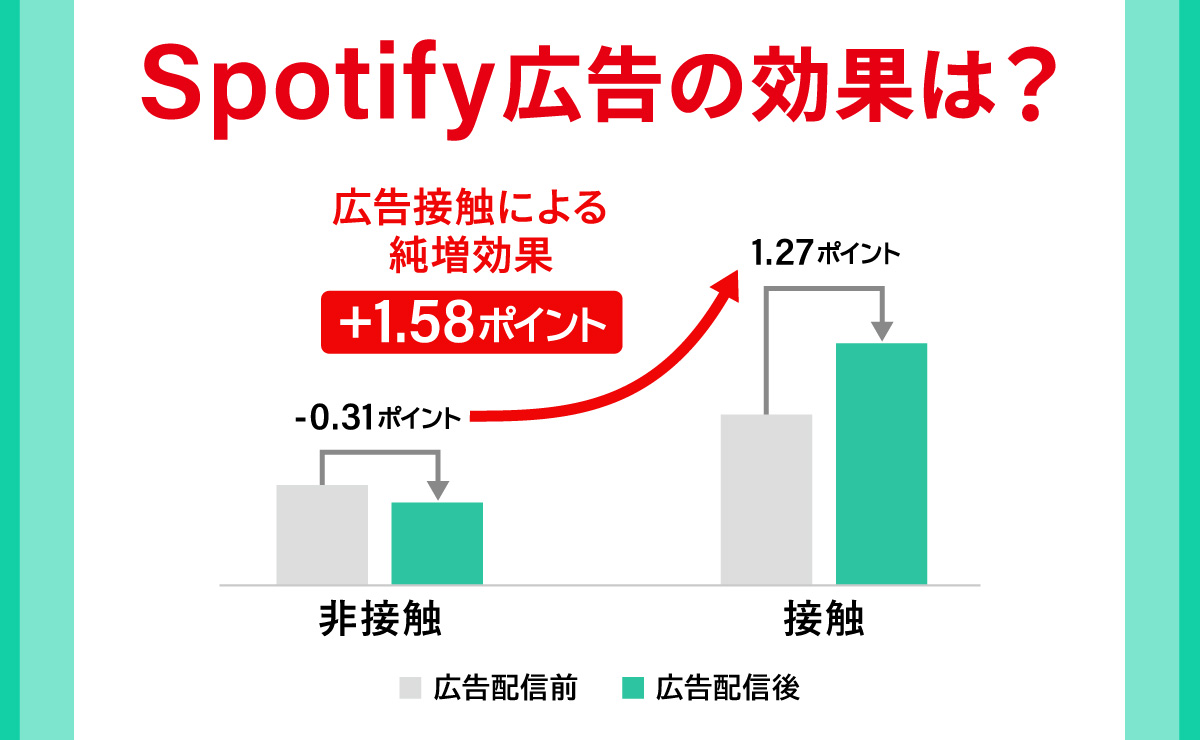
▼Case Study: Store Visit Rate +1.58 points, Estimated Net Increase in Store Visitors: 29,662, Estimated Net CPA for Store Visitors: 178 yen
▼Integration with Exposure Data from Various Media and Client First-Party Data
▼Audio Advertising Becomes a “Measurable Investment”
“Visualizing” the Effectiveness of Spotify Ads
Until now, there was no system in place to quantitatively measure how much Spotify ads contributed to store visits or purchases. To address this, Dentsu Inc. entered into the world’s first measurement partnership agreement with Spotify Japan as an advertising agency and jointly developed and released “SONATA,” a solution that enables quantitative verification of the effects of exposure to Spotify ads and visualizes their return on investment.
“SONATA” is a measurement solution that, while protecting privacy, uses Spotify ad exposure data as a starting point to link and integrate it with various consumer behavioral data held by Dentsu Inc. for comprehensive analysis. Its main features are as follows, enabling end-to-end measurement, comparison, and improvement.
- Measurement of Net Advertising Lift: By linking data on users exposed to Spotify ads with behavioral data such as store visits, website visits, and purchases, it is possible to calculate the net advertising lift by comparing it to a non-exposed control group.
- Multifaceted Analysis to Inform Planning: It enables multifaceted analysis by target audience, creative, time of day, and other factors, which can be leveraged to plan future initiatives.
- Integrated verification with other media: In addition to comparing effectiveness with TV and radio ads, the solution enables visualization of overlapping reach and the effects of repeated exposure.
- Integrated campaign design combining custom segment creation and effectiveness measurement: Based on TV viewing and in-store visit data, Dentsu Inc. creates its own unique segments, enabling an integrated approach—from targeting with Spotify ads to analyzing results— .
Case Study: Store Visit Rate +1.58 points, Estimated Net Increase in Store Visitors: 29,662, Estimated Net Increase in CPA per Store Visitor: 178 yen
KDDI’s “Ponta Pass” launched a Spotify audio ad campaign primarily to increase service awareness and drive store visits to a specific location. Analysis linked Spotify ad exposure data with store visit data and compared the visit rates of those exposed to the ads with those who were not. The results showed:
- Visit Rate: 1.58-point lift
- Estimated net increase in store visitors: 29,662
- Estimated CPA (Cost Per Acquisition) per net increase in store visitors: 178 yen
These were the results obtained.
By presenting these concrete figures, advertisers can assess “how effectively audio ads drive results” based on objective metrics rather than intuition.
Integration with exposure data from various media and clients’ first-party data
Although “SONATA” is a newly released solution, several analysis projects using real data are already underway. The main analysis themes are as follows:
① Analysis of the effects of overlapping exposure with other media
For exposure spanning multiple media—such as TV, video, and OOH—the platform enables the visualization of synergistic effects resulting from “audio × audio” or “visual × auditory” interactions.
Example:
・Measuring cross-reach between radio and Spotify ads
・Cross-media effectiveness of OOH × Spotify ads
② Standardization of Listen-Through Conversions (conversions by users who listened to audio ads) and Non-Click ROI Evaluation
Current ad effectiveness measurement is based on the premise of “clicks,” as symbolized by the “last-click model.” However, with audio ads, there are many cases where purchases or website visits occur even without a click. SONATA makes it possible to measure “behavioral changes resulting from having ‘heard’ an ad.” Moving forward, we will continue to standardize “listen-through conversions,” which traditional metrics have been unable to fully capture.
③ The Vision for the Future Envisioned by Dentsu Inc. and Spotify: Integrated Analysis of Client First-Party Data and Spotify’s Proprietary Data
Looking ahead, we are working to build an environment that enables the integrated analysis of member data and e-commerce purchase data held by advertisers, combined with Spotify’s fandom data and music preference data. Through this, we aim to develop solutions that—for example—identify “artists and genres that resonate well with loyal customers,” thereby improving targeting accuracy and deepening customer understanding.
Audio Advertising Becomes a “Measurable Investment”
Audio advertising has traditionally been viewed as a medium where “it is difficult to quantify whether it led to action.” However, with the introduction of “SONATA,” audio advertising is evolving into a medium where its effectiveness can be visualized.
For advertisers and marketers, this means they will be able to optimize audio advertising planning—which has traditionally relied on “intuition” and “experience”—based on reliable performance metrics. This is the significant value that “SONATA” delivers.This also presents an opportunity to position audio advertising as a “medium with evidence-based performance metrics.” And by combining the “audio experience” provided by Spotify with Dentsu Inc.’s expertise in data integration, measurement, and operations, audio advertising is now taking its first steps toward becoming the next standard.
Was this article helpful?
Share this article


Newsletter registration is here
We select and publish important news every day
For inquiries about this article
Back Numbers


Author
Atsushi Kawada
Spotify Japan K.K.
Product and Commercial Growth
Product Marketing and Partnerships Manager, JAPAC Lead
Hiroaki Inaba
Dentsu Inc.
Entertainment Business Center
Data Analyst