Spotify is one of the world’s largest audio streaming services. At its advertising creative awards, “Spotify Hits 2025” ( overview here ), entries handled by various Dentsu Group companies won awards in major categories.
In this article, we’ll provide a summary of the talk session from the internal webinar titled “Strategies and Planning for Moving ‘Sound’: A Deep Dive with the ‘Spotify Hits’ Winners.” While introducing the award-winning entries and shortlisted works, we’ll explore the characteristics of successful creative and advertising on Spotify, the marketing value of Spotify, and the potential of audio advertising.
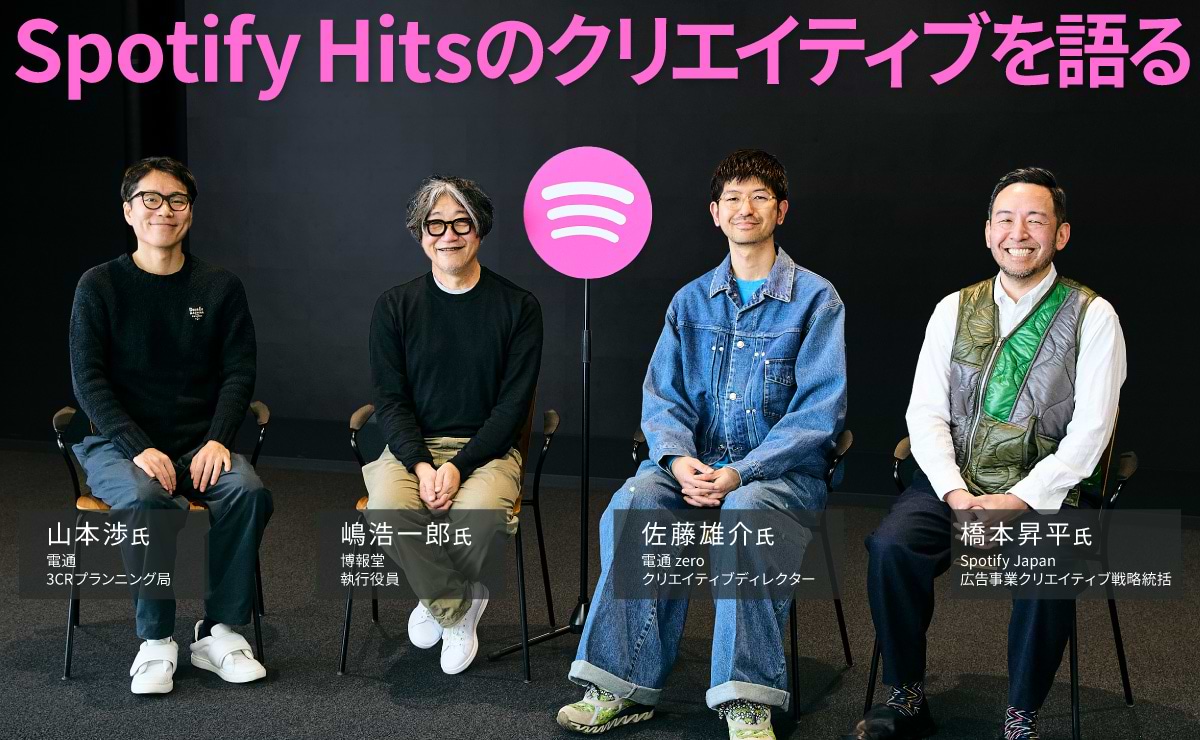
This webinar featured Koichiro Shima (Executive Officer, Hakuhodo) and Yusuke Sato (Creative Director, Dentsu Group), who served as judges for “Spotify Hits 2025,”Wataru Yamamoto (Creative Director, Dentsu Inc. 3CR Planning Bureau), who worked on the winning entries, and was moderated by Shohei Hashimoto (Head of Creative Strategy, Advertising Business, Spotify Japan).
Rather than just promotion, we want people to enjoy the brand experience
Hashimoto: First, let’s look back at Spotify Hits 2025.The categories are “Ear Candy (Best Immersive Audio Campaign),” “Seized the Moment (Best Moment Campaign),” “For the Fans (Best Audience Strategy Campaign),” “Mic Drop (Grand Prix),” and “Future Hitmakers (Best Innovative Idea),” which was newly established this year—for a total of five.
Hashimoto: The three key points for running ads on Spotify are “Ear Candy,” “Seized the Moment,” and “For the Fans,” and the winning entries were those that embodied each of these points.
Shima: This is the second year Spotify Hits has been held, following last year’s event. I think Spotify advertising has evolved significantly over these past two years. New techniques—ones that make you think, “I didn’t know you could do it that way”—are emerging one after another. I used to think that audio advertising, including radio, had settled into a certain “formula,” but I realized there are still many ways to approach it. It was particularly encouraging to see young, digital-native creators experimenting with various approaches to audio advertising using Spotify.
Hashimoto: Now, I’d like to introduce the winning entries in each category. First, “Ear Candy” is an audio campaign that delivers an immersive experience that delights the ears, making full use of new techniques and special effects.
Hashimoto: The winner in this category was “Surround Commercials: ‘Circle’ & ‘Circle (Club Activities)’” for Otsuka Pharmaceutical’s Pocari Sweat, which was handled by Mr. Yamamoto.
This audio ad lets listeners experience the scene of baseball team members forming a circle and cheering each other on before a game, as if they were standing right in the center of the circle.
Shima: The sense of realism in this ad was incredible. Digital ads tend to focus more on prompting specific actions, such as purchasing a product, or on explaining the product itself. However, what I noticed throughout this year’s entries was that many ads went beyond simply explaining the product to truly expressing the brand’s world.
A distinctive feature of Spotify ads is their ability to appeal to listeners in various states of mind—whether they’re relaxing or focused on sports, for example. That’s why they can foster communication that goes beyond mere brand awareness to promote a deeper understanding of the product. The Pocari Sweat ad was also skillfully crafted to convey the brand’s worldview while simultaneously serving as a product advertisement.
Yamamoto: Thank you. Rather than focusing on promotion, our mindset was to let people enjoy the brand experience. Since Spotify users actively come to listen to content, we were more conscious of the idea that “content = something everyone can enjoy” rather than just thinking, “Let’s sell at all costs.”
Creating Ads by Visualizing Specific Scenarios
Hashimoto: Next up is “Seized the Moment.” This award recognizes campaigns that engage users through a creative approach that captures a specific moment. This year, the award went to Suntory’s Kinmugi ad.
Sato: Spotify is characterized by higher listening rates during commute times and when people are heading home. So, under the theme “Kinmugi lasts until you get home,” Suntory seized the moment of the commute—aiming to incorporate not just the moment of drinking, but the journey leading up to it, into the brand experience.
Shima: Creators craft ads while visualizing specific scenarios—such as “What kind of situation are listeners in?” or “What are they doing while listening?” Many of the submitted entries were created with this perspective in mind. For example, imagining someone relaxing alone at night while sipping whiskey—that kind of imagination is key when creating ads for Spotify.
Yamamoto: The Kinmugi ad features a conversation full of gripes after work, but I find it interesting how it offers a positive interpretation without becoming negative. I actually felt a little more upbeat after listening to this ad myself.
Shima: The way the music from “The Light of the Firefly” plays alongside the sounds of daily life really tugs at your heartstrings.
Hashimoto: Including the clatter of the door opening when coming home—that switch between “on” and “off”—seems to have been a key creative touch.
Sato: Short video versions of this ad are also available on YouTube and other platforms, and because the “Light of the Firefly” music is so effective, it’s great that you can imagine the scene of coming home just from the audio alone.
Music is also a key element in shaping a product brand
Hashimoto: Next up is “For the Fans.” Coca-Cola Japan’s “Iroha-su” was recognized for its ad design that appeals to the fanbase of a music artist and delights fans. This ad features an original song written by Fujii Kaze.
Hashimoto: They used video footage from the TV commercial on Spotify, sponsored the “THIS IS Fujii Kaze” playlist for Fujii Kaze fans, and utilized virtually every advertising product available for fans.
Sato: They truly placed Fujii Kaze’s massive music fandom at the very center of their concept. The campaign’s worldview was built at the point where Fujii Kaze’s artistic activities and the “Iroha-su” brand seamlessly overlapped.
Shima: The worldview of the music and the worldview of the product were a perfect match. Since digital advertising places such a high value on capturing attention, I felt like there were fewer commercials that effectively conveyed a worldview through music. On platforms like YouTube, some people watch videos at double speed. In that regard, Spotify is designed to be listened to at normal speed, so users really pay attention. There was once a golden age of commercial jingles, and I sensed the potential for a revival of that trend.
Hashimoto: That’s right. There’s been a lot of talk lately about “Sonic Identity”—using sound to strategically express a brand’s personality—and music is a crucial element that defines a brand. I think this was a case where Spotify was considered specifically for leveraging music.
A work that charmingly conveys its appeal won the Grand Prix!
Hashimoto: The “Mic Drop” Grand Prix—awarded to the best entry across all categories—went to Yamaha’s ad.
Sato: This ad features a performance with mistakes and conveys the message, “Let’s love our mistakes.” I thought the concept and structure of the ad were excellent. While it’s also been rolled out in OOH and video formats, this ad is best experienced through sound—it’s a project that conveys its humor in a charming way, and all the judges highly praised it.
Shima: The idea is brilliant and charming, and I think it’s a success in terms of corporate branding because it genuinely makes you think, “Ah, this is a great company.” As you listen, you can tell exactly where the performance stumbles, and it’s crafted in a way that people who practice the piano can strongly relate to. It doesn’t feel like the mistakes are forced; the balance is exquisite—it makes you think, “They’re trying their best, but they just mess up here.”
Yamamoto: When you listen to the ad, the music is perfect right before and after the mistake, so the mistake really stands out. I think it’s brilliant, including the calculated touch that makes you chuckle.
Hashimoto: Even the slightly off-key notes—you just think, “Yeah, I know exactly what that’s like.”
Since audio ads rely on the user’s imagination, “less is more” is the way to go
Hashimoto: From here on, we’ll hear more details from Mr. Yamamoto, the Ear Candy award winner. Regarding the Pocari Sweat “Circle” ad, could you tell us about your creative intent behind it?
Yamamoto: To begin with, the reason we chose Spotify was that our target audience this time was young people, primarily high school students.
Shima: It was right around the time when summer high school sports were in full swing, wasn’t it? The sound really makes it feel like you’re listening from inside the circle. I heard the recording process was quite challenging.
Yamamoto: That’s right. We did two test recordings, but whether there were too many or too few people, it didn’t sound like surround sound. We had them form a circle around the microphone, but some people’s voices carried well while others didn’t, so we made various adjustments—like placing those whose voices carried farther farther away from the microphone. We also kept the catchphrase as short as possible; having them pass it around with “Fai-o! Fai-o! Fai-o!” helped keep the voices circulating right in the center. We went through a lot of trial and error.
Shima: So you went through quite a bit of trial and error on set.
Yamamoto: That’s right. When we did the pre-recording, I felt we needed to create more variation in the voices. During the actual shoot, we changed up the cast and tried to vary their vocal tones as much as possible. We experimented with various approaches and gained quite a bit of insight, so if anyone else is thinking of trying a commercial like this, I’d be happy to share what we learned.
Sato: In terms of structure, it’s the kind of ad that starts by mentioning, “This was recorded using binaural audio” (a technology that reproduces three-dimensional sound). That’s why everyone focuses on it, wondering, “What will it sound like?”
Hashimoto: Actually, according to global best practices and guidance from Spotify, ad performance is better when the brand name is mentioned within the first five seconds, so we’re following that advice as well.
Yamamoto: Rather than feeling like we absolutely had to include the brand name, I thought saying, “This is a surround sound commercial,” would help listeners immerse themselves more, so we were able to incorporate “Pocari Sweat Presents” fairly naturally. It wasn’t intended to be placed at the very beginning just to make sure the brand name stuck. Of course, mentioning it twice is more effective than just once. However, I think there are some creative concepts where stating the brand name right at the start can diminish the fun that follows, so I believe we need to be flexible in that regard.
Shima: Since people tend to listen more intently once the context is established, in a sense, revealing the punchline right at the start can actually heighten their focus. That’s part of the strategy, isn’t it?
Yamamoto: That’s right. We figure that if people can enjoy the experience itself more deeply, their favorability toward the brand will also increase.
Sato: Since this ad is genuinely entertaining, listeners won’t be disappointed even if the setup is revealed right at the start.
Shima: When creating ads, we tend to pack them with information, but with audio ads, the user does the imagining, so “less is more.” It’s a case of “whoever lets the listener imagine the most wins.” This commercial does an amazing job of stripping away unnecessary information, which really keeps the listener focused.
Spotify ads are entertainment that flows within entertainment
Hashimoto: Finally, I’d like to introduce “Future Hitmakers.” Our goal was to recruit creators under 30—regardless of whether they’re affiliated with an ad agency—who are genuinely interested in creativity and will shape the future of advertising. To that end, we asked KDDI, Ajinomoto, and FamilyMart to provide us with briefs.
Shima: We got a surprisingly large number of applications, didn’t we?
Hashimoto: Here, I’d like to introduce the winning entry from KDDI. The brief was titled “Moments of Youth Connected by UQ Mobile,” asking how to get young people to use the UQ Mobile carrier and what the brand could do—through Spotify—to contribute to students’ youth. The winning entry was a project by Dentsu Digital Inc. called “A Playlist for a Lifetime.”
As a brand playlist,they selected songs that celebrities listened toduring their youth. *Casting shown is just one example.
Sato: The judges praised the strong concept: “The music you discover in your teens shapes who you are.” Based on the idea that the music teens listen to now is what they’ll listen to for the rest of their lives, this project involves creating campaigns across audio and other media.
Shima: When I thought about what people would listen to if they could listen as much as they wanted without worrying about data limits, they really nailed what this generation wants to hear. It’s the kind of playlist you’d actually want to listen to. It clearly conveys the client’s message—that you can listen to plenty of playlists without worrying about data—and it makes use of Spotify’s unique playlist features, making it a project that makes everyone happy.
Sato: Since Spotify is part of the content itself, it becomes a form of entertainment within entertainment, which really elevates the quality of the experience. Don’t you think that makes even the most creatively bold ideas more effective?
Shima: We saw incredible evolution in the “Spotify Hits” campaigns between the first and second years. I expect that as another year passes, we’ll discover new ways to utilize technology. I think Spotify is a great platform for advertising production where we can experiment with interesting applications of technology and AI. Our company (Hakuhodo) will do our best too!
Yamamoto: I think Spotify is a medium where new approaches and ideas will continue to emerge. I’d like to keep trying out various things going forward.
As Head of Creative Strategy, he oversees creative collaborations that enable brands to connect with diverse audiences on platforms and expand the potential of audio advertising. Having spent more than half of his career in the digital field, he continually strives to create new value through the fusion of technology and creativity.
Joined Hakuhodo in 1993. Engaged in corporate PR activities at the Corporate Communications Bureau. Seconded to The Asahi Shimbun Company in 2001. Participated in the launch of the “Bookstore Grand Prize” in 2004. Currently serves as a director of the NPO Bookstore Grand Prize Executive Committee.In 2006, he founded Hakuhodo Kettle. In 2012, he opened the bookstore “Bookstore B&B.” His edited and authored works include *Koichiro Shima’s Guide to Generating Ideas* (Discover 21) and *How to Create a “Media” Brand: Editorial Techniques That Move People and Sell Products* (Seibundo Shinkosha).
Yusuke Sato
Dentsu Inc.
zero Division
Group Creative Director / Commercial Planner
Born in Tokyo. His work centers on advertising creativity and branding. He has received the Creator of the Year Award, the ACC Award, the TCC Award, the ADC Award, the Dentsu Inc. Advertising Award, the Galaxy Award Grand Prix in the Commercials category, and became the first Japanese recipient of a medal in the “FILM” category at Young Cannes (Cannes Lions). He has also won awards at MAD STARS Grand Prix, NY ADC, Spikes Asia, AdFest, and others.Part-time lecturer at Nihon University’s College of Art and Musashino Art University.
In addition to the Grand Prix in the Radio category at the Cannes Lions, the company has won awards for its audio ads at the ACC Awards, TCC Awards, Dentsu Inc. Awards, Spikes, AdFest, and Spotify Hits.
Also read
In-Depth Discussions with Spotify Hits Winners: Strategies and Planning for “Sound” That Moves the Heart

 Spotify Opens the Future of Audio Advertising [5/5]