Note: This website was automatically translated, so some terms or nuances may not be completely accurate.
 The Cutting Edge of "Messaging" That Supports the Power of Top Management's Words [4/4]
From a PR perspective, messages are meant to “reach” their audience

Hello. I’m Shingo Ishikawa from Dentsu Inc. Messaging Partners. In this fourth installment of our series, I’d like to discuss how to “deliver” a message.
——What Is Communication Design That Connects Society and Companies?
When a company engages with society, the first question it faces is, “What message should we send?” However, creating a message isn’t the end of the story. Only by designing how to deliver it can a company build a healthy relationship with society.
In this installment, I’ll focus on the “PR perspective” for ensuring corporate messages resonate with society.
We’ll reexamine communication through the lens of “societal trends” and outline practical steps for implementation.
An Era Where Simply Wanting to Communicate Isn’t Enough
In this series so far, we’ve discussed how companies can craft the core messages they want to convey.
However, due to changes in the information landscape—centered around social media—messages are instantly evaluated based on the recipient’s interpretation.
Today, it is essential to balance “the message you want to send” with “the message society will accept.” What is needed here is a “PR perspective” that considers how society will perceive it.
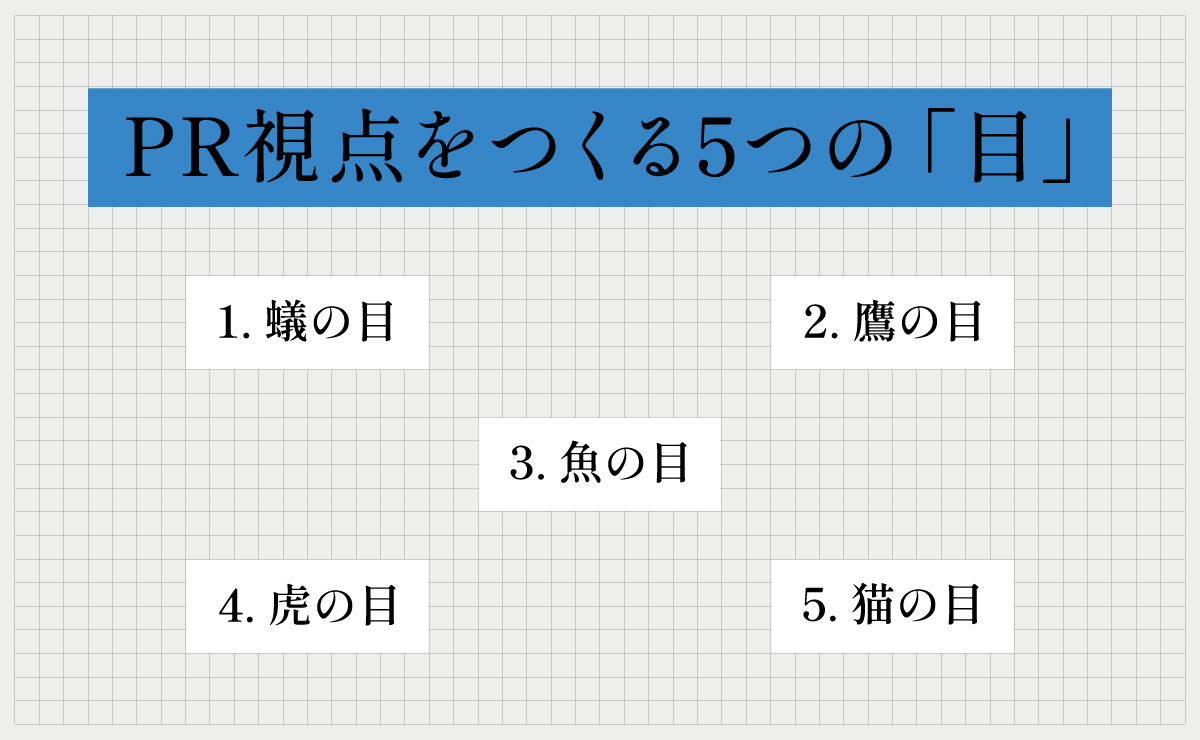
The 5 “Perspectives” for Developing a PR Perspective
PR has evolved beyond the scope of public relations activities into a communication strategy that enhances the value of the relationship between companies and society. In other words, the PR perspective means “viewing the company through society’s eyes.” In this article, we’ll introduce five perspectives that connect companies and society.
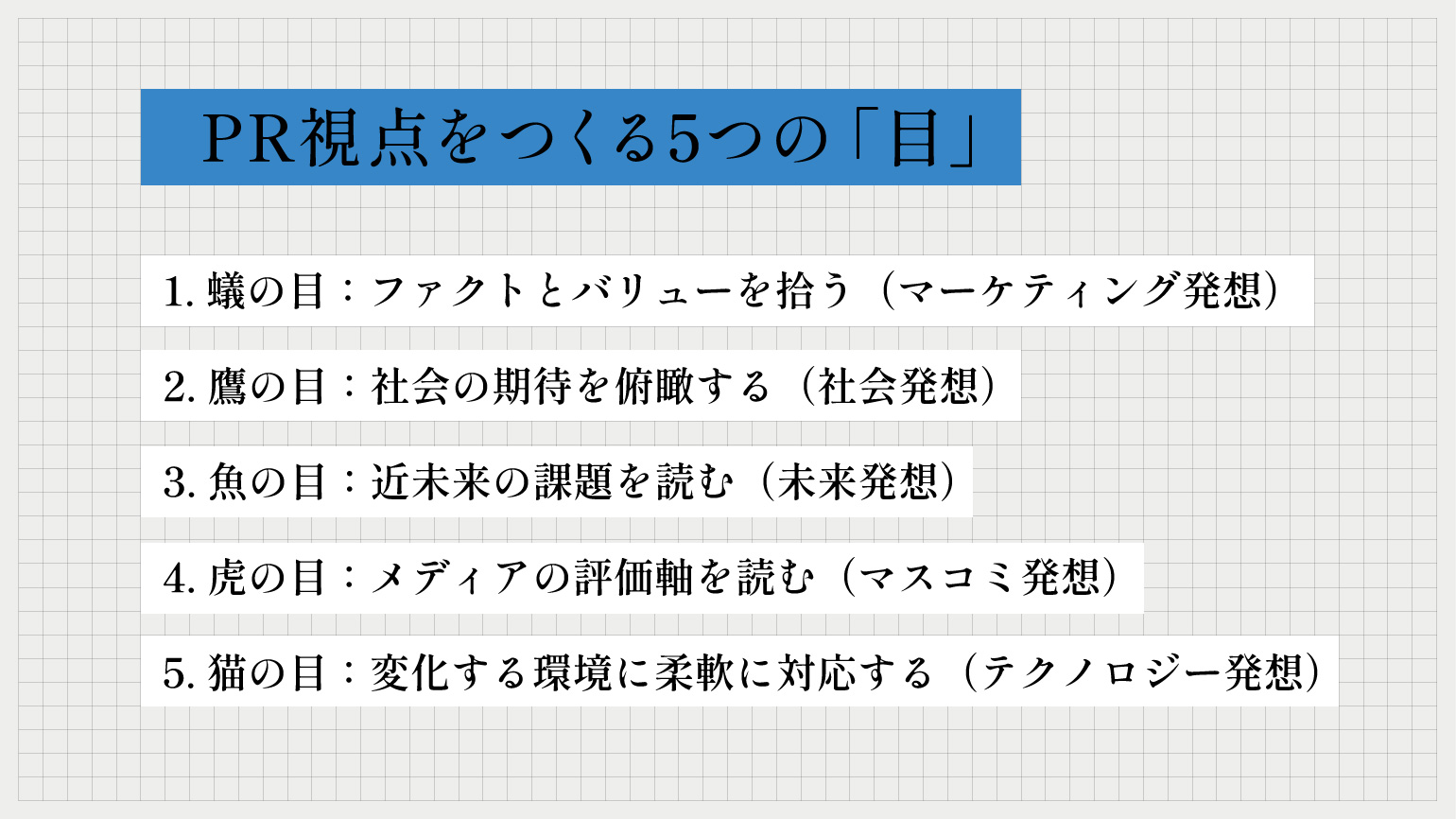
1. The Ant’s Eye: Gathering Facts and Value (Marketing Perspective)
First, this perspective involves visualizing your company’s value by gathering its “facts” one by one. By taking stock of concrete, quantifiable value rather than abstract principles, your message gains persuasiveness.
In the third article of this series, we touched on “taking stock” of words. Similarly, when it comes to facts, by broadly examining manufacturing processes, service experiences, data, and internal documents—and visualizing them while categorizing facts and value—you can often gain clarity on what you should be highlighting.
By overlaying these facts with the messages we’ve developed, we create the foundation for rephrasing our messages into language that society can easily understand.
2. Eagle’s Eye: Taking a Bird’s-Eye View of Society’s Expectations (Societal Perspective)
Next, we take a bird’s-eye view of what society as a whole expects from the company, connecting the corporate message with “social expectations.” This is a crucial step in determining how well the message will be received by society.
Through sessions and workshops, we survey social trends, public opinion, policies, and industry trends to identify themes that impact our company. In doing so, we verify the alignment between the societal perspective and the corporate message, and proceed to rephrase and rework the message to incorporate the societal perspective.
3. The Fish’s Eye View: Anticipating Near-Future Challenges (Future Thinking)
This perspective connects future social challenges with corporate actions, much like reading the shifting currents of a river.
We visualize future lifestyles based on input such as “potential challenges in future society” and “insights into future consumers,” and determine how our company should address these future challenges. By articulating “what kind of society we aim for and what promises we make,” we connect future actions with our messaging.
In the third installment of this series, we mentioned that “messaging is a map to the future.” By connecting with the challenges of future society, we navigate toward the destination on that map.
In addition to this, we also assist with the development of new businesses for the future by collaborating with DENTSU SOKEN INC. and the Future Business Research Institute.
4. Tiger’s Eye: Reading Media Evaluation Criteria (Media Perspective)
This is a perspective that targets newsworthiness with a sharp eye, much like a predator stalking its prey. It also involves designing outputs in a way that gains the media’s understanding.
The process involves identifying criteria that make the media want to cover a story—such as social relevance, novelty, public interest, and unexpectedness—and then comparing our company’s activities against these criteria to pinpoint the “angle” that will attract media coverage. Based on this, we structure information content using the “Background → Social Issue → Corporate Initiatives → Future” framework to design a story the media will want to tell.
Since the points of interest differ across mass media, online media, and specialized publications, identifying “what captures their interest” is the key to story design.
5. Cat’s Eye: Adapting Flexibly to a Changing Environment (Technology-Driven Approach)
The communication landscape—including social media and AI—changes frequently. This perspective involves responding nimbly to those changes and selecting the “optimal delivery method.”
In recent years, companies have increasingly been communicating in their own words through their corporate websites and social media accounts. By analyzing trends in social media, video, search, and online communities, they determine which messages resonate best on each channel. Optimizing how messages are presented across channels—such as tailoring content for "YouTube" or "news media"—makes the message more readily accepted by society.
By combining these five perspectives, the message evolves into the following state:
- Backed by facts
- Aligned with social trends
- Forward-looking
- Appreciated by the media
- Spreading through technology
By refining your message from this perspective, your company’s “stance” will effectively “resonate” with society.
To ensure your message resonates
To maximize the value of your message, the process of disseminating it both internally and externally is essential. Here, we introduce three key methods for ensuring your message resonates.
1. Communicate through top leadership (Top-down messaging)
Words spoken by top management carry a unique weight.
Top-level communication builds trust and persuasiveness by ensuring leaders can “speak in their own words” and by “structuring the message in a way that society can easily accept.” To this end, we also provide support such as speech training for top executives.
2. Empowering Employees to Make It Their Own (Internal Penetration)
The moment employees are able to “speak in their own words,” the message becomes part of the organizational culture.
Through workshops and the creation of internal guidelines and credo books, we foster a culture where employees can articulate the company’s message.
3. Expanding to the Media and Customers (External Outreach)
As mentioned in the section on the five perspectives, the message spreads throughout society by providing the media with “reasons to cover it” and offering customers “empathy and experiences.” By identifying newsworthy angles that capture reporters’ interest and designing experiences and content for customers, the message naturally spreads throughout society.
Toward a Message That Resonates with Society
A company’s message will not be accepted simply by being conveyed.
- Corporate Facts
- Society’s Expectations
- Future Challenges
- The Media’s Perspective
- Changes in the Communication Environment
Only by combining these five perspectives can we create communication that resonates between society and the company.
Messaging Partners provides comprehensive support from message design through to adoption, working alongside companies to ensure their “voice” carries real meaning within society.
Dentsu Inc. Messaging Partners
Email:messaging@dentsu.co.jp
Click here for the detailed eBook on “Dentsu Inc. Messaging Partners”
https://www.d-sol.jp/ebook/sustainability-corporate-branding
Was this article helpful?
Share this article


Newsletter registration is here
We select and publish important news every day
For inquiries about this article
Back Numbers
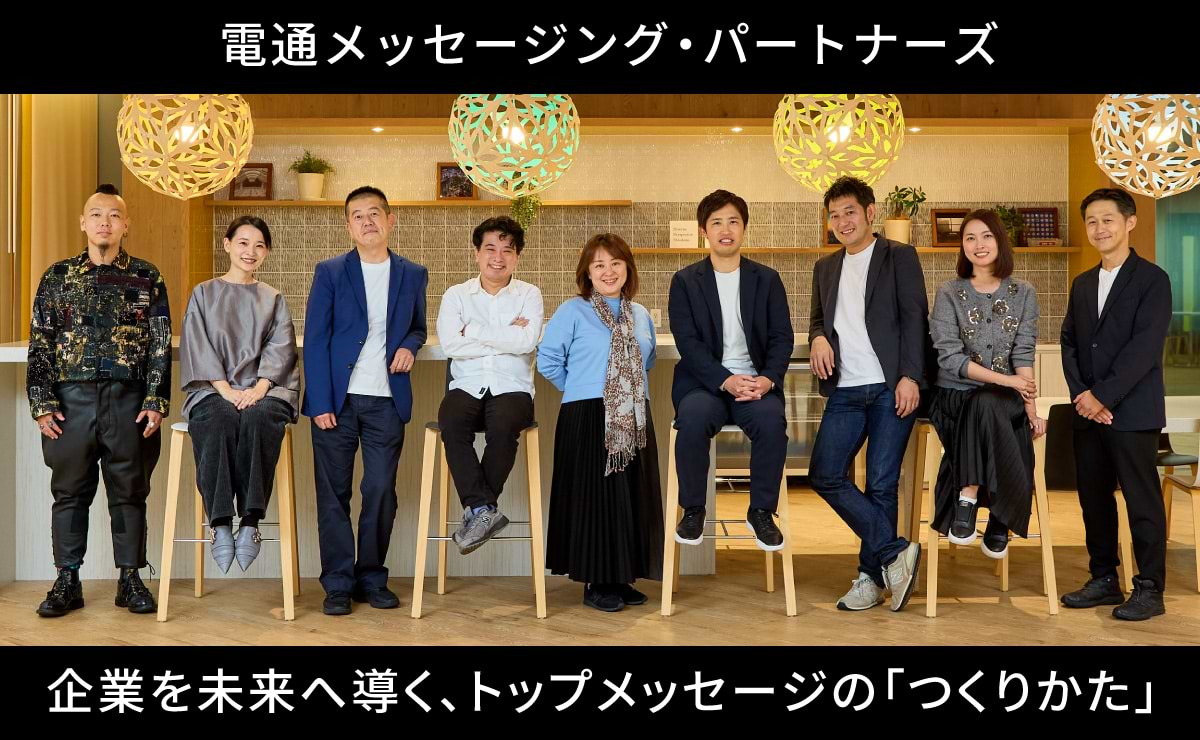
Author

Shingo Ishikawa
Dentsu Inc.
Marketing Division 4 Future Scenario Consulting Department
Senior Consulting Director