Dentsu Live Inc. is Japan’s largest company specializing in event spaces. It plans and operates a wide variety of events—both in-person and virtual—and also handles spatial design.
This series explores Dentsu Live Inc.’s “Business Transformation (BX) through Experience Design.” We examine the potential for leveraging the event business—which is currently often viewed merely as “promotion”—as a key component of the BX approach.
Each article features a highly specialized member of the Dentsu Live Inc. team, who will discuss the new possibilities of “events” in business, illustrated with real-world examples.
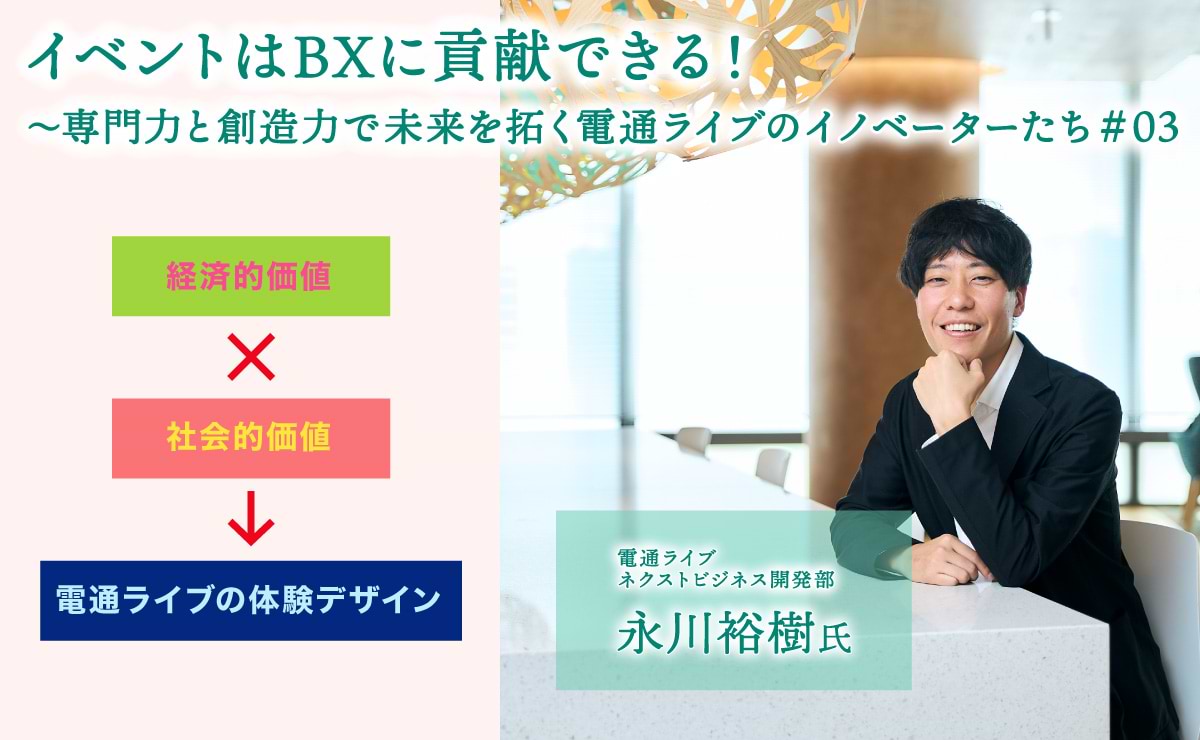
This time, we speak with Yuki Nagakawa of the Next Business Development Department. He discusses Dentsu Live Inc.’s approach to experience design—transforming event spaces from mere “temporary promotions” into venues that simultaneously generate economic and social value—using “Kids Park ASONIWA” (hereinafter “ASONIWA”), which opened in October 2025 at the Kamei Hotel Aso in Kumamoto Prefecture, as a case study.
The Goal Is Not Simply to Create Space, but to Solve Problems Starting from “Inspiring Experiences”
──First, please introduce yourself.
Nagakawa: I joined Dentsu Tech (now Dentsu Live Inc.) in 2015. At the time, they were recruiting specialists in the space sector, and since I had studied architecture in college and graduate school, I started my career based on that background.
From the time I joined until about last year, I was continuously involved in work related to the spatial sector. I gained experience across a wide range of so-called “space creation” projects, including large-scale trade shows, events linked to TV commercial shoots, and projects involving entire neighborhoods. In addition, I was responsible for developing permanent spaces, such as the design and production of showrooms, restaurants, and galleries.
──So you’ve handled both events and permanent installations across a very broad spectrum. Could you give us some specific examples of projects you’ve worked on?
Nagakawa: For example, in the development of the “ITOCHU SDGs STUDIO” facility in Tokyo, I was involved from the very start of the project. The overarching design philosophy was how to convey the importance of the SDGs to the general public. Together with Dentsu Inc.’s creative team, we explored how to position themes like “food” and “play” as entry points to that message. Building on that, I served as a spatial producer, overseeing everything from design to construction to bring the concept to life within the space.
The “ITOCHU SDGs STUDIO” in Minato Ward is a place where visitors can explore ways to engage with the SDGs that resonate with them. (From top right, clockwise): A café where adults can enjoy thinking about children’s perspectives under the concept “What if adults became children?”; “KIDS PARK,” where children can discover their own ways to engage with the SDGs; “Star Kitchen,” where visitors can explore the SDGs through food; and a gallery hosting SDG-related exhibitions and events.
──Could you tell us about the unique features of Dentsu Live Inc.’s space business?
Nagakawa: While it is common in the display industry to design with a focus on “how to create the space itself,” Dentsu Live Inc. tends to think in reverse, starting from “how to use the space and what to make happen there.” We build experience designs in collaboration with the operations team, or create the content ourselves. We also collaborate with the Dentsu Inc. team. What sets us apart is that we plan not just the “design of the space,” but also the “design of the experience.”
Our goal is not simply to create event spaces. To put it bluntly, what we want to create is a “real, moving experience.” We build a relationship between the client’s brand and consumers through experiences that appeal to the five senses. As a result, the output may take the form of an event or a space. We view event and space design not as the end goal, but as a means to solve problems.
Generally, companies tend to define their challenges and present the request, “We want to create a space to achieve this goal,” with the production team’s role being to bring that vision to life. In contrast, Dentsu Live Inc. often works with clients to think through the process from the very beginning: “How should we define the challenge in the first place, and what is the best way to solve it?”
An experiential kids’ park where children can get to know and fall in love with Aso
──Let’s talk about “ASONIWA.” First, could you give us an overview of what kind of facility it is and what kind of experiences it offers?
Nagakawa: It’s an experiential kids’ park for children ages 0 to 12 located at Kamei Hotel Aso, and it’s a facility that hotel guests can use for free. What sets it apart is that, rather than simply being a place to play, the entire space is designed to offer “experiences where children can learn about Aso’s nature and culture while playing.”
──What exactly do you mean by “learning through play”?
Nagakawa: A key feature is a program called “ASO PHONE.” It starts with a main phone unit; when you pick up the receiver, you receive a mission. From there, you move to sub-units and play equipment scattered throughout the space, progressing through the mission by performing playful actions such as pressing buttons, arranging letters with blocks, or rolling balls.
Upon completing a mission, you receive a keyword related to Aso as a “secret word.” When you return to the main unit and enter that keyword, you receive an explanation. We’ve translated topics unique to Aso—such as the formation of the caldera, controlled burns, spring water, the starry sky, and local wildlife—into language suitable for children and incorporated them into the experience.
Additionally, upon completing a mission, a receipt printed with an explanation of the keyword is issued from the main unit. This ensures that not only do the things learned that day remain with the child, but it also introduces spots around Aso related to the keyword, naturally leading to experiences outside the hotel.
──So it’s designed not just to be confined to the hotel, but to serve as a bridge to the broader Aso experience. How did this project actually begin?
Nagakawa: Kamei Hotel Aso is currently undergoing rebranding and renovation by its operating company, Iconia Hospitality. As part of these efforts, we were approached with the request to “create a kids’ park.” The initial request was very simple: “Can we create a fun-looking kids’ park that will help attract guests to the hotel?”
—So at that stage, the requirements weren’t yet fully defined in detail.
Nagakawa: Yes. That’s precisely why we first held very thorough discussions—including the on-site manager and area manager—about “why we were creating this Kids Park.” While kids’ spaces in typical hotels tend to be positioned simply as “a place to let children play,” I didn’t want it to be limited to that. I believe the client also shared the desire to “create something different from the rest.”
──How did the direction for the experiential design take shape?
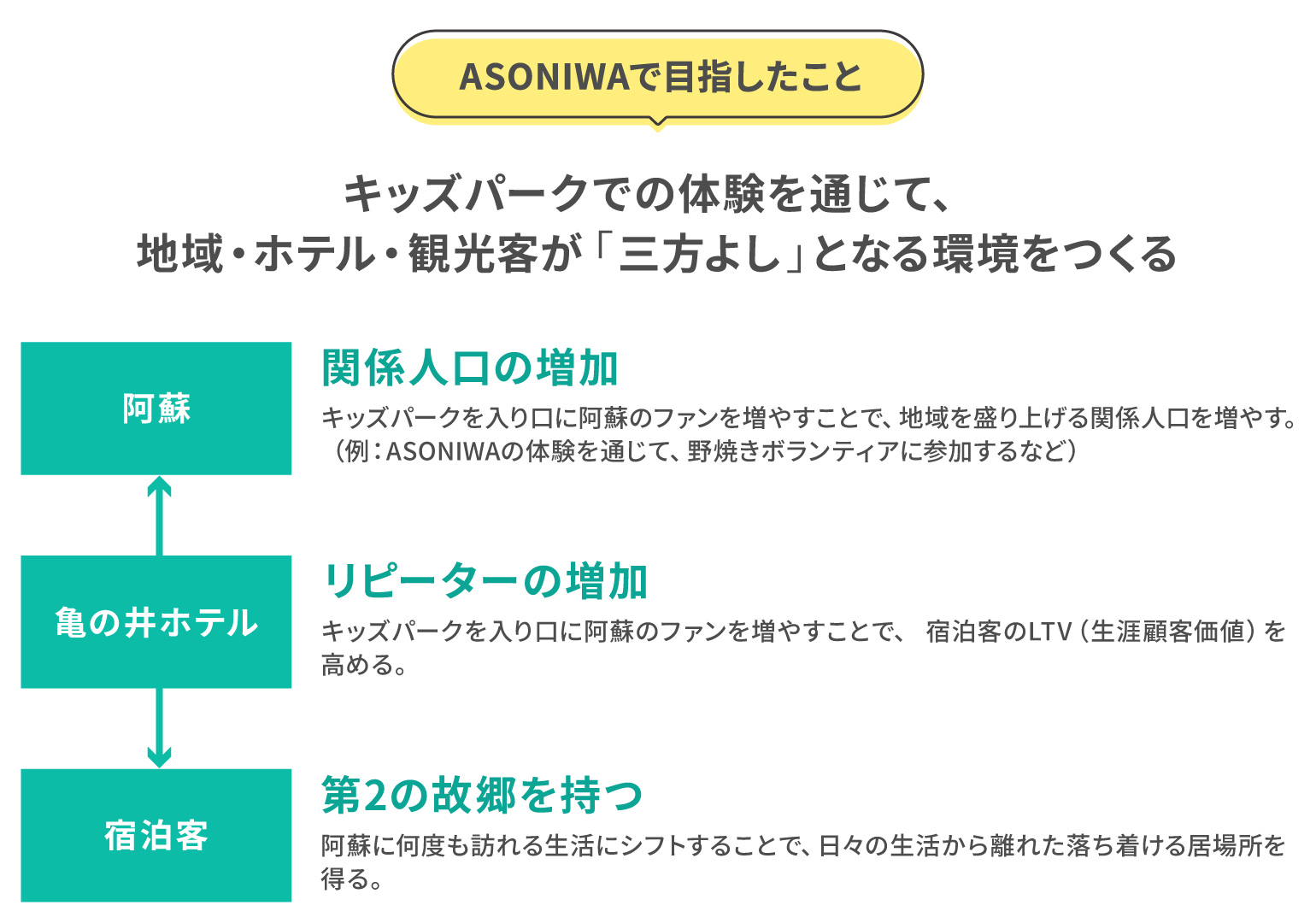
Nagakawa: The key insight was the challenge that “even when people come to Aso, they often just ‘go to their destination and that’s it.’” So, we decided to have guests first learn about Aso and grow to love it right here at the hotel. From there, they would naturally be drawn to nearby activities and facilities. We wanted to make the hotel a base from which guests could enjoy the whole of Aso. We built the experience around this core concept.
If we viewed the Kids Park merely as a tool to attract visitors, our thinking would inevitably become short-term. Instead, we aimed to foster an interest in the region through experiences and create pathways that lead to action. As a result, this would enhance the value of their stay and provide a reason to return. That was the kind of experience design we aimed for.
Creating experiences that extend from the hotel into the local community, centered on the theme of biodiversity
──You mentioned that ASONIWA was designed as a “hub for getting to know and fall in love with Aso.” When actually creating these experiences, what specific efforts did you make?
Nagakawa: There are three main points. The first is the design of the space itself. The second is how to “translate” the appeal of Aso into a “learning experience.” The third is a design that doesn’t end within the hotel but connects to the local community.
First, regarding the “design of the space itself,” when I considered elements that symbolize Aso, I felt that grasslands were the most easily recognizable and appealing.As exemplified by Kusasenri, Aso is characterized by its grasslands, and it has recently been called a “biodiversity hotspot.” These grasslands support that richness, and they are maintained through a symbiotic relationship between human activity and nature, such as through controlled burning. Therefore, we made “grasslands” the theme of the space and created an area that feels like a vast expanse of lawn. Additionally, we incorporated Aso’s geographical features, such as placing playground equipment in the center that evokes the caldera.
The second key point is not simply to introduce the charms of Aso, but to “translate” them into an experience where children can “discover things for themselves.” At the heart of this is the ASO PHONE: children receive a mission on the parent unit, arrive at a keyword through play on the child unit, and finally return to the parent unit to receive an explanation. This back-and-forth structure itself is designed so that children encounter learning as they explore the space on their own.
──How did you decide on the themes covered in ASO PHONE?
Nagakawa: First, we established the overarching theme of “biodiversity,” which is one of Aso’s key attractions. From there, we designed specific keywords such as Akaushi cattle, starry skies, the caldera, and controlled burning. Take Akaushi cattle, for example. They aren’t just a local specialty and delicious—there’s also the aspect that by grazing on the grass in the meadows, they prevent the grass from growing too tall, thereby helping to sustain the meadows over the long term. We selected keywords to help reveal these kinds of “connections.”
I believe Aso is a land where the grasslands have been preserved through the relationship between people and wildlife. That’s why I wanted to reveal the “behind-the-scenes” aspects—such as “what exactly is controlled burning?” or “how are Akaushi cattle connected to the grasslands?”
Regarding the third point, “design that connects to the region,” as I mentioned earlier, we didn’t stop at experiences within the hotel; we designed the experience to serve as a bridge to the wider region. The receipt guests receive after completing the mission includes not only explanations of the keywords but also information linking them to related facilities, activities, and organizations. In other words, it doesn’t end with simply “learning” about something; it leads to “going there” and “getting involved.”We aimed to create a network where ASONIWA serves as the starting point, connecting to nearby attractions and partner organizations.
──Listening to this, it sounds like you’re creating everything—from content production and spatial design to the creative elements—as a unified whole.
Nagakawa: We direct the graphics, design the space, and create the content. This kind of integrated experience design is an extension of what we’ve done in event planning and production up to now. On the other hand, what was a new challenge for me this time was proposing and redefining the “nature” of the place from our perspective.
Initially, the request was for a “fun kids’ park that would attract visitors,” but we shifted that to a “base for exploring the region and falling in love with Aso.” As a result, for the hotel, the value of the stay increases and repeat customers grow. For visitors, they gain a “second home” at their travel destination. And for the Aso region itself, it’s a positive development in terms of increasing the number of people connected to the area. I believe we were able to aim for creating such a “win-win-win” environment.
──Could you also tell us what you focused on when designing the space for children?
Nagakawa:Alongside my work in spatial design, I’m also involved in promoting environmental sustainability within the event industry. As I’ve continued to create event spaces for children, I’ve become increasingly conscious not only of environmental sustainability but also of what we should pass on to the next generation to ensure our society’s long-term survival. I hope ASONIWA can serve as a gateway to that. I wanted to create a place where children can discover nature and the local community through play, which is why we adopted the overarching theme of biodiversity.
──Could you tell us about the response since opening?
Nagakawa: First and foremost, the most obvious feedback is that “it’s being used extensively.” It seems some children visit multiple times during their hotel stay, so I think we’re fulfilling our basic role as a kids’ park.
Another indicator is the number of receipts issued. While it’s still hard to gauge exactly how well our intended experience is being conveyed, we’re issuing a significant number of receipts. I think it’s at least serving as a gateway for people to realize, “Oh, this is what Aso is like.” If the opportunity arises, I’d like to conduct surveys on usage patterns and interviews with visitors.
──How has the response been to themes like “sustainability” and “biodiversity”?
Nagakawa: I’ve heard that it’s being used not only by Japanese people but also by international visitors. Especially overseas, many people travel with the specific goal of experiencing nature—what’s often called “sustainable tourism”—so it may be providing a unique experiential value for inbound tourists as well.
The experience itself is available in both Japanese and English; the ASO PHONE display, voice prompts, and receipt text can all be switched to English. In that sense, I believe we’ve created a format that can be enjoyed regardless of nationality.
──Do you have any plans to further expand ASO PHONE in the future?
Nagakawa: Regarding the content, we’ve designed the system so that the operators can freely modify it. Since keywords can also be replaced later, we can update the content to align with our policies, such as “We want to add this theme in the future” or “We want to introduce this facility.” We’ve intentionally left that “flexibility” in place, so I’m personally looking forward to seeing how it evolves from here.
Creating Experiences That Balance Economic and Social Value
──Based on this case study, could you share your renewed perspective on the value of “space creation and experience design” that Dentsu Live Inc. can provide?
Nagakawa: What sets this case apart is that we designed it from the outset with the premise of balancing “economic value” and “social value.” Initiatives at commercial facilities and hotels must, as a fundamental premise, generate economic value by attracting a large number of customers. The Kids Park, too, cannot succeed unless it contributes to customer traffic and sales. That is a non-negotiable prerequisite.
On the other hand, in this project, we were able to incorporate mechanisms that generate social value simultaneously through thematic design and community partnerships, rather than focusing solely on economic efficiency. In addition to “attracting people” and “driving sales,” we aimed to create “learning opportunities” and “positive ripple effects for the local community.” I believe that designing these two pillars from the very beginning is the significant value we were able to provide.
──Indeed, I got the impression that your starting point was different from that of so-called conventional kids’ parks.
Nagakawa: To be perfectly honest, I didn’t start out thinking, “Let’s create a playground for children.” If someone asked me to “create a kids’ park,” I imagine most people would first study numerous existing examples of kids’ parks, draw inspiration from them, and then develop a design. But in my case, I took a different approach: I went back to the drawing board, considered the hotel’s specific challenges and the local context, and only then arrived at the concept for the kids’ park.
That’s precisely why the design takes adults into account as well as children. While it’s a place where children play independently, parents are always there with them. Whether parents feel convinced that “this is a place I want my child to play” is actually quite important. It’s not just about having fun; there needs to be something to learn or a meaningful experience. Creating that sense of satisfaction for parents is one of the essential elements in making them want to come back.
—So that sense of satisfaction ultimately leads to improved customer satisfaction and LTV, right?
Nagakawa:That’s right. At a typical kids’ park, the experience tends to feel “consumed” the moment you arrive—it’s often self-contained. I didn’t really want to aim for that. So, I asked myself: How can we create a space that makes people want to come back again and again? We designed it to generate reasons for repeat visits. To achieve this, we structured the experience around themes like getting to know and falling in love with Aso, and connecting with the local community. We were also mindful that creating these reasons for return visits would contribute to the hotel’s business by improving LTV.
──Finally, how would you summarize the value Dentsu Live Inc. provides in a single phrase?
Nagakawa: I believe it’s “the ability to adapt our output based on the challenge at hand.” While we are an event and venue company, when we consider what’s best for solving a problem, the output could be a kids’ park, or it could be running workshops on an ongoing basis to nurture the space. There are countless ways to approach it.
We prioritize how what we create can contribute to our clients’ challenges—and, in some cases, to societal challenges. We design without being constrained by specific methods. We intend to continue pursuing this kind of work in the future.
Management Promotion Bureau, Next Business Development Department
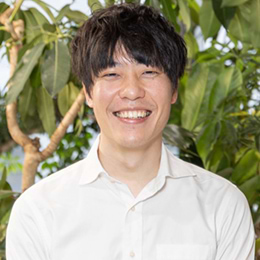
After working at Dentsu Tech, he joined Dentsu Live Inc. in 2018. As a spatial producer, he handles a wide range of projects, from permanent facilities to international events. His strength lies not only in creating spaces but also in designing experiences that solve social issues through “play.” He pursues and implements sustainable, new forms of space where social issues and business connect seamlessly. He is a licensed architect and real estate broker.

 Events Can Contribute to BX! —Dentsu Live Inc.: Pioneering the Future with Expertise and Creativity [3/5]