Note: This website was automatically translated, so some terms or nuances may not be completely accurate.
 The Good Relationship Between Marketing and Sustainability [3/3]
Almost Zero Waste! Behind the Scenes of a Sustainable Event with a 99.7% Resource Recycling Rate
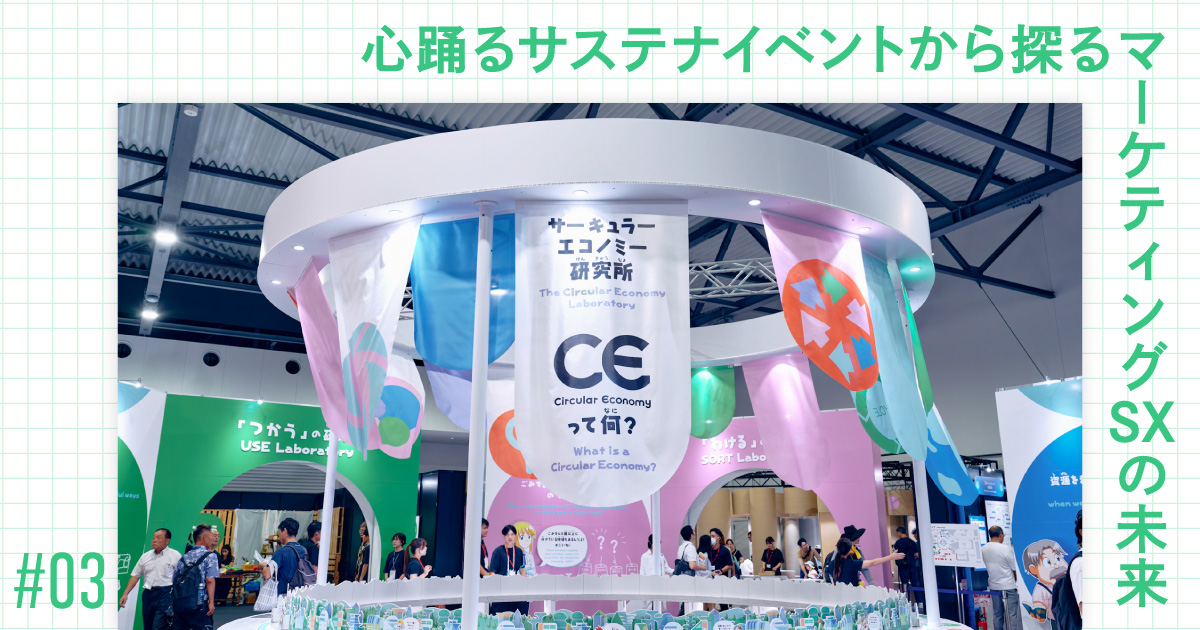
In this series, our team explores the wonderful relationship between marketing and sustainability.
In this installment, we’ll introduce the “Circular Economy (CE) Lab,” an interactive event organized by the Ministry of Economy, Trade and Industry (METI) at the Osaka-Kansai Expo (EXPO Messe “WASSE”).
Although the circular economy is a topic that may seem daunting at first glance, the event was well-received by participants and is now being rolled out in various locations as a classroom-style event that builds on its legacy to teach about the circular economy.
How was this experience—which allows children to “have fun while learning about sustainability”—created? Furthermore, what process enabled the event to achieve such a high resource recycling rate, with 99.7% of the materials used being reused?
Yuka Sawai and Yurika Mori from the Sustainability Consulting Office, along with Yuki Nagakawa from Dentsu Live Inc., will take you behind the scenes—from the background of the project to the design and operational innovations, all the way through to implementation.
<Table of Contents>
▼“Circular Economy Lab,” a collaboration with the “Science Manga Survival” series
▼Only one in three people know what the “Circular Economy” is!?
▼Precisely because the content is serious, “It’s educational, but we won’t make it feel like ‘school’!”
▼Behind the Scenes of the “Exhibition Design” That Achieved an Astonishing 99.7% Resource Recycling Rate
▼Making Use of Legacy Assets Too! “Keeping Materials and Knowledge Circulating”
▼Let sustainability be the spark that sets your heart racing.
The “Circular Economy Research Institute,” a collaboration with the “Science Manga Survival” series
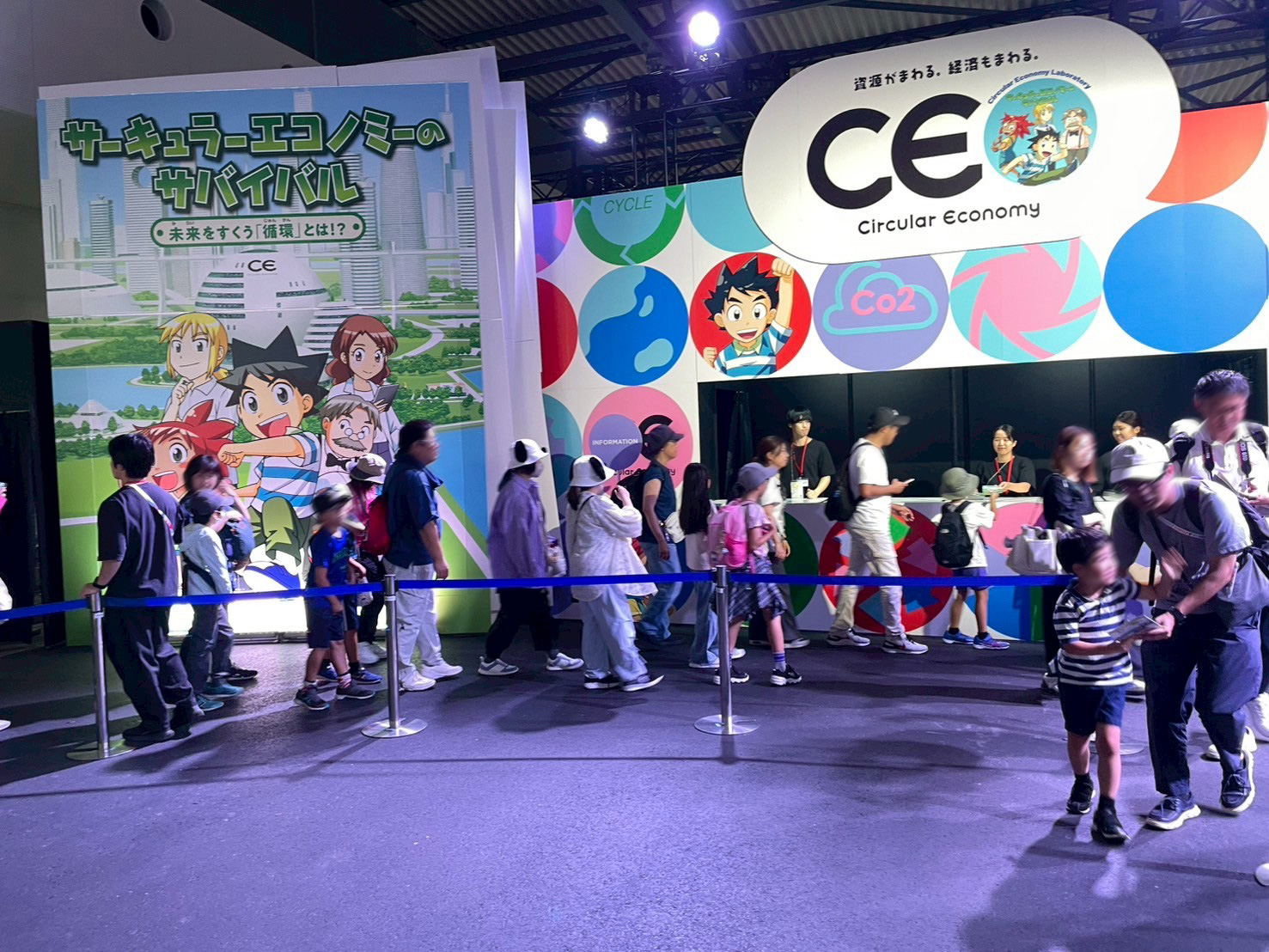
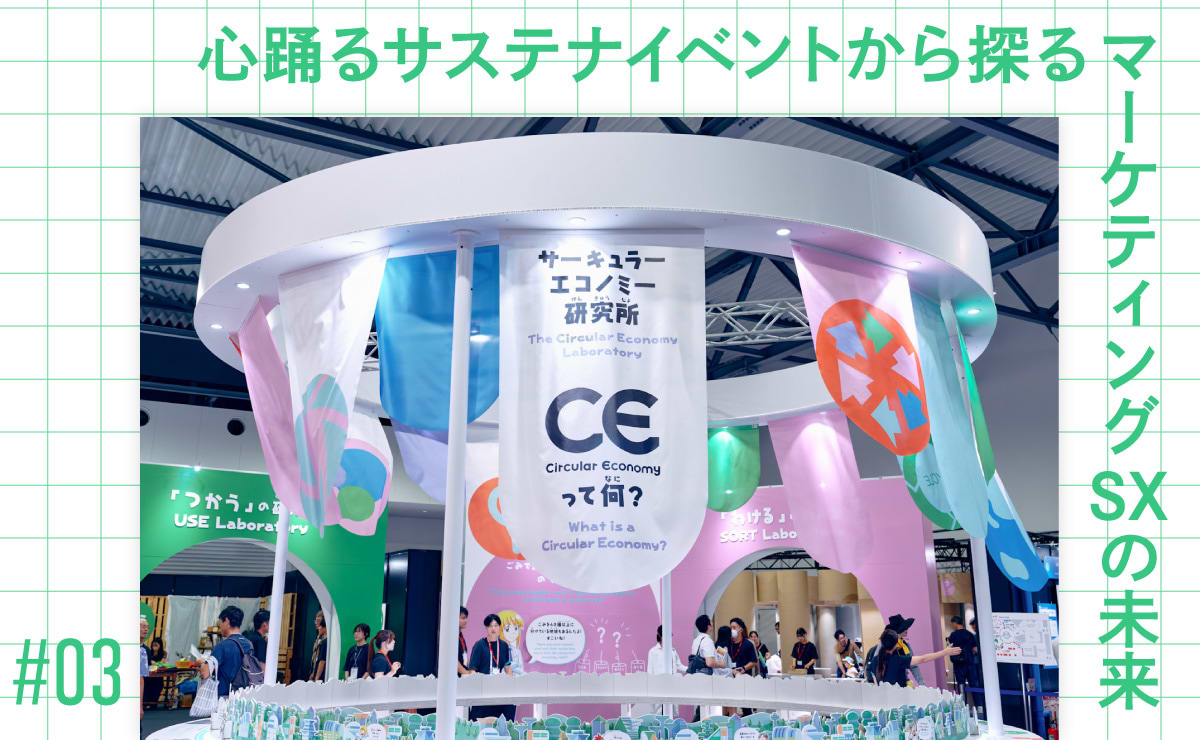
Despite running for just seven days (September 23–29, 2025) at the Osaka Kansai Expo, the “Circular Economy (CE) Lab” recorded approximately 58,000 visitors, 100 collaborating partners, and a resource recycling rate of 99.7%. Although the theme was highly specialized, it proved so popular that lines formed with wait times of up to 30 minutes during peak hours.
The event, a collaboration with the “Science Manga Survival” series (Asahi Shimbun Publications)—which is hugely popular among elementary school students—was packed with interactive activities designed to make learning fun. Four “labs” were set up inside the venue where visitors could experience the circular economy firsthand and take on the mission to “save the Earth of the future” alongside Geo, the manga’s protagonist, and his friends.
The mission of this event was to raise awareness of the circular economy itself. This effort was driven by the low level of awareness of the “circular economy” among the Japanese public.
Only one in three people know what the “circular economy” is!?
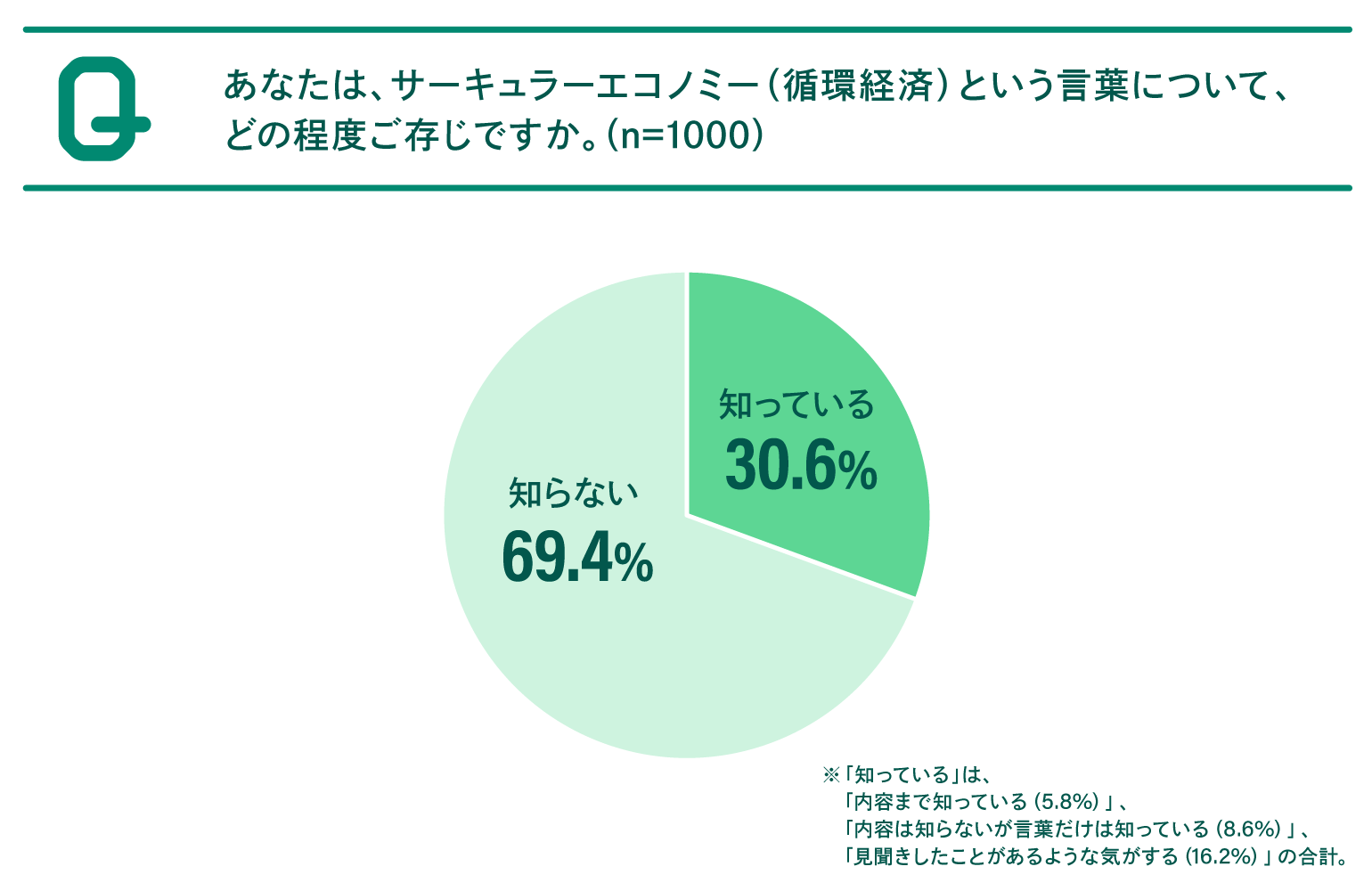
*Online survey of 1,000 people nationwide aged 18 and older (100 male and 100 female respondents from each age group: teens, 20s, 30s, 40s, and 50s) conducted July 30–August 1, 2025 / Source: Ministry of Economy, Trade and Industry
According to a survey by the Ministry of Economy, Trade and Industry (METI), the awareness rate for the “circular economy” is about 30 percent. The survey found that roughly one in three people are familiar with the term.
While the global transition from a linear economy (*1) to a circular economy is progressing, awareness in Japan has not yet spread sufficiently. The Ministry of Economy, Trade and Industry views this situation as a major challenge for the Japanese economy.
However, it is not enough to simply raise awareness of the term. What is needed is action from each and every individual.
Sustainability is seen as “too good to be true.” As a result, even when we present an ideal vision of sustainability in practice, it often comes across as mere rhetoric, and people don’t actually incorporate it into their daily lives. We therefore concluded that it might be more effective to focus on challenges that encourage each individual to change their behavior.
Therefore, based on the hypothesis that “even if people understand it’s a good thing, they may not have a clear picture of what to do specifically,” this event categorized consumer actions needed to realize a circular economy as “circular consumption behaviors.”We translated actions that contribute to the circular economy into the verbs “buy,” “use,” “sort,” and “recycle,” and based on this concept, we planned and designed the exhibition. Within the CE Research Institute, we established four “labs”: the “Buy” Lab, the “Use” Lab, the “Sort” Lab, and the “Recycle” Lab.
*1 Linear Economy: A unidirectional (linear) economic model following the sequence: resources → manufacturing → consumption → disposal. It is also referred to as a “mass production, mass consumption, mass disposal economy.”
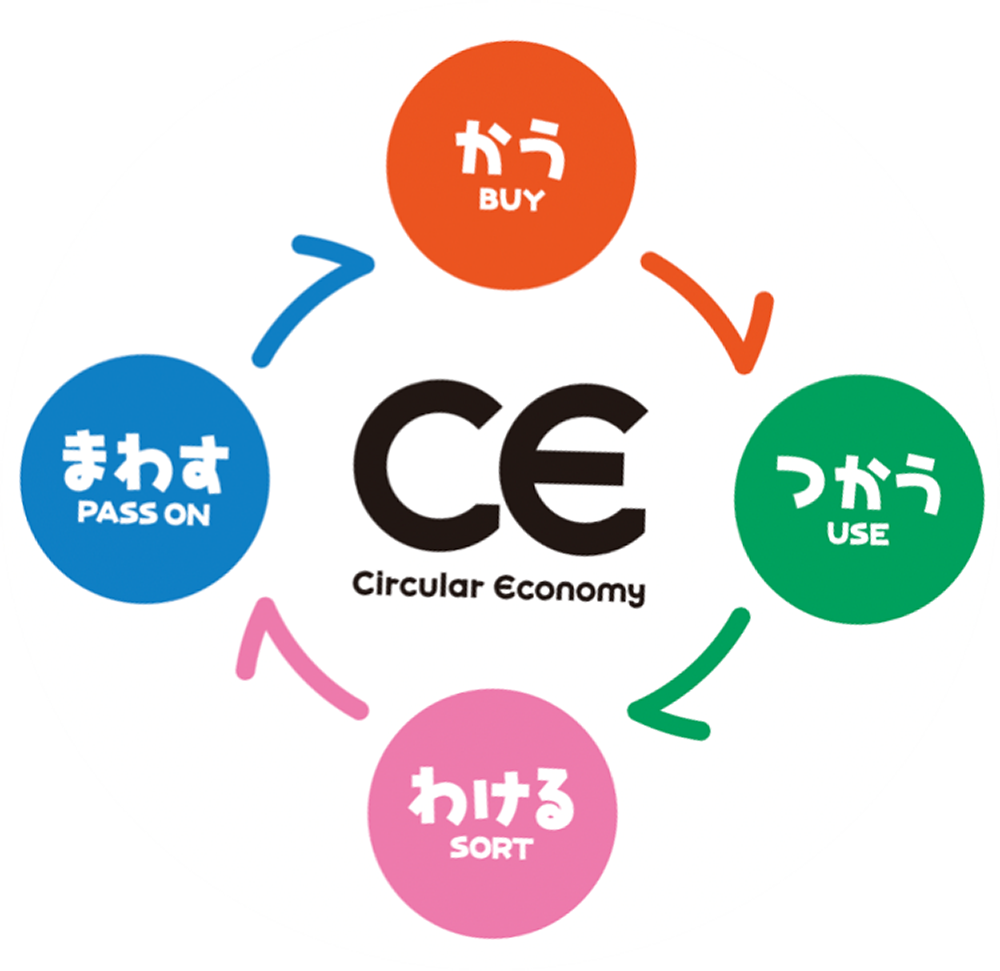
Precisely because the content is serious, our motto is: “It’s educational, but we won’t make it feel like ‘school’!”
No matter how simply the circular economy is explained using easy-to-understand language and illustrations, not everyone will automatically think, “Let’s incorporate this into my daily life!” Therefore, mechanisms were created that use “playful pathways” to allow visitors to practice the concept of resource circulation while having fun and working through challenges.
For example, in the “Shopping” Lab, participants can explore a space recreating a shopping district, physically handling products while solving puzzles to discover “How can I make a truly ‘good’ purchase?” The challenges are deliberately designed to be perplexing even for adults, ensuring that while the lab is designed as an entry point for children, adults can also become fully immersed. Some participants, including parents and children, took on the challenges multiple times and stayed for over two hours.
The “Sorting” Lab is designed to let visitors tackle waste sorting in a game-like manner.Visitors are given six “trash chips” representing different types of waste. They sort these into the “Sort-a-Thon Machine,” which features 28 categories modeled after the waste sorting initiatives in Osaki Town (Kagoshima Prefecture), a town known for its recycling efforts. For example, some participants wondered, “Is ‘Dr. Nou’s printed materials’ from the science manga *Survival* considered general waste…?” The correct category was “copy paper.”
The overarching narrative of the exhibition is straightforward: “Your resolution at this exhibition and the actions you take afterward will save a future on the brink of destruction.” Ultimately, visitors receive a small souvenir: they “grace the front page of the ‘Future Newspaper’ as saviors of the world.”Your name, the date of your visit, and the circular action you pledged to take (the “Everyone’s CE Action Pledge”) are printed on the page. This approach—skillfully using the “Future Newspaper” as a memento of your visit to the Expo to serve as a reminder—was particularly impressive. The exhibition was also packed with other features designed to help visitors incorporate these actions into their daily lives, such as promotional booklets and card games.
As a result, through this exhibition experience, over 99% of participants responded that they want to help realize the “Circular Economy.” The actions chosen by visitors were mostly related to everyday purchasing behaviors, such as “eating locally produced food” and “buying reused items.” Looking at these results, it’s clear how important it is to translate these concepts into actions that are both accessible and simple.
Behind the Scenes of the “Exhibition Design” That Achieved an Astonishing 99.7% Resource Recycling Rate
In the environmental sector, mere messages without concrete action can easily amount to greenwashing. For this event, initiatives were also implemented to improve the resource recycling rate of the construction materials themselves. At typical events, a large amount of materials tends to be disposed of as waste after the event concludes. To address this, the organizers reevaluated the linear economy premise of “make, use, dispose” and adopted a production policy based on the “circular economy premise” from the planning and design stages.
Specifically, rental and reused items were first selected for each component and area, and the spatial design was carried out based on the premise of using those selected materials.Furthermore, when new materials were procured, they were limited to items that are easy to recycle as raw materials (*2), such as cardboard panels, paper tubes, and printed paper. By incorporating considerations ranging from material selection to “where and how to recycle” from the very beginning, the team achieved a design and operation model that did not assume disposal. As a result, the resource recycling rate reached an impressive 99.7%! This far exceeded the standards of the event industry, where the “make and break” process is the norm.
*2 Material recycling = A recycling method in which used products or waste are reused “as raw materials”
After the event, materials were sorted and weighed by type, then tagged with QR codes to digitally manage the process from collection to recycling. By implementing traceability to “visualize” the path of resources, highly accurate circular management became possible.
The benefits of adopting a circular economy approach in event production go beyond simply reducing environmental impact.
For organizers, the ability to demonstrate a tangible contribution to society through reduced environmental impact— thereby enhancing the PR value of the event itself—and the opportunity to improve budget efficiency by thoroughly minimizing resource waste are highly attractive benefits.
Although this was our first attempt and there is still room for improvement, this event provided us with many valuable insights and proved to be a highly meaningful model case for implementing the circular economy.
Leveraging Legacy! “Circulating” Both Materials and Knowledge
It’s not just materials that can be reused. At this event, we’re leveraging that legacy to hold “Circular Economy School” sessions in various locations. We’re repurposing some of the exhibits and educational booklets used at the Expo as teaching materials, and offering them as interactive, classroom-style programs that incorporate a card game.
The star of the program is a memory game developed based on the “circular consumption behaviors” established through this project. It’s designed so that as children play, they naturally pick up terms and actions related to the circular economy.
At the venues, children got excited, shouting “Paperless!” “Sharing!” and “Circular!”—giving rise to “CE natives” who were every bit as enthusiastic as the adults.
These educational events have also been held in Toyama, Kyoto, Tokyo, and Saitama, and we’ve received positive feedback from participants.
In addition, shifting the venue, special classes were held at elementary schools that had requested them.
Even though many of the children were hearing the term “circular economy” for the first time, they thought hard about what actions they could take starting today.
Not only resources, but also the lessons and insights gained at these events will be circulated to the next venue and the next generation. I believe this, too, is a fine example of the circular economy.
Let sustainability be the spark that sets your heart racing.
In this article, we’ve focused on introducing events centered on the theme of the circular economy.
Sustainability is, by its very nature, an important issue not only for businesses but also for consumers, and this is becoming common knowledge, especially among children and young people. Precisely because everyone has a vague understanding of it, the key is how to embed these concepts into each individual’s actions.
It was based on this idea that the “Circular Economy (CE) Research Institute” designed its events not only to educate about the circular economy but also to incorporate numerous elements that make people “want to give it a try.”
And to spur action, we need a “spark that sets hearts racing.” The Dentsu Inc. Sustainability Consulting Office will work alongside companies to integrate this exciting approach to sustainability into their business operations.
<Summary of This Session>
・Sustainability is such a positive concept that it can easily be overlooked; therefore, a challenge-driven approach is effective for driving action
・Precisely because it’s a serious topic, the key is to design programs that “avoid making it feel like a lecture.”
・Design the “exit strategy” from the perspective of “How can consumers incorporate this into their daily lives starting tomorrow?”
・When addressing sustainability, incorporate an awareness of resource circulation into your design from the planning stage onward!
・Let’s keep reusing both resources and knowledge in a continuous cycle and pass the baton forward!
Was this article helpful?
Share this article


Newsletter registration is here
We select and publish important news every day
For inquiries about this article
Back Numbers
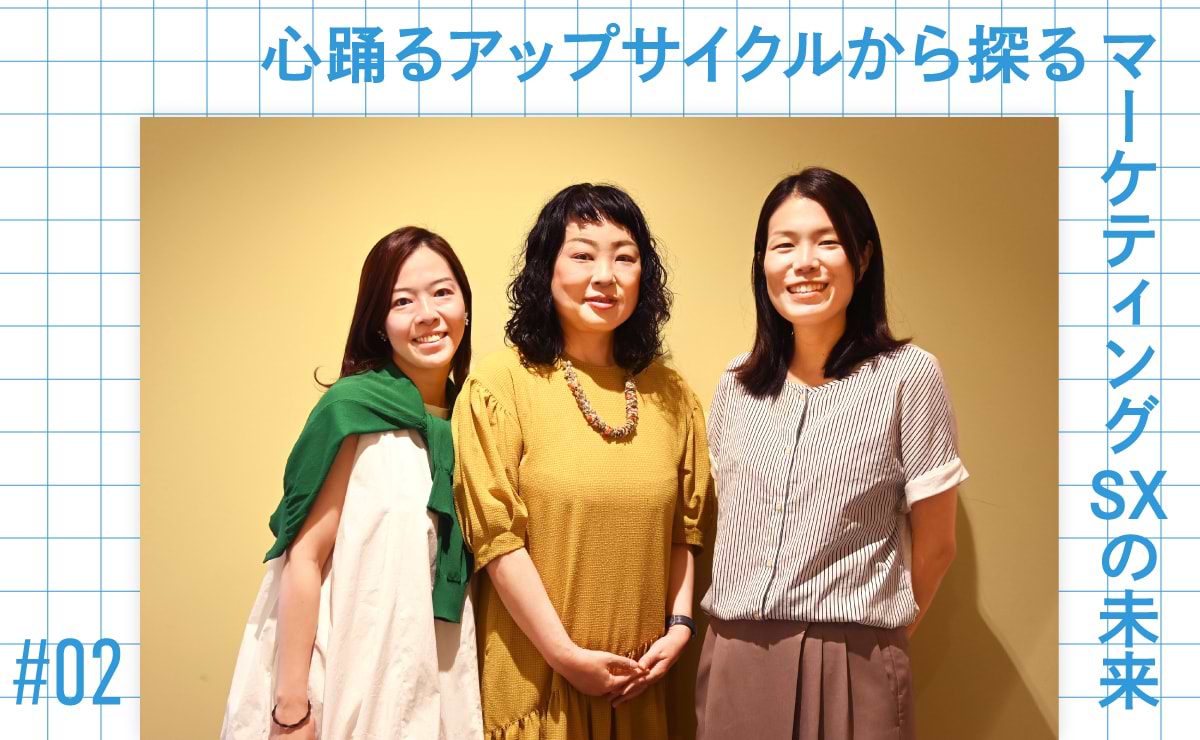

Author

Yuka Sawai
Dentsu Inc.
Sustainability Consulting Office
生物多様性チームリーダー/PRプランナー

Yurika Mori
Dentsu Inc.
Sustainability Consulting Office
Creative Writer/Planner
Hiroki Nagakawa
Dentsu Live Inc.
Management Promotion Bureau, Next Business Development Department